


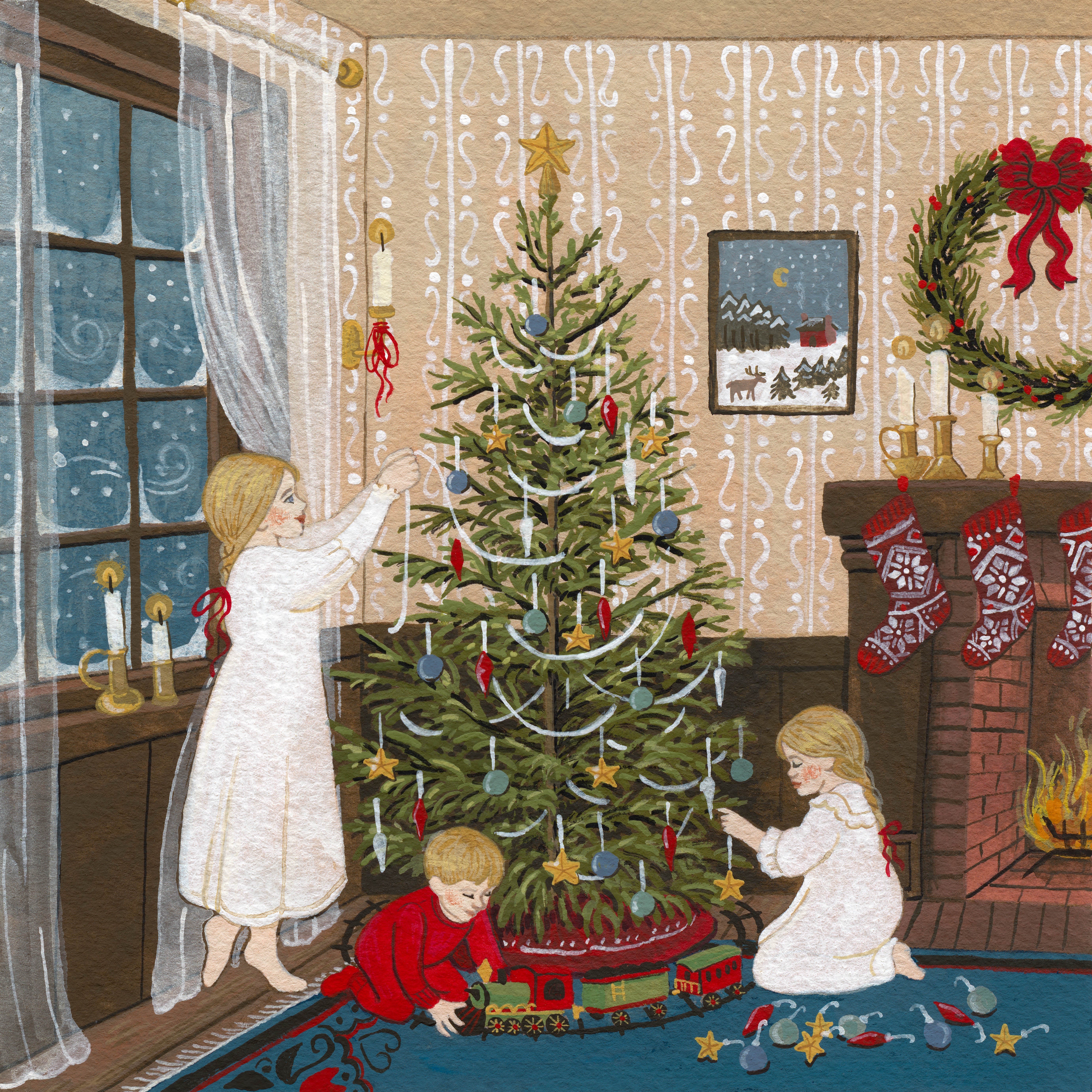
If you and I were collaborating to set up an ideal backdrop for Christmas joy, here are my first thoughts: We start with the enticing smell of cinnamon, nutmeg, and cloves, perhaps from hot cider or cookies just coming out of the oven. Fresh greenery wraps around the banister, giving off the spicy, resinous scent of a winter forest. Next, some temperature contrast: Warmth from a crackling fire is answered by a chill breeze swirling around the ankles as dear friends come through the front door, which can’t be shut right away because hugging everyone must happen first, this minute. There is music, of course—and here’s where you and I might choose differently—I hear choral music, or perhaps some mandolin and Irish flute. Do you hear soft jazz, or perhaps something orchestral? A tempting spread is laid out on a long table, bare winter branches in tall vases presiding, with holiday offerings, savory and sweet, nesting among loose cranberries and fir cones, yellow and red berries of bittersweet vines twining among sprays of pine needles. Upstairs, solitary candle flames surrounded by darkness shine in hall windows.
Our stage is set for the joy we expect at Christmas.
Come with me some evening to a busy town square during the early part of December. If we were to station ourselves next to a towering, brilliantly lit Christmas tree there, I’m sure we could find many people ready to cheerfully describe how much they love this time of year. Others might be more reluctant to admit that the Christmas season is among the hardest of times for them. At other times of the year, the rattle of keys in the lock of an empty apartment, answered by no human voice, may go unremarked, but at Christmas it’s another matter. Especially in periods of what we might euphemistically call a blue mood, there can be a pronounced gap between the cheer that’s evident around us—expected of us—and the dreariness of our internal atmosphere. The effervescence of the season may heighten the simple pleasures, but it can also accentuate the pains.
While there are bound to be many different elements that contribute to the Christmas mood crash, I can put forward one likely possibility. A regular day in mid-December might not be any harder than a regular day in mid-January, but the expectations of how great a Christmas-season day will be are sky high, and it’s the difference between what we’ve got and what we’re told we should have, or what we think everyone else has got, that causes the deep disappointment.
Without us really being aware of it, this lack can in turn bring out a bit of the Scrooge in us, eventually tempting us to grumble under our breath, “A plague on Father Christmas!”
There isn’t always a Christmas miracle in the wings that can remedy such a situation.

Still, we’re not without options. I think we could benefit from exploring more deeply the nature of joy, paying particular attention to conceptions that aren’t among our top mental search results. For example, author and speaker Rob Bell pushes back against the traditional associations we have with joy as uninterrupted positive emotions. He maintains that joy contains the full spectrum of human experience. “Joy doesn’t run and hide from the pain and the conflict and the anguish—it wraps its arms around all of it.” And in embracing the harsh and the painful, “it heightens your sense of the precious, sacred, holy nature of this moment.” In seeing joy as including all of what we encounter, we might wonder whether by expanding the definition so much it becomes baggy and shapeless, meaningless because all-encompassing. But I don’t think so. This sounds to me like the sort of insight brought to us by opposition in all things.
I’m one who has been known to struggle feebly against the truth that we need the bitter in order to appreciate the sweet—couldn’t I just read a handy summary describing the bitter, and then move on to tasting the sweet? Is there no other way? Yet the opposition, the pain, the suffering, the sorrow, the loss, are these not the things that wrench us, that stretch us, creating enough space to contain coming joys? Without the adversity, we would remain smooth and taut; joy could bead up on our surface and roll right off.
After decades of being presented with the idea that joy is an uncomplicated near neighbor to delight and exuberance, glee and rapture, cheer and merriment, seeing joy with room enough to take in the painful side of our experiences is going to require some getting used to.

I’m reminded of an odd little story called “Tear-Water Tea,” by Arnold Lobel. In the story, Owl puts an empty kettle on his lap and begins to think of sad things. The tears that result fall into the teapot, later to be boiled for tea. Owl thinks of chairs with broken legs, and songs that cannot be sung because the words have been forgotten. He thinks of spoons that have fallen behind the stove and are never seen again. Sobbing the while, he thinks of mornings nobody saw because everybody was sleeping, of mashed potatoes left on a plate because no one wanted to eat them. He thinks of pencils that are too short to use.
After Owl has heated up his kettle, the story concludes: “Owl felt happy as he filled his cup. ‘It tastes a little bit salty,’ he said, ‘but tear-water tea is always very good.’”
In this story for young ones I find a surprisingly mature insight: Owl appears to recognize value in contemplating loss. He knows a way to get to the result he wants, even if it will take him through deep sadness, and so he sets the conditions that will bring it about.
For us, seeing our way to productive engagement with loss and disappointment may not be as simple as holding a kettle in our lap as Owl did, but perhaps we can support one another in looking more directly at the hard side of our experiences, to be ready to sit with them, to be willing to wrestle with them, knowing that joy has room for all of it, and that the hard things make spaces in us that joy can fill.

Jesus had something to say about lighting a candle in a setting where it would do no good, reminding us that it doesn’t make sense to put a lighted candle under a basket. I think he would agree on the limited impact of lighting a candle in the full glare of the noonday sun. In order to best see a candle flame, he might remind us, choose the darkest place.
There will doubtless be enough darkness in our own lives, and when such darkness finds us, happy are we if we can see the way the light grows brilliant in the presence of such a backdrop.
I mentioned choral music as an element of Christmas joy, and want to share with you a lovely composition called “Carol of Joy.” Eileen Berry’s poem provides the text—a study in contrasts—and composer Dan Forrest’s atmospheric musical setting for her words shortchanges neither the lows nor the highs.
The poem’s opening images set a definite mood: fallen leaves, withered and dry, a dim winter sky after the fading of a brief sunset, lengthening shadows—these create the backdrop of darkness without which a light can struggle to be seen. The poem goes on to address a fallen world held fast by death, sinners burdened and bound, answered by the birth of Jesus, the light shining in darkness.
To me, this is the joy of Christmas, that in spite of parts of our lives being wrapped in sorrow, such need not be the entirety of our experience. It is the stillness when dark closes in that makes space for sensations that can open us up. Our lives may feature cold barren hillsides and deep empty valleys, as the poem expresses, but looking up, we behold the chorus filling the skies—
Oh friendless world, to you is the song!
All Heaven’s joy to you may belong!
You who are lonely, laden, forlorn:
Now unto you a Saviour is born!
A link to the recording is below, and the five minutes you invest in it will be richly repaid. You might enjoy reading the poem before, during, or after listening, but however you do it, this is an opportunity to open yourself up to an experience that encompasses a broad range of emotions.
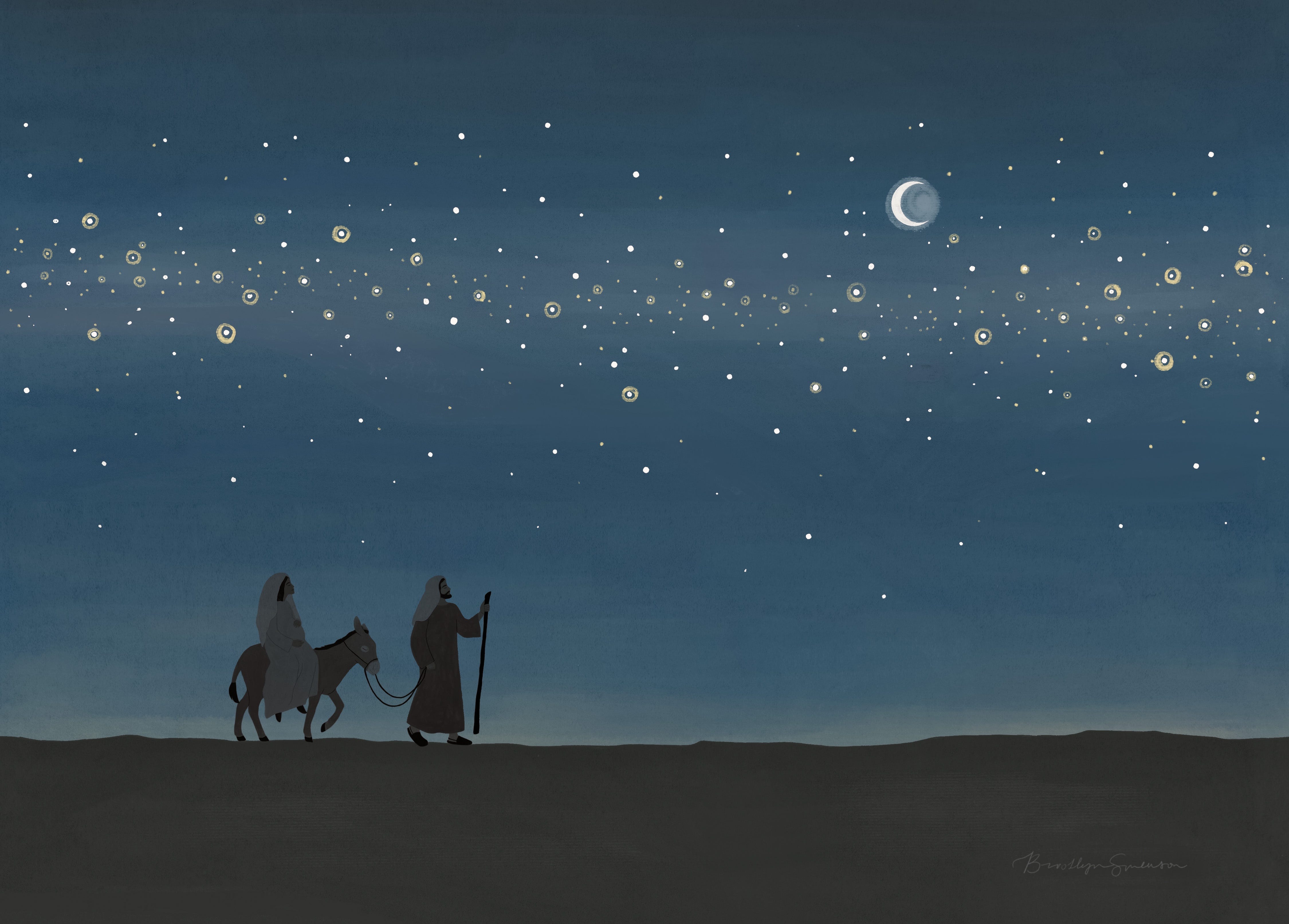
If we were to try to make our own batch of tear-water tea, I think we would have different images filling our minds—our troubles are not generally on the level of pencils too short to use. You will of course have your own list, featuring thoughts that clutch at you during dark hours awake when you most need your sleep. Perhaps some of those concerns have been with you for years. For it to have any potency in our lives, joy has got to be responsive to those concerns; it has got to meet us where we are. I think it’s been ready to, but in order for that to happen we have to renovate our understanding of this whole enterprise, leaving behind the picture-perfect, the perfectionistic, the all-smiles-here mantras, and follow the Savior’s example of meekness, acknowledging and accepting that these are the conditions and experiences we’ve got, and with these tools we will partner with God in the preparations that will shape us. In the frenetic pleasure-seeking on display throughout our modern culture we certainly have evidence enough of the futility of going down those paths. Perhaps true submissiveness unlocks the gate between us and lasting joy, a joy that wraps its arms around all that we have experienced and will yet face.
In upstairs windows, surrounded by darkness, candle flames shine on.
Carol of Joy
by Eileen Berry
Green leaves all fallen, withered and dry;
Brief sunset fading, dim winter sky.
Lengthening shadows, Dark closing in;
Then, through the stillness, carols begin!
Oh fallen world, to you is the song—
Death holds you fast and night tarries long.
Jesus is born, your curse to destroy!
Sweet to your ears, a carol of Joy!
Pale moon ascending, solemn and slow;
Cold barren hillside, shrouded in snow;
Deep, empty valley veiled by the night;
Hear angel music—hopeful and bright.
Oh fearful world, to you is the song–
Peace with your God, and pardon for wrong!
Tidings for sinners, burdened and bound–
A carol of joy—A Saviour is found!
Earth wrapped in sorrow, lift up your eyes!
Thrill to the chorus filling the skies.
Look up sad hearted—witness God’s love;
Join in the carol swelling above!
Oh friendless world, to you is the song!
All Heaven’s joy to you may belong!
You who are lonely, laden, forlorn:
Now unto you a Saviour is born!
Lori Forsyth remembers storybook New England Christmases both as a kid and a mom. Singing is now one of the most important elements of the season. She is the Wayfare Managing Editor.
Art by Brooklyn Swenson. Born from a love of meaningful moments, Brooklyn’s art captures the essence of childhood wonder and nostalgia. Rooted in the rich traditions of Scandinavian folk art, she creates pieces that bring inspiration and intentionality to each season. She hopes to transport you back to simpler, more magical times, and add warmth to your home with the beauty of the past and hope for brighter days ahead.

Finding Joy

There is a moment in teaching piano when a young student, either on their own or with some guidance from me, realizes that a small bit of rhythmic variation to a descending scale produces the melody “Joy to the World.” The look of surprised recognition that crosses their face is a joy to behold. Right there, gro…
Submit your writing on joy for Advent 2026!

Listen to Constant Wonder from BYU radio
Mark Advent with Constant Wonder. Listen in to the unfettered joy of amateur astronomers tracking Jupiter as they dance and laugh about a discovery and reflect on what makes a miracle.
This is Episode 9 of the BYU Radio Constant Wonder series marking the Christian Advent with daily vignettes that distill the spirit of the season. Our mission is to explore wonder and awe in all nature, human or wild, vast or small. We search for encounters that move us beyond words.
Guest: Brother Guy J. Consolmagno, Director of the Vatican Observatory


Beautiful reminders, Lori! As we prepare for a long winter it’s good to remember the Light shines brightest in darkness.
Beautifully written and soul sustaining!! Thank you Lori and Wayfare!! 💗