


I spent the after-school hours of my early elementary years with my Grandma Helen. I would walk the nearly three blocks from our small town elementary school on Fourth Avenue to Sixth Avenue where my grandparents lived. During those long afternoons, Grandma Helen served up a snack and a healthy portion of her childhood memories. We settled in the small study, a room hemmed in by my grandpa’s desk and my grandma’s overstuffed recliner chair, with built-in bookcases and a television so small it must have intuitively known the real entertainment came from my grandmother’s past.
In those moments wrapped in the warmth of the room, there was one experience that she spoke of often. It was a small memory, but her vivid retelling set it apart from her other youthful adventures. She would describe watching her father count tithing donations on their dinner table every Sunday. One time she told of struggling families bringing calves or chickens to fulfill their faith, another of her eyes peering over the table’s edge to spy the carefully collected and stacked coins that represented the congregants’ devotion. As she grew, her father’s commitment to carefully counting his flock’s donations remained firm even as births, deaths, or wars changed both the donations and those receiving them. He would count the tithes of his congregation for twenty-five years, dutifully sending their solemn sacrifices into the bishop’s storehouse.
I thought of this story recently, not for the memories of Grandma Helen or the rectitude of my great grandfather. Rather, I have felt a connection to my great grandmother, Lucy. She must have been working in the farmhouse kitchen while my great grandfather counted the tithes. She wouldn’t have taken an active role in the counting and her presence by his side would have been so natural, so assumed, that he might not have even registered her work beside him. She would have seen it all splayed out on the table as she readied the meat and potato dinner that would conclude their day of devotion. Perhaps, as she was making dinner, she would think of the tithes and instinctively set aside a portion of the meal in preparation for the knock on the kitchen door from a desperate member in need of nourishment. Earlier in the day at church, she probably sat alone, yet surrounded by children, as my great grandfather conducted the meetings and counseled those in need. My great grandfather would have tended to his flock as Lucy dealt with the children, making the church meetings the culmination of a long week of solitude. Lucy would have been alone for most of the week as my great grandfather went out during the evenings to minister to the needy who couldn’t make it to church on Sundays. Submitting to this solitude was a coin added to her own offering. Maybe she found comfort as she reflected on how Christ also served in solitude. Did that give her reassurance knowing that even the loneliness of tending to others was a type of Christ?
Removed by time and place, I feel a kinship with Lucy. Like Lucy, my husband was twice called to serve as a bishop. Unlike Lucy, my experience did not span decades in one congregation; instead, it consisted of two short stints in separate congregations in Thailand and the Philippines. These wards varied in both their make-up and their needs. Still, for all the differences, I was there, just as Lucy must have been, moving like a whisper. I imagine both Lucy and me standing beside our partners observing, counseling, and supporting without being seen by others. I don’t know if Lucy found her role challenging. Did she feel she had a God-given mandate to serve, even if it would rarely enjoy the warm public spotlight of her husband’s calling? Did she have reservations or resentment that crept into her consciousness? Did she struggle to reconcile a calling to discreetly minister to the pain and suffering she witnessed that would never be recognized but would require just as much dedication? I ask these questions of Lucy because I have asked them of myself. I wonder if something unseen is ever valued and if dedication is the right stick upon which to measure my contribution. Does the silence of our acts negate them when our whispered service is never acknowledged aloud? Maybe by finding myself in Lucy’s story, I can find the elusive answers to these questions.
I remember one period when tragedy had befallen many in a congregation where my husband served as bishop. With every trip to the store, I bought an extra bag of rice, an extra dozen eggs, and even sardines packed in tomato sauce—something we never ate but was a favorite with ward members. When that wasn’t enough, I raided our freezer for frozen chicken or vegetables to feed families. I imagine that is what Lucy did. When harvesting, she laid aside some of the fruits of their labors, beyond the regular donations, so that quiet needs could be filled by her silent acts. I also imagine her as I think about wrangling children to church and then sitting alone in the pews, desiring devotion but dealing out discipline. I wonder if she felt the heavy expectations of being a bishop’s family. Did she counsel with her children, as I did, explaining the privilege of serving? Did Lucy draw on examples of Christ gently supporting those around him to show her children that service takes many forms? Even with all that, was she scared their father’s long absences would only engender resentment?
Sitting here pondering the similarities of Lucy’s story and my own, I feel a deep sense that we are not alone. I think of those throughout generations who have witnessed the work of the Lord spread from a spark to a flame while gently fanning it with their quiet devotion. The sacred text is fat with names whose stories of support and silent service are not expounded upon or even told. I leaf through the pages, and I find stories of Lehi, Helaman’s son, supporting his brother, Nephi; Omner and Himni with their brothers Aaron and Ammon; Shiblon and Helaman; and then there are the women. Out of all these stories, I feel a special kinship with the women and finding myself in their stories comes naturally. I struggle to feel this same connection with the likes of Omner, Himni, and Shiblon. Even though they worked as supporting characters, they were named, remembered, even applauded for their parts. Yet, the women were left unnamed and uncounted to silently move through the text. To find a mirror of my own invisible service and dedication, I look to the women.
My mind lingers on Lehi and Sariah’s daughters. Maybe it is the dearth of detail or its position in the beginning of the book, but something in their story fascinates me. The story of these daughters garners only a superficial mention and holds impossible questions. What were their names? How many daughters did Sariah have? Were they older, helping guide their brothers or younger sisters who relied on their protection? What path did they choose in Lehi’s dream? These questions weigh heavily on a text that has no answers. Yet, I can still imagine them as I did with my grandmother. In my imaginings, I give them names—maybe there was a Deborah or Rebecca, a Hannah or Jael. Thinking of them with names makes their story come alive.
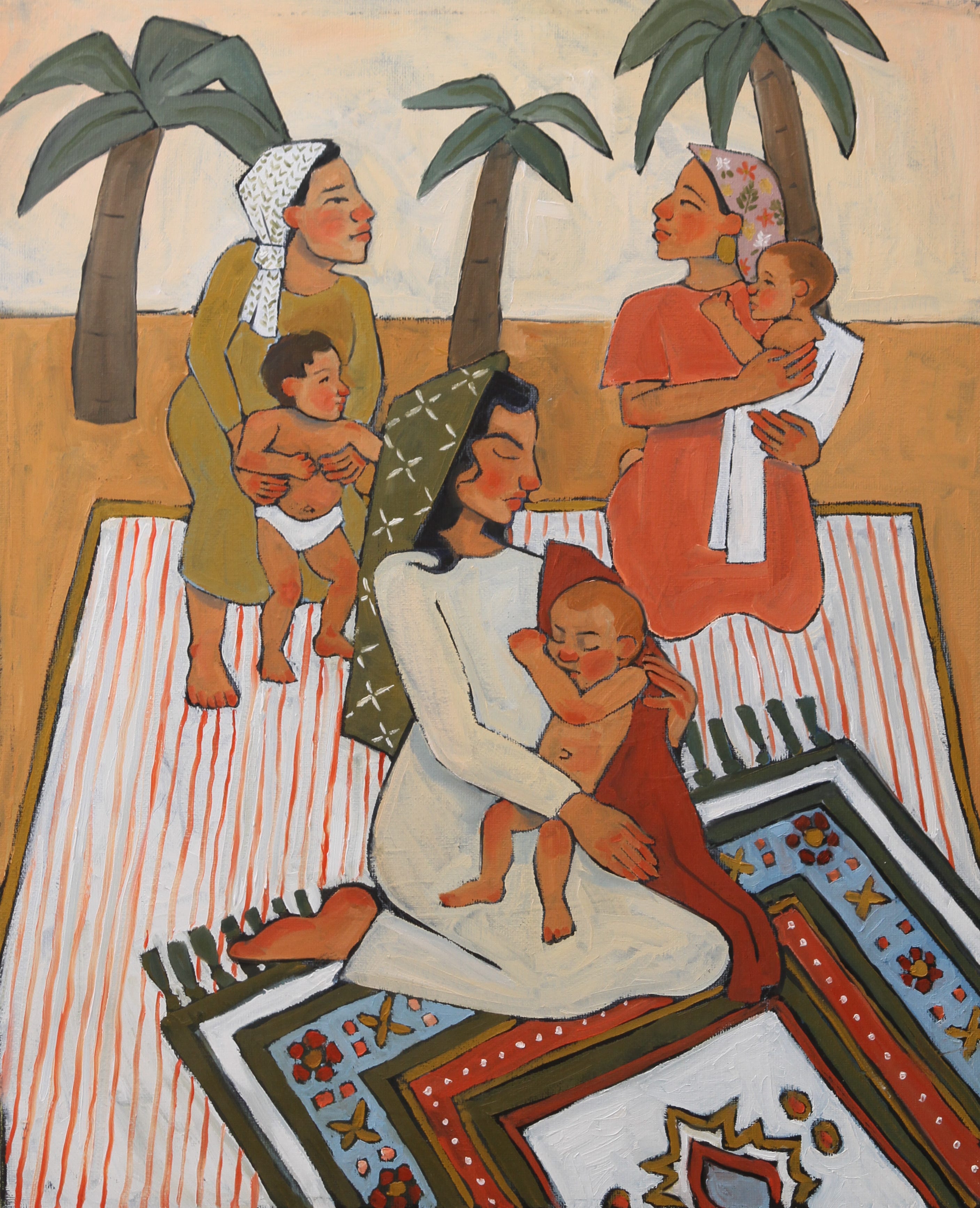
I see Deborah and Rebecca there viewing the ball of curious workmanship along with their father outside the tent. Maybe they were the first to see it since they would have risen early with Sariah to prepare the raw meat meals for others. Was it Hannah who gently carried it in her trembling hands to their father? Maybe they were at his side as the family looked at it with wonder and awe. I see them there, without a clear view, peeking at the spindles moving, waiting and wondering in which directions the compass would take them. Maybe, sometimes, Jael came across the ball as she cleaned or organized for the next move. Could she trace its dimensions under the cloth protecting it? I see them on the long arduous trail to the land Bountiful—setting up camp, dismantling it, only to set it up again. They must have used their creativity to combine their meager resources of gathered fruits and herbs with the sweetened raw meat to make a meal. I can see Jael and her sisters in the boat, each nursing a baby nestled in the crook of an elbow as they take turns caring for their sick parents and younger brothers. They must have managed these exhausting tasks while petitioning for peace as their brothers fought. I imagine them landing in the promised land seeing the reality of their new life. Did Deborah look at her sisters with resigned hope knowing that they were off the storming sea, yet seeing the labor awaiting them as they again would figure out feeding the family, clothing and teaching children? All the sisters suffered the long journey and the struggle in their new world along with the narrators. Yet, in the silence of their story, I imagine their invisible acts. They were essential partners in bringing the family on their long march to the land of promise. Their examples sustained their family and rooted them to God.
I hear the echoes of their story as I clean and organize for our next move. We will be leaving in a few weeks for another country. I must make meals from rapidly emptying cupboards to use the food that can’t be taken to our new destination. Our food does not need the same level of miracle that Sariah and her daughters needed to make the food palatable but, still, I feel a kinship in the challenge of creating meals from dwindling supplies. I feel them near me as I pray that the mouths I am feeding will accept my offering. Our movers will come in a few days, and I am about the business of dismantling our current life without knowing what comes next. Our journey will not be eight years, but it will traverse continents and will surely be accompanied with unbidden surprises that punctuate a desire for peace. I, like the sisters, will enter a new land as full of promise as it is tinged with desperation. I hope to acclimate and see it for all its opportunity while knowing that daily adaptation comes from hard work that is pregnant with miracles.
As I prepare for the movers, I find the folders with receipts and papers. My husband, recently released as bishop, must have missed them when he handed over the mantle to the next bishop. I pick up the folder and hold it with the same reverence that the sisters must have held the ball of curious workmanship. Although the folders are merely made of paper and full of receipts, I feel love and generosity flowing through them. I think of the many times I was dispatched with these papers in hand to pay from our own funds electric bills, water bills, or rent that would be later reimbursed. I saw the suffering and offered relief in the only way I knew how: by being a vessel through which the Lord’s work could flow even if it were without praise or recognition. My work was unnamed and unknown just as the work of Lehi and Sariah’s daughters was.
Finding myself in the stories of my grandmothers and Sariah’s daughters, I feel the tension. The desire to be recognized and seen pushes and pulls against the hidden work done with devotion. I understand the yearning for an explicit power that somehow seems more valuable for its visibility even as I feel the potent power of our unseen acts. I see the contradiction in finding value in the work I performed as a bishop’s wife when similar work rarely falls upon a man. My husband won’t be called upon to support his bishop-wife, and few women hold responsibilities that require a husband to dedicate his life to his wife’s calling. Maybe imagining the details in these women’s stories helps me reconcile this irreconcilable tension. Perhaps I imagine the lives of my grandmothers and Sariah’s daughters to understand myself, or perhaps my imaginings are merely a reflection of my own experiences, or maybe I’m trying to convince myself that what I did mattered. I know that my story is not everyone’s story and that what may ring clear in my ears is dissonance to another. I wonder if this is what is meant when some have suggested—an attempt to change the past by changing the way I look at it. With these contemplations, maybe I am harvesting beauty from ashes. I am exercising the power that lies waiting in the silence.
Thinking of this, I see my grandmothers, Sariah’s daughters, and me through a different glass. I don’t need to find myself in their stories because we really share the same story—working in the margins, filling in the gaps, picking up the crumbs, moving the family. We are all caretakers living stories of sacred devotion mixed with practical support. These acts unify us through time and space, partnering us with God. Our names and our stories may not be recorded in books of scripture or registers at church because these stories, our stories, sit at the periphery of history. Yet, we have a hope that they are written in the annals of heaven. We stand equal with the names written on the pages, proclaiming our witness of Christ as we labor in God’s vineyard so that together we can reach the ultimate promised land where Christ and our Heavenly Parents wait.
Trisha Smith-Pierce, a small-town girl from Wyoming, has spent half of her adult life living abroad. She is a teacher by training and lead parent to three children shared with her husband Josiah.
Art by Becca Jessee.
