


I. Brighter Day Dawning
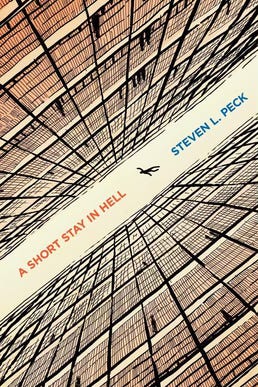
This May, I saw a Facebook post from my friend Steven Peck. “It is time to spill the beans,” he said. For some time, he had resisted the urge to tell everybody that he’d signed a contract for an edition of his 2009 novel A Short Stay in Hell to appear in Penguin UK’s Vintage Classics series, alongside works from authors like Gabriel Garcia Marquez, Toni Morrison, Orhan Pamuk, and Margaret Atwood. That wasn’t just another book contract; the inclusion was a way for Vintage to signal that this is a book which belongs in the literary canon, a work that can change the way a reader sees the world.
Those of us who have read the book already knew that. I can still remember the feeling in my head when I finished. Soren Johanssen, the protagonist, lived as a Latter-day Saint and now finds himself in a hell that is one giant library (modeled on a Jorge Luis Borges short story) which contains every possible book of a certain fixed number of characters that fill about four hundred pages. He is told that he’ll be allowed to leave when he finds the true story of his life with no typos. It turns out that pure randomness is an unforgiving master. In practice, Soren and the other people condemned to the library spend years searching through nonsense books before finding a single coherent phrase; Soren wanders far and suffers terribly on this quest. A Short Stay in Hell is not a long book—I read it in a single sitting one afternoon—but the action takes place over a timespan longer than the current age of the universe. Before I read the book, I thought there must be alien life somewhere, if only because the universe is so big. I left the book with a radically different perspective on raw probability. Many people have described grappling with immense numbers through the book and feeling a kind of existential terror. But through that terror, Steve’s novel reawakened me to the miracle of life as we know it.
The book has always felt like a classic. That said, the recent recognition is a milestone worth marking. As Michael Austin observed in Tamarra Kemsely’s report in the Salt Lake Tribune, this appears to be the first time a Mormon author has been embraced by a publisher that serves as an arbiter of the literary canon. And that puts us in the canon. To my mind, A Short Stay in Hell is a very Mormon book, and not just because its protagonist happens to have spent his brief mortal life in the faith.
By taking us into an unending blandness, the book shows the value of eternal progression—a progression that might include eternal play and where the best defense against the potential monotony of eternity is a dynamic, exalted sociality. To me, Steve’s book also sits at the intersection of his career in evolutionary biology and the theological inheritance that grew out of Mormonism’s rejection of ex nihilo creation. The oppressive scale of the untrimmed possibilities that make up the library in the story serves as an implicit apologia for the tumultuous evolutionary processes God appears to have used in creation. Few of Peck’s readers have a background in any of these inheritances or debates, but they still respond to them on a visceral level. In the novel, readers feel the intellectual depth that comes from working in a tradition.
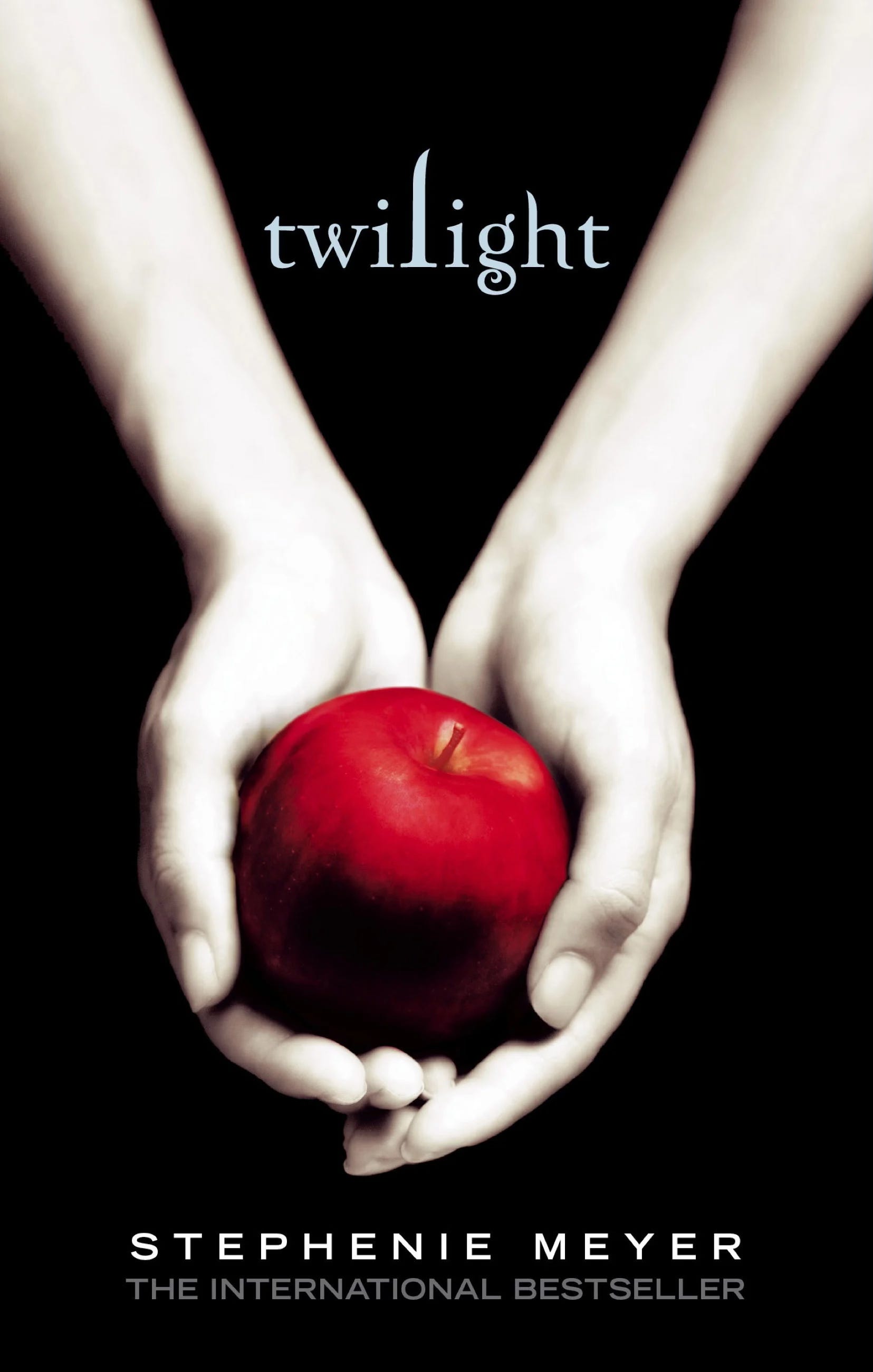
While having a work of Mormon literature at Vintage Classics is new, having readers respond to stories grown from our cultural soil is not. Ordinary readers have enjoyed writers steeped in Mormon thought for decades. Two of the twenty bestselling writers of the twenty-first century are Latter-day Saints. That’s fifty times more representation at the top than you’d expect from a group that makes up 0.2% of the world population. And there are good arguments to be made that both Stephenie Meyer and Brandon Sanderson found success in part by tapping into streams of thought in our religious culture.
Writing in The Atlantic in 2008, Caitlyn Flanagan argued that the appeal of Twilight came from Meyer’s willingness to treat romantic love as having stakes as high as Eden. At a time when books like Sisterhood of the Travelling Pants focused on the stability of female friendship as sexual connections came and went, Twilight resonated with readers who intuitively felt that love and sex carried a deeper promise and danger. Flanagan suggested that Meyer’s Mormonism allowed her to approach questions about sex and childbirth with a weight that had washed away from mainstream pop culture even as it remained stubbornly a part of human experience.
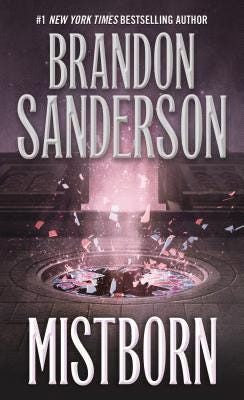
As for Sanderson, readers don’t need to look far to see him in conversation with Mormon ideas.
In the Mistborn series, a lost past needs to be recovered and redeemed to make room for a better future. One of the keys to that recovery happens to be records preserved on uncorrupted metal plates. The basic contours of the broader Cosmere (a cross-novel universe where Sanderson’s most popular stories unfold) likewise seem shaped by streams of Mormon thought. Ideas about intelligences, material spirit, and a spectrum between the mortal and the divine all figure prominently. Ideas about apostasy strike me as an influence. I was raised with a view of apostasy that simultaneously honors the divine principles in the world’s religions and argues for a restoration that circumscribes those truths into one great whole. The idea of a unified truth which has been broken and scattered is a recurring Cosmere theme.
I am not suggesting that any of these authors is simply repackaging the restored gospel of Jesus Christ for a fiction-reading audience. I continue to use the word Mormon for these and other literary works because they do not purport to be gospel truth or to present a pure version of the faith. They are speculative riffs on some of the intellectual, spiritual, and cultural conversations Latter-day Saints as a people have obsessively pursued for two centuries. Our literature is made up of individual imaginations, grown in a rich shared Mormon soil.
II. Miltons and Shakespeares
Steven Peck, Stephenie Meyer, and Brandon Sanderson may be the most prominent examples of acclaim and popularity, but they are part of a much larger literary landscape. I’ve been writing Mormon literature for the past twenty years and have kept up to some degree. In that time, I’ve seen dozens of Latter-day Saint writers appear on New York Times bestseller lists and far more carve out steady careers on the midlist. Latter-day Saint writers have received a wide range of literary awards and fellowships. And we’ve experienced a gradual Renaissance in people producing more literary writing about the faith, creating aesthetically rich texts intended for Latter-day Saint audiences.
There is a broad, grassroots network in which Latter-day Saint writers can learn and grow. Where I live in Utah county, there are probably as many writing groups as there are Latter-day Saint meetinghouses. There are readers and book clubs galore. We have a strong publishing landscape. Deseret Book survived a difficult economic transition that killed many midsized publishers. There are a handful of Latter-day Saint small presses, journals, and writing contests. Over the past ten years, there has been significant growth in the body of literary work about Latter-day Saint themes and experiences written by members around the world and translated into English.
At times, people interested in Mormon literature compare our output to the Catholic and Jewish voices in literature. Those comparisons are wonderful if they urge us to learn from the Flannery O’Connors and Chaim Potoks of the twentieth-century American canon, but if they’re treated as indictments of our output, that’s hardly fair. In 1900, there were only about 230,000 Latter-day Saints. We ought to assess our output and infrastructure by comparison to religious groups that also emerged out of the nineteenth century, like the Baháʼís and Seventh-Day Adventists, the Ahmadiyyas and Jehovah’s Witnesses. Some great creativity has come out of all those communities, but for a faith our age and size, we ought to be quite pleased with what we’ve accomplished.
In 1888, Orson F. Whitney famously predicted that Latter-day Saints would “yet have Miltons and Shakespeares of our own.” As someone in the field, I have mixed feelings about that particular quote from his “Home Literature” speech. It bothers me that it focuses attention on elite breakthroughs at the expense of the overall literary ecosystem. It also bothers me that people often read Whitney’s prediction of Miltons and Shakespeares of our own as a prediction about acclaim. I don’t find acclaim inherently interesting. I liked Steven Peck’s work before the editors at Vintage did. I’ve told people that if a Melissa Leilani Larson play or a Darlene Young poem tastes good on my tongue, breaks my heart, and widens my soul, that’s all I wanted from Shakespeare anyway.
But my friend Eric Jepson might argue with me about the relevance of the old aspiration to have a Milton or Shakespeare of our own. On past panels, I’ve heard him say that Shakespeare’s craft is only one ingredient in his literary greatness. What really transformed the playwright into the cultural icon, Eric suggests, is the focused attention generations of audiences have given to his works. It’s the audience that makes a writer great by reading with intensity. By that view, Milton remains potent, even if Paradise Lost is seldom showing up on bookstore endcaps these days, because of people who still take their most practiced attention and their deepest questions to his work.
When it comes to elevating our own body of literary texts through careful attention, I’m afraid Latter-day Saints remain behind. We haven’t defined our own literary canon enough yet to deconstruct it. We don’t publish much literary criticism about our work. With the exception of Brandon Sanderson fans, we don’t tend to read works of Mormon literature with a Shakespearean intensity. Many of the most literary-minded Latter-day Saints don’t read Mormon literature at all.
There’s a gap between our growing aesthetic and audience successes and our compromised collective self-respect. We are still quite willing to believe in our own intellectual inferiority.
It’s tempting to blame outsiders who resort to cheap stereotypes about us, from the nineteenth century commentators who argued that Mormon polygamy produced mentally substandard children to the modern ones who think Mormon beliefs inevitably produce some mix of kookiness, naivete, and extremism. The broad tropes of dismissal that Terryl Givens and Spencer Fluhman have identified certainly still exist. They remain a common lens for approaching our literature. I don’t expect the outside stereotypes to stop. When I read Jason Kehe’s spectacularly cringeworthy 2023 Wired Magazine essay “Brandon Sanderson Is Your God,” I felt like I was back in 2013, reading Mark Oppenheimer’s mildly insulting “Mormons Offer Cautionary Lesson on Sunny Outlook vs. Literary Greatness” in the New York Times.
But I’m no longer comfortable shifting the blame to those people. After all, our community has neglected to offer them compelling alternative angles to consider the intersection between a Mormon literary tradition and the broader twenty-first century landscape. If a journalist wanted to write about our literary tradition in a fair way, would they find enough useful literary criticism on the tradition in a quick search? We can’t expect others to treat us with a respect we don’t offer ourselves.
Two decades ago, when I was just starting out as a writer, our self-disdain felt pervasive and endemic. When I applied for the Creative Writing master’s program at BYU in 2008, a faculty member I reached out to advised me to downplay my interest in Mormon literature on my application, because it was broadly perceived as provincial and unworthy of serious study. As an adjunct professor a few years later, I had to defend my decision to include Eric James Stone’s “That Leviathan Whom Thou Hast Made” on a creative writing course syllabus, even though it had just won a Nebula Award, been a finalist for the Hugo, and Eric was willing to come visit my class. When we ultimately studied the story, most students found it rich and engaging (just as the awards juries had)—though one student told me that, like all Mormon fiction, she found it sentimental and didactic.
It’s possible that my student had a more refined aesthetic palette than I do, but I suspect her active disinterest in the story came from a place of cultural shame. We have been told so long and in so many ways that we don’t belong that we sometimes begin to believe it.
Do we have our own Miltons and Shakespeares? No. We have many authors who are more widely and enthusiastically read than Milton is today, but we won’t make our own authors enduring until we get serious about claiming them.
III. Lengthening Our Stride
Don’t get me wrong. Publications like Wayfare are tending the ground. Organizations like The Association for Mormon Letters, Storymakers, Mormon Scholars in the Humanities, and The Center for Latter-day Saint Arts are counting the harvests. Rising scholars like Liz Busby and Emma Tueller Stone are engaging with popular novels by Latter-day Saints. Senior scholars like Michael Austin are continuing to fight the good fight. But we need to do more to tell our own story and to claim our own texts.
If Latter-day Saints want the kind of acclaim that comes out of academic circles, we need to invest in academic discourse. There are complicated historical reasons why BYU moved away from engagement with Mormon literature in the 1990s, but that era has passed. I would love to see leadership address past discouragement of the study of Mormon literature and actively encourage and support faculty who try to catch up on their reading and enter the field. I would love to see the English departments on all three BYU campuses pay real attention to Mormon literature’s varied imaginationscapes. I’d love to see Mormon literature as a topic of discussion in public lectures and public readings.
Right now, many scholars are kept from Mormon literary texts that are relevant to their interests because they know not where to find them. With a critical mass of critical attention, it would be easier for the universities with Mormon Studies chairs to incorporate Mormon literary works into their programs of study and their public programming. Those programs are good at investigating the Mormon past, but they’d do well to also engage, through literature, with themes that have clearly sunk deep into Latter-day Saints collective imagination. The study of past events is not enough. If we want to understand the soul of the Latter-day Saint people, our memories ought to be in conversation with our dreams.
And I’d love to see us invested more seriously in developing writers. If we’re going to have Potoks and O’Connors of our own, we need to encourage people who are invested in their writing and their faith. We need to have conversations about what it means to depict Latter-day Saints in complex ways that honor their humanity. We need to think about the different ways a Mormon mind can face the paradoxes of human nature and the challenges of our historical moment.
I’d love to see a Latter-day Saint writer, or group of writers, teach a creative writing class that directly considers different ways to incorporate spiritual and religious themes, imagery, and questions into literature. Of course there are risks of oversentimentality or didacticism when people try to write about their deepest convictions. Let’s talk about the risks in a context that also acknowledges rewards! Because faith can also be a way to explore what it means to be a human being, to ask questions at a scale we might never have the audacity to consider without the religious voices that point us toward Gods, exalted sociality, and eternity’s weight.
A quarter into the twenty-first century, Mormon literature is arriving. It’s time for our attitudes to catch up. Let’s not wait for others to tell us that we have a writer whose work can sustain deep attention. Let’s claim our own treasures first. As Orson F. Whitney observed in his “Home Literature” sermon, the development of Mormon literature ought to involve learning from the world’s literary treasures while exercising our agency to develop our own tastes, styles, authors, and institutions. “We may read, we may gather sweets from all these flowers,” Whitney mused, “but we must build our own hive and honeycomb.”
James Goldberg is a poet, novelist, and champion of Mormon literature. His works include The Five Books of Jesus and A Book of Lamentations.
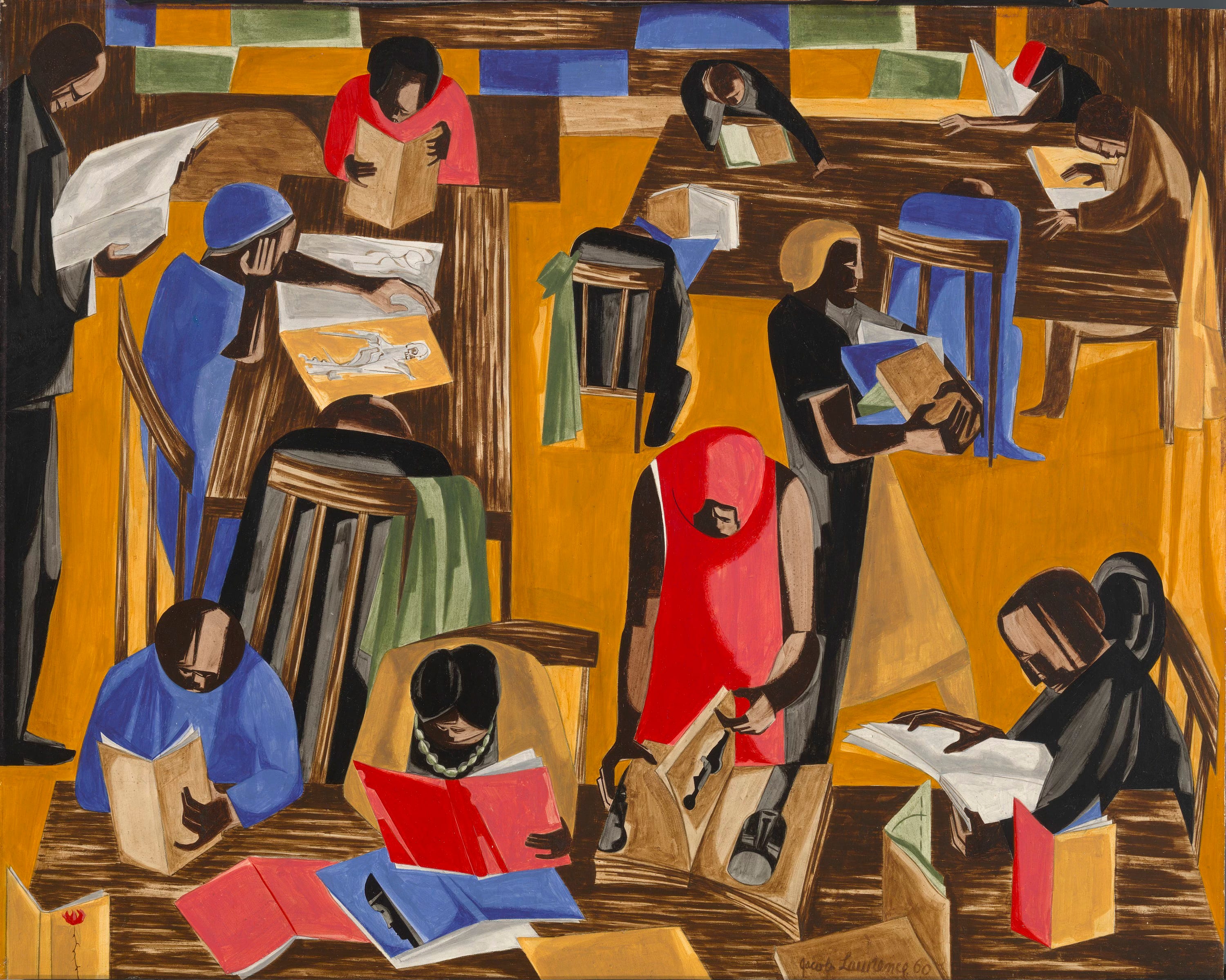
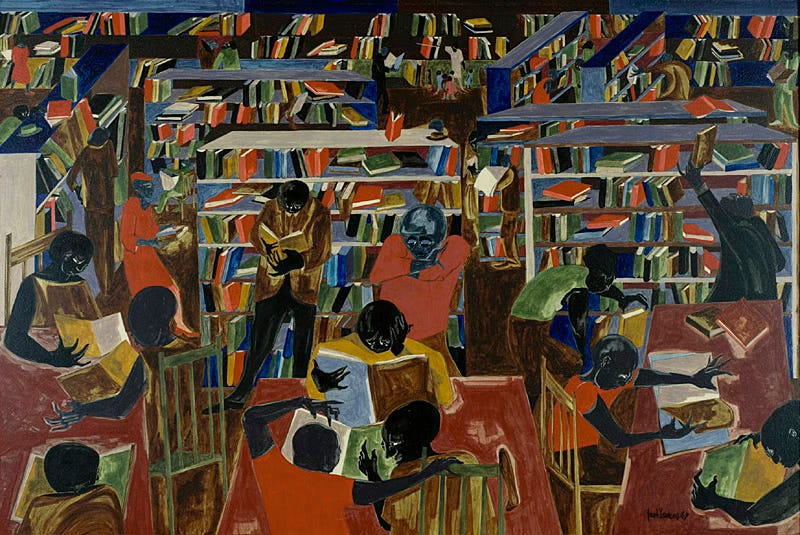
Art by Jacob Lawrence (1917–2000).


.
I wonder if Wayfare would be interested in a jab at canon-building? Short, accessible essays on some of the great books most of us have never heard of?
I recently bumped into an old (2017) attempt of mine which includes books about the afterlife, a well-meaning deacon, South American gangsters, and, ahem, sex.
https://motleyvision.org/2017/10/16/youre-looking-for-a-book
Regardless, very well said, James. I think I smell a title essay for your next collection?
Incidentally, James, I can't wait for you to see my essay in the new Further Light. We are sympatico, you and I.