


I find it hard to forgive. I hold grudges and harbor unkind feelings for far too long. I even do this vicariously. If I think someone has harmed a member of my family or someone I love, they are moved onto the proverbial naughty list. No presents for them. I am easily offended. You don’t even need to do anything. I might be offended by how someone votes or by what they believe. Even as I write this, I find myself thinking of the alarmingly long list of people whom I tend to avoid because of some offense, real or imagined. Now, because I am English, these grudges and resentments are kept locked up inside, stewing and simmering away. I am inherently conflict-averse. I am outwardly polite. I will shake your hand and smile, while chuntering on the inside. Yes, I chunter. I am a major chunterer.1
I think it is part of the reason I find David to be so compelling. He was a champion chunterer. He chuntered to God about Saul (1 Samuel 20:1). He chuntered at Achish (1 Samuel 29:8). And, to come to the text at hand, he chuntered about the way he was treated by Nabal (1 Samuel 25:21–22). David disliked injustice. It offended him. But we are getting ahead of ourselves.
Nabal, David, and Abigail in Between
As 1 Samuel 25 opens, we find David, a fugitive leader of some six hundred men, on the run from King Saul. David has been living among the flocks and shepherds of a very wealthy man called Nabal during the winter, offering protection to both sheep and shepherds. When David hears that Nabal has started shearing the sheep, he sends some of his men to receive a gift from Nabal during this festive season for protecting his abundant flocks (did I mention that Nabal is very, very wealthy?). Instead of honoring this service with a generous gift, Nabal calls David a runaway slave, failing to recognize him as the anointed future king. He dismisses the young men whom David sent as unknown and undeserving beggars. David is offended. No, he is incensed. But, unlike me, David is not conflict-averse. He calls four hundred of his company to take up their swords, and they head towards Nabal’s household to exact revenge.
At this point, the narrative perspective shifts to Abigail, Nabal’s wife. To say that Nabal married up would be an understatement. This “woman was intelligent and beautiful,” while Nabal, “a Calebite, was a hard man and an evildoer” (1 Samuel 25:3, JPS). Even Nabal’s household didn’t like him. When one of them rushes to Abigail to report what Nabal has done, he cannot help but add that Nabal “is such a nasty fellow that no one can speak to him” (1 Samuel 25:17). Abigail acts quickly. She knows who David is and what he is capable of. So, she gathers up a generous gift for David and his men and rushes off to place herself between David and the certain destruction of everyone in her household.
And it’s lucky she did, because David had been marching, and chuntering, and working himself up: “Now David had been saying, ‘It was all for nothing that I protected that fellow’s possessions in the wilderness, and that nothing he owned is missing. He has paid me back evil for good. May God do thus and more to the enemies of David if, by the light of morning, I leave a single male of his’” (1 Samuel 25:21–22). No English reserve here.
Abigail reaches David and throws herself to the ground, pleading for peace. She does not seek to deflect or gaslight. She does not offer empty promises. She does not offer feigned empathy or say “your cause is just but I can do nothing for you.” Instead, Abigail makes things right. She provides the demands of justice. And in doing so, she is the protector and wise governess of her entire household. Had she met David’s emissaries, she says, things would have been different: “Please, my lord, pay no attention to that wretched fellow Nabal. For he is just what his name says: His name means ‘boor’ and he is a boor. Your handmaid did not see the young men whom my lord sent” (1 Samuel 25:25).
Abigail successfully sues for peace. She is every bit as intelligent as we were told, with that intelligence that is full of grace, good sense, and quick wit. She realizes that immediate action is necessary if she is to negotiate a peaceful détente. Abigail is also fearless, trusting in both David’s good character and her ability to appeal to it. Importantly, she also makes amends, presenting David and his men with a generous gift from the bounty of her household. Ultimately, she trusts in the Lord and that David is the Lord’s anointed (1 Samuel 28–31). Even David finds himself grateful for her intercession. He praises God for sending her, and to her he says, “And blessed be your prudence, and blessed be you yourself for restraining me from seeking redress in blood by my own hands” (1 Samuel 25:33).
When Abigail returns home and eventually tells her husband how she had saved their household, he is mortified. And “about ten days later the Lord struck Nabal and he died” (1 Samuel 25:37–38). David praises the Lord and immediately proposes to Abigail (1 Samuel 25:39–42).
I have a sense that buried within this marvelous story is the balm to cure my grudge- and offense-ridden heart. And I think the source of this balm has something to do with Abigail and the way she threw herself into the task of making peace. And I think it might also have something to do with the way that the Lord struck down Nabal. David, both protecting and chuntering, might also have a role to play.
Recent Scholarship on 1 Samuel 25
But first, let’s turn to the scholars and find out what the story may have meant in its ancient context.
The modern interpretative trajectory, in English at least, was set by Henry Preserved Smith, an avowed higher critic and Professor of Biblical History and Interpretation at Amherst College. He wrote his commentary on the Books of Samuel at the end of the nineteenth century. For him, the explanation of the story is primarily source critical. “The story,” he says, “seems to be drawn from the source from which, in subsequent chapters, we have David’s family history. The interest of the author is not in David’s method with the wealthy sheep owners, but in the way that he got a wife, and in the kind of wife he got.”2 From this view, Nabal, the servants, and even David’s actions serve to set the actions, and therefore the character, of Abigail in greater relief.
More recent scholars recognize, with Professor Smith, that Abigail is the hero of the story.3 But they are less interested in the source-critical method, tending to follow Brevard Childs and Robert Alter in reading the final form of the text rather than trying to distinguish and exposit possible preexisting sources. This canonical reading has further resulted in identifying intertextual resonances with the marriage of Rebekah (Genesis 24), and the Exodus narrative, with Nabal playing Pharaoh, the story of Ruth,4 and with the story of Bathsheba (2 Samuel 11).
Also, rather than seeing 1 Samuel 25 as an awkward interlude between two chapters dealing with David and Saul, chapters that Henry Smith thought were from different sources, scholars now consider 1 Samuel 24–26 to be a coherent unit. These three chapters wrestle with the relationship between Saul and David, with the middle chapter using narrative analogy to talk about Saul through the figure of Nabal.5 The overarching theme is avoiding blood-guilt from either slaying the Lord’s anointed (1 Samuel 24:11; 26:9) or shedding innocent blood (1 Samuel 25:30–31).
Scholars also see 1 Samuel 25 as a proleptic narrative, pointing forward to a future event but with two quite different events in mind—either the death of Saul in 1 Samuel 31, or the death of Uriah instigated by David to facilitate the marriage with Bathsheba in 2 Samuel 11.6
Beyond literary connections, scholars have also tried to discern the realpolitik at play in the narrative. Was David innocently protecting Nabal’s flocks and shepherd, or was this some kind of protection racket? Did the death of Nabal and the marriage to Abigail advance David’s path to kingship?7 What honor codes were at play in Abigail’s behavior?8 These questions have helped scholars place this story in its sociological setting and led them to see 1 Samuel 25 as a pivotal moment in David’s ascent to the throne, aided by significant wealth and a brilliant, strategically minded wife.
A Pastoral Reading of 1 Samuel 25
I leave this review of the scholarship with a greater sense of the richness of this chapter, its context, and intertexts. I understand better the complexity of the narrative and the developing figure of David. And I have a better sense of how this story might have been understood in its historical setting. The figure of Abigail has taken on even greater importance, even if that importance was intended primarily to accrue to David. I also have a growing sense of how the work of scholars can contribute the balm I need to cure my grudge- and offense-ridden heart. To put it all together, however, I need to venture out on my own. So here goes.
First, I realize that I am not David, despite the chuntering. He had much greater reason to be offended and hold grudges than I do. I am not on the run. No one, let alone God’s anointed leader, is trying to kill me. No one has even returned me evil for good. I’m not in the business of freely taking care of the sheep and the shepherds.
I am, however, frequently Nabal. Nabal is both a character and a caricature. “The characterization of Nabal begins with his very name,” says the Harvard Bible scholar Jon Levenson, a name “which is, in fact, a form of character assassination.” Imagine me squirming as I continue with this quotation. “The Hebrew word nābāl, often translated as ‘fool,’ designates not a harmless simpleton, but rather a vicious, materialistic, and egocentric misfit.” Bit harsh. But I’m too far in to go back now. Levenson continues:
Other passages present the nābāl as an embarrassment to his father (Prov 17:21), a glutton (Prov 30:22), a hoarder (Jer 17:11), and even an atheist (Psalm 14:1). Most significant for our purposes is Isa 32:6, in which the refusal to feed the hungry and give drink to the thirsty, precisely the sin of Nabal in 1 Samuel 25, is listed among the characteristic of the nābāl.
Now, that passage from Levenson was hard reading, but this Isaiah passage really gets the point home:
No longer will the fool be called noble;
nor the villain be termed honorable.
For the fool utters foolishness,
and his mind plots evil,
to do foul things,
to utter error about the Lord,
to keep empty the throat of the hungry man,
to deprive the thirsty of drink.
As for the villain, his actions are vile,
he counsels deviousness,
to deprive men of their rights through lies,
even when the claim of the poor man is just.
But the noble man counsels only noble things,
and stands his ground in his nobility.
(Isaiah 32:5–8, Levenson’s translation)9
Levenson goes on with his description of the nābāl as rendered in 1 Samuel 25. But I’m going to stop there and just sit with that for a moment.
Could it be that I am entirely self-deceived? Am I a fool uttering foolishness when I convince myself that my grudges are justified, that my unkind feelings are warranted, that my judgments are in any way just? Am I depriving my brothers and sisters of their rights through lies—that is, am I imagining lies about people, and thus depriving them of the right to be seen for who they are?
It turns out that the balm that I thought I needed is actually a bitter draft. And the bitterest part is still to come, because Nabal’s chief fault in this story is failing to recognize David. Now, it is difficult not to think that from a pastoral perspective, David stands in this story for the Son of David, Jesus. And the greatest tragedy of the fool is failing to recognize Jesus. This is the message of so much of the New Testament, especially those poignant verses in Matthew 25:3–40 that inspired “A Poor Wayfaring Man of Grief.”
Now, the judgment day has not yet come, and there is still time to repent. There is still time for renewal and reconciliation. There is still time to become a new creature. “And the Lord said unto me: Marvel not that all mankind, yea, men and women, all nations, kindreds, tongues and people, must be born again; yea, born of God, changed from their carnal and fallen state, to a state of righteousness, being redeemed of God, becoming sons and daughters; and thus they become new creatures; and unless they do this, they can in nowise inherit the kingdom of God” (Mosiah 27:25–26).
I suspect the model of this new creature is Abigail. The name Abigail means “The Father is rejoicing.” Imagine that. Imagine becoming the kind of person who makes the Father rejoice. And what is it that makes the Father rejoice? I think the answer is found in Abigail’s actions in 1 Samuel 25, which can be encapsulated by the idea of peacemaking. Abigail made peace. When justice was due, Abigail made peace. When bad was given for good, Abigail made peace. When the food was withheld, Abigail made peace. When her household was in peril, Abigail stepped in between and made peace.
When I think of this wonderful chapter now, I see myself differently. I thought I was David, but all the while I have actually been Nabal. Though, even as I see myself in Nabal, even as I recognize the depths of my own foolishness, I find hope. I realize that I could become Abigail. I was a fool, but through Christ, I can become wise. I can become a peacemaker. I can be someone who stands in between. I can make the Father rejoice. That’s the balm that I was seeking.
Kristian S. Heal is a Senior Research Fellow at the Neal A. Maxwell Institute for Religious Scholarship. His research focuses on the reception of the Hebrew Bible in early Christian literature and worship. He received a BA in Jewish History from University College London, an MSt in Syriac studies from the University of Oxford, and a PhD in Theology from the University of Birmingham.
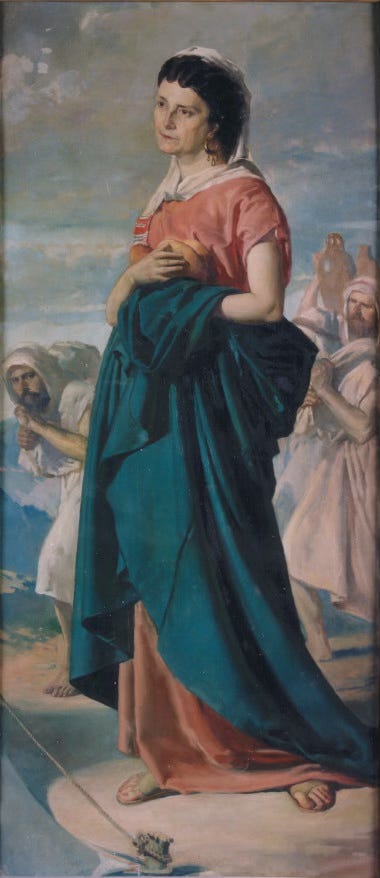
Art by Antonio Cortina Farinós (1841–1890).
The Old Testament Reflections series is published in collaboration with the Maxwell Institute: https://mi.byu.edu/old-testament-reflections.
Thank you for reading Wayfare Theology. If you no longer wish to receive these items in your inbox, click manage subscription under your profile and turn off notifications for this section.
KEEP READING


The Oxford English Dictionary defines the verb “chunter” as “to mutter, murmur; to grumble, find fault, complain.”
Henry Preserved Smith, A Critical and Exegetical Commentary on the Books of Samuel (The International Critical Commentary. Edinburgh: T&T Clark, 1899), 221.
Elisheva Baumgarten, “Charitable Like Abigail: The History of an Epitaph,” Jewish Quarterly Review 105, no. 3 (2015): 312–339; Ellen van Wolde, “A Leader Led by a Lady: David and Abigail in 1 Samuel 25,” Zeitschrift für die Alttestamentliche Wissenschaft 114 (2002): 355–375.
Yitzhak Berger, “Ruth and Inner-Biblical Allusion: The Case of 1 Samuel 25,” Journal of Biblical Literature 128, no. 2 (2009): 253–272; Joshua Berman, “Abigail and Her Honor Culture Wisdom,” Journal of Biblical Literature 144, no. 4 (2025): 637–656.
Jon D. Levenson, “1 Samuel 25 as Literature and History,” The Catholic Biblical Quarterly 40, no. 1 (1978): 11–28. See also, Robert P. Gordon, “David’s Rise and Saul’s Demise: Narrative Analogy in 1 Samuel 24–26,” Tyndale Bulletin 31 (1980): 37–64; Barbara Green, “Enacting Imaginatively the Unthinkable: 1 Samuel 25 and the Story of Saul,” Biblical Interpretation 11, no. 1 (2003): 1–23.
Levenson, “1 Samuel 25 as Literature,” points to Bathsheba. Gordon, “David’s Rise,” points to the demise of Saul.
For references, see John Kessler, “Sexuality and Politics: The Motif of the Displaced Husband in the Books of Samuel,” Catholic Biblical Quarterly 62, no. 3 (2000): 409–423, citing 411.
Berman, “Abigail and Her Honor Culture Wisdom.”
Levenson thinks that the verbal connections between 1 Samuel 25 and this passage are too clear for there not to be a common source (“1 Samuel 25 as Literature,” 14).

