


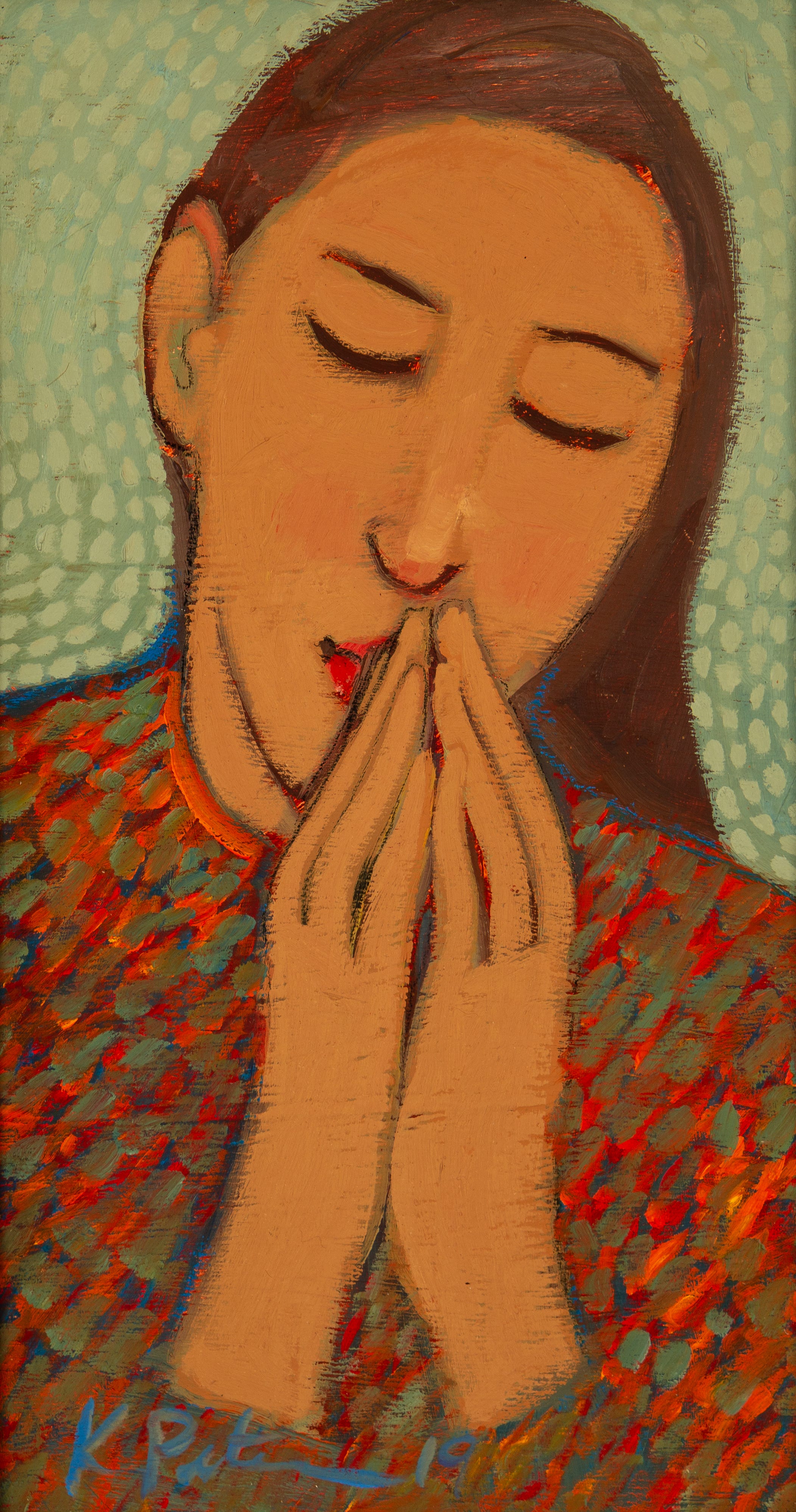
I was in the therapist’s office, tears welling as my chest tightened and heat rushed through my body. Someone in my life had made a passing comment that they had no idea would put me into a fight-flight-freeze response. I logically knew that I wasn’t in danger, but my body was ready to protect me, and even in the recounting of the event, anxiety coursed through my chest and torso.
“I want you to close your eyes,” said my therapist.
Tears leaked out as my eyelids shuttered.
“Picture the room where you were. Picture the people there.”
My heart continued to beat an insistent thump, heat prickling my face and hands. The air felt thin, as a panic attack crept closer. The tears came faster.
“Now, picture Jesus. Where would Jesus be right now?”
First, silence. And then, in my mind’s eye the Healer materialized in front of me, arms spread out and face to mine, inserting himself as a literal shield between me and the words that had unknowingly touched an open wound.
Relief cooled my cheeks, and an immediate calm filled my limbs, my tears now healing water.
In just a few minutes, what I had intellectually known about Jesus—that he protects, advocates, and heals—had transformed into something that I got to experience with him. And from that point on instead of pondering on what Jesus would do, I asked myself a new question: Where would Jesus be?

Though I thought I was going to therapy to address an undefined brand of anxiety, within one or two sessions, I had ranked on the official PTSD scale and had started cognitive processing therapy. My suggested treatment plan was tailor-made to not only teach me about how my brain works, but also what triggered my nervous system and how to collect evidence to counteract my trauma-coded anxieties.
In the months I met with my therapist to treat the PTSD, I also talked about God, church, friends, and my marriage. Each week made me work for recovery, which, while difficult, also brought me slowly and steadily back into the light. But the most valuable thing I experienced during that time was imaginative prayer. It wasn’t until a couple of years later that I came across the actual term imaginative prayer, but once I did, I realized that I’d been praying this way for a long time. When my traditional prayer methods stopped working for me, and God felt distant and unreachable, imaginative prayer is the practice that kept me tethered to the divine, gifting me an invitation to bring the Savior more actively into my life. I retired the question What would Jesus do? in favor of one that brought Jesus into my three-dimensional, messy, lived-in life.
In the church pews, discouraged and dissonant: Where would Jesus be?
In a county courtroom, receiving an unjust decision: Where would Jesus be?
In a dark bedroom, unable to sleep: Where would Jesus be?
In a chaotic family room, feelings exploding out of children and smothering my nervous system: Where would Jesus be?

The origin of imaginative prayer is typically attributed to Saint Ignatius and his Spiritual Exercises, a series of themed meditations designed to guide one into deeper relationship with Christ by activating a biblical narrative through the imagination. Strict Ignatian contemplative prayer requires one to imagine a scene from the Gospels and dive into granular details about a chronicled moment with Jesus.
Pick your favorite moment from the New Testament; mine is when Jesus heals the woman with the issue of blood (Luke 8:43–48). Now close your eyes and immerse yourself in the scene. Where are you physically within the moment? I’m in the market in a crowd of people, nowhere close to what will be the center of the action. The sun bakes the stalls of fresh wares, and my eyes prick with the dust ever-present in the air. I can feel the jostle of fellow shoppers, can even sense claustrophobia creeping in. Anxiety starts to build in my chest. The smells compete with the noise, and peace feels laughably impossible in the moment.
And then a defined hush settles over the street. I look over through the dust and people to see a woman kneeling on the ground, her hand outstretched. My eyes scan upward and catch on a person I haven’t yet met but who feels intimately familiar. His eyes are kind, wet with unshed tears. He’s smiling at the woman, someone I recognize from the outskirts of town, someone whom I’d avoided because she was unclean. But this man is reaching down to her and speaking softly. I can’t hear his words, but I can feel his power. And the woman? She looks different now. Lighter, happier, whole. My eyes prick for a different reason, and I feel a shift in my very essence. Witnessing this interaction even from the sidelines succeeds in altering my spirit; everything that follows in my life will be an After to this moment. My errand is forgotten, my irritation evaporated, and too soon the noise of the street picks back up and the vendors resume their trade.
Coming out of this reverie and taking stock of my St. Ignatian contemplation, I pay attention to where Jesus was throughout these verses: even in a sea of people, even on his way to perform a different miracle, he was kneeling next to the outcast. And now my way of moving through the world has shifted by a degree.
Immersing myself in beloved New Testament stories is a fresh way for me to experience scripture, my imagination filling in the gaps between the biblical verses as I bring my favorite miracles to life. But even more than the ancient accounts, I like to bring Jesus forward into the present, with me right here in my Oregon suburban townhome.
Theologian Gregory A. Boyd talks about the imagination like this: “We have come to mistrust [the imagination], especially in spiritual matters. We have come to identify imagination as something that takes us away from truth rather than something that can be useful, and indeed necessary, to enable us to experience truth.” Consider Lehi and Nephi and their respective dreams from the Book of Mormon: I’m sure that Jesus could have taught these men about grace, agency, temptation, sin, forgiveness, reconciliation, and salvation in innumerable ways, yet he allowed them to experience it in their minds. Perhaps not all imaginative prayer is a vision to be recorded on gold plates, but I find that Lehi’s and Nephi’s experience of their dreams proved a more potent teacher than a Sunday School class would have been.
When sincerely applied, imaginative prayer allows us to “re-present” Jesus and craft new, experiential interactions with him. Boyd reframes imagination as thinking that “imaginatively [replicates] reality in our minds . . . the mind’s ability to evoke images of things that aren’t physically present.” And if Jesus can’t be physically present, his presence in my mind is the next best thing.
Information doesn’t directly create an experience—we need our imaginations to take that information and make it real. I could read about Jesus non-stop and still never experience the Savior. Imaginative prayer is a way to take what we are taught about God and then allow it to transform us.
At some point in the recent years of my unraveled and rewoven faith, I found that kneeling next to my bed no longer moved me closer to heaven. The formulaic and familiar prayer language didn’t feel holy to me anymore. I believed in an all-loving God, but I rarely felt Them. I started to learn about other ways of praying, seeking out other Christian thinkers and diving into ongoing spiritual conversations to expand my definition and application of prayer. Therapy had successfully laid the groundwork for mental recovery, and my subsequent dive into prayer practices created the momentum I needed to heal.
Throughout the Bible, prayer shifts depending on the needs of the supplicant. For centuries prayer was denoted with a sacrifice; in other seasons prayer was offered three times a day. Prayer has been performed standing, kneeling, or even prostrate. The clothes one wore would sometimes be ripped in prayer to communicate grief or sorrow, and in celebration, a prayer could be danced.1 But always, prayer is a cry to God. Always, prayer is designed to forge relationship.2 And so the manner in which we pray doesn’t matter so much as the extent to which we break open our hearts, how willing we are to be transformed. Is my prayer—whether sung, cried, whispered, thought, or imagined—reaching toward God, building relationship, cementing trust? Am I allowing myself to be seen by God, to be welcomed by Them in all of my brokenness and needy mortality?
Our Heavenly Parents created brains that are capable of unending imagination; consider the centuries and millennia of art, music, literature, dance, mathematics, theoretical and applied physics, biology, medicine, astronomy, the study of varied animal species and classes, the many engineering disciplines, architecture, haute couture, fine dining and gastronomy, martial arts, interior design, psychology, screenwriting, film directing, computer coding, color theory, not to mention theology, and on and on and on go the wonders and the ever-expanding horizons of the human mind.
Where is God real if not in the imagination?

The question Where would Jesus be? has guided my discipleship ever since I was first invited to answer it. Any moment that I’m facing indecision or hurt or dissonance, I pause and ask myself where I would find the Savior at that very moment. It is both surprising and not surprising at all that I find him in the foyer with the anxious teenager instead of on the stand with the stake president. I find Jesus advocating for the silenced, using his voice to amplify theirs. I find him in the midnight car talks, weeping and listening to the friend who has tried so hard for so long to make a belief system work that she almost broke herself in the process.
I find him next to the panhandler at an interstate on-ramp, behind the disheveled mom in Costco with a babe strapped to her chest, and sitting beside the lonely widower on Christmas. I find him in all the places that ache, bringing companionship, solidarity, and ever-present hope. I also find him in the dreamers, encouraging us to think big, to lean into our souls’ desires, and to continually evolve into new creatures. He is excited for us when we see and pursue new possibilities.
Imaginative prayer was the thread that brought heaven back to me, weaving God in and through the dailiness of my life. My days are now punctuated with a rough amalgamation of regular meditation, half-muttered petitions, intentional affirmations, and continual imaginings of where I would find Jesus (and my practice has expanded to considering the different places I’d find God the Mother and God the Father).

One late night in mid-December 2023, when the days ran short and dark, I opened an email that threw me into a tailspin. My anxiety ratcheted up, and all intentions to ease into restful sleep vanished. Those familiar (though by now much less persistent) symptoms of PTSD reemerged: racing heart, shortness of breath, that consuming sense of fear and immediate danger.
And then, Where would Jesus be?
Spiritual muscle memory reminded me to remember Jesus.
Where would Jesus be?
I settled into bed, turned off the light, and focused on my breathing, wiping my tears.
Where would Jesus be?
In my imagination, the Healer materializes in a chair that he’s placed right outside my bedroom. He camps by my door, protecting my heart. He doesn’t let anything in that doesn’t breathe peace, light, love. As this new sense of safety starts to permeate my mind, my body relaxes, my heartbeat slows, and ever so gently I fall asleep.
Once I had excised the trauma from my tissues through long months of therapy, I could trust my body and my mind to reveal to me truth.3 This product of my imagination produced literal and immediate transformation in my body, a very real and palpable experience with the divine. What else could this be but a prayer?
So where is Jesus? He’s with you, with me, with every one of God’s children, in all the places where we most need him. He, along with our divine Parents, is a mere thought and imagining away, woven through our neurons and synapses, ready, eager, and willing to transform us and the world we inhabit. Our God is an experiential being, already condescended to be with us in this broken world, delighted to bring us heaven.
And for me? I want to be wherever they are.
This essay and the one below appeared in Wayfare issue 6.
Charlotte Wilson is an editor and writer running a small business between school pickups. She lives with her family in the Pacific Northwest, loves watching shows late at night with her husband, and ignores the laundry piles in favor of a good book.
Art by Kathleen Peterson.
When the Israelites fled Egypt and stood on the other side of the Red Sea, they sang their thanks to God. Miriam, denoted a prophetess (Exodus 15:20), took her tambourine and invited the women to dance with her in praise to Jehovah, a moment I think deserves its own imaginative prayer.
Consider Enos’s full day of prayer, his “wrestle which [he] had before God” (Enos 1:1). Having witnessed his father’s relationship with God, Enos desired his own connection with the divine, and he spent hours and hours forging it. Certainly his prayer took on multiple forms as the sun rose and set, each iteration bringing him a new experience with Jesus.
See Jacob 4:13: “For the Spirit speaketh the truth and lieth not. Wherefore, it speaketh of things as they really are, and of things as they really will be; wherefore, these things are manifested unto us plainly, for the salvation of our souls.” Emphasis added.
The Word Is Mercy

Epiphany: the appearance of a divine being, the sudden manifestation of an essential meaning, an intuitive grasp of reality triggered by a simple and striking event.


This is beautiful. I think it should be the text for the fifth Sunday lesson about freedom of religion. Everyone needs to be able to imagine their own Jesus or their own God.
This is so beautiful and freeing! Thank you for giving me another way to pray! 🙏🏻