


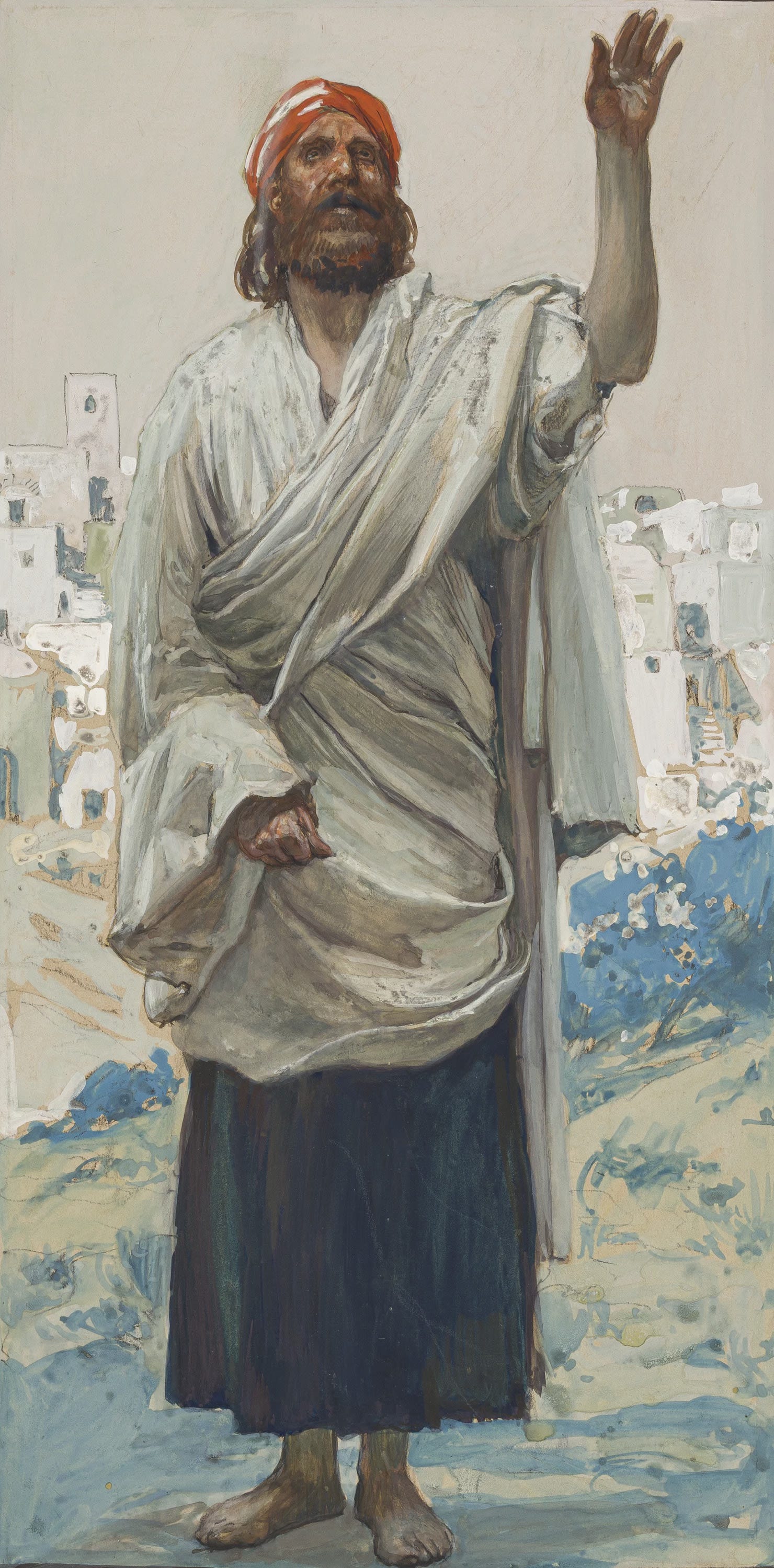
In a collection of scripture like the Old Testament that is no stranger to shocking tales of moral ambiguity, there can be a real debate over who wins for the most extreme example. If I had to vote, it might well be for Hosea, the prophet whose ministry begins with this command from the Lord:“Go take for yourself a wife of infidelity, and children of infidelity; for the land commits flagrant infidelity, abandoning the Lord” (Hosea 1:2, NASB, modified).1
The premise of Hosea’s story is so out there that many commentators have labored to cast it as strictly allegorical—not something that God actually commanded and that Hosea actually did. But the text itself isn’t easily wrangled into such safe precincts. No less a figure than the great Jewish scholar Abraham Heschel has summarized the many ways that the story seems to reflect real events, and our own official scripture aids and curriculum do not shy from this likelihood, either.2 After all, God is on record elsewhere making some pretty outlandish demands of his servants. Just ask Abraham (see Genesis 22), Gideon (Judges 7), or Isaiah (Isaiah 20).
Obedient to God’s astonishing command, Hosea takes a woman of ill-repute named Gomer to wife and has three children with her, only the first of whom is explicitly designated as his (Hosea 1:3, cf. vv. 6, 8).3 As each child is born, the Lord tells Hosea what the name should be, and each name is laden with significance.4
The first is a son that the Lord says should be named Jezreel, which in Hebrew is sonically very close to the name Israel and so primes the hearer to consider that this child, like Gomer herself, is meant to be understood as symbolizing the covenant people. The name means “may God sow,”5 but it is also the name of a famous valley town in northern Israel that served as an administrative center during some periods and was a place of political treachery and violence which the Lord says he will avenge upon Israel (v. 5).6 Not a bright picture, and it just gets dimmer with the next child, a daughter, born to Gomer. The Lord commands Hosea: “Call her name Lo-Ruhamah, for I will no more show mercy to the house of Israel nor will I forgive them in any way” (v. 6, Alter).7 In Hebrew, Lo-Ruhamah means “no mercy” or “no pity,” so the dire import of this child’s name is that God is going to expose Israel to the horrific consequences of its sin.
And the picture gets darker still. The third child, a son, is born and the Lord commands: “Name him Lo-ammi, for you are not my people, and I am not yours” (NRSVue, literal variant). With this final child, the relationship reaches its nadir, for God is now speaking of disowning Israel entirely, the ultimate catastrophe.
But then comes a word that suddenly delivers hope: “Yet,” says the Lord, and what follows is the promise of a reversal of all the calamity that had just been foretold: “Yet the number of the people of Israel shall be like the sand of the sea, which can be neither measured nor numbered,” a reminder and a reiteration of the original promise God made to Abraham at the first instance of the covenant (see Genesis 22:17). And then, even more specifically, God says, “In the place where it was said to them, ‘You are not my people,’ [in other words, Lo-ammi] it shall be said to them, ‘Children of the living God’” (Hosea 1:10). And then, one by one, the Lord reverses the import of each child’s name.
Invoking the first child’s name, originally associated with bloodshed and treachery, the Lord announces, “they shall rise up from the land” (speaking of the children of Israel, but also summoning an image of sown seeds sprouting from the ground), “for great shall be the day of Jezreel” (Hosea 1:11). The meaning of Jezreel shifts from the dark associations of the past to a renewed promise of “God shall sow”—the miracle of life itself, and the capacity for regrowth and restoration, and the prospect of belonging to the land one cultivates.
The next reversal is even more dramatic. Hosea is commanded, “Say to your brothers, ‘Ammi,’ and to your sisters ‘Ruhamah’” (2:1). That is, the negatory participle “lo” is removed from both names, so that they become affirmative claims by the Lord of “My people” and “Mercy.”
The rehabilitation of the names of the three children born to Gomer is one of the most powerful traits of Hosea’s writing. (Think with pity on these kids who had to go play with their mates who had normal names like Isaac and Benjamin, Naomi, and Sarah, when theirs were so infelicitous—until, that is, they were changed and became beautiful names, even blessings.)
But what of Gomer?
To complete this tableau of healing, the unfaithful wife, also representing Israel, is addressed as well. The Lord says that despite her waywardness and the consequences that must follow, he is determined to “allure her”—that is, to tenderly woo her back, through invitation, through proffered blessings, and by giving her safety—so that in the end she will no longer address him in the name of an idol, but will call him truly “my husband” (2:16–17). In return, the Lord promises her a three-fold “I will take you for my wife,” an iteration and affirmation of the marriage vow itself (2:19–20).
Traditional interpreters and academic scholars agree that, within Hosea’s framing, the name Gomer is not meant to carry oracular weight the way her children’s do. Indeed, the non-symbolic nature of her name is taken as an argument for the historical and not just purely metaphorical nature of this story.8 But the absence of wordplay with Gomer’s name in Hosea itself is no prohibition against it in our reflections. One of the privileges of scripture study is the opportunity we have as readers to bring creative and novel connections to the sacred text. Of course, we should do so responsibly, taking care not to twist meanings and intentions. But in this case, I propose we have an opportunity to proffer a reading of Gomer’s name that underscores and reinforces the narrative arc of the other names we’ve encountered.
According to Andersen and Freedman, the root meaning of the Hebrew g-m-r (גמר) means “accomplish, complete,” and Strong’s Hebrew Lexicon lists the same root as meaning “to end (in the sense of completion or failure).”9 Let’s reflect on the bi-directional quality of this term. In the first instance, Gomer is a woman of ill-repute—someone whose choices have wrecked her social standing and badly undermined her potential. In that sense, she is done-for, finished, a failure. These are all senses encompassed by the negative connotations of Gomer.
But as the Lord exhorts Hosea to “Go, love a woman who has a lover . . . just as the Lord loves the people of Israel, though they turn to other gods” (Hosea 3:1), and as Hosea purchases her, literally redeeming her from the marketplace, and begins to tenderly guide her into a safe and secure relationship with himself, the potential meaning of her name likewise shifts (Hosea 3:1–4). As she brings three children into the world and learns to be true to the man who has shown steadfast love for her, her name can begin to reflect a very different sense of being finished—a positive sense that means complete, fulfilled, and well-spent. Like her children’s names, and like our own lives, Gomer’s name is also capable of doing an about-face. Fortunes can be reversed when least expected through the redeeming love of God.
D. Morgan Davis is a Research Fellow at the Neal A. Maxwell Institute for Religious Scholarship. He holds a PhD (2005) in Arabic and Islamic studies from the University of Utah, an MA in history from the University of Texas at Austin, and a BA in Near Eastern Studies from Brigham Young University.
Art by James Jacques Joseph Tissot (1836–1902) and Charles Hoffbauer (1875–1957).
Thank you for reading Wayfare Theology. If you no longer wish to receive these items in your inbox, click manage subscription under your profile and turn off notifications for this section.
The Old Testament Reflections series is published in collaboration with the Maxwell Institute.
KEEP READING


I prefer the NASB’s literal reading for v. 2a. Many translations, including the familiar KJV, use words for whoredom in the three places where this translation has infidelity. The reason I prefer this version is not to dilute the shocking connotation of the language of whoredom, but to preserve a double valence that is clearly intended in the original. The Lord is illustrating the severity of apostasy through idolatry by paralleling it with the wickedness of sexual sin. The word infidelity (to be unfaithful) carries both the theological and conjugal meanings simultaneously. For a full discussion of the subtleties involved in translating these verses, see Francis Ian Andersen and David Noel Freedman, Hosea, The Anchor Bible 24 (Doubleday, 1980). All other quotations from the Bible here are from the NRSVue.
See Heschel, The Prophets, 65–66; Scripture Helps: Hosea 1–6; 10–14; Joel.
For the analysis that follows, I have benefitted in particular from Joshua M. Matson’s summary of the literature and analysis in “God’s Steadfast Love, Mercy, and Kindness in the Marriage and Family of Gomer and Hosea” in David Rolph Seely and others, eds., Tender Mercies and Loving-Kindness: The Goodness of God in the Old Testament (Religious Studies Center, Brigham Young University; Deseret Book, 2026), 319–335.
Other prophets like Isaiah also get involved in naming children with oracular or portentous names (see Isaiah 7:3, 14; 8:1–3), but based on standard dating, Hosea’s is the earliest instance.
Andersen and Freedman, Hosea, 172.
See 2 Kings 9–10 for some of these events.
Robert Alter, The Hebrew Bible: A Translation with Commentary (W. W. Norton & Company, 2018).
See Heschel, The Prophets, 65; Andersen and Freedman, Hosea, 171.
