


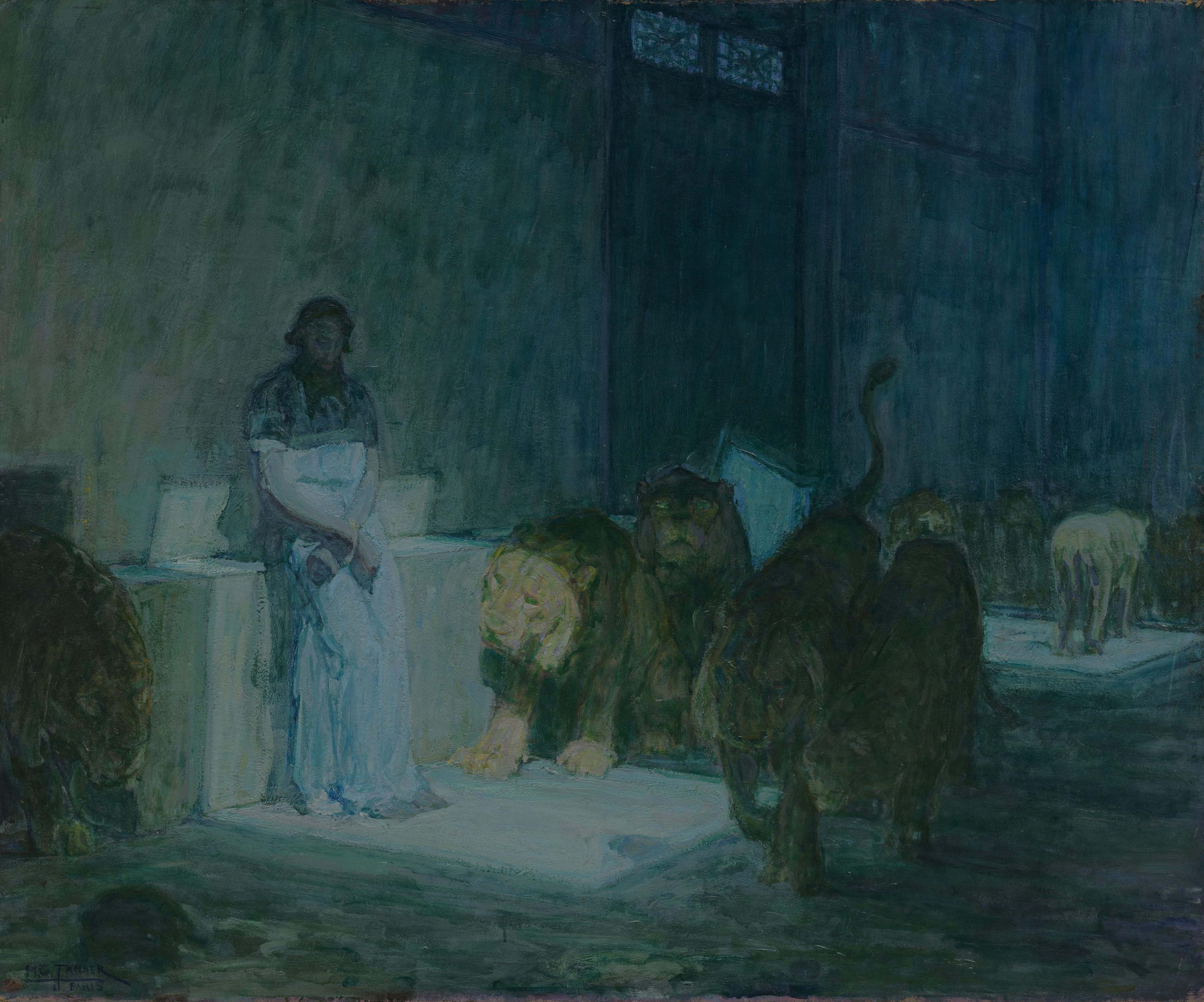
The Old Testament includes several versions of, and variations on, a story we all know. They are sometimes called divine triumph narratives. Every version of it features one or more representatives of the God of Israel facing off against one or more agents of some other god—Moses versus Pharaoh, Elijah versus Baal’s priests, a shepherd boy versus a giant. Modern readers can easily miss what these stories meant to their ancient readers. We tend to reduce them to lessons about the mere mortals they mention. Just think about what we call these stories. To us it’s David and Goliath, for instance, though the boy and the giant are bit players in the cosmic duel between the Philistine god Dagon and the God of Israel.
In other words, every one of these stories has the same protagonist, and he declared the theme the stories share when he invited a multitude of people to “arise and come forth unto me, that ye may thrust your hands into my side, and also that ye may feel the prints of the nails in my hands and in my feet, that ye may know that I am the God of Israel, and the God of the whole earth” (3 Nephi 11:14, emphasis added; see Isaiah 54:5 and 3 Nephi 22:5). The narrators of these stories are more concerned with making that point than with historical accuracy. The narrators did not worry whether the stories are true as we understand that idea. Rather, they composed stories that culminated in the truth. That’s why the stories vary but are also essentially the same: A covenant underdog faces some great foe, and the enormous power gap between them emphasizes the point of the story, which is, as Pharaoh Ramses (played by Yul Brynner in the 1956 film The Ten Commandments) says ultimately of Moses: “His God is God.”
My favorite thing about the book of Daniel is its high concentration of these stories. Its ancient readers knew the story form and content. It was foundational to their identity. They knew that every variation of the story states the same theme, the thing to remember, the point, the “I am the God of the whole earth” (3 Nephi 11:14).
Sometimes the Hero declares the theme: “Against all the gods of Egypt I will execute judgment: I am the Lord” (Exodus 12:12, 14:18).
Sometimes the faithful covenant underdog declares the theme: “I come to thee in the name of the Lord of hosts,” so “that all the earth may know that there is a God in Israel” (1 Samuel 17:45–46).
Sometimes witnesses declare the theme: “The Lord, he is the God; the Lord, he is the God” (1 Kings 18:39).
The book of Daniel invites us to consider whether the story is still true, whether the theme has failed, whether the God of Israel is the one now distracted, on a journey, or sleeping (1 Kings 18:27). The book of Daniel even raises the possibility that the God of Israel has simply been bullied into submission.
Daniel 1 begins by telling us that when Nebuchadnezzar II, king of Babylon, besieged Jerusalem, the Lord simply gave it to him. Marduk (aka Bel) was Nebuchadnezzar’s main god, and about 605 BC, Nebuchadnezzar carried “part of the vessels of the house of God” to “the land of Shinar to the house of his god” and placed them “into the treasure house of his god” (Daniel 1:2). Marduk looted Jehovah’s temple to furnish his own. Moreover, the best and brightest Israelite young people, including Daniel, Hananiah, Mishael, and Azariah, were to be forcibly assimilated into Babylonian culture. To any ancient Near Eastern observer, the God of Israel had become subject to Marduk.
That is the setting for the Book of Daniel’s duels between deities. The duels begin in Babylon when King Nebuchadnezzar II orders name changes for the Israelite subjects in order to strip them of their covenant identity and connection to the God of Israel, of whom their Hebrew names testified: Daniel means “God is my judge.” Hananiah testifies of the Lord’s grace, Mishael aspires to be like God, and Azariah affirms that the God of Israel helps. In Babylon, the young men are assigned new names that pay homage to the Babylonian pantheon: Daniel was called Belteshazzar, a prayer that Bel would be his protector, and his friends were named Shadrach for the god Aku, Meshach, also paying homage to Aku, and Abednego, meaning a servant of the Babylonian god Nego or Nebo.
That meant that the stakes were already high when Daniel dared to remain faithful to the covenant. Trusting the God of Israel to keep covenant always and everywhere, “Daniel purposed in his heart that he would not defile himself” (Daniel 1:8). Can covenant people stay faithful to the covenant with no temple and no promised land? After ten days of covenant faithfulness, Daniel and his friends are “fairer and fatter in flesh” than everyone else at court, and “ten times better than all the magicians and astrologers” in the realm (Daniel 1:15, 20). It was a modest vindication of the God of Israel, to be sure, but also an indication that he was alive and well in Babylon.
The next duel came when Nebuchadnezzar dreamed and demanded that his wise men tell him both the dream and its meaning or be cut into pieces. “No one can reveal it to the king except the gods,” they answered (Daniel 2:11). Indeed, none but the God of Israel could, and he revealed the dream to Daniel, leading Daniel to declare the wisdom and power of God, then offer thanks and praise to him (Daniel 2:19–23).
“There is a God in heaven that revealeth secrets,” Daniel subsequently tells the king (Daniel 2:28). Then Daniel describes the king’s dream in detail. The king dreamed of a giant statue made by humans of gold, silver, brass, iron, and clay. Then a stone—explicitly not made by humans but by God—rolled forth and crushed the statue into such small pieces that they blew away, while the stone became a mountain that filled the earth. Daniel calls Nebuchadnezzar “the king of kings,” but makes it crystal clear that the God of Israel is the source of his power, might, glory, and dominion—the King of the king of kings (Daniel 2: 36–38). Daniel’s God is destined to establish a kingdom that will grow and ultimately subdue all others.
Nebuchadnezzar himself declares the theme, telling Daniel, “Your God is a God of gods, and a Lord of kings, and a revealer of secrets” (Daniel 2:47). Like Pharaoh’s line, it’s a reluctant king’s realization. Watching Nebuchadnezzar slowly come around becomes a subplot of the chapters that follow. In the very next chapter, he builds his own statue, all gold this time, as if to hedge against his dream, and he orders the whole empire to bow to it or burn (Daniel 3:1–6). This sets up another duel. This time Shadrach, Meshach, and Abednego deliver a profound variation on the theme. As if to reclaim their rightful names, they declare, “our God whom we serve is able to deliver us from the burning fiery furnace. . . . But if not, be it known unto thee, O king, that we will not serve thy gods” (Daniel 3:17–18).
Their covenant faithfulness to God doesn’t depend on being rescued, and God’s covenant faithfulness remains even if he does not do what he is able to do. The furnace is heated seven times hotter, and the Israelites are bound and thrown into it. The heat kills the men who threw them into the fire, but the king, peering in, says, “I see four men, unbound, walking in the middle of the fire, and they are not hurt, and the fourth has the appearance of a God” (NRSV Daniel 3:25). Nebuchadnezzar decrees that no one should blaspheme against the God of Shadrach, Meshach, and Abednego, “for there is no other God who is able to deliver in this way” (NRSV Daniel 3:29).
In Daniel 4, Nebuchadnezzar acts as if he is god. Walking on the roof of his palace, he boasts, “Is not this great Babylon, that I have built . . . by the might of my power?” (Daniel 4:30). A voice from heaven answers immediately, telling Nebuchadnezzar that he will be promptly deposed and that “the most High ruleth in the kingdom of men, and giveth it to whomsoever he will” (Daniel 4:32). The king is promptly deposed, and he realizes and restates the theme once more. Then God restores Nebuchadnezzar to his throne.
In Daniel 5, a new king, Belshazzar, whose name, like Daniel’s Babylonian name, evokes Marduk (or Bel’s) protection, comes to power. The new king throws a feast and sends for the very vessels taken from the Lord’s temple in Jerusalem, described in chapter 1. Belshazzar and his princes, their wives and concubines, drink wine from the sacred vessels while they “praised the gods of gold, and of silver, of brass, of iron, of wood, and of stone” (Daniel 5:4). Then the king sees a hand write on the wall and suddenly becomes less cocky. None of his wise men can read the writing, despite his promise of fine clothes and jewelry. The queen reminds the king about Daniel, who is summoned to read the writing.
Daniel refuses the clothes and jewelry and reminds Belshazzar that Nebuchadnezzar chose to learn the hard way “that the Most High God has sovereignty over the kingdoms of mortals, and sets over it whomsoever he will,” and for that reason it seems unwise for Belshazzar to exalt himself and profane “the vessels of his temple” (NRSV, Daniel 5:17–23). Daniel reveals that the hand that wrote on the wall was sent from God’s presence, and the writing discloses God’s decision to end the kingdom. That night Belshazzar dies, and the superpower Babylon along with him. In the book of Daniel, kings and gods come and go. Daniel remains, ever faithful, preserved by the God of Israel, the God of the whole earth.
The Medes came to power. Darius was their king. Darius made Daniel his second-in-command. This sets up the best-known divine triumph narrative in the book of Daniel. Consider carefully what we might miss if we reduce the story to its mortal and temporal aspects—Daniel and the lions’ den. What other details does the narrator intend for us to consider? What about law? Jealous princes conspired against Daniel but found no fault in him “except we find it against him concerning the law of his God” (Daniel 6:5). Law, then, becomes the crux of the matter. The narrator wants us to understand this, and emphasizes that the Medes have a law that makes a Median king’s decree irrevocable (Daniel 6:8). The God of Israel has a law, too. His law conflicts with Darius’s decree. Whose law will Daniel choose?
The narrator makes sure we know that Daniel knows about Darius’s decree. Daniel knows, and we know, that the stakes are life and death. Daniel opens his windows “toward Jerusalem,” and prays “three times a day . . . as he did aforetime” to the God of Israel because he is also the God of the whole earth (Daniel 6:10). No mortals, not even Darius, can save Daniel now. Is Darius powerful or powerless? It depends on who he’s compared to. He knows, even as he has Daniel thrown into the den of lions, who has power. He tells Daniel, “May your God, whom you faithfully serve, deliver you!”
Darius doesn’t sleep all night (Daniel 6:18). At dawn he goes to the den and calls out, “O Daniel, servant of the living God, has your God whom you faithfully serve been able to deliver you from the lions?”
Yes, comes the reply. “My God sent his angel and shut the lions’ mouths so that they would not hurt me.” Covenant faithfulness, the narrator emphasizes, God’s covenant faithfulness saved Daniel because Daniel was faithful to the covenant. The story ends with Darius making a new decree, a poetic speech in Daniel 6:26–27. This is the theme of this story and every story like it in the Old Testament. Whether, in actual fact, Darius sent his ultimate decree “to all peoples and nations of every language throughout the whole world,” is beside the point. Don’t miss the point. As you read the decree, remember that the mere mortals are interchangeable parts. The Protagonist is the point—the God of Israel, the God of the whole earth:
“I make a decree, that in all my royal dominion people should tremble and fear before the God of Daniel:
 	For he is the living God,
 	 	enduring forever.
 	His kingdom shall never be destroyed,
 	 	and his dominion has no end.
 	He delivers and rescues,
 	 	he works signs and wonders in heaven
 	 	 	and on earth
 	 	for he has saved Daniel
 	 	 	from the power of the lions.”
Steven C. Harper is a covenant son of God who strives to be a disciple of Jesus Christ. His primary work is to teach the restored gospel of Jesus Christ in ways that help students develop resilient faith in, and become lifelong disciples of, the Savior.
Art by Henry Ossawa Tanner (1859–1937).
The Old Testament Reflections series is published in collaboration with the Maxwell Institute: https://mi.byu.edu/old-testament-reflections.


