


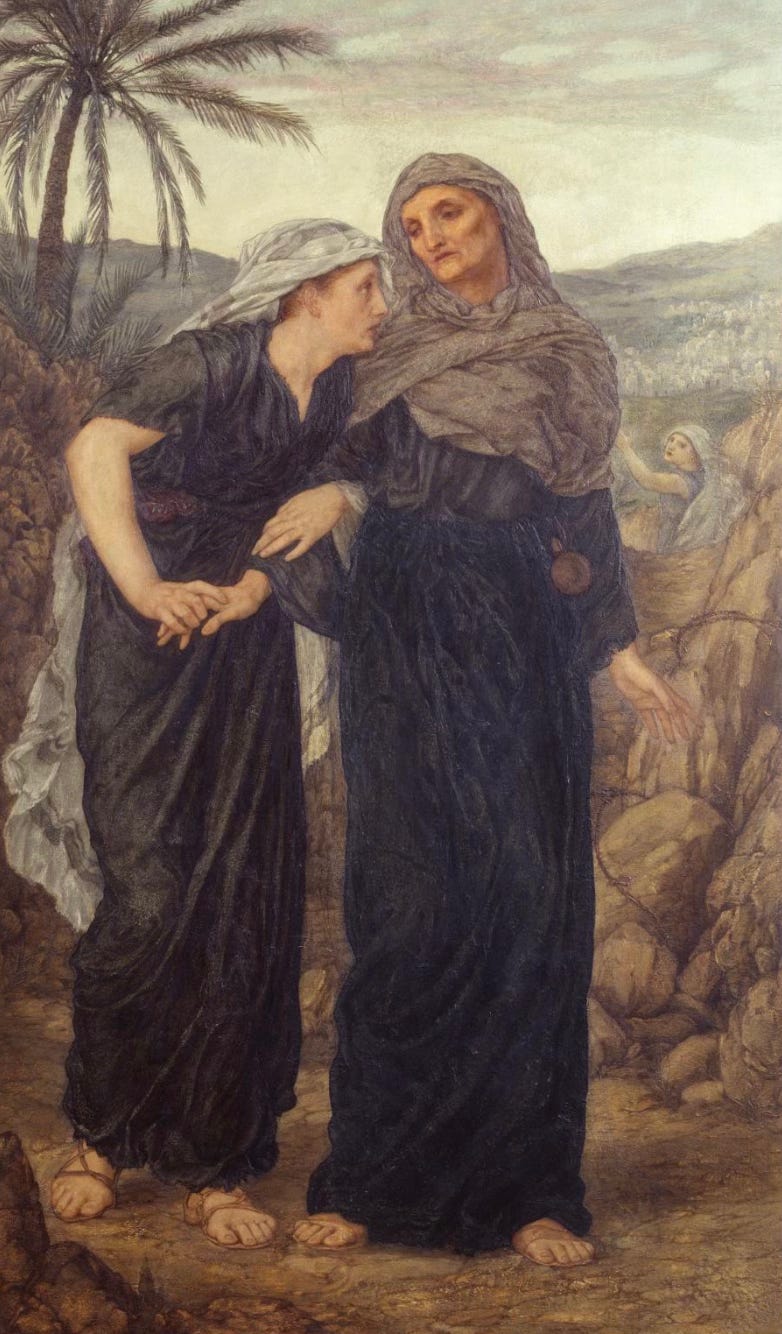
The book of Ruth, no more than a short story in length and scope, packs its few pages with a volume’s worth of moral reflection on love, self-sacrifice, and redemption. The narrative is familiar: Naomi is bereaved, Ruth is loyal, Boaz is generous, and the mutual devotion that develops between the three protagonists restores a lost lineage with the birth of Obed.
The story traces a hopeful arc from emptiness to fullness. Naomi’s lament that “the Lord hath brought me home again empty” (Ruth 1:21, KJV) has, by the end, become joy in the chosen grandchild she clasps to her breast, a “restorer of thy life, and a nourisher of thine old age” (Ruth 4:15). Beyond the marriage plot, the story’s portrayal of Naomi and Ruth represents the Bible’s most sensitive (and positive) exploration of women’s relationships. And Boaz’s role as go’el, or “redeeming kinsman,” is, for Christian readers, a powerful type of Christ our Redeemer, Bridegroom, and generous Friend.
The brisk plot reads as variations on the theme of “costly love.” The idea that love comes with a price tag of vulnerability, responsibility, and suffering gained prominence in Christian thought during the twentieth century in the work of, among others, Dietrich Bonhoeffer. (Costly love is the subject of my colleague Terryl Givens’s current study of Christian theology.) Christ’s suffering in the events of the Atonement was one staggering cost of his perfect love. Such love, Jesus taught, must be the foundation of the friendship that characterizes his disciples (John 13:34–35) and his church (1 Corinthians 13:4–8).
To be sure, recognition of love’s cost long preceded the ministry and passion of Jesus Christ. It is central to hesed, the divine lovingkindness at the center of the Hebrew Bible’s covenant theology and ethics—and a concept President Nelson taught Latter-day Saints to cherish. Hesed is a kind of loving faithfulness that exceeds the bounds of law or custom: It gives whatever is needful for the well being of the beloved regardless of conventional duty. In this way, hesed entails a certain overflow or excess.1 The book of Ruth portrays Ruth, Naomi, and Boaz as models of such costly love.
After the deaths of her husband and sons, Naomi frees her daughters-in-law from the expectation that they return with her to her native Bethlehem. She understands that the rupture would rip them from the only community they know and likely deprive them of the chance for remarriage. Better for them, she knows, to return to their mothers and build a new life. This will leave Naomi bereft of family, aged and defenseless, to make her new life alone. She could pressure the young women to stay with her, as custom demands. But she refuses to afflict Ruth and Orpah with her own misfortune, and so she urges them three times to return home with her blessing (Ruth 1:8, 11, 12). From Naomi, we learn that costly love doesn’t always require tightening a relationship. Sometimes it may require loosening.
Orpah indeed elects to return home. She is often reproached for this decision, but I’ll speak up on her behalf. The fact that love is costly does not mean that every costly action taken on behalf of another is necessary or necessarily loving. Tremendous acts of self-sacrifice can be misguided, unhelpful, harmful—or even, paradoxically, selfish, when they are undertaken to serve the emotional needs of the one who sacrifices. Given that Naomi freely and sincerely relieves her daughters-in-law of their obligation, I find Orpah’s decision to return home to be an honorable one.
Ruth’s devotion to Naomi, of course, reveals a deeply-felt attachment to her mother-in-law and a genuine desire to make her life at Naomi’s side: The word used in 1:14 for Ruth’s “cleaving” to Naomi is the same used in Genesis 2:24 to describe the two-as-one relationship of husband and wife. Ruth’s declaration of hesed is justly famous:
Entreat me not to leave thee, or to return from following after thee: for whither thou goest, I will go; and where thou lodgest, I will lodge: thy people shall be my people, and thy God my God:
Where thou diest, will I die, and there will I be buried: the Lord do so to me, and more also, if ought but death part thee and me. (Ruth 1:16–17)
And she is as good as her word. She indeed cleaves to Naomi and makes their two lives one. Ruth works tirelessly for their mutual welfare as she labors in the fields (Ruth 2:7), shares provisions (2:18), obeys Naomi’s instruction (3:6), and risks her life and standing to secure their future with Boaz (3:9). Ruth’s loyalty goes well beyond the requirements of law and convention to bless Naomi’s life at real personal cost to herself. Ruth the Moabite is a paragon of hesed worthy of the God of Israel.
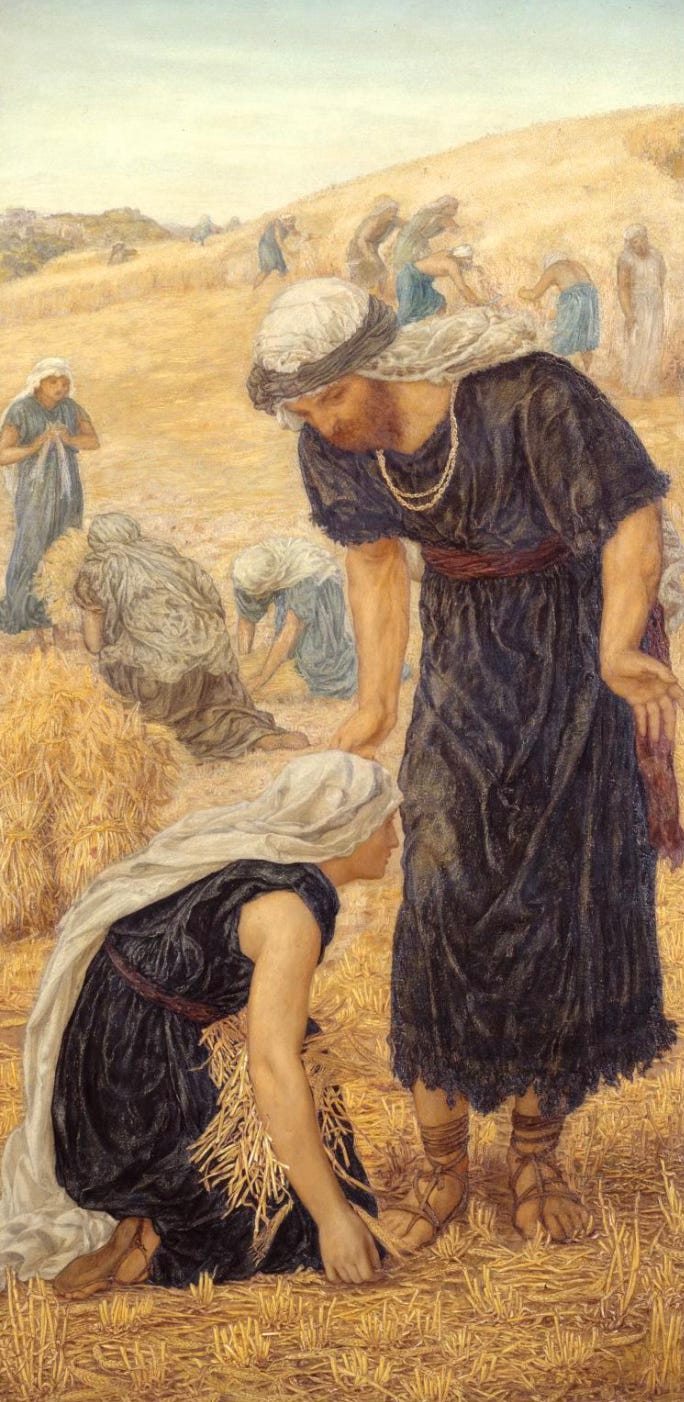
Boaz, for his part, displays steadfast generosity to the refugee women. He is called to act with higher love at each narrative turn, and he rises to the call every time. First he shares food and water with Ruth (2:14), and then he allows her to gather full stalks of wheat rather than the meager field leavings (2:15). After their nighttime encounter at the threshing floor, Boaz gives Ruth an immensely, even hyperbolically, generous gift of six measures of barley (3:15). Finally, Boaz, in contrast to the unnamed kinsman who acts as a miserly narrative foil, promises to marry Ruth—and thus to divide his estate and diminish the inheritance of his existing children. In this, he secures the women’s future and redeems his kindred.
As bridegroom, Boaz takes on the role of go’el, a family member who bears the right and responsibility to step in when a relative requires aid. Beyond its social utility, the go’el has theological significance: The Hebrew Bible uses go’el for God, Israel’s redeeming kinsman who reclaims them from slavery and restores them from exile. The book of Ruth directly likens Boaz’s generosity and the Lord’s hesed: In Ruth 2:12, Boaz blesses Ruth for taking refuge under the “wings” of “the LORD God of Israel.” Then at the threshing floor, Ruth asks Boaz to spread his “wing” over her (3:9; “skirt” in KJV). Boaz grants her request and becomes the human instrument of the divine shelter he earlier invokes. His costly love is the means by which God’s hesed arrives for Ruth and Naomi.
I’m deeply moved by the various expressions of costly love explored in the book of Ruth. I am the variety of sinner who suffers from an excess of self-absorption and self-regard. I regularly need admonitions to act generously, to give freely of my resources and my time, and to look outside my own projects and interests.
Nevertheless, valorizing costly love can pose problems. Some people, often but not always women, suffer from too little self-regard, not from too much. For them, emphasis on godly selflessness can feed extreme acts of self-sacrifice, bordering on self-erasure. In the most troubling scenarios, the call to “die to self” may feed unequal, unfree relationships in which one party is left voiceless, unable to assert her boundaries and needs. The self-giving party is instrumentalized as a means to somebody else’s ends; her sacrifice is made to serve external purposes in which she has no share. Though it may be demanded in the name of love, such “selflessness” is actually exploitation, and it is no part of the pure love of Christ.
In other cases, costly love can be weaponized as a form of moral high ground: C. S. Lewis memorably describes the dynamic wherein one person “surrender[s] benefits not that others may be happy in having them but that he may be unselfish in forgoing them.” Under the banner of “unselfishness,” a person may, at best, engage in unnecessary and unhelpful self-sacrifice, or, at worst, manipulate those around her.
Feminist theologians have long recognized these difficulties. Some have argued that Christlike self-giving, freely chosen from a position of spiritual agency, is fundamentally different from coerced submission, and that only the former describes genuine discipleship. Others have questioned whether the costly love of the cross should be a model of redemptive suffering at all for those whose experience has been one of forced self-sacrifice. Still others have proposed that the highest vision of Christian love is the flourishing of both parties, not the dissolution of one into the other. The Latter-day Saint theologian who has explored these difficult questions most fully is Deidre Green, and her work deserves wide consideration.2
The book of Ruth suggests covenant as a solution to the problem of costly love. Ruth’s famous declaration to Naomi—“your people shall be my people, and your God my God”—is a covenant utterance, complete with a sealing oath (Ruth 1:16–17). Ruth’s covenant with Naomi accomplishes the work that all covenants undertake: namely, to create a new unity of purposes where there was division. More than a promise of care and provision, Ruth’s covenant hesed to Naomi fuses their purposes. Where Naomi goes, Ruth goes, because the two women now share the same goals and plans.
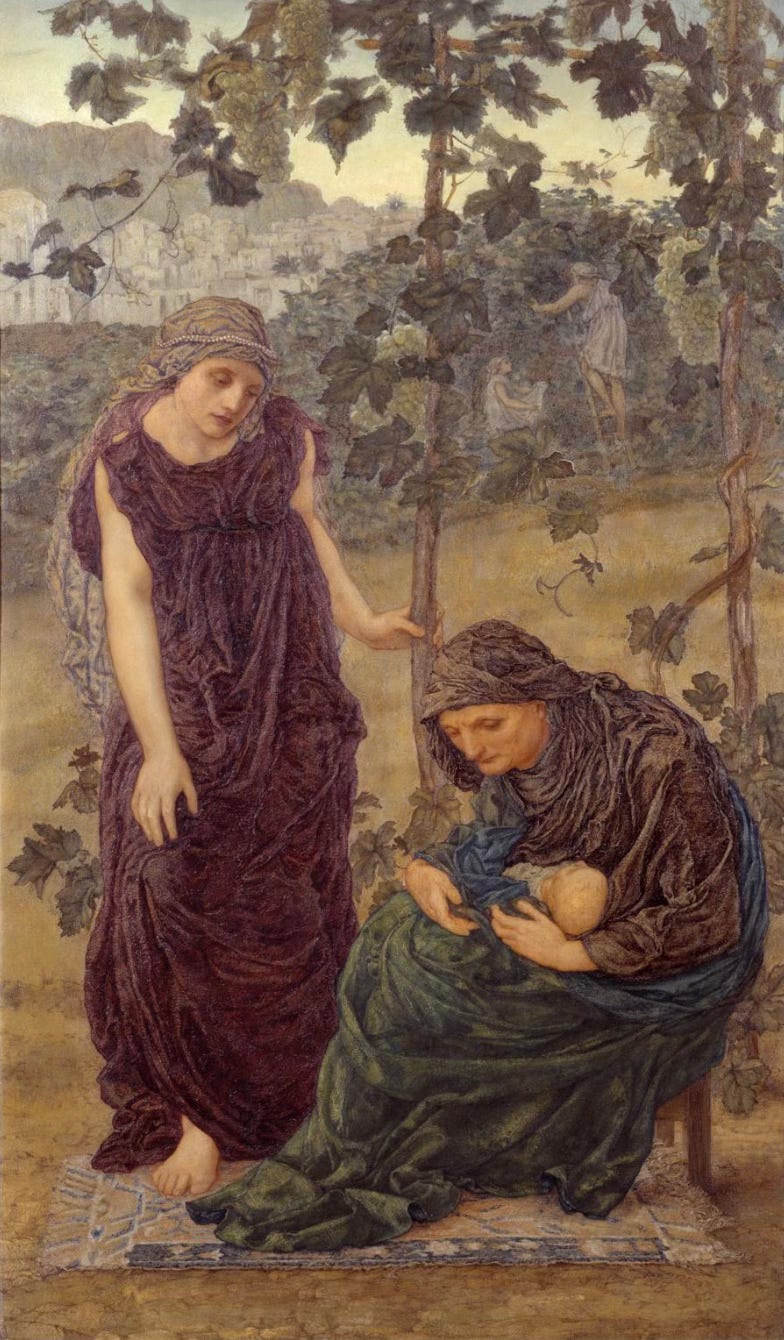
Seen in the light of covenant, Ruth’s love is costly indeed, but it is not self-erasure. True, she gives up a past life, but she enters a newly-formed joint life in which her flourishing and Naomi’s are no longer in competition. “Costly love” absent covenant would have made Ruth a self-sacrificial means to Naomi’s ends; the introduction of covenant transforms the moral situation by making their purposes mutual. Covenant ensures that Ruth, the one who bears the cost, has a share in the ends her sacrifice serves. Naomi’s redemption is Ruth’s redemption: Ruth’s child is laid on Naomi’s breast. Their covenant creates a common life in which the category of “whose ends” partially dissolves.
In the end, I remain unsettled. It’s clear that costly love is a powerful but risky idea. I confess that it poses a conundrum that I don’t yet know how to solve. I worry about any solution that dilutes the costly demands of Christian discipleship: “He that findeth his life shall lose it: and he that loseth his life for my sake shall find it” (Matthew 10:39). At the same time, Jesus commanded his disciples to “love thy neighbour as thyself” (Matthew 22:39). Any interpretation of Christian love that erases the self cannot fulfill the commandment, because it eliminates one of its terms. Perhaps Naomi and Ruth’s covenant-bound relationship gives us a model of costly love in which the mutual flourishing of lover and beloved is achieved.
Rosalynde Frandsen Welch is Associate Director and a Research Fellow at the Neal A. Maxwell Institute for Religious Scholarship. Her research focuses on Latter-day Saint scripture, theology, and literature. She holds a PhD in early modern English literature from the University of California, San Diego, and a BA in English from Brigham Young University. She is the author of Ether: A Brief Theological Introduction, published by the Maxwell Institute, as well as numerous articles, book chapters and reviews on Latter-day Saint thought. Dr. Welch serves as associate director of the Institute, where she coordinates faculty engagement and co-leads a special research initiative.
Art by Thomas Matthews Rooke (1842–1942).
The Old Testament Reflections series is published in collaboration with the Maxwell Institute: https://mi.byu.edu/old-testament-reflections.
Thank you for reading Wayfare Theology. If you no longer wish to receive these items in your inbox, click manage subscription under your profile and turn off notifications for this section.
KEEP READING


The Jewish Study Bible, eds. Adele Berlin and Marc Zvi Brettler (Oxford University Press, 2004), 1578.
See Deidre Green, Jacob: A Brief Theological Introduction (Maxwell Institute, 2020). The scholar Valerie Saiving inaugurated this conversation with her important article, “The Human Situation: A Feminine View,” in Womanspirit Rising (Harper & Row, 1979).

I love this and have nothing to add, but I love this even more. Thank you.