


The story of Saul and the rise of the united monarchy needs to be read in a larger context to understand the theological and ideological stakes. There are continuities in the books of Deuteronomy through Kings that have led scholars to consider them to be a coherent Deuteronomistic History. The theory, first advanced by Martin Noth in 1943, posits that these books were an extended history of Israel, written by a single author or compiler during the Babylonian Exile.1 Later scholars identified additional themes and complex structures in these books, leading them to argue for layers of composition. Most recently, a synthesis by Thomas Römer, Professor of Hebrew Bible at the Collège de France, proposed that the Deuteronomistic History was the product of a scribal school active from before King Josiah down through the Persian period.2
In concrete terms, the continuities within the so-called Deuteronomistic History can be seen in the theology of kingship. The claim of the scriptures from Deuteronomy onwards is that righteous kingship works as a political system, as exemplified in David and Josiah. The book of Judges, for example, anticipates the rise of the monarchy when it twice states, including as the last line of the book, that, “In those days there was no king in Israel; every man did as he pleased” (Judges 17:6; 21:25). However, there is clearly a debate within the text of scripture that problematized the inevitability, or at least the desirability, of the rise of the monarchy. This ideological tension is enacted through warnings and stories in 1 Samuel 8–12, with alternating arguments for and against the rule of monarchs. Scholars think these alternating texts may represent different sources (an early pro-monarchic source and a later anti-monarchic source):
Anti: 1 Samuel 8; 1 Samuel 10:17–27; 1 Samuel 12:1–25
Pro: 1 Samuel 9:1–10:16; 1 Samuel 11:1–15
And this debate is enacted in the lives and reigns of the kings, from Saul onwards. Ultimately, the history of the kings of Israel and Judah confirms the suspicions of the anti-monarchists. In the four centuries of monarchic rule, the children of Israel only experienced six entirely good kings, and none of these were in the northern kingdom (though this may represent the bias of the author of Kings).
That this is an overarching theme in the Deuteronomistic History is seen in the fact that before there were even kings in Israel, there was a theology of ideal kingship. This is described in Deuteronomy 17:14–16 (emphasis added):
Be sure to set as king over yourself one of your own people; you must not set a foreigner over you, one who is not your kin. Moreover, he shall not keep many horses or send people back to Egypt to add to his horses, since the Lord has warned you, “You must not go back that way again.” And he shall not have many wives, lest his heart go astray; nor shall he amass silver and gold to excess. When he is seated on his royal throne, he shall have a copy of this Teaching written for him on a scroll by the levitical priests. Let it remain with him and let him read in it all his life, so that he may learn to revere the Lord his God, to observe faithfully every word of this Teaching as well as these laws. Thus he will not act haughtily toward his fellows or deviate from the Instruction to the right or to the left, to the end that he and his descendants may reign long in the midst of Israel.
Notice how the king is subject to the law rather than being a source of law, as the ancient Babylonian king Hammurabi (d. 1750 BC) was. Notice, too, how the warnings against royal excesses are echoed in 1 Samuel 8:10–18 and seem to have David and Solomon in mind. Knowing the Deuteronomist, the warning is doubtless against the marriage to foreign wives who lead kings astray, something that is well illustrated in the story of Solomon and other kings and epitomized in the figure of Jezebel.3 The ideal king imagined by these verses is probably Josiah (2 Kings 22–23).
The embrace of kingship was not only a rejection of God as king but a rejection of a covenant relationship with God that relied on the righteousness of the people. What Israel wanted was for Samuel to “appoint a king for [them], to govern [them] like all other nations” (1 Samuel 8:6). Naturally, Samuel was offended—he ruled as judge and wanted his sons to succeed him. But God reminded Samuel that “It is not you that they have rejected; it is Me they have rejected as their king” (1 Samuel 8:7). Instead of being loyal to God, the people sought a political system in which the burden of righteousness was placed upon the king. The king was loyal to God, and the people in turn showed loyalty to the king (we see many instances of how a king or future king punished those who were not loyal to the Lord’s anointed king). The people seemed to want to abdicate their own responsibility, their individual duty to be loyal to their heavenly king, and place that duty upon an earthly king. But Samuel disturbs the people’s hopes of escaping from their moral responsibility by telling them that “If you will revere the Lord, worship Him, and obey Him, and will not flout the Lord’s command, if both you and the king who reigns over you will follow the Lord your God, [well and good]. But if you do not obey the Lord and you flout the Lord’s command, the hand of the Lord will strike you as it did your fathers” (1 Samuel 12:15).
Saul Among the Prophets
The first argument for kingship is Saul himself. Not the jealous, vengeful Saul that we meet later in his story, but the modest and handsome Benjaminite, who stands above his fellows not only in height but also in faithfulness, seeking guidance at the hand of the seer as he takes care of his father’s flocks. When Samuel suggests that Saul is the leader that all Israel are seeking (1 Samuel 9:20), Saul demurs, objecting that “I am only a Benjaminite, from the smallest of the tribes of Israel, and my clan is the least of all the clans of the tribe of Benjamin! Why do you say such things to me?” (1 Samuel 9:21).
As a sign that Saul has been chosen, Samuel tells him what he is to do next: “When you leave today.” The first part of this prophetic itinerary concerns recovering the lost asses and obtaining provisions. But then Samuel tells Saul that he will have a transformative encounter with the Spirit of the Lord. “After that,” Samuel tells him, “You are to go on to the Hill of God, where the Philistine prefects reside. There, as you enter the town, you will encounter a band of prophets coming down from the shrine, preceded by lyres, timbrels, flutes, and harps, and they will be speaking in ecstasy. The spirit of the Lord will grip you, and you will speak in ecstasy along with them; you will become another man” (1 Samuel 10:5–6, emphasis added). And then, “As [Saul] turned around to leave Samuel, God gave him another heart; and all those signs were fulfilled that same day” (1 Samuel 10:9, emphasis added). All of these things happened as Samuel foresaw, and when people saw Saul speaking in ecstasy among the prophets, they asked, “Is Saul too among the prophets? (1 Samuel 10:11).
Saul was not only anointed, but he was transformed by “the spirit of the Lord.” For readers of the Book of Judges, this all sounds familiar. The “spirit of the Lord” was involved in the call of four of the “judges” (“chieftains” in the Jewish Publication Society translation). “The spirit of the Lord descended upon [Othniel] and he became Israel’s chieftain” (Judges 3:10); “The spirit of the Lord enveloped Gideon” (Judges 6:34); “The spirit of the Lord came upon Jephthah” (Judges 11:29); and “The spirit of the Lord moved [Samson]” (Judges 13:25). In each case, the chieftain is moved to action and achieves victory for Israel. In Samson’s case, the spirit of the Lord forcefully intervenes three additional times (Judges 14:6, 19; 15:14). In each call, the spirit of the Lord has a transformative and enabling effect. Saul’s experience with the spirit of the Lord is sufficiently similar to reassure us of the continuities, but there are subtle differences; to see these, it is important to pay close attention to the language used and the results produced.
Firstly, the effect of the spirit of the Lord is enacted in the book of Judges, usually in a quelling of Israel’s enemies in a significant victory, or, more unusually, in tearing apart a lion (Judges 14:6). The chieftain, newly galvanized, empowered by, or gripped with the spirit, rallies the troops and goes on to victory. Using the same verb as Judges 14:6, the spirit of the Lord “gripped Saul” in 1 Samuel 11:6, and he goes on to rally Israel and win a great battle against the Ammonites. But in the case of Saul, the effects of the spirit are described in greater detail, as when we learn that when the spirit of the Lord gripped him, “his anger blazed.” This rage will reappear in Saul’s decline and fall. The story of Saul is one in which a peculiar sensitivity to spiritual affect can have both glorious and catastrophic consequences.
Before we return to the rage, note how the effect of the spirit of the Lord in Saul’s first encounter with Samuel and the band of prophets was ecstatic, personally transformative, and conditional. When Saul met this band of prophets, “he spoke in ecstasy among them” (1 Samuel 10:10, Jewish Publication Society version). In the NIV and ESV, the meaning is more surprising: “he prophesied among them.” Saul is not simply ecstatically praising God among the prophets but prophesying among them. This whole experience was transformative. “You will become another man,” Samuel prophesied, and indeed, Saul was changed by this encounter: “God gave him another heart” (1 Samuel 10:6, 9). The subtle subtext of this anointing and transformation of Saul is the need to continue to hearken to the prophet’s voice, and failing to do this is at the root of Saul’s undoing.4
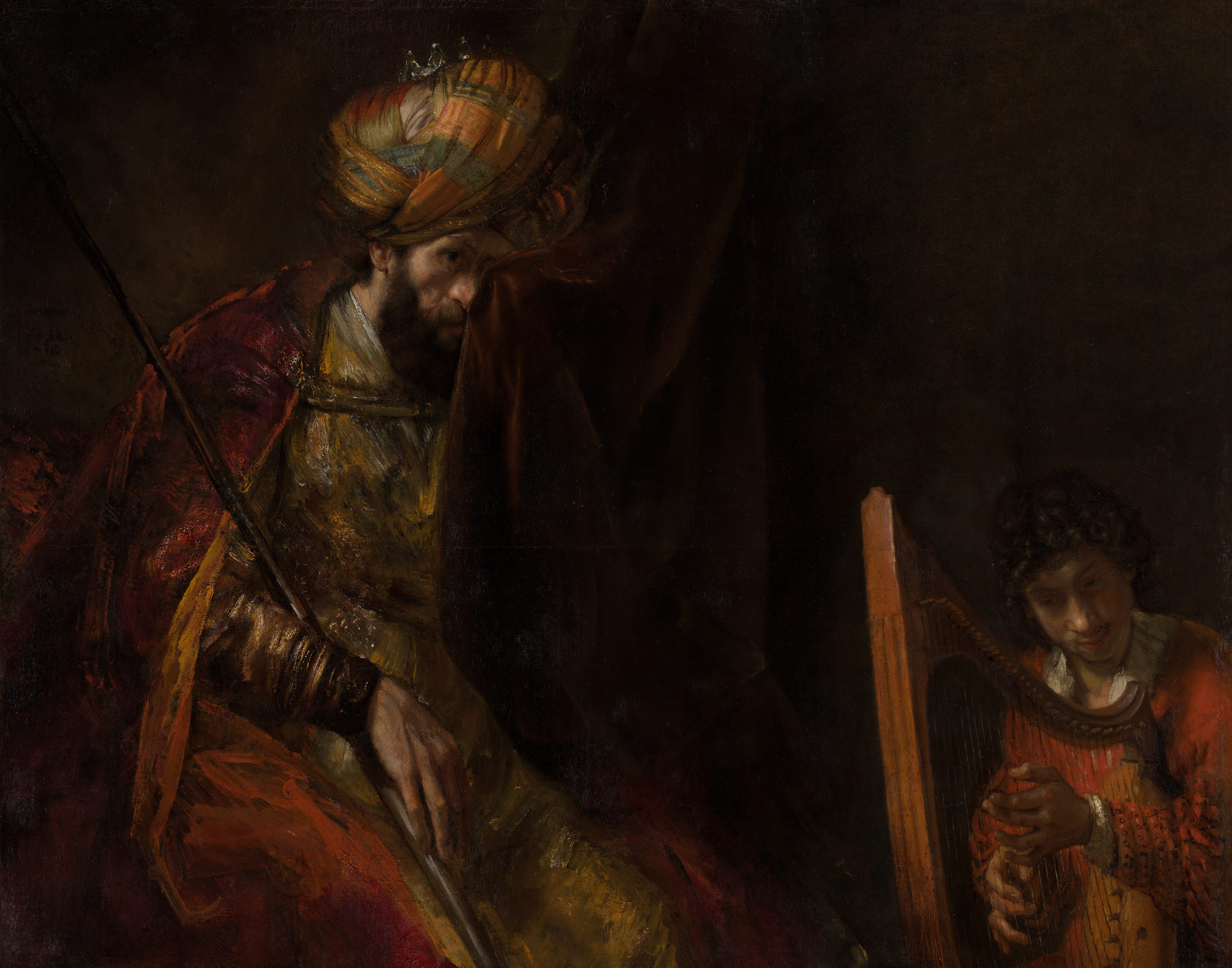
So far so good. There are, however, other passages relating to the “spirit of the Lord” or the “spirit of God” in the story of Saul that raise questions. What does it mean, for example, when we are told, “Now the spirit of the Lord had departed from Saul, and an evil spirit from the Lord began to terrify him” (1 Samuel 16:14, JPS)? Immediately before this, David had been anointed by Samuel, “and the spirit of the Lord gripped David from that day on” (1 Samuel 16:13). David is now the anointed king, enjoying the favor of God and the power of his spirit. What is interesting is that the spirit of the Lord did not simply depart from Saul, but that he was now terrified by “an evil spirit from the Lord” (1 Samuel 16:14, 15), or “an evil spirit of God” (1 Samuel 16:15, 16). This spirit produced a rage that could only be quelled by a well-played lyre. The reader may have some qualms at this point.
The diligent Latter-day Saint reader will consult the footnotes and be comforted that the JST reads “an evil spirit which was not of the Lord” in the first instances, and “an evil spirit which is not of God” in the latter. This is an elegant solution. Modern scholars who also find the phrase perplexing have offered other solutions—linguistic rather than theological or textual. One scholar, for example, points out that the collocation “evil spirit” in Hebrew is not a noun-adjective combination, but rather “a construct chain” which is better translated as “the spirit which brings forth disaster.”5 Another scholar unpacks the phrase as “a spirit that is sent from Yahweh to carry out a negative mission.”6 Perhaps a useful analogue is the “angel of the Lord” sent to destroy Jerusalem in 2 Samuel 24:15–16. Or the destroying angel sent among the murmuring desert-wandering Israelites (Numbers 14:37), as described in 1 Corinthians 10:10.
This solution may not be entirely satisfactory. As Walter Brueggemann notes, such a solution may “trouble our positivistic minds.” But “we must remember that the world of the biblical perspective is a world without secondary cause. All causes are finally traced back to God, who causes all . . . . This narrative simply assumes that the world is ordered by the direct sovereign rule of God. All the spirits that beset human persons are dispatched from this single source.”7
We could also extend the intertextual context further. The author(s) of Samuel may have had the book of Exodus in mind when crafting the Saul–David dynamic, connecting the Deuteronomistic History with the Pentateuchal narrative. In this schema, David is a new Moses under threat by Saul, who plays the role of Pharaoh. My suggestion is that the “injurious spirit from the Lord” in 1 Samuel 16:14–16 might function the same way as God hardening Pharaoh’s heart in Exodus 7:3–4, 13, 14, 22; 8:15, 19, etc. (compare Romans 9:17–18). In both instances, it is this unexpected divine intervention that drives the story forward and produces a dynamic and taut narrative. In both instances, Joseph Smith intervenes, and it is precisely this which made me think they might be connected. What seems to us a problem to be fixed is perhaps the splendid peculiarity and power of the Bible—and the worldview it reveals—shining through. After all, the God who hardened Pharaoh’s heart also brought about the Exodus, just as the God who troubled Saul gave David the confidence to slay Goliath. Embracing the miraculous stories of the Hebrew Bible may sometimes require us to wrestle with an unfamiliar theological worldview.
Kristian S. Heal is a Senior Research Fellow at the Neal A. Maxwell Institute for Religious Scholarship. His research focuses on the reception of the Hebrew Bible in early Christian literature and worship. He received a BA in Jewish History from University College London, an MSt in Syriac studies from the University of Oxford, and a PhD in Theology from the University of Birmingham. He is the author of Genesis 37 and 39 in the Early Syriac Tradition (Brill, 2023) and co-editor of Ancient Christians: An Introduction for Latter-day Saints, published by the Maxwell Institute. Kristian was also the resident scholar for the Maxwell Institute’s Abide podcast on the Old Testament (50 episodes).
Art by Rembrandt van Rijn (1606–1669).
The Old Testament Reflections series is published in collaboration with the Maxwell Institute: https://mi.byu.edu/old-testament-reflections.
Thank you for reading Wayfare Theology. If you no longer wish to receive these items in your inbox, click manage subscription under your profile and turn off notifications for this section.
KEEP READING


An English translation is available in Martin Noth, The Deuteronomistic History (JSOTSup 15. Sheffield Academic, 1981).
Thomas C. Römer, The So-Called Deuteronomistic History: A Sociological, Historical and Literary Introduction (Bloomsbury, 2007).
See Nancy Nam Hoon Tan, “The Motif of ‘Foreign Wives’ in Deuteronomistic Literature,” The ‘Foreignness’ of the Foreign Woman in Proverbs 1–9. A Study of the Origin and Development of a Biblical Motif (De Gruyter, 2008), 65–80. For another reading, see Bradley L. Crowell, “Good Girl, Bad Girl: Foreign Women of the Deuteronomistic History in Postcolonial Perspective,” Biblical Interpretation 21.1 (2013): 1–18.
On this theme, see Marvin A. Sweeney, “The Distinctive Roles of the Prophets in the Deuteronomistic History and the Chronicler’s History,” in Brad E. Kelle and Brent A. Strawn (eds.), The Oxford Handbook of the Historical Book of the Hebrew Bible (Oxford University Press, 2020), 201–213.
David Toshio Tsumura, The First Book of Samuel (The New International Version).
Mark J. Boda, “An Evil Spirit from God?” in Rick Wadholm Jr. and Meghan D. Musy (eds.), Community: Biblical and Theological Reflections in Honor of August H. Konkel (Pickwick Publications, 2022), 24–42, citing 30. See also Daniel I. Block, “Empowered by the Spirit of God: The Holy Spirit in the Historiographical Writings of the Old Testament,” The Southern Baptist Journal of Theology, 1/1 (1997): 42–61.
Walter Brueggemann, First and Second Samuel (Interpretation: A Bible Commentary for Teaching and Preaching, John Knox, 1990), 125.
