


I think it’s fair to say that the books of Ezra and Nehemiah are not well known to Latter-day Saints. They’re rarely quoted in Restoration scripture; their narratives are not as memorable as nearby stories like Esther’s; and they belong to the postexilic period, where many of us lose the thread of Old Testament history. But there is much of interest in these short books for anybody looking to understand how the Hebrew Bible took its present form, how it influenced the culture into which Jesus of Nazareth was born, and how scripture became such a powerful source of authority for Jewish people—and, later, for the Protestant culture into which Joseph Smith was born.
The books of Ezra and Nehemiah, which may at one point have been combined in a single scroll, are the most important biblical sources for understanding the immediate aftermath of the Jews’ return to their homeland after seven decades of exile in Babylon. The story picks up from the end of 2 Chronicles, when the Persian empire, which supplanted the Babylonian, introduced a pragmatic, tolerant approach to governance, and King Cyrus decreed that the Jews return to Jerusalem to worship their god.
The narrative focuses on three key Jewish figures: Zerubbabel, who led the first group of exiles back to Jerusalem and commenced the rebuilding of the temple; Ezra, a priest and scribe who arrived decades later and reintroduced the people to the Torah; and Nehemiah, a former cupbearer to the Persian king who came still later to Jerusalem to rebuild the city walls. Ezra–Nehemiah are notable among the historical books of the Old Testament for the way in which they incorporate first-person memoir into anonymous third-person historiographical reports, royal correspondence, and official documents in Aramaic and Hebrew. (Look for Ezra’s memoir in Ezra 7–10 and Nehemiah’s principally in Nehemiah 1–7.) Using these mixed narrative strategies, Ezra–Nehemiah tells the story of how the Jews reclaimed their scripture, renewed their covenant, and reestablished worship in the temple.
Underlying these spiritual and physical reconstructions, a more central task faced the Jewish people: rebuilding religious authority, which I understand as the socially recognized right to define doctrine, regulate practice, and interpret tradition within a religious community. Well-calibrated authority allows a religious community to avoid contention and coercion because members accept the legitimacy of its requests. The exile demolished the traditional center of Jewish authority, the temple, which anchored religious life as the dwelling place of God’s presence and the institutional seat of the priesthood. Without an accepted locus of authority, the returning exiles lacked the shared framework necessary to organize their collective religious life.
As Latter-day Saints, we understand religious authority to be granted by God, conferred by revelation, and ordered through the priesthood. But even though priesthood authority is granted by God, it must also be grounded in our collective acceptance of its legitimacy; if it is not, history suggests that schism, decay, or authoritarianism awaits. This principle is canonized in Latter-day Saint scripture: “No power or influence can or ought to be maintained by virtue of the priesthood, only by persuasion, by long-suffering, by gentleness and meekness, and by love unfeigned” (Doctrine and Covenants 121:41). We can read Ezra–Nehemiah as the efforts of Jewish leaders to reestablish religious authority after the exile by means of persuasion and instruction.
(It’s worth noting that, on one point, Ezra employs a means that is decidedly coercive: He instructs Jewish men who have married foreign women to divorce their wives and send them away with their children. It appears that this decree is only partially carried out, but it remains a troubling anomaly in the otherwise effective and inspiring ministry of Ezra [see Ezra 9–10].)
We can find in Ezra–Nehemiah three strategies for establishing religious authority through instruction and persuasion. The first and most urgent task in the postexilic period is to rebuild the people’s trust in the Lord by showing them that the calamity they just experienced had been foreseen by the Lord—and that the deliverance they were now experiencing was his merciful doing. The very first verse of Ezra 1 announces that Cyrus’s decree was instigated by the Lord: “Now in the first year of Cyrus king of Persia, that the word of the Lord by the mouth of Jeremiah might be fulfilled, the Lord stirred up the spirit of Cyrus king of Persia” (Ezra 1:1, KJV). Readers are taught that God’s protective hand is behind Cyrus’s proclamation.
Moreover, the writer offers an interpretation of Jeremiah’s prophecies in which the exile and return both unfold as fulfillments of a divine plan. The phrase “the hand of the Lord” appears throughout the record (Ezra 7:6, 7:28, 8:18, 8:22, 8:31; Nehemiah 2:8, 2:18), interpreting postexilic history as the benevolent hand of God working behind the scenes. The fullest version of this view is the Levites’ long historical prayer in Nehemiah 9, which rehearses the entire sweep of Israelite history and frames the exile as divine judgment for disobedience, followed by divine mercy (see Nehemiah 9:31). Ezra–Nehemiah sets the stage for a rebuilt religious authority with a theology of God’s faithfulness despite human failure.
Within this overarching frame, Ezra–Nehemiah validates the legitimacy of the reestablished priesthood by showing how temple worship has been resumed in continuity with the preexilic past. This is the second strategy. The altar is rebuilt according to the law of Moses (Ezra 3:2). The temple is constructed in the likeness of Solomon’s (Ezra 5:11). Ezra himself is identified as a scribe skilled in the law of Moses (Ezra 7:6). The climactic scene in Nehemiah 8, wherein Ezra conducts a public Torah reading and covenant renewal, is shaped to remind readers of the ancient covenant given on Sinai: the gathered assembly, Ezra’s role as mediator, his elevated platform, and, most importantly, the people’s affirmative response and communal covenant all echo Moses descending Sinai to stand before the children of Israel. Moses is the legitimating forerunner for the entire postexilic project. The writers are careful to show that every act in the reestablishment of temple worship is a recovery of past practices, not solely an invention of their own.
Finally, Ezra–Nehemiah teaches its readers to understand and revere ancient Jewish scripture and to identify with the history it narrates. The climactic chapters of Nehemiah 8–10 bring all three strategies together, but the primary emphasis falls on the people’s reencounter with their own textual tradition. On that morning, Ezra reads from the Torah for hours as Levites circulate among the people, translating the Hebrew scripture into Aramaic and helping them understand its meaning. In the course of reading, the people discover the commandment to observe Sukkot, a religious holiday commemorating the Exodus, with booths made of branches, and they immediately act on what they’ve found. The reading provokes a strong emotional response: “all the people wept, when they heard the words of the law” (Nehemiah 8:9). Whether they wept out of contrition, grief, or joy, the people evidently experience a deep and tender attachment to the words of scripture. Its authority has become personal and devotional, not merely historical or institutional. The entire scene dramatizes the process of scripture presenting new meanings to—and then requiring new obligations from—attentive readers.
The model of communal life centered on the reading and observance of Torah dramatized in Ezra–Nehemiah became the foundation for Second Temple Judaism and, after the destruction of the Second Temple in 70 CE, made possible the survival of Judaism as a tradition grounded in scriptural interpretation. More, it indelibly marked the Christian communities that grew out of Judaism. The significance of these events can hardly be overstated.
It is the work of a different essay to consider how these three strategies were employed in the early Restoration to seal the Saints’ acceptance of restored scriptural and priesthood authority. Today, The Church of Jesus Christ of Latter-day Saints faces a related but distinct challenge: shoring up religious authority in places where the Church is growing quickly without deep connection to its roots—and among younger generations who distrust all institutional authority. What will that process look like? I don’t know if it should be modeled after the approach taken by Zerubbabel, Ezra, and Nehemiah. I will gratefully leave those questions to the Lord’s anointed. As for me, I fervently hope that scripture will always remain the living heart of the religious authority that binds our community.
Rosalynde Frandsen Welch is Associate Director and a Research Fellow at the Neal A. Maxwell Institute for Religious Scholarship. Her research focuses on Latter-day Saint scripture, theology, and literature. She holds a PhD in early modern English literature from the University of California, San Diego, and a BA in English from Brigham Young University. She is the author of Ether: A Brief Theological Introduction, published by the Maxwell Institute, as well as numerous articles, book chapters and reviews on Latter-day Saint thought. Dr. Welch serves as associate director of the Institute, where she coordinates faculty engagement and co-leads a special research initiative.
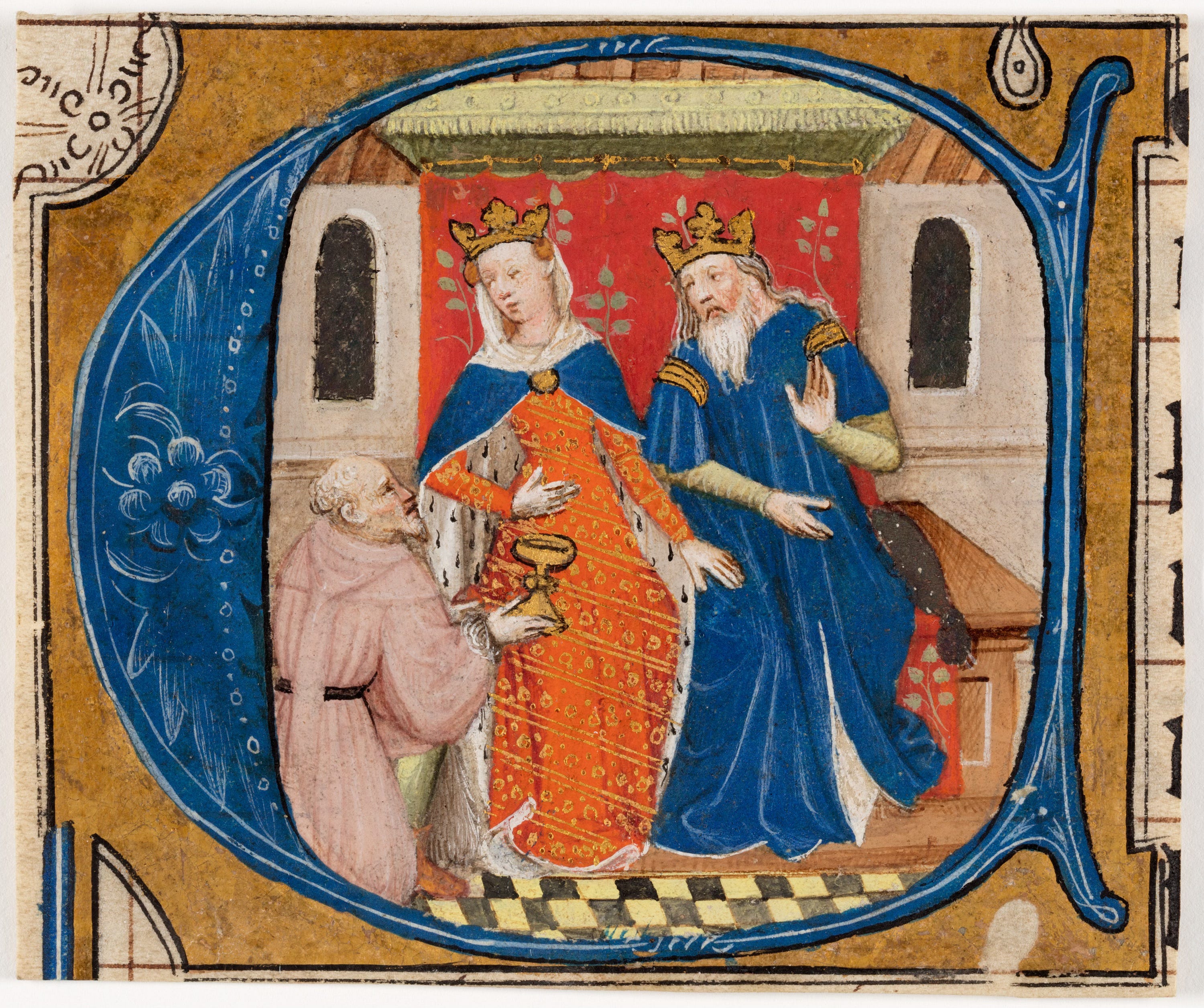
Art by Masters of Zweder van Culemborg (active 1420–1440).
The Old Testament Reflections series is published in collaboration with the Maxwell Institute: https://mi.byu.edu/old-testament-reflections.
Thank you for reading Wayfare Theology. If you no longer wish to receive these items in your inbox, click manage subscription under your profile and turn off notifications for this section.


