


“As we become more aware of the complexity and the internal contradictions in so-called orthodox Christian history, I see less and less room on any legitimate scholarly grounds for not taking Mormonism as really the most important innovation in Christianity since the Protestant Reformation.” -Samuel Loncar
Samuel Loncar is a scholar who works at the intersection of philosophy, religion, science, technology, and art. Wayfare Editor Zachary Davis sat down with Loncar and Terryl Givens for a wide-ranging conversation about the meaning of the Latter-day Saint movement and why it should receive more serious engagement from theologians and scholars of religion.
You can listen to or read the conversation below.
Zachary Davis: Sam, Mormonism is new, but in your reading, it’s also recovering something much older.
Samuel Loncar: I’m somewhat heretical as a philosopher, in the sense that I take history much more seriously than is conventional in current academic philosophy.
Terryl Givens: Heresy is a positive term in our culture, you know.
Samuel Loncar This is great for me—I’m finally finding my people.
I’d had a background interest in Mormonism, partly out of respect for the people I’d met from the community. But as I did more work, I began to realize—somehow, in a way that’s really difficult to explain, just through coincidences—that Joseph Smith seemed to have uncovered aspects of what I came to see, on my own as a scholar, as essentially important parts of what we would call ancient Christianity, which I think of as essentially a philosophical school.
And there’s no way he could have had access to the materials I’ve had access to, which is basically the last hundred, hundred-fifty years of scholarship on ancient Christianity and its historical milieu.
Zachary Davis: Now, Terryl, you said heresy is not a curse word in our tradition. Maybe you could talk a little about some of the early heresies in the early centuries of Christian development. There are interesting linkages with some of our theology.
Terryl Givens: I think of three heresies in particular—well, you could actually go to four—that reemerge in altered form in Mormonism.
First of all, I’d point to Marcion, one of the earliest and most important of the heretics—important in the sense of how seriously the threat was taken by the rest of Christianity. One scholar, Adolf von Harnack, actually says Christianity is essentially just an extended response to Marcion.
Marcion was, according to some accounts, at one time a mainstream Christian who found it impossible to reconcile the God of the Old Testament with this new Christian message embodied in Jesus Christ. He came to believe that the Old Testament represented a creator God who was evil, whose character was completely at odds—the vindictiveness, the wrathfulness, the vengeful, retributive kind of justice he embodied could not be reconciled. So he believed that God had to be love in the sense that John said, “God is love.” It’s not just one of his attributes. In some ways, I think Mormonism recaptures that belief when Joseph Smith moves increasingly in the direction of a much more inclusive, universalistic faith.
So that’s one way in which the Marcionite tendency is recuperated by Joseph Smith. And of course, there’s the Origenist heresy, condemned by Justinian in the sixth or seventh century. Two principal aspects of that heresy: one was the eternal preexistence of the human soul, and the other was the apokatastasis—the belief that eventually God would find a way to recover the entirety of the human race into his kingdom.
Joseph Smith, of course, teaches very early on the doctrine of the eternal nature of the human soul—its premortal existence—which seems to be, again, a modern reenactment of that Origenist heresy. One could also point to Pelagius. As recently as—well, I think even since Pope John Paul II, Pelagianism has been invoked as a kind of modern threat to the church. Pelagianism is generally construed as the belief that denies original sin and affirms free will. In some interpretations of Pelagius—though I don’t think they’re fully accurate—Christ is not necessary, because we can simply choose to do good and effectively redeem ourselves.
Joseph Smith’s emphasis on the freedom of the will, and his absolute denial of original sin and depravity, seem to move in that direction. And then you could also talk about Arianism—the great debate of the first church councils: is Christ subordinate to the Father? Mormonism quite clearly and emphatically indicates that yes, there is a kind of hierarchy: Christ is subordinate to the Father within a priesthood hierarchy.
So all of those heresies find a comfortable place within Mormonism in one form or another.
Zachary Davis: Maybe another historical question for you, Sam: where is Christianity now?
Samuel Loncar: Well, that’s such a difficult question. I’m tempted to just comment on what Terryl was just saying, but I’ll try to get at it indirectly.
One thing that’s interesting to note is that Origen was originally, in many ways, the founder of Christian orthodoxy. It’s over the evolution of the Orthodox Church—by the fourth and fifth century, as you were saying, and by the time of Justinian—that, I think, the Council of Orange condemns a form of semi-Pelagianism, in a period that’s really post-Augustinian.
So the Western Latin Church after Augustine ends up with a kind of internal tension about its own history, which is truthfully connected to a long-simmering split between the Latin Christian Church and the Eastern Orthodox Church—which has always been more directly influenced by the Platonic tradition because of its Greek-speaking heritage.
Origen, in one sense, really was representative of something very mainstream. And this, again, is part of what I find very interesting about Mormonism: if you read the Gospels, they all seem to assume the possibility of Elijah coming back—which is a very strange thing that no one mentions, but it’s assumed in every Gospel that there’s a debate over whether John the Baptist is Elijah.
If you ask how that could have been possible—what was even the thought-world of the first-century Gospel writers?—it’s actually in direct continuity with Origen and what we’d call broadly Platonism. It seems Philo believed in the pre-existence of the soul, and it’s very likely, depending on how you interpret the Essenes, that they may have as well.
So there’s a very deep connection here, and it’s linked to a strong view of moral agency. In Plato’s Republic, part of the picture of the soul’s pre-existent state is that it’s the freedom which the soul misuses, or learns to use well, that results in aspects of its embodied condition.
Of course, Mormonism has a much more pro-material view of that. But I do think that’s a remarkable disconnection—that there’s something at the origin of Christianity itself that, in a way, is never really reconciled. There are deep internal contradictions, and I think that’s part of why Mormonism today, or Christianity today, needs to become more self-conscious.
After two centuries of what people would call critical scholarship, I think scholarship hasn’t been critical enough. If you think of Christianity as what’s possible using the best methods of all available scholarship—not just any given dogmatic teaching of a communion—then I think Christianity is in a space where it doesn’t know how to draw its own boundaries.
And that issue is deeply connected to the inclusion or exclusion of Mormonism from the self-understanding of Christianity by non-Mormon Christians. There are good reasons, from the standpoint of what we’d call lower or orthodox Christianity, that Mormons have been excluded—because they are indeed radically, self-consciously in contradiction to orthodox Christianity as articulated in the Nicene Creed and subsequent councils.
But we also know—as the Catholic Church has had to reckon with—that there are Eastern churches, like the Monophysite churches, which are technically heretical by those exact same creedal standards, and which the Catholic Church is now in communion with. So I think the truth is, as we become more aware of the complexity and the internal contradictions in so-called orthodox Christian history, I see less and less room, on any legitimate scholarly grounds, for not taking Mormonism as really the most important innovation in Christianity since the Protestant Reformation.
Terryl Givens: I’m really happy to hear that diagnosis, because I think it’s accurate. In some ways, Latter-day Saints have been deluded about the amount of progress that’s been made in the last generation. The growth and success of Mormon studies—both as an intellectual phenomenon and as a publishing micro-industry—has led many people to believe, “Oh, that means Latter-day Saints finally have a place at the table. They’re being taken seriously. They’re being published by academic presses like Oxford, Chapel Hill, Illinois.” In reality, I think that’s a misperception of what’s happening. It’s clear to me—in part based on my own personal experience with Oxford—that they found a ready market, mostly among Latter-day Saints themselves, for these books, and so it was a financial decision.
It doesn’t represent, I don’t think, any significant academic legitimacy that’s been achieved. If you look, for example, at Black studies or women’s studies, there was a time when it was clear their voices were being excluded from the canon, so demands were made for women’s studies and Black studies departments, and those demands were met.
But we’re now at a point where one would expect to find women and minorities represented in the canon—in general literature classes, general history courses. It seems to me that Mormon studies may be stuck, in some ways, because we’ve been content to have our own corner of the sandbox, where we talk to each other and present at conferences and publish.
But, as Sam indicates, we’re not yet actually part of the more general Christian conversation—we’re always kind of red-flagged as, “Well, that’s a Latter-day Saint voice participating in this more general dialogue.”
Zachary Davis: Sam—you’re an unusually creative and gifted scholar, and you’ve come to recognize there’s more to Mormonism than meets the eye, that there’s substance there that rewards attention. Do you believe other scholars in your field and beyond will rediscover the interesting aspects of our theology the way you have?
Samuel Loncar: If you think about it from a sociological standpoint, if you look at all the other Christian communions, you see phenomena that historians would point to as similar to Mormonism—just as you point out in much of your work.
But none of them create anything like the Mormon Church. Nothing like it. Methodism—none of these things create something so analogous to what we’d think of as more like an Orthodox Jewish community: so incredibly cohesive. It’s obviously very rocky and complicated in one deep sense, I’m sure, but it creates, to this day, an amazingly well-ordered social way of life.
Whether people like it or dislike it, there’s something quite distinct about it. And the ability to have done that under the crosswinds and pressures of what people call modernity, and to have done it as a modern phenomenon with these very unusual combinations of theological and philosophical commitments—that’s an extraordinary phenomenon historically, one that I think requires much more explanation.
There should be a kind of head-scratching wonderment at what this phenomenon is. And it’s complicated enough that there’s room for people of many different interests, as we see. But I do think the lack of sustained interest in intellectual history, and the lack of a deep connection between the history of ideas and the history of theology motivating social and cultural history, makes it harder for mainstream scholarship to recognize how significant Mormonism is.
Zachary Davis: Mormonism was born in modernity. It’s democratic in a quite modern way, and yet it still maintains a strict hierarchical structure that creates order. But there’s an interesting balance—a priesthood of all believers, and yet a way of ensuring you don’t get mass splintering into theological individualism. Do you think, Terryl, that this makes it more suited to the problems of modernity?
Terryl Givens: Yeah—I’m just thinking out loud here, but it seems to me that it’s modernist and postmodernist at the same time, in very different ways. On the one hand, Joseph Smith works from the presupposition that there’s a kind of master narrative, an ur-text, which he is recuperating.
And we get all these bits and pieces of that originary vision manifesting—he has visions of parchments, revelation is given to him, he recovers writings of Abraham and of Moses. But I think we’ve crippled ourselves, to some extent, intellectually and theologically, by thinking there was a totality of Christianity that flowered in the first two centuries, and that we’re just working in a kind of nostalgic way to recuperate and recover that.
I think David Bentley Hart is right that we have to divest ourselves of that nostalgia and realize that a growing tradition has to keep evolving new ways of engaging modern challenges and dilemmas. So yes, it’s true—the Articles of Faith say, “In the same organization that existed in the primitive church.”
But I hope Mormonism has a broader, more exciting vision than just recuperating a kind of ecclesiology that was present in the second-century Roman Empire.
Samuel Loncar: Yeah, I’d add that the primitivism so characteristic of Protestantism—all the reformers see themselves as returning to a pristine condition.
That’s a huge part, of course, of the nineteenth-century democratic primitivist movements—Campbell, the Churches of Christ, and other movements analogous to Mormonism from that broader cultural and religious-historical standpoint. And the problem with primitivism, historically, is that it always ends up being false.
Once you actually study the first- and second-century church—this is why church history in the German tradition ended up being so subversive of orthodox categories—no one finds their church there. The famous accusation, in question form, that Cajetan put to Luther was, “Where has your church been for a thousand years?”
So I think the Mormon emphasis, at least in its theological structures—as I understand it from your work on ongoing revelation—allows, at least in principle, an adaptability that’s very hard to achieve when you’re in a communion theologically tied to its own shoelaces.
If it stands on that point, it’s going to trip. It’s very difficult if you say, “This is exactly what this was.” Then you have to protect people from knowledge, because if they just study history, they’ll realize that’s not true. What’s striking to me is that Mormonism—the more we know about the complexity of ancient Christianity, the more we realize that “Christianity” itself is a kind of belated category.
So the ancient phenomenon of these messianic movements centered on Jesus—Mormonism increasingly looks like it fits uncannily well, not with one version of them, but with a strange, emerging composite of traditions we didn’t really recover until the recovery of the Dead Sea Scrolls and the Nag Hammadi Gnostic corpus.
These are quite recent—the last seventy years or so—recoveries of these texts. And my assumption is that, in that sense, Mormonism is still ahead—it may even be ahead of its own tradition, because there’s an integration of scholarship that I think is possible. That’s something I’m interested in, in my own work—like Joseph Smith’s interest in Enoch.
The Enoch Seminar in modern academia is maybe thirty years old. So the scholarly study of Enoch and the Enochic texts in the modern academy is very recent. But what it shows unquestionably—even to a person of zero interest or knowledge about Mormonism—is that the Enochic tradition, and these traditions of celestial revelation and revelations of knowledge about preexistent states, were very important in the milieu of what we’d call Second Temple Judaism and early Christianity.
And somehow, from a scholarly standpoint, Joseph Smith’s interest in that, and his production of texts related to it, is an extraordinary phenomenon that requires—I think that’s a very direct example where it’s almost as if—maybe part of this is romantic imagination, but even then, I don’t think that knowledge was available.
So the very intuition—a kind of radical Protestant intuition, you might say—that there’s something very deep that isn’t present in any form of Christianity, as he told it in the original revelation, that the church isn’t yet in its full form... You could say there’s nothing more unoriginal than that; every new church basically thinks, “The true church isn’t here. I’m going to start the true church.” Well, then the question is: what happens in two hundred years to those traditions? Most of them don’t look anything like what Mormonism has achieved.
Zachary Davis: So are you saying that when it comes to Enoch or temple theology, Joseph Smith really couldn’t have known these were ancient practices, at least not in the way he articulated them?
Sam Loncar: Well, he could have known in the sense that he read the Bible and other texts, but in the way I mean as a scholar—this is something I’m actively researching. I’m trying to figure out what he could possibly have read, just to dot the I’s and cross the T’s.
But it’s uncanny. Let me put it this way: the recovery of the importance of the temple in biblical theology is basically a generation old. That’s how recent it is. One of the leading scholars on that, for example, is Jon Levenson, who wrote an article in the Journal of Religion in the 1970s. Levenson is a professor of Hebrew Bible at Harvard Divinity School and a brilliant biblical commentator and theologian who knows the rabbinic Jewish commentary tradition as well as critical scholarship, inside and out.
His work is brilliant, but there aren’t a lot of people taking it up. Of course, there’s also Margaret Barker, who I think is well known in the Mormon community, and Crispin Fletcher-Louis. It’s still very nascent. From the standpoint of the modern academic phenomenon, I think it’s simply the case that if someone wants to say Christians have always taken the temple seriously, that’s just false.
It’s just not true. Protestantism in general did not take the temple seriously as a phenomenon, and it was very hard to know much about the temple. But over the past two hundred years of historical scholarship—since Jewish scholars, since what’s called the science of the study of Judaism, the Wissenschaft des Judentums, founded in the nineteenth century by Abraham Geiger—there’s been more than a century of rigorous historical scholarship on the Second Temple, which is part of what people like Barker are able to build on.
Barker builds on the whole tradition of nineteenth- and twentieth-century critical scholarship to present what she’s presenting, and yet it turns out to be of extraordinary relevance to Mormons, because Mormonism seems to do something, sociologically, that no Protestant communion has ever done—and, to my knowledge, no communion has done, except arguably the early church: it combines what you could call a sectarian emphasis, in the way the sociologist of religion Ernst Troeltsch means it, as opposed to a state church.
So you have a kind of communal assembly that’s voluntary—people opt into it—but there’s also a very strong familial authority, with the priesthood of the male head of the home, which you could say is somewhat analogous to Jewish practice, where much Jewish ritual is observed in the family and in the home, and then you go to synagogue.
But then, of course, there’s no Jewish temple since the destruction of the Second Temple. So Smith recovers all three elements of something that, as far as I can tell, hasn’t really existed—certainly not in Protestantism: there’s a churchly element, in the sense of a voluntary sectarian community one freely chooses or is born into and stays in.
But then there’s also an essentially secret or esoteric ritual dimension, which isn’t just the church—it’s an actual temple. That’s so radical that I think, basically because of all the prejudice against Mormonism since its founding, it hasn’t been appreciated. I don’t think academics are even going to be able to appreciate it until they can appreciate the significance of the work on the temple in their own fields, like biblical studies and the history of theology.
So that’s a second dimension to the challenge of why Mormonism hasn’t been more justly received in the academic community—besides the issue I mentioned earlier. This is a very complex issue that’s at the heart of my own work: I think the temple was at the heart of what we call Christianity.
The temple is the literal body of the human being as a microcosm. The temple is the actual dwelling place of the God of Israel at the time Paul is writing. And the temple is, in some sense, the cosmos itself. But that seems to basically vanish, without much apparent trace. Then suddenly, since this revolution in scholarship in biblical studies and the history of theology, we now have the resources to actually look at Mormonism and say, “I don’t know how they did this, but this is somehow almost in conversation with the scholarship that’s happening now.”
Terryl Givens: What Sam is saying reminds me that Patrick Mason has pointed out that Joseph Smith never used the expression “restoration of the church.” In some ways, we’re never going to stop using that expression, but it serves us poorly, because the restorationist model was strip away, strip away, strip away—get back to the skeletal framework.
Joseph Smith is all about amplification, amplification, eclecticism, and syncretism. The expression he encounters, apparently sometime in 1833 or 1834—he gloms onto this expression: the coming of the church out of the wilderness. And suddenly that starts—
He re-edits some of the revelations, like what’s now section five of the Doctrine and Covenants. He’s captivated by this notion of a kind of inspired eclecticism, where he’s assimilating, gathering, harvesting all the best elements of these “voices in the wilderness” referred to in Revelation chapter 12.
I think that’s a much more productive and accurate model for understanding how Joseph Smith’s mind was working, and how the project was unfolding in absolutely unpredictable ways that weren’t constrained by a fixation on a primitive model.
Zachary Davis: Could you say a little, Terryl, about why the LDS Church has traditionally been hesitant to draw on theology as a mode of teaching and exploring? And do you see any changes recently?
Terryl Givens: Here’s just one symptomatic anecdote about the need. When Prop 8 was the most controversial topic in the Church—and in the country—I received a phone call from a beloved family member who said, “Dad, I’m being murdered out here in my graduate program, because all my colleagues want to know how on earth I can possibly defend or support the Church’s position.”
She said, “If I were Catholic, I’d have two thousand years of theology to draw on.” She said, “All I’ve got are pronouncements from the pulpit. There has to be some kind of reasoned basis for these theological and doctrinal positions we espouse.” And there was really nothing I could say.
Theology has had a very contentious, seesawing history in the Church. Few members realize that when Joseph Smith approved the Lectures on Faith for teaching and publication, they were originally called the Lectures on Theology. Joseph Smith said theology was the most important pursuit to which one could devote oneself.
But by the time we get to Wilford Woodruff, he’s calling theology the greatest tomfoolery in the world. Theology comes to be associated with an apostate tradition that no longer has revelation, and so relies on human reason to replace, rather than supplement, revelation. By the 1930s, suddenly, we have a golden age again, where intellect is valued and prized, and the Church deliberately chooses its leading intellects to write Church manuals and curricula.
Then we get to 1939, 1940, and it reverses in the other direction. We get to a point where, as recently as the 1980s, Eugene England is called on the carpet for publishing works he called speculative theology. He made no claims to doctrinal authority, yet he was still told to cease and desist publishing in the area of speculative theology.
So it’s still a term fraught with suspicion. Even Hugh Nibley—maybe the greatest Mormon intellectual of the twentieth century, or one of them—himself said, “Theology is what happens when revelation fails.” Which was a terrible thing to say. I think if more Latter-day Saints could understand the Catholic respect for and appraisal of theology—
They understand that theology works in service of authority. If you believe in an inspired leadership, an inspired tradition, then it’s the task of theology to explicate, expand, and enlarge the domain of critical thought about God and his revelations. So, yes, I’d like to see less suspicion in several quarters, because I think theology can provide an invaluable service.
There’s another kind of resistance—and this is probably just pop-cultural, not unique to Latter-day Saints—the assumption that discipleship is lived religion, and theology is just abstract speculation. Even people like Peter Enns—a great writer on faith, who erects a hard-and-fast distinction between doctrine and practice, and says one of the failings of Christianity is that it’s been so obsessed with doctrine when it’s really about practice—I’d say no, the danger is in separating those two.
Christ, by virtue of the kind of life he lived, embodied important principles and truths and ideals. I think Christianity goes astray precisely in not recognizing the overlap and congruence of those terms. Once you render the love of God into an abstract idea you can speculate about, separate and apart from lived religion, that’s where you get into trouble.
So that’s a long way of saying: I think our young people are hungering for theological investigations that enrich and supplement religious commitment—but don’t substitute for personal experience of the sacred.
One reason I think theology has lost its place of respect in the modern epistemic hierarchy is the rise of science as a counter-authority that generally receives more respect from modern subjects.
Sam, you’ve given a great deal of thought to the relationship between religion and science, and yet you still think theology is a critical field to engage with and study. So I wonder if you could share how you think about the terms “religion” and “science,” and why you believe anyone interested in the truth should engage with theology.
Samuel Loncar: Yeah. I recently published an article—I wouldn’t necessarily recommend it, since it’s quite academic—called “Science and Religion: An Origin Story,” in Zygon: Journal of Religion and Science, which makes a more complex version of the argument I’ll summarize here. There’s a very basic question, strangely not often asked by historians of theology and philosophy: where does theology come from?
The answer is Plato’s Republic. The first occurrence of the term theologia is in the Republic, when Plato is discussing the poets and the importance of theology as the foundation of any true state. So, first of all, the theological tradition isn’t separate from the philosophical tradition—this is one of the biggest myths that characterizes Christian theology in general, including academic Christian theology.
My work challenges this. It’s simply not true: theology is part of philosophy. Philosophy, in the ancient world, was the closest thing to what we now call religion. That word—”religion”—didn’t originate in its modern sense until the sixteenth or seventeenth century, or maybe even as late as the nineteenth.
This is well known to people who specialize in the origin and concept of religion, like Peter Harrison. So, first of all, if we want to use the word “religion” for antiquity, we’re actually better off using the word “philosophy.”
Philosophia—philosophy, the love of wisdom. Think of Proverbs: “Get wisdom.” It’s the most important thing. What’s a sign of wisdom? That you love knowledge more than silver and gold. So the love of wisdom, and the fruit of wisdom, is the tree of life—wisdom is the tree; she’s the woman who yields eternal life to those who seek her.
So that’s at the foundation of a single source that we’ve split into what we now call philosophy and theology, or perhaps lived practice and theology within a tradition. I think all these splits have their reasons, but first of all, we should recognize theology has always been seen as inseparable from exactly what Terryl is saying—a way of life ordered toward truth and wisdom.
The idea that you could separate them is like saying science itself is a practice, not an intellectual activity—which would mean a person didn’t really know anything about what the word “science” means. The word “science” used to just mean rigorous knowledge.
And again, the word we used to use for science was philosophy. Look at Harvard—it still has chairs like the Chair of Moral Philosophy. Why? Because they thought moral philosophy was a science. The founder of economics in our sense—the eighteenth-century Scottish Enlightenment sense—called it political economy, which is part of philosophy.
So we’ve used the word “science” in this narrow way in English only since roughly the mid-to-late nineteenth century, the Victorian period. But really, according to Stephen Gaukroger, in his recent four-volume work with Oxford, not until the beginning of the twentieth century. So part of what we have to do is demystify our categories.
Science is knowledge. And if you want it to mean something very specific—like “science and religion are in conflict”—that’s just a story we’ve made up, for complicated reasons, in secular culture over the past hundred and fifty years or so.
Zachary Davis: So in ancient times, if you met someone from a different religion, how would you even talk about that? Would you say, “What god do you worship? What philosophy do you follow?”
Samuel Loncar: It’s a great question. But truthfully, one thing we know is, for example, if you look at the Jewish context—Philo and Josephus, the two greatest writers in Greek from the Jewish community, writing about the Jewish community at roughly the time of Christianity, both in the first century.
Josephus a little after Philo, after the destruction of the temple, in particular. They both refer to “the Jewish philosophy,” and describe it as having three major sects. The early Christian communities called themselves “the true philosophy.” So if they were going to call themselves anything, people would be interested in them as philosophers, like Plato.
Plato talks about the philosophy of the Egyptians. Pythagoras says he learned all their rituals and philosophy from the Egyptian priests when he was in Egypt. So if you look at the ancient Greek sources, they present the wisdom traditions of other cultures as those cultures’ “philosophies,” if they’re going to use a word at all.
But more generally, most people didn’t have a word for religion, and, like you said, Zach, they’d be interested in people’s gods. As scholars have shown, people were very respectful of one another’s gods in the polytheistic world. Gods essentially functioned as a kind of diplomacy. We know this partly because there are many inscriptions by non-Jewish people at Jewish synagogues we’ve discovered—synagogues thanking some Roman benefactor who gave a significant offering to the God of Israel worshiped in that place.
So, yes, if you were an intellectual, you’d basically call it philosophy—but most people wouldn’t have even thought of it as a separate thing. It was just an everyday part of life. Gods were everywhere. You couldn’t walk anywhere in the Roman Empire, as the Yale historian Ramsay MacMullen says, without practically knocking into an image of a god. They were just everywhere.
Zachary Davis: My whole life I’ve heard people say, “I don’t believe in religion, I believe in science.” Why is that a wrong way of thinking?
Samuel Loncar: Well, obviously, for that person, I’d want to respectfully help them clarify what they mean by that.
It’s understandable—we’ve obviously come to oppose science and religion. There’s a lot of work on that. But I think the sticking point—and here I’ll give ground to the people who attack religion—is revelation.
Theology, in the Christian tradition, was normed on the idea that it has infallible revelation. Once that became culturally incredible—basically around the nineteenth century, in the university system—the idea that theology itself is a science became incredible too.
But science, I think, is respected now because it seems more empirical, more open, more successful. Theology doesn’t have the equivalent of the technology science has produced. So I’d give every concession to the fact that, if you have to trust something as a word, people are in a way wise to trust science, because it means knowledge.
The question is: does trust in science mean you exclude religious considerations, or does it justify excluding you, as a human being, from taking religious considerations seriously? Many people think the former, and I’d just try to gently help them understand, based on the best historical and academic knowledge we have, that that’s not the case.
Your actual faith in science is part of the history of a religion you don’t understand, because science now functions for many people as a religion—and this isn’t something I’m making up, it’s very well known. The great French sociologist Auguste Comte thought science would replace religion; he was in the French positivist tradition. And many contemporary new atheists, like Dawkins, are unselfconsciously religious in their commitment—not to science as we’d all agree we should practice it, as an empirical, open-minded investigation of the natural world, but to something much more like a religious worldview that permits you to simply screen out certain questions you don’t want to deal with.
I think there could be nothing more unscientific than that. So as long as a person is open-minded, and science can include religion, then maybe they’re fine to think that way. But I think we’ve felt embattled because of an internal tension in our culture about whether our claims about revelation make sense.
If they don’t make sense, maybe we can replace revelation as an authority with science. That’s kind of been the big experiment Western culture has been running for the past hundred, hundred-fifty years.
Zachary Davis: Is Mormonism friendlier to science than other Christian religions?
Terryl Givens: I think it is—or certainly has the potential to be—in part because it has never embraced the kind of radical discontinuity between the material and spiritual worlds that, according to Coleridge, is the ground of all miracle: the heterogeneity of matter and spirit.
By not buying into that bifurcation, we don’t have to see them as in tension or opposed. Joseph Smith was a kind of naturalist theologian. The King Follett discourse is, in a sense, the ultimate naturalization of theology, where the whole border between the human and the divine just dissolves.
Natural law and moral law seem to function in similar, analogous ways. There’s never been a real conflict between science and religion in the Mormon past, except on the part of some individuals who were biblical fundamentalists within the Church and found Darwin problematic.
But there was never any official resistance to Darwinian developments, for example. I think there are all kinds of exciting things happening in consciousness studies today that posit consciousness as the ground of reality. And then you think of Doctrine and Covenants section 93, with its reference to the fact that, without agency—without an agential intelligence—there’s no existence.
So I think there are beautiful potential harmonies to be found between cutting-edge physics and cosmology and Latter-day Saint theology.
Zachary Davis: Should Latter-day Saints try to become more closely bound with the rest of the Christian tradition, or should we embrace our distinctiveness—stay that unusual church out in Utah?
Terryl Givens: That’s a great question. I think there’s been a shift in signaling, if I’m reading it correctly, from Church leadership on this topic.
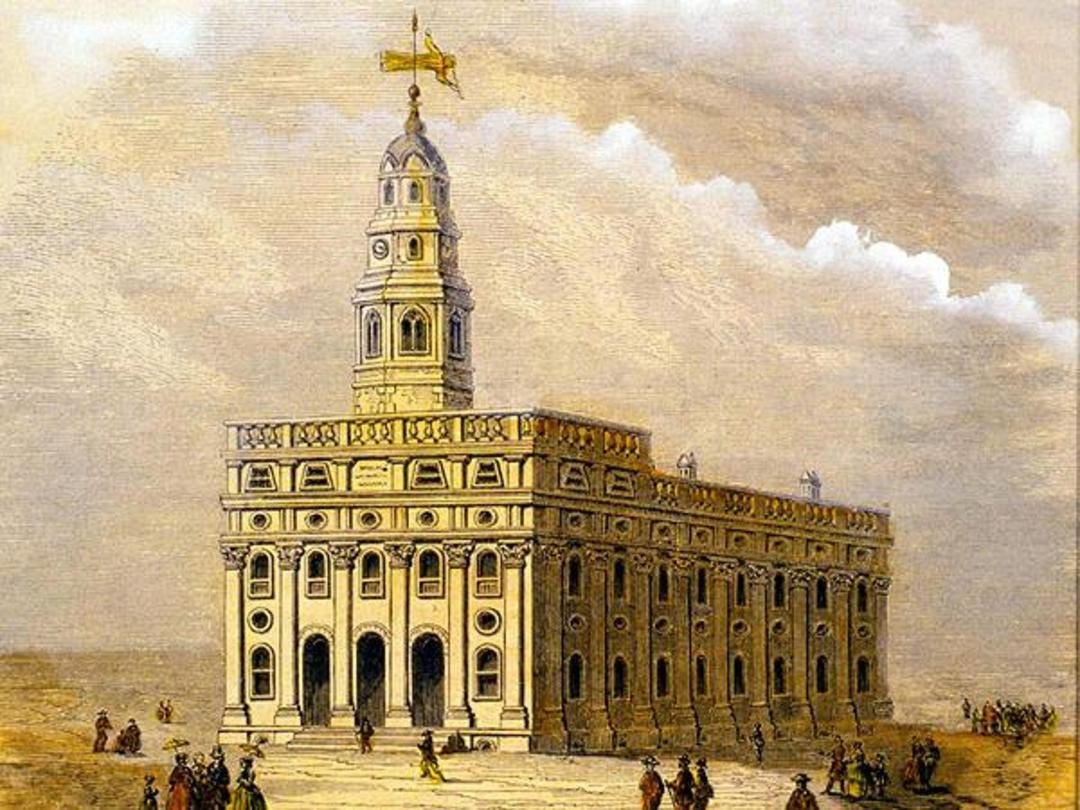
As I’ve indicated before, it seems to me that the very architecture of the Utah temples reflects an attitude of aloofness and isolation—a kind of fortress mentality. I’ve been doing a study, in recent weeks, of how the language of the Book of Mormon describing “two churches only”—the church of the Lamb and the church of the devil—has been interpreted historically.
There’s been a historical reading that Latter-day Saints, as the one and only true church, means there’s no real bridge we can build to the rest of an apostate Christendom. All that language has shifted in the last generation. Zion now comes to be addressed from the pulpit as a multicultural, multi-religious project.
There’s a recognition that we have to engage diverse traditions and cultures, not condescendingly, but with an attitude of actual mutual appreciation. I personally think Zion is inconceivable as a project apart from the mutual participation of all people of goodwill and intent.
My own research over the past couple of decades has convinced me there’s a vast wealth of genuinely inspired prophetic utterance that has occurred in the so-called wilderness—one we would benefit from, individually, in our discipleship, by appropriating and appreciating. From Julian of Norwich to George MacDonald to Thomas Traherne, you name it.
So I think it’s not just possible but necessary for us to engage our fellow Christians more directly, and both sides would be bettered by the process.
Samuel Loncar: What do you think is the biggest misunderstanding the broader Christian community has of Mormonism?
Terryl Givens: I’m not sure the problem is really so much misperception as it is frustrated expectation. In my very first book, I was trying to answer this question: why did Mormonism elicit such a furious response, one totally disproportionate to any real threat it represented?
Polygamy is episodic—that’s one phase of it. But it seemed to me that the continuous thread running from 1820 to the present day is a kind of unabashed—some would say atavistic—impulse that refuses to modernize or allegorize the fundamentals of the Christian story, and their recapitulation in Mormonism’s foundations.
It’s the tangible facticity of gold plates and resurrected beings—what I call the collapse of sacred distance. And let me close with an anecdote that I think captures this for me. When I was at the beginning of my career, just beginning my work in Mormon studies and exploring these questions in depth, I had a colleague who had a visceral hatred of Mormonism.
It was tangible, and real, and we were friends in spite of it. One day, he reacted as if a snake had bitten him because I’d handed him a Mormon text and suggested he take a look at it. I finally said, “So what is it? What is it that creates this antipathy in you?”
He said, “All right, I’ll answer that.” He said, “Do you really believe that a million years from today, you’re going to be in heaven creating new worlds, new posterity?” And I said, “Let me ask you a question first. What are you going to be doing one million years from today?” He said, “Growing in the grace of Christ.”
I said, “No—11:30 a.m., the afternoon of November 3rd, one million years from today, I knock on your door. What will you be doing?” He thought a minute, and then all the air went out of his sails, and he said, “I see your point. Anything I could say would sound absurd.” And that, for me, captured it perfectly.
It’s that quintessential collapse of sacred distance—that Joseph Smith had the audacity to describe what the angels visiting him were wearing, the nature of a celestial sociality, and the project of engendering some kind of eternal posterity. Any definition of theology you’ll find in any handbook will tell you theology is the story of God’s dealings with man from the Garden of Eden to the final resurrection.
And Mormonism says, “No, we can go way beyond that in both directions.” It’s this audacity—it’s a reenactment, it seems to me, of what Christianity itself did in lifting the veil from God’s face. But we don’t have two thousand years of the mists of history to make that more palatable.
So I think it’s a kind of affront to a Christianity that has tried to render itself more respectable in the modern age.
Samuel Loncar earned his Ph.D. at Yale University. He is a philosopher, scholar, and consultant who works at the intersection of philsophy, religion, science, technology, and art. His book Philosophy as Science and Relgion is forthcoming with Columbia University Press, and his scholarship has appeared in publications like Kant Studien, Religious Studie, Neue Zeitschrift für Systematische Theologie und Religions Philosophie, Metaphilosophy, and Zygon: A Journal of Religion & Science. Loncar is the Editor-in-Chief of the Marginalia Review of Books, where he directs the Institute for the Meanings of Science.
Terryl Givens is Senior Research Fellow at the Maxwell Institute and author and coauthor of many books, including Wrestling the Angel, The God Who Weeps, and All Things New.
Zachary Davis is the Executive Director of Faith Matters and the Editor of Wayfare Magazine.
Once you accept that historical premise, a major hurdle remains—how do Latter-day Saints and traditional Christians talk to each other when they use loaded terms like consubstantial?
Reclaiming ‘Consubstantial’ as a Covenantal Promise
A Restoration Perspective on the Unity of the Godhead
1. Introduction: The Translation Bottleneck
The theological conversation between traditional Christianity and the Restoration often stalls on the word consubstantial. Many Latter-day Saints rightly set it aside when it is heard as implying material fusion. However, returning to the Latin root substantia, which in Roman legal contexts meant “property, inheritance, or estate”—unlocks fresh meaning.
Importantly, neither the Romans nor the Hebrews fixated on the metaphysical “what stuff is made of” questions that dominated Greek philosophy. Romans thought in terms of authority, administration, and indivisible estates. Hebrews emphasized covenant (berit), name, and relational fidelity. The Restoration recovers and clarifies this concrete, covenantal worldview through latter-day revelation.
2. The Greek Metaphysical “Trap”
The Nicene debates relied heavily on Greek categories (ousia, homoousios, hypostasis) shaped by philosophical inquiry. The Greeks were uniquely concerned with the inner composition and “what-ness” of things. In contrast, Romans lacked a single dominant term driving the same level of metaphysical speculation, and Hebrews showed little interest in abstract substance. Their focus was on who God is in relationship, what He promises, and how His authorized agents carry His full power. The Apostles, thinking in Hebrew categories while living under Roman rule, never framed the Godhead as a puzzle of shared metaphysical material. Joseph Smith’s First Vision restored the original, scriptural pattern: three distinct personages united in purpose.
3. Beyond Greek Metaphysics: Divine Council and Restoration
Michael Heiser’s work recovers the ancient Israelite worldview of a Divine Council in which Yahweh acts through authorized agents who bear His Name and authority. The Restoration goes further. The Godhead itself is the perfect, eternal Presidency—distinct persons exercising indivisible divine authority through perfect unity.
4. The Convergence: Roman Law, Hebrew Covenant, and Latter-day Revelation
The Latin term consubstantial (cum + substantia) works beautifully because it captures joint participation in the same Divine Estate. Romans used substantia for inheritance and unified administration; a single estate could belong indivisibly to co-heirs without erasing their distinct identities. Hebrews contributed the unbreakable covenant bond.
Neither culture was preoccupied with the material composition of divinity. They cared about covenant bonds, authorized representation, and unified will. When the Father, Son, and Holy Ghost act, They act with one indivisible title to divine power. This aligns with latter-day scripture:
• “And then are ye in me, and I in you” (John 17:23, see also D&C 93:21–23).
• We are “joint-heirs with Christ” (Romans 8:17; D&C 76:58).
5. Love as the Binding Substance
Latter-day prophets and leaders have consistently described the unity of the Godhead in terms of perfect, mutual love and shared will rather than material essence. This active, relational “substance” of love is the living reality of Their consubstantiality. It is administrative and covenantal: non-competitive, perfectly harmonious communion.
6. The First Presidency as a Restoration of Covenantal Unity
The organizational structure of the First Presidency in the Church of Jesus Christ of Latter-day Saints serves as a latter-day testament to this non-metaphysical unity. Its members are distinct individuals, yet they function as one in authority, purpose, and voice. When the President of the Church speaks under inspiration, it is as if the Lord Himself is speaking. This mirrors the Godhead: separate persons bound by covenant and keys, exercising indivisible authority. The First Presidency is a living model of the Divine Presidency.
7. Conclusion
Reclaiming consubstantial as a term for the Covenantal Promise is an act of restoration. It moves the Godhead out of abstract philosophical debate and back into the warm, Hebraic sanctuary of covenant, where God is revealed as a loving Divine Presidency bound by an eternal, saving bond. This understanding deepens our worship, strengthens our covenants, and clarifies our path as joint-heirs with Christ toward exaltation.
Bibliography
Boman, Thorleif. Hebrew Thought Compared with Greek. Translated by Jules L. Moreau. London: SCM Press, 1960.
Doctrine and Covenants. The Church of Jesus Christ of Latter-day Saints.
Heiser, Michael S. The Unseen Realm: Recovering the Supernatural Worldview of the Bible. Bellingham, WA: Lexham Press, 2015.
Joseph Smith—History. Pearl of Great Price. The Church of Jesus Christ of Latter-day Saints.
Justinian I. The Institutes of Justinian. Translated by Thomas Collett Sandars. London: Longmans, Green, 1874.
Lectures on Faith. Compiled by Joseph Smith.
Millet, Robert L. The Mormon Faith: Understanding Latter-day Saints. Salt Lake City: Deseret Book, 1998.
Prestige, G. L. God in Patristic Thought. Eugene, OR: Wipf & Stock, 1964.
Smith, Joseph. Teachings of the Prophet Joseph Smith. Selected and arranged by Joseph Fielding Smith. Salt Lake City: Deseret Book, 1976.
Stead, Christopher. Divine Substance. Oxford: Clarendon Press, 1998.
The Holy Bible. Authorized King James Version. The Church of Jesus Christ of Latter-day Saints.
First of all, I found this conversation interesting. It raised some important questions about church history, theology, and how Christians have understood themselves through the centuries. I also appreciate the tone of the discussion. Mormonism should not be mocked, misrepresented, or dismissed without serious thought. Latter-day Saints are people created in the image of God, and many of them sincerely love Jesus, value family, serve their communities, and seek to live out their faith.
But sincerity, historical significance, and even similarities to ancient religious ideas do not settle the question of truth.
That is where I believe this conversation begins to make some leaps that I cannot make.
The basic argument seems to be that Joseph Smith recovered teachings and practices that resemble ideas found in certain ancient Jewish and Christian writings—things such as premortal existence, temple practices, continuing revelation, human agency, heavenly ascent, and the possibility of becoming like God.
That is certainly worthy of study. But finding an ancient parallel is not the same thing as finding apostolic Christianity.
The ancient world was filled with competing ideas about God, the soul, creation, salvation, angels, spiritual realms, and eternal life. Some of those ideas were held by Christians. Others were held by Jewish sects, Greek philosophers, Gnostics, and various religious movements surrounding Christianity.
So the question cannot simply be, “Is this idea old?”
The question has to be, “Is it true?”
More specifically, as a Christian pastor, I have to ask:
Was this taught by Jesus?
Was it taught by the apostles?
Is it consistent with the witness of Scripture?
Does it agree with the gospel that was delivered to the church?
That is where my concern lies.
I agree that church history is complicated. The early church wrestled deeply with the identity of Jesus, the nature of God, grace, free will, salvation, and the authority of Scripture. The church did not always respond perfectly. Political influence, human pride, and institutional power certainly played roles at different times.
But complexity does not mean there was no truth to defend.
The fact that Christians debated the identity of Jesus does not mean every answer was equally faithful. The fact that there were many early movements calling themselves Christian does not mean every one of them preserved the teaching of Christ and the apostles.
The New Testament itself warns that false teachings would come.
Paul wrote:
“But even if we or an angel from heaven should preach to you a gospel contrary to the one we preached to you, let him be accursed.”
—Galatians 1:8, ESV
That verse matters greatly when we talk about Joseph Smith, angelic visitations, additional scriptures, and a restored gospel.
Paul did not say that the gospel should later be expanded, corrected, or restored by another messenger. He warned the church not to receive a different gospel, even if the messenger claimed to be an angel from heaven.
That does not give Christians permission to be cruel or dismissive. But it does require discernment.
I also think we need to be careful with the word “restoration.”
Jesus did not say his church would disappear from the earth and need to be rebuilt eighteen hundred years later. He said:
“I will build my church, and the gates of hell shall not prevail against it.”
—Matthew 16:18, ESV
The church has certainly experienced corruption, division, compromise, and seasons of terrible failure. But Christ has always preserved a people who belonged to him. The New Testament gives us no reason to believe that the gospel, the authority of Christ, and the presence of the Holy Spirit completely vanished from the earth.
Reformation is biblical. Renewal is biblical. Repentance is biblical.
A total apostasy followed by a nineteenth-century restoration through new scriptures and a new prophet is much harder to reconcile with the promises of Jesus.
The deepest concern, however, is not Mormon organization, culture, or even temple practice.
The deepest concern is the doctrine of God.
Historic Christianity teaches that there is one eternal, uncreated God. He did not become God. He has always been God.
“Before the mountains were brought forth,
or ever you had formed the earth and the world,
from everlasting to everlasting you are God.”
—Psalm 90:2, ESV
God declares:
“Before me no god was formed,
nor shall there be any after me.”
—Isaiah 43:10, ESV
That is very different from the idea that God was once as man is, that human beings and God share the same essential order of existence, or that human beings may progress to become gods who create and govern worlds.
Christianity certainly teaches that believers will be glorified, transformed, and made like Christ. Peter even speaks of becoming “partakers of the divine nature.” But we do not become additional gods.
There will always be a distinction between the Creator and the creation.
We will share in God’s life by grace. We will never become God by nature.
That distinction is not a minor piece of theology. It changes the entire story.
It changes who God is.
It changes who Jesus is.
It changes who we are.
It changes what salvation means.
I appreciated the discussion about temple theology because Christians should take the Bible’s temple imagery more seriously. Scripture begins with God dwelling with humanity in Eden and ends with God dwelling with his people in the new creation.
But the New Testament does not lead us toward a restored system of secret temple ordinances.
It leads us to Jesus.
Jesus is the true temple.
His body is the place where God meets humanity.
His sacrifice fulfills the priesthood and sacrificial system.
Through his blood, the curtain is torn, and all who belong to him are invited to draw near.
The church is now called the temple of the Holy Spirit—not because we possess hidden ceremonies, but because the Spirit of God lives among and within his people.
The temple story is fulfilled in Christ.
That is why I cannot move from “Mormonism has temples” to “Mormonism has recovered ancient Christianity.” The presence of a temple does not prove the presence of the gospel.
I am also cautious about the claim that Joseph Smith somehow knew things he could not have known.
Joseph Smith lived in a culture filled with biblical language, restoration movements, revivalism, folk religion, Freemasonry, speculation about angels, priesthood, Israel, Enoch, prophecy, lost scriptures, and the end times.
He did not need the Dead Sea Scrolls to become interested in Enoch. Enoch is in the Bible.
He did not need modern temple scholarship to become interested in the temple. The temple fills the Old Testament.
He did not need newly discovered ancient writings to speak about angels, heavenly visions, priesthood, or a New Jerusalem. All of those themes are already present in Scripture.
Joseph Smith was clearly a gifted and remarkably creative religious thinker. But creativity is not the same as revelation, and resemblance is not the same as restoration.
I am willing to say Mormonism is one of the most important religious movements to emerge from the American Christian world. It deserves serious study. Christians should understand it accurately. We should listen carefully to what Latter-day Saints actually believe rather than repeating cartoons or insults.
But historical importance does not establish theological truth.
My final concern is pastoral.
I do not want this discussion to become an argument in which Christians try to win and Mormons become projects to conquer.
These are people.
They are our neighbors, friends, coworkers, and family members. Many are trying to honor God with the light they have been given.
Our calling is to speak the truth in love.
That means we can appreciate what is admirable without pretending our differences are small.
We can respect people without affirming every doctrine.
We can build friendships without surrendering biblical conviction.
And we can speak about Jesus—not merely as one divine being within a heavenly hierarchy, not as our elder spirit brother, and not simply as the one who shows us the path toward exaltation.
Jesus is the eternal Word made flesh.
He is not one god among others.
He is the image of the invisible God.
All things were created through him and for him.
He is before all things.
He died for our sins, rose bodily from the grave, and offers eternal life as a gift of grace to all who place their faith in him.
The question is not ultimately whether Mormonism is ancient, innovative, socially impressive, or academically interesting.
The question is the same one Jesus asked his disciples:
“But who do you say that I am?”
That is the question every one of us must answer.