


For many years, I co-taught a course at Hanover College called “The History of Biblical Interpretation.” My colleague was a specialist in the Bible; I was trained as a historian of religion. As we were conceiving the course one summer, we met periodically to shape the syllabus. Each time we met, we saw more clearly that we needed to reduce the scriptural texts we would consider. After all, we would be tracing changes across great spans of time and cultures, not only in interpretation, but also in philosophies and methods of interpretation, as well as in notions of what scripture is and to what uses it might be put. By fall, we surprised ourselves by deciding to spend the entire semester on the history of interpretation of a single chapter: Genesis 3. This chapter was to be our case study through which history would pass. Our surprised students (some initially disappointed) soon learned that we had our hands and minds full.
This memory comes to me as I sit to sketch a blog post, limited to a few hundred words, about Moses 1 and Abraham 3: two of the richest, most provocative chapters in our comparatively large canon. These, too, are chapters on which we might fruitfully spend a semester.
So, you will pardon me for electing to focus on a single verse from these chapters.
Moses 1:39, among the most cited passages in all of Restoration discourse, may not seem a surprising choice. It orients and inspires us. It is familiar. But familiarity has its dangers, comforting us to dullness betimes, preempting further inquiry and growth if we are unwary.
1:39 is a miracle of compression, captured by the 24-year-old Prophet Joseph mere months after the Church’s organization. The passage came to us in response to the most existentially profound of questions, posed to God only a few verses earlier by Moses. Moses had, in vision, just been plunged, then exalted, to awe—through an encounter with evil and “the bitterness of hell” as well as a panoptic vision of the whole of earth and its inhabitants and God’s majesty (Moses 1:13–29). In that bipolar perch, at the precipice of eternity, Moses calls upon God: “Tell me, I pray thee, why these things are so . . .” (Moses 1:30).
At first, it seems that Deity declines: “And the Lord God said unto Moses: For mine own purpose have I made these things. Here is wisdom and it remaineth in me” (Moses 1:31). He then speaks further to Moses of the world and its people, alluding even to other worlds of his making. At this, Moses persists, pleading, “Be merciful unto thy servant, O God, and tell me concerning this earth, and the inhabitants thereof, and also the heavens, and then thy servant will be content” (Moses 1:36). It is in this context that all eternity shook, or might have, as in Enoch’s comparable vision (see Moses 7). For here the God of creation proffers the most succinct, eloquent, and potent mission statement in all of scripture, in all of literature, and in all the cosmos: “This is my work and my glory—to bring to pass the immortality and eternal life of man” (Moses 1:39).
This passage might also be the grandest extant expression of “love,” for love works, sacrifices, or suffers to elevate others. Like the wider chapter in which this passage is ensconced, however, the meaning and implications of even just these eighteen words are too abundant for my space and capacity. Perhaps we’d do better to attend here to a single word in this single verse, such as “glory.”
The problem with that proposal is that the nature of scriptural “glory” is itself diverse, sometimes complex or obscure. It is a term oft read, pronounced, imagined, or sung, but little considered, at least in print.1 It appears more than a dozen times in chapter one of Moses and diffusely, with a range of meanings, in all four standard works. As noun or verb, it can denote obvious things, good or ill, such as esteem or accomplishment or conceit. It can suggest extravagant light, ravishing beauty, or humbling majesty. Or ostentation. In other scriptural instances we lose certainty about where description or metaphor end and metaphysics begins. Glory can sometimes be palpable, as when, we are informed, “the glory of the Lord filled the tabernacle” (Exodus 40:35). In Moses 1:2, the prophet enjoys protective glory—was able to endure God’s presence because “the glory of God was upon Moses.” In verse 5, we learn that no person can witness all of God’s glory and “afterwards remain in the flesh on the earth,” though we are given no explanation for why this should be so. In Doctrine & Covenants 76 and in accounts of Joseph Smith’s first vision, as elsewhere, glory of varying degrees or kinds seems a property of resurrected bodies. Moses 1:39 is not the only verse in which glory is associated with work or purpose. Elsewhere, it seems connected to “power.”
So “glory’s” meaning ought not be assumed but cannot be explored adequately here in depth. Driven to humility, I shall content myself by leaving off with a single observation about this single word in a single verse of a single and singular chapter, Moses 1.
The observation touches on the distinctive quality of the beauty of God’s glory as cast in 1:39. It goes something like this:
Why did God create the world and human beings? Exotic, unrooted, and sometimes flippant answers sprinkle the internet, but among traditional Christian theologians, the understanding inclines to God creating the world “for God’s own glory.” Sometimes this perspective is rooted in biblical scripture (Isaiah 43:7, Isaiah 60:20, and Romans 11:36, for example). Always it is informed by a sense of God’s unreachable “godness,” in contrast to human limitations or sinfulness.
The notion of God creating for the purpose of God’s own glory may strike Latter-day Saints as a false god, one who is vain, needy, or self-serving. However, we ought not caricature others’ perspectives. In many instances, theologians detect no divine conceit. When he asserted that God made the world and its human inhabitants “for His own glory,” the influential Puritan thinker Jonathan Edwards held that God created the world as an arena in which to display his infinite beauty, power, fullness, love, grace, and goodness. His creatures were designed to receive him, praise him, and find their ultimate joy in him. Edwards did not construe God acting selfishly, but rather as offering a benevolent outpouring just where humanity’s highest happiness is found: mainly delighting in God’s glory. God naturally manifests his own glorious traits for his own satisfaction and praise, which perfectly suits his perfect judgment and human needs.2 Edwards’s diaries report his having visions of this divine glory and experiencing joy in contemplating Christ’s excellent grace.
This perspective of our Christian neighbors has depth and appeal. Nonetheless, I experience God’s self-profession, cast in Moses 1:39, as striking and elevated. It is lovely, integrated, persuasive, and transformatively motivating. If God created the world for his and her own glory, it is because that glory—that goodness, beauty, power, light, and purpose—consists precisely of the loving act of raising and bonding with the intelligent souls to whom they give, and with whom they share, the universe.
We are invited not merely to bask in such glory—glorious as such basking may be—we are invited, rather, to partake of it.
Philip L. Barlow is a scholar at the Neal A. Maxwell Institute for Religious Scholarship at Brigham Young University.
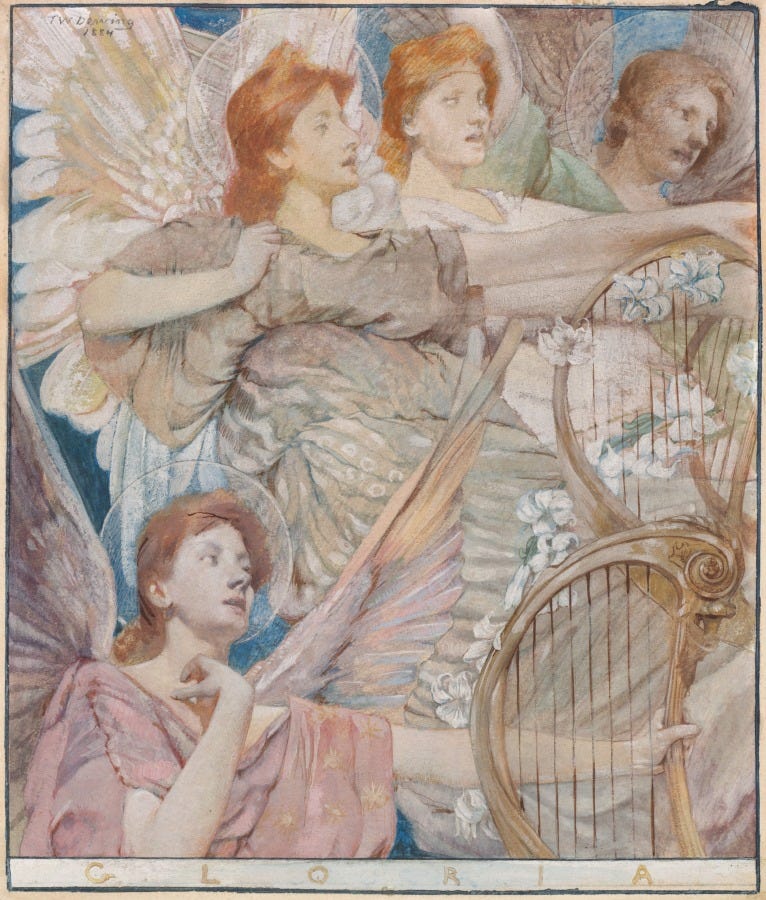
Gloria (1884) by Thomas Wilmer Dewing (1851-1938).
This series is published in collaboration with the Maxwell Institute: https://mi.byu.edu/old-testament-reflections.
To receive each new post in the Old Testament Reflections series, first subscribe to Wayfare and then adjust your account settings to turn on notifications for “Wayfare Theology.”


Robert Rees has accomplished one imaginative, unpublished essay on “glory.”
Edwards laid out his views on the matter most fully in a posthumously published work: A Dissertation Concerning the End for Which God Created the World (Monergism Books 2020). https://www.monergism.com/thethreshold/sdg/edwards/A%20Dissertation%20Concerning%20The%20E%20-%20Jonathan%20Edwards.pdf.

Philip, your reflection on the 24-year-old Prophet’s “miracle of compression” after the “bitterness of hell” meets the bedrock of my own history. At 24, I was driven to a similar precipice am intruder
Our correspondence on Radical Monotheism confirms the One is not an abstraction but a relationship: if, as it was said by H. Richard Niebuhr, “Love needs a Lover,” then Truth requires a Witness who refuses liquidation. What follows—“Her Embrace,” by Don Ianuzi—is that witness.
Her Embrace
The air was thick with the smell of old paper and espresso. Eli listened, his finger tracing the rim of his cup. The others had been talking for some time—Rabbi Lev with his patient, open hands, Mark with his clean certainty, Pastor John with his sharp, unforgiving lines.
It was John who had brought it up again. The nature of God. The necessity of the right name, the right doctrine. The unbridgeable gap between the saved and the damned.
“You cannot love a blur,” John said, his voice firm. “You must love a person. With a face. A law. A throne.”
Mark nodded, though for different reasons. “A loving Father has a plan. A structure. Line upon line.”
Rabbi Lev simply smiled. “And what of the Name that is too great to be spoken? The name that is a verb? *To be*?”
Eli set his cup down. The sound was soft, but it quieted them.
“My wife,” he said.
They looked at him. The shift was abrupt, human.
“If I were blindfolded, and she walked into this room, I would know. Not by her shape. Not by the doctrine of her. I would know by the air changing. By the way the silence around me suddenly shifts, by her kiss, by her embrace.”
He looked at John. “You ask how I know I’m loving God and not an idea. I know because of the love itself. It feels like *knowing*. Not like knowing *about*. Like knowing her kiss. It’s a thing that happens. A fact.”
He turned to Mark. “You build a beautiful system. A river, you called it. But the river isn’t God. The love is the water. The system is the banks. Don’t mistake the container for the thing that fills it.”
Finally, he looked, who was watching him with deep, quiet attention.
“Paul got it,” Eli said, his voice lower now. “He said without love, I am nothing. Not without correct belief. Not without authority. Without love, I am *nothing*. He didn’t say love is something God does. He said it is the ground everything else stands on. The one thing that doesn’t pass away.”
He paused, letting the words settle into the quiet.
“It’s not a thing you add to your theology to make it nicer. It’s the ground *of* the theology. If your God isn’t big enough to be that… that infinite, patient, enduring fact… then your God is too small. Love isn’t a quality God *has*. It’s the air in which He exists. And we exist in it, too. Or we don’t exist at all.”
He picked up his cup again. The argument was over. He had not quoted anyone. He had simply spoken of his wife, of the air in the room, and of the kiss . In doing so, he had made God bigger than any of their walls.