


Imagine that your Sunday School class starts a new year with Genesis 1:1. Your prayerful and prepared teacher wants to communicate exactly what the Bible says, but communication is challenging and the Bible is noisy. In any communication, an encoder (in this case, your teacher and the Bible) sends a signal. A decoder (you) receives the signal. Noise between the encoder and decoder inevitably hinders transmission and reception of the signal. If the fire alarm rang just as a class member began reading, “In the beginning . . . ,” that physical noise would obviously disrupt the communication. But less obvious kinds of noise do too.
If you were fasting and worried about a loved one, you might find it hard to concentrate on the words of Genesis 1:1. That would be physiological noise. If you heard the words, “God created the heaven,” and you thought of heaven as outer space or the place where God lives, that would be cultural or semantic noise, because in Genesis, heaven includes a dome that holds back the rain, or the water above the earth. Cultural or semantic noise occurs when the encoder intends one meaning and the decoder’s culture or cognition does not include that meaning. All kinds of communication noise make it challenging to decode from the Bible what God did, and when, and how, and why.
Take the, for instance. There is no equivalent to the in the Hebrew version of Genesis 1:1. It doesn’t say “in the beginning God created.” Avram Shannon, professor of ancient scripture at BYU, translated it as “in a beginning,” adding “even this does not quite explain what is happening grammatically.” Hebrew scholar Robert Alter rendered that line as “When God began to create heaven and earth.” That phrase “heaven and earth” is culturally noisy, too. We are likely to hear it as outer space and planet earth but Professor Shannon says the original Israelite audience would have heard it as “sky and land.”
Decades ago, I was so excited to learn the Old Testament, but I became discouraged when I learned how complex it was. This post is not intended to discourage your hopes and plans for studying the Old Testament. It is intended to share the hope and the help that I have discovered over the years. The best help, and best hope, is a Restoration-based hermeneutic. What, you may be asking, is a hermeneutic? It is the tools and tactics used to interpret scripture. If the Old Testament is what you will read for Come, Follow Me this year, your hermeneutic is how you will read it.
Now you may be asking, must we use big words? Can’t we just read the Old Testament and understand its obvious meaning without using a hermeneutic? We do not have to use big words or know what a hermeneutic is, but we will use a hermeneutic for a couple of reasons. First, reading the Old Testament and understanding the meaning that seems most obvious is itself a hermeneutic—the naive one I had decades ago. Second, every Bible reader is confined by language, a culture, a physiology, a psychology, a finite set of understandings. We can only exceed these limits to the degree that we recognize them and extend them by education and revelation. So we can either intentionally choose the tools and tactics we will use to read the Old Testament, or they will be chosen for us.
Choosing a Restoration-based hermeneutic means learning to read the Bible the way Joseph Smith did. It means using the knowledge and resources the Lord restored through Joseph Smith. Joseph learned to revere the Bible early in his life. He called it a “sacred depository.” He searched it, believing that it “contained the word of God.” But he also discovered that the Bible and its ancient and modern interpreters were noisy. Joseph’s history says, “I believe the bible as it read when it came from the pen of the original writers; ignorant translators, careless transcribers, or designing and corrupt priests have committed many errors.” Joseph’s history also says that Bible teachers “understood the same passages of scripture so differently as to destroy all confidence in settling the question by an appeal to the Bible.” Yet Joseph successfully acted on the Bible’s frequent invitation to ask and receive, seek and find (Joseph Smith—History 1:12). Having learned these lessons in his youth, Joseph spent the rest of his life working hard to decode the Bible. He read carefully, asked many questions, and sought answers through the complementary means of intellectual and spiritual work. This process produced the creation accounts in the Books of Moses and Abraham that expand our understanding of Genesis.
A Restoration-based hermeneutic respects the Bible as a sacred depository and remains aware of its humanness and limits. Even with all the tools the Restoration provides, we will often not be sure what has been mistranscribed, mistranslated, or otherwise corrupted. We can, however, be confident in the scholarship that has shown that the Bible is a complex compilation of various sources, each of which has been redacted—meaning edited or changed—over time by people whose identities and agendas are not precisely known, but scholars have made informed observations about. This means that Genesis and the other “Books of Moses” have not come down to us in Moses’s own handwriting, and we should not assume that Moses wrote them.
Let’s show how a Restoration-based hermeneutic can help us understand what “Books of Moses” could mean. The Book of Mormon is vital to a Restoration-based hermeneutic because it was translated and transmitted to us more transparently and directly than the Bible. The Book of Mormon is an anchor point for what we know and how we know. Nephi said that the plates of brass included “the five books of Moses, which gave an account of the creation of the world, and also of Adam and Eve” (1 Nephi 5:11). So we can be confident in that. But we should also not stretch it to mean more than it says.
For example, we might assume that the Book of Mormon says that “the five books of Moses” were written by Moses, but it does not say that. The Book of Mormon shows how ancient, sacred texts were selected, edited, composed, and adapted by less ancient authors, compilers, and editors. Mormon compiled and wrote the books of Mosiah, Alma, Helaman, and others based largely on writings of those people. So sacred books can be of a person without being by that person. Further to this point, the Lord revealed to Joseph Smith the Book of Moses that is now in the Pearl of Great Price. It makes no claim to have been written by Moses. It is the premier example of being the book of Moses, not by Moses.
At some point (or points) much later than when God began creating, unknown writers and editors included two separate creation accounts in Genesis chapters 1 and 2. In the first one, Genesis 1–2:3, God created man and woman together at the end of the process of organizing the planet for them. In the second one, Genesis 2:4–25, the Lord God formed the earth and heavens, then formed man, then planted a garden in Eden, and finally formed woman as the culmination of creation.
The Book of Moses in the Pearl of Great Price adds much to these accounts. First, it provides a context for the knowledge it conveys. Unlike Genesis, which begins out of the blue, the Book of Moses begins with the Lord speaking to Moses face to face, explaining the why of creation as means to the end of immortality and eternal life for God’s children (Moses 1:39). Further, God showed Moses the vastness of creation, “worlds without number” at least to mortals, but known to God. Moses wanted to know why and how God created, and the Lord explained the why, as noted above, but when it came to how, all God revealed is that he did it “by the word of my power have I created them, which is mine Only Begotten Son, who is full of grace and truth” (Moses 1:32). Finally, the Book of Moses includes both of the versions of creation in Genesis 1–2, but between them it adds, “I, the Lord God, created all things of which I have spoken, spiritually, before they were naturally upon the face of the earth” (Moses 3:5).
The Book of Abraham also adds to our understanding of creation. Like Moses, Abraham’s account tells us how Abraham learned of creation. The Lord revealed it to him, showing Abraham how he himself participated pre-mortally in a divine council. There, the gods planned creation of the world as means to the end of exalting pre-mortal children, “intelligences that were organized before the world was” (Abraham 3:22). In Abraham’s version, “the Gods took counsel among themselves,” planning every aspect of this planet as means to the end of creating in their image. “So the Gods went down to organize man[kind] in their own image, in the image of the Gods to form they him, male and female to form they them” (Abraham 4:26–27).
If we include the teachings of Joseph Smith and President Dallin H. Oaks in our tools and tactics for reading the Old Testament, we could imagine Abraham’s references to Gods counseling together as a divine family council. President Oaks taught, for instance, “Our theology begins with heavenly parents. Our highest aspiration is to be like them.” Scholars have gained exciting insights into the divine counsel by studying the Bible and other ancient sources, but the Lord’s revelations to Joseph Smith remain our best sources of knowledge about it. Choosing to read the Bible the way Joseph Smith did—and informed by the restored scriptures the Lord revealed through Joseph Smith—does not answer all questions about the nature of creation by divine counsel, but it provides knowledge that we would otherwise not have so clearly or completely, including:
Gods purposefully created this earth and others so we could progress to become exalted like them
Creation was accomplished under the direction of Jesus Christ, by organizing and ordering existing materials, not making something out of nothing
Our sources of knowledge about creation have come to us through revelators and redactors, and the restored scriptures are much more transparent about that process than the Bible is, so the restored scriptures help us understand the process by which the Bible was composed
The scriptures do not reveal exactly how the Gods created; the Lord has only revealed why he created, so we might miss the mark if we focus on how rather than why
Imagine that your Sunday School class starts a new year with Genesis 1:1. No matter how prayerful and prepared you and your teacher may be, the Old Testament will remain challenging. But the Restoration provides tools and tactics. One of these is to revere the Bible without regarding it as flawless. Another is to realize that Joseph Smith worked hard to read the Bible and he received much revelation in the process. He worked hard to learn Hebrew and Greek but never mastered either.
Joseph Smith showed that if we work hard with our minds and our spirits, we can decrease the noise that makes the Old Testament so difficult to decode. The Lord revealed through Joseph the restored scriptures that can inform our reading of the Old Testament. Engaging these sacred texts as Joseph did is worth the work even if, like Joseph, we do it imperfectly, and even if all we discover is that Gods formed this planet and us on purpose, from pre-existing materials and intelligence, through the ministry of Jesus Christ, as means to the end of us becoming like our Heavenly Parents.
Steven C. Harper is a covenant son of God who strives to be a disciple of Jesus Christ. His primary work is to teach the restored gospel of Jesus Christ in ways that help students develop resilient faith in, and become lifelong disciples of, the Savior.
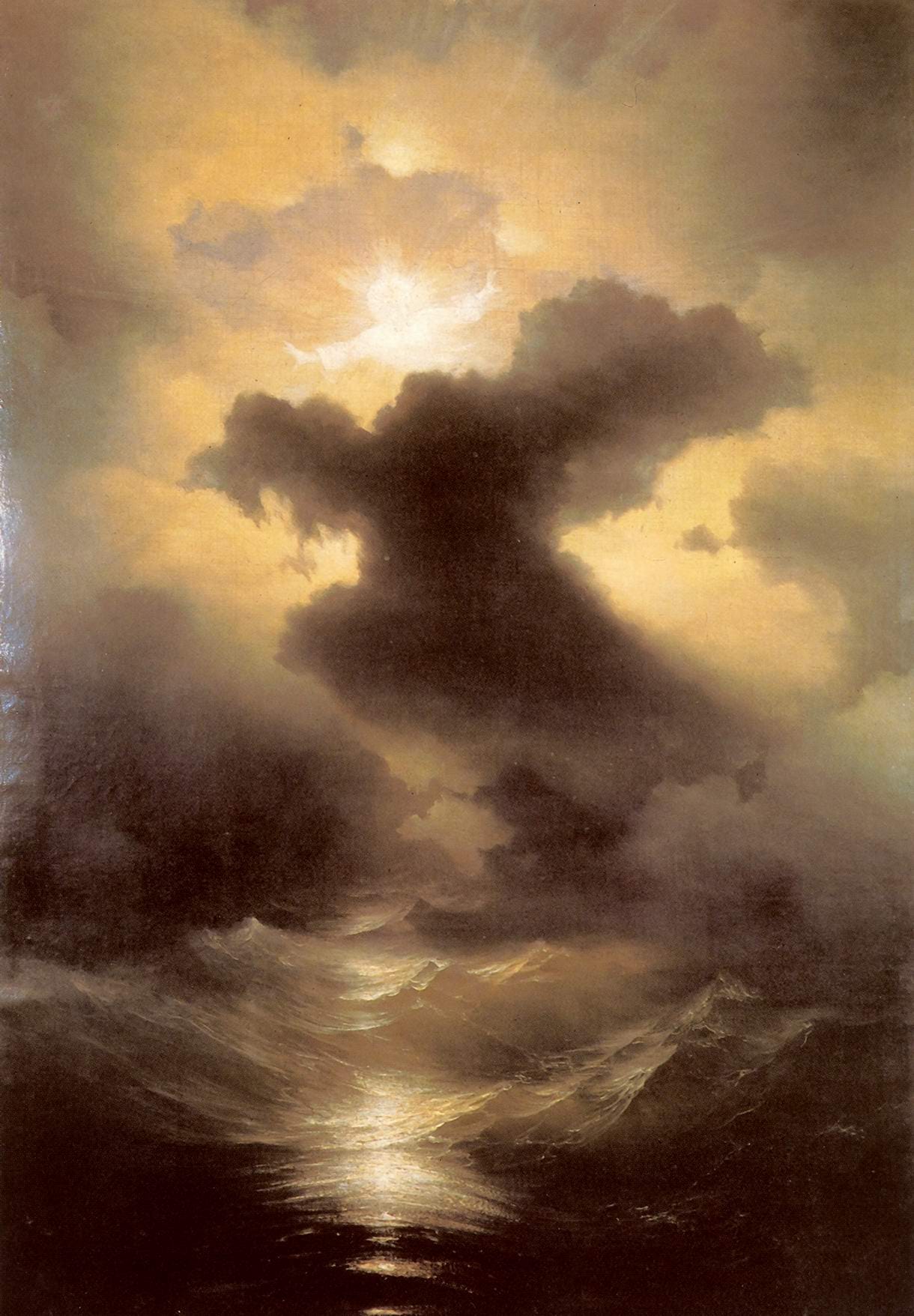
Chaos. The Genesis. by Ivan Aivazovsky (1817-1900).
This series is published in collaboration with the Maxwell Institute: https://mi.byu.edu/old-testament-reflections.
To receive each new post in the Old Testament Reflections series, first subscribe to Wayfare and then adjust your account settings to turn on notifications for “Wayfare Theology.”
