


Last week’s reading featured Jonah paraphrasing one part of the Lord’s ancient self-proclamation as “merciful and gracious, longsuffering, and abundant in goodness and truth” (Exodus 34:6; cf. Jonah 4:2). Jonah was upset by this, because his heart had been set on seeing Nineveh destroyed rather than spared, since it was the seat of the cruel Assyrian empire. Their swift repentance on hearing his warning had moved the Lord to let them live. The Lord showed mercy to Nineveh, Jonah was chagrined, but Nineveh, apparently, lived happily ever after. We tied that story to the earlier story of Elijah who was taught that the Lord was not in destructive wind, earthquake, or fire, but in the still, small voice (1 Kings 19.11–12).
At the outset of this week’s reading, this theme of divine mercy is once again sounding loud and strong. We find the prophet Micah extolling the Lord’s loving kindness: “Who is a God like unto thee, that pardoneth iniquity, and passeth by the transgression of the remnant of his heritage? he retaineth not his anger for ever, because he delighteth in mercy” (Micah 7:18). But then we come to the book of the prophet Nahum, and a different emphasis is on offer.
Nahum reverses the energy of both the Elijah and Jonah incidents as he utters a curse—“the burden”—of the Lord against none other than Nineveh. Apparently, there has been more to the story since the book of Jonah, because by the time Nahum addresses Nineveh, whatever reprieve they had been granted by the Lord through Jonah is over. “God is jealous, and the Lord revengeth; the Lord revengeth, and is furious; the Lord will take vengeance on his adversaries, and he reserveth wrath for his enemies,” writes Nahum with three-fold emphasis (Nahum 1:1–2). And if Elijah is listening from the heavens, he will surely appreciate the irony of what Nahum has to say next:
The Lord hath his way in the whirlwind and in the storm, and the clouds are the dust of his feet. . . .
The mountains quake at him, and the hills melt, and the earth is burned at his presence, yea, the world, and all that dwell therein.
Who can stand before his indignation? and who can abide in the fierceness of his anger? his fury is poured out like fire, and the rocks are thrown down by him. (Nahum 1:3–6)
No still, small voice here! This is the terrible wrath of God that so many wrongly associate exclusively with the Old Testament.
If this seems a stunning reversal, it is actually consistent with the ancient declaration we noted above; you just have to keep reading past the mercy part to get to the judgment part: “The Lord, The Lord God, merciful and gracious, . . . forgiving iniquity and transgression and sin, and that will by no means clear the guilty; visiting the iniquity of the fathers upon the children, and upon the children’s children, unto the third and to the fourth generation” (Exodus 34:6–7).
Yes, Nahum acknowledges, “The Lord is slow to anger, and great in power,” but there is a limit to divine forbearance, and Nineveh is about to find out that God “will not at all acquit the wicked” (Nahum 1:3). But again, this “great power” is only wielded the far side of divine restraint. “The Lord is good, a strong hold in the day of trouble; and he knoweth them that trust in him,” writes the prophet, but to proven enemies, by “an overrunning flood he will make an utter end of the place thereof, and darkness shall pursue [them]” (Nahum 1:7–8). As the Book of Mormon teaches so pointedly, divine mercy cannot rob divine justice (Alma 42:25), and in this reading we see that in stark relief.
In this season of advent, it can be sobering to recognize that the baby born in Bethlehem was the same Messiah who was expected to deliver his people with mighty power, and whose first coming among the Nephites was preceded by exactly the kinds of commotions that Nahum forecast upon Nineveh. It was whirlwind, fury, fire, and not just rocks but whole mountains heaved on top of Nephite cities (3 Nephi 8:6–17). In the aftermath, the voice of Jesus himself is heard as he details the destructions he has brought about—the same Jesus who, possibly only moments prior to these acts, had uttered “Father forgive them, for they know not what they do” from the cross (3 Nephi 9; Luke 23:34).
These extremes of mercy and destruction can be difficult to reconcile as belonging to the same being. The Lord does offer explanations for terrible destruction. To the surviving Nephites, he repeatedly draws a connection between their calamities and their nation having stoned the prophets and cast them out, “that the blood of the prophets and the saints shall not come up any more unto me against them” (3 Nephi 9:5–12; quoted phrase from v. 7). And to the Israelites, Micah gives the Lord’s horrific characterization of their crimes: “Hear . . . O heads of Jacob . . . who hate the good, and love the evil; . . . who also eat the flesh of my people, and flay their skin from off them; and they break their bones, and chop them in pieces, as for the pot, and as flesh within the caldron. . . . They build up Zion with blood, and Jerusalem with iniquity” (Micah 3:1–3, 10). “For the rich men thereof are full of violence, and the inhabitants thereof have spoken lies, and their tongue is deceitful in their mouth” (Micah 6:12). “They all lie in wait for blood; they hunt every man his brother with a net. . . . The prince asketh, and the judge asketh for a reward; and the great man, he uttereth his mischievous desire. . . . The best of them is as a brier” (Micah 7:2–4).
The gist of it seems to be that when a certain point of wickedness or estrangement is reached, there may come a devastating divine reaction against the cruel and the blasphemous, whether part of the covenant or not, but especially against those of the covenant who have been taught to know better and have nevertheless gone against God’s commandments. The problem is that we would not commend this sort of violence from an earthly parent toward even a very cruel grown child. Such a child might have to be physically restrained and even removed from the family’s environment, but violence for violence is never the optimal recipe for healing and growth.
Theologically, I think the best that can be said for the divine violence for human violence we sometimes find in scripture is that once a certain level of unaccountable power and cruelty is attained by earthly kingdoms and actors, God has sometimes intervened to check the rapacious in their destructive path. Innocents as well as malignants die in the resulting upheavals, but at least for a time the hideous overflow of evil is checked—along with nearly everything and everyone else—and there is a chance for rebuilding and recovery of some sort. These are not the operations of the kingdom of God in its fulness, however. They are the dim patterns of the corruptible world. Their vestigial shadows in the scriptural record are best read not as excuses for us to want eye-for-an-eye retribution in our own times, but as cautionary tales against exactly the kind of disproportionate aggression they narrate. Whatever they reflect from the past, the way we read them today is what matters most. If we find ourselves taking pleasure—or even feeling national pride—in the culture of vengeance that is encouraged in so many of our films, feeds, and political declamations, we can be sure that we are advancing along the path that leads, as it has always led, to mourning among the ruins. When I find myself in such angry spirals, I know it is time to find a quiet place to sit once again with these words from Micah:
Wherewith shall I come before the Lord, and bow myself before the high God? shall I come before him with burnt offerings, with calves of a year old?
Will the Lord be pleased with thousands of rams, or with ten thousands of rivers of oil? shall I give my firstborn for my transgression, the fruit of my body for the sin of my soul?
The answer comes back with a resounding question of its own:
He hath shewed thee, O man, what is good; and what doth the Lord require of thee, but to do justly, and to love mercy, and to walk humbly with thy God? (Micah 6:6–8).
D. Morgan Davis is a Research Fellow at the Neal A. Maxwell Institute for Religious Scholarship. He holds a PhD (2005) in Arabic and Islamic studies from the University of Utah, an MA in history from the University of Texas at Austin, and a BA in Near Eastern Studies from Brigham Young University.
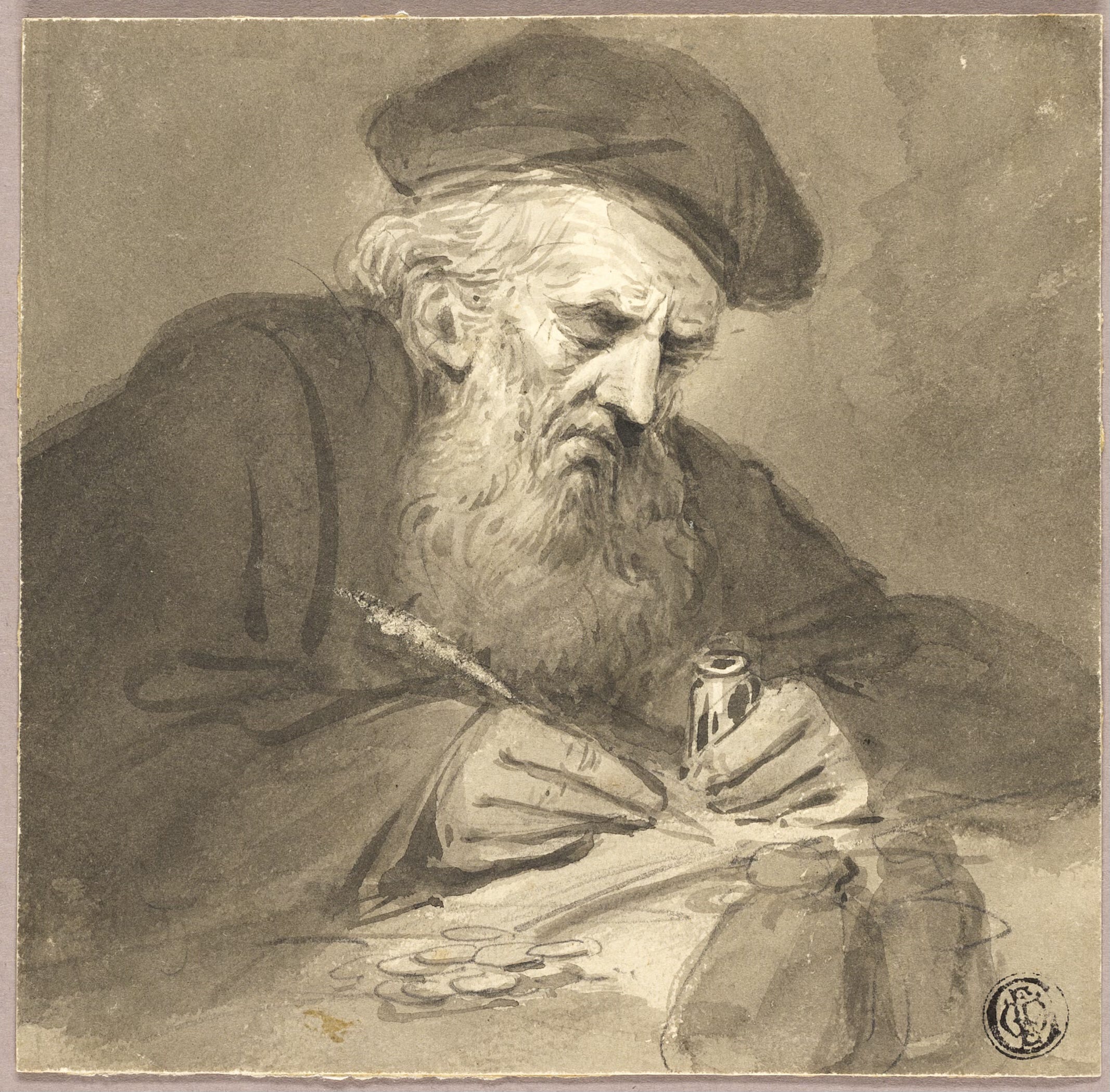
Art by Edward Bird (1772–1819).
The Old Testament Reflections series is published in collaboration with the Maxwell Institute: https://mi.byu.edu/old-testament-reflections.


