


I began to notice them in the airport, the way one learns to identify confederates—the little tells of mannerism, clothing, and speech. I spoke to none of them, but I knew where we were all headed. They were on the plane, then the next day, on the train, then on the light rail, a trickle, then a stream, then a river converging on the sidewalks of Salt Lake City. Now we sit in rows of folding chairs, eight thousand of us facing the stage at the other end of this vast room, our chatter filling the air.
The lights dim. The room falls silent. A video plays on the massive screens hanging from the ceiling. Red lightning flashes; thunder rumbles from loudspeakers. An urgent voice issues forth: “A storm is coming . . . ”
I didn’t think I’d be this affected—my heart pulses in my throat as the video fades to black. The stage is spotlit.
“Worldhoppers,” a voice announces, “please welcome your hosts, Brandon and Emily Sanderson.”
The room roars.
The man on that faraway stage, wearing his signature blazer-over-a-t-shirt and standing next to his wife with his hands in his pockets, still doesn’t seem quite sure what to do with what he finds in front of him. In the past few years, Brandon—he’s always just “Brandon” to his fans—has published a half dozen books and run the best-funded Kickstarter of all time. He has gone toe-to-toe with the publishing industry to fight for authors. And the company he founded with his family and friends is now hosting Dragonsteel Nexus 2024, a convention attracting thousands of people from all over the world. From humble beginnings, he has become, by any measure, one of the most beloved and best-selling fantasy authors of all time.
Tonight is the release event for Wind and Truth, book five of a projected ten-book series, The Stormlight Archive. His magnum opus. It’s a pivotal point for the series and for his career.
Brandon Sanderson is, reportedly, nervous.
Brandon and Emily make pleasantries, thank-yous, and a few announcements, then Emily leaves the stage, leaving Brandon alone. It’s time for his speech. On what might be the most important night of his life.
“Yeah, this is the part where I blab at you,” Brandon says, pacing the stage with a smile. “What have I been thinking about lately?
“Well, I’ve been thinking about Robespierre.”
I was not thinking about the French revolutionary Maximilien Robespierre that morning when I ducked into the Salt Palace Convention Center with my friends. I was thinking about how to fill out my passport.
We’d each been given one at registration: A booklet with a blue cover and “Worldhopper Passport” printed in gold foil. The booklet’s gray pages bore the names of planets and locations from Brandon’s books, and below those names were lists of tasks and empty boxes awaiting stamps.
My friends and I were in giddy overdrive. The passport was clearly part of a game, and a game meant a prize.
Our first task was to scope out the cavernous, hangar-like main hall. Portable blue curtains subdivided the concrete: A craft room and a game room with rows of plastic tables; A labyrinth of crowd control stanchions leading to the official Dragonsteel Store; A curious structure like a black-and-white circus tent; Food stalls scattered on the periphery; And the Exhibitor Hall, where phalanxes of vendor booths patiently lurked to ensnare our wallets. We guessed that completing activities—playing games in the game room, visiting vendor booths, etcetera—would win us passport stamps. We just had to find a way to tackle them efficiently.
And before eight thousand other people did. Already on the morning of the first day of a three-day convention, people swarmed everywhere—wearing backpacks, lanyards dangling from their necks, in pairs and squads and pushing strollers, all ages, all genders, many, many people dressed up as characters from Brandon’s books—all of them grinning, passports in hand, poking at things, investigating things, making plans. The first panel of the day was one I’d been planning on attending, so I rushed off, promising my friends I’d update them on anything stamp-related that I learned.
The panel was scheduled in a large, carpeted room stuffed with lines of cushioned red chairs. Locating a middle section with a decent view, I squeezed into a seat. A glance around left me a little dizzy. There were hundreds of people.
But it was quiet. Outside the doors, the convention center was a dull roar, but inside, people spoke in low tones to the people in their party or they sat alone, bowed over their passports.
And like a chill sneaking through a window I’d forgotten to close, a question I’d been asking for the days and months leading up to Dragonsteel snuck up on me.
What am I doing here?
The thing is, I’ve never been totally comfortable being a “fan.”
Being a fan means being loyal to something. Fandom puts you in a fundamentally argumentative posture; Star Wars is better than Star Trek and Red Sox versus Yankees follow the same principle. Even within fandoms there are schisms over whether this romantic pairing is the truest, or whether the team should have fielded this quarterback versus that one. And for whatever reason, the requirements of this posture seem to have become more extreme over time. “Like this or die.” Or sometimes, “If I don’t like where this goes, I will die.”
I find loyalty difficult, but not because I don’t think it’s important. In fact, in my life as a person of faith—the same faith as Brandon—I think that loyalty might be the most important thing in the universe. Our faith’s founding figure, Joseph Smith, taught that by making sacred promises with God and each other, we can be “sealed” to our loved ones, thereby allowing those relationships to continue even after death. Thus, in Smith’s cosmology (as I read it) heaven is nothing less than a network of sealed relationships uniting the entire human family in a web of relationality. The promises we make to be with each other and with God may be nothing less than the very ground of our existence—now and forever.
I wouldn’t have it any other way. But this means I don’t give my loyalty easily, including to cultural artifacts, no matter how much I love them. A fictional plot can twist at any moment. Cultural trends cycle and re-cycle.
It also means I’ve never been a convention goer because I know I will be mingling with people who are loyal, whose lives begin and end with these stories. I worry that at best, I would be a zero to them. At worst, an impurity.
But I knew I couldn’t stay away from Dragonsteel Nexus 2024. I’d been reading Brandon’s books for over fifteen years, and I thought they were great and worth celebrating. I was excited for Wind and Truth.
And part of me was intensely curious. At the newest height of his career, but with so much still at stake, how was Brandon Sanderson thinking about fandom and about his fans? And could that include me?
The panelists mounted the stage. A guy wearing a baseball cap popped open a laptop on the table and leaned towards the microphone. “So, should we get into it?”

What’s even the point of a convention?
Homo sapiens has probably been organizing meet-ups around shared interests since at least communication appeared as smoke on the horizon. The first science fiction conventions date back to the 1930s, and the first comic-con was held in the 1970s. But it’s the size of fan conventions—over 200,000 attendees at some comic-cons—plus their purpose that feels unique in human history. Never have so many people gathered in one place to connect over a cultural experience that they mostly experienced somewhere else. Whether book, TV show, movie, video game, or comic book, a defining feature of nerd culture is that one usually encounters the primary cultural products in the same physical space as, at most, a few dozen other people—and far more often, totally solo. And what separates a nerd from someone else who curls up on the couch alone to watch Ted Lasso or to read Jane Eyre is the desire to evangelize. No wonder, then, that despite legitimate hurdles to the whole endeavor—introversion, lingering shame, a relative lack of social skills—fans cannot help but convene. Convening may be the only way to shatter the fear of solipsism, to confirm that one belongs to a greater culture.
All that to say, Dragonsteel Nexus 2024 was a big, big deal. It wasn’t part of another convention, not Brandon Sanderson sharing a panel discussion or an allotment of square footage in an exhibitor hall. Brandon Sanderson and his books were the event.
What has made him so successful? The convention-goers I asked gave many reasons. The characters are compelling and inspiring. The page-turning plots deliver emotional impact and epic action, culminating in explosive and satisfying climaxes. The books help someone make sense of their depression, or their loneliness, or just get through a tough time at work.
But maybe the biggest part of the appeal is Brandon’s worldbuilding. Over a dozen books and counting take place within the same shared universe, called the Cosmere. Many Cosmere books are self-contained, focusing on the characters, events, and magics of a particular world. But undergirding all these worlds and their stories is a comprehensive and consistent system of magic that’s never fully explained in any one book but is frequently referenced and hinted at. This system is so detailed that fans approach it like a science, using the data they’ve gathered on it so far to theorize how the superstructure of individual characters and plots will develop in future books. In Brandon’s books, gaining greater knowledge of the Cosmere and its magic systems is almost always a key to victory for the characters. And there are a small number of characters, often appearing only in cameos and side roles, who are “worldhoppers,” people who know how to slip between planets and think about the Cosmere from a comprehensive angle.
It only makes sense that Brandon’s fans see themselves as worldhoppers too. Reading is worldhopping, jumping from viewpoint to viewpoint, book to book. And since knowledge is power in the Cosmere, the attentive reader can have a deep sense of participation as they see how characters grapple with the same puzzle pieces the reader has access to. Sometimes the characters don’t grasp the puzzle as well as the readers and sometimes they leap ahead; irony, horror, comedy, shock, triumph, delight and surprise can result.
Thus, Wind and Truth is the convention’s main event, but the theme is worldhopping. Hence the passport. Hence the text of the flags flanking the Salt Palace: “Dragonsteel Nexus 2024. Be a part of the story.”
And hence the panel I was watching: “The Butterfly Effect: Disruptors of the Cosmere.” For close to an hour, before a crowd of hundreds, the four fans on stage took turns positing what-if scenarios at pivotal moments in the story of the Cosmere and debating what changes might have then cascaded through the books. What if, for instance, a certain character’s romantic interest had not died in an early book, allowing both characters to later inherit some of the Cosmere’s immense magical powers in future books? Would their relationship have survived or soured?
“Well, we know it takes time for a Shard’s intent to corrupt a person’s personality,” one panelist pointed out.
Some nods from the other panelists, heads cocked in reflection. There were instances of Shards working together before.
“You could potentially see an interesting thing in Era Two,” a second said, “where discord is still happening, but in two beings instead of one.”
“You never want to date your coworkers,” riffed a third. The room laughed.
I felt torn. Even though I’d read all the same books, I remembered less than half of the events that the panelists were so deeply and enthusiastically arguing over. I understood much less than half of the magic systems they were referencing. If I laughed, would I be laughing about the same thing? If I asked the guy sitting next to me for an explanation, would he look at me with kindness, confusion, pity, disgust? Did I belong in this room? Did I want to?
Truth was, I was only at the panel to see one of the panelists, a minor Youtuber who creates fan videos explaining the Cosmere. I’d discovered his videos only recently but had enjoyed them so much I wanted to thank him in person. And yes, in this recursively tiny pond, it was a chance to be touched by the fame of a kind of big fish (the size of at least a few thousand Youtube subscribers). After the panel, I had no trouble zipping up to him as he came off the stage.
“I just wanted to say, I love your content. Would you sign my Worldhopper Passport?”
He obliged and thanked me for the compliment. Then he withdrew something from his pocket.
“And here,” he said, a conspiratorial wriggle in his voice, “is a Silverlight key.”
Into my hand he deposited a small piece of white, 3D-printed plastic in the shape of a cool-looking key. I hurried out of the room grinning.
My friends and I reconvened and confirmed that completing convention-related tasks had been rewarded with stamps in our Worldhopper Passports; I’d received a stamp from someone in a Staff t-shirt at the end of the panel.
“But did any of you get a Silverlight key?” I asked, trying and not entirely succeeding to not sound smug. “Do you know what that’s for?”
No, they hadn’t, and no, they didn’t know, but it seemed like an exciting piece of the convention game.
The next seven hours of convention flew by, attending panels, playing board games, wandering the exhibitor hall—to everything its season and a stamp to every activity under heaven. We discovered that a completed set of stamps could be traded for a pack of Stormlight Storydeck cards at the circus-tent-like structure in the middle of the main hall. Each pack of the Storydeck contained a random assortment of cards, but what was on the cards was an ingenious idea for a convention game: a few paragraphs of a story written by Brandon and his team. A set of nine cards, when flipped onto the reverse side and placed in a rectangle, created a piece of artwork relevant to that story. There seemed to be three stories, spread across fifty-four cards each; one hundred and sixty-two cards total, eighteen stunning pieces of artwork. Already by the end of the first day I’d collected a few dozen cards.
But I still didn’t know what the Silverlight key did.
Despite the long day, it was only an appetizer for the main event: the Wind and Truth release party. Eight thousand attendees in the biggest hall. Lightning flashing on the screens. The real reason we were here: The book. The man himself. Talking about his book.
Except he wasn’t talking about the book. He was talking about the French Revolutionary Maximilien Robespierre.
“If you don’t know anything about Robespierre, his story is fascinating to me,” Brandon said. “The very machine he helped create eventually cut him to pieces. Literally.”
Brandon paced the stage with one hand waving a clicker and the other in his pocket. Maybe he could sense my bewilderment, because his delivery suddenly seemed to falter. His eyes glued themselves to a teleprompter somewhere near the front of the stage.
But he pressed on. With a promise to return to Robespierre, he moved onto more familiar ground, recounting his earlier career. The mood in the room picked up, people cheering and laughing as he showed slides of a very young, beardless Brandon at book signings.
Then he said, “I feel like in fandom, we’re making a constant fight for legitimacy.”
“I once had a mother at a book signing look at me straight in the eyes and say, after her daughter got one of my books signed, ‘All she’ll read is this fantasy stuff. How do I get her to read something that’s actually good?’”
The groan from the audience was immediate, almost instinctual. Brandon half-grimaced, half-grinned.
“Society really likes to shame people who enjoy things. Have you noticed that? ‘How dare you like something.’ Whatever you like, someone’s going to pop out of the woodwork and try to make you feel stupid for being interested in it. Every fantasy writer, myself included, has been confronted by these interviewers who imply the entire genre is crap and then they push us to distance ourselves from it.”
The audience had become more animated. And so had Brandon.
“I’m proud of my books,” Brandon said. “I think my stories do something interesting and innovative with the narrative and with the storytelling. I think the Stormlight Archive explores what fantasy is capable of being, all while delving into the human condition.”
Smiling, he delivered the next lines like hammer blows. “I like my prose! I do it deliberately! I don’t think it is bad, I think it is good! It just tries to do something different!”
The cheering of eight thousand fans swelled to the ceiling of the massive room. I almost expected chanting to break out—or wanted to start chanting myself. Four! More! Years! Four! More! Years!
And then Brandon pivoted.
“The point is,” Brandon said, “taste is subjective, and we don’t all have to agree to make a community. If our rallying cry is ‘Everything we don’t like is crap,’ then we’re missing the point. Stories bring people together, and I believe that fantasy fiction is one of the most powerful ways that happens.
“As things have changed for me, in my life, it feels like things have changed for us as a culture in parallel; my career and rise seem to parallel the rise of nerd culture in general.
“Our success hasn’t stopped people from wanting to point at us and poke fun. It happens. We can’t do anything about that, other than to stand tall and ignore them.”
With the hand holding the clicker, he jabbed a finger down emphatically. “But let’s also make sure not to emulate them.
“We as people who love fantasy books are, in many ways, like the political revolutionaries I mentioned at the start of my speech. My challenge for you is to learn from the stories of people like Robespierre. Don’t let our movement eat itself alive. Let’s not be the type of people who feel ashamed for our love of books, but let’s also not be the type who distance ourselves from subgenres that others are discovering and coming to the fandom through.
“When you return home, remember what I’ve talked about. Let’s make a place in fandom. Let’s make sure we’re not gatekeeping who gets to be a fan. That doesn’t work anymore.
“So. If you want to be here, Dragonsteel Nexus is for you. Thank you for making this our biggest release event ever. I love you, you’re amazing, and I hope you have a fantastic Nexus 2024.”
And just like that, his speech was over. The audience cheered him off.
I was flabbergasted. For a moment there, the speech had been everything I’d expected—triumph, glory, participative. But then it had turned into . . . a lecture? A sermon?
I wasn’t sure that he’d said the words Wind and Truth once.
I definitely wasn’t sure that I agreed with what he’d said.
It was a noble sentiment: There’s room here for everyone. By all rights, it should have appealed specifically to me, putting my impostor syndrome at ease. But I also heard an uncritical and passionate call to action to not being critical. Wasn’t the point of being a fan—liking something, loyalty to something—inherently an exercise in preference? Fandom wasn’t an expression of preference over minor details but over fundamental details in the stories we told about our very lives. How could a community without discernment, without borders, be a community at all? The paradox seemed like it would implode under its own mass, like a black hole.
But solving it would have to wait. The Q&A was starting.
Why is Brandon so successful? I think the real answer is the Q&A.
On special occasions like holidays, his birthday, and, of course, the annual convention, Brandon answers questions from his fans. Plenty of questions are of the expected variety: writing advice, or Brandon’s thoughts on other books or movies. But most questions are about his worlds. Keen readers who have delved deep into the Cosmere system line up at a microphone and ask Brandon questions about how the system works. The most entertaining questions try to stump Brandon or push him to the edge of the knowledge he can reveal. And they can be devilishly complicated.
A fan in a gray jacket approached the microphone. When he spoke, his English was slightly accented. “My question is regarding Connection. With Connection you can make people understand the language of the place that they’re in by changing their native language for people who are multilingual. So, my question’s regarding people who grow up bilingual. How does that interact with it?”
“There are multiple ways to interact with that,” Brandon responded. “One would be to replace one of the languages, but also you can make Connection with more advanced uses to not just replace but to add to—or to change your past in a bit of a Forging way. So there are a lot of different ways it can manifest depending on the skill of the person who is making that bond.”
“As a quick follow-up,” the questioner continued, “I myself grew up with Spanish and English—some people really grew up with Spanglish rather than the two languages.”
Brandon grinned, catching where the question was going. As he spoke I could almost see his brain churning. “Yeah, that could totally happen. In fact, you can tell—here’s an example. You can tell in certain books when someone has a bit of an accent, that oftentimes that’s a tell—like, if someone has no accent, it means they’re using magical means to circumvent it. And if they do have a bit of an accent, then they may have learned it or they may have been bilingual and are adding on—or things like that. Thank you for your question.”
“Thank you,” the fan replied, and the audience clapped, as they did for every exchange, for both the questioner and the answerer.
Another fan: “Do the Shards of Adonalsium still have a tangible Connection to Adonalsium?” He drew a link in the air with his fingers. “So, the vessel and the power.”
“I mean, technically yes, because the remnants of Adonalsium are the Shards and that Connects all of them. Probably not in the way that this question’s intended to mean . . . ” Brandon tilted his head from side to side. “But it is a technical yes.”
“This is harder than my thesis defense was,” he joked at one point.
Knowledge is power in the Cosmere, and a worldhopper’s knowledge allows them to participate in its grand events. Brandon, of course, has all the knowledge. But I think it’s this remarkable style of transparency that sets him apart and makes him so beloved as an author. The only questions he doesn’t provide an answer to are questions that will be answered in future books, to which he replies “RAFO.” “Read and find out.” It’s a dance of trust between him and his readers. His opus is one big promise to reveal all, one big “read and find out.”
But it also means that, for now, keeping secrets is essential. Entertainment and surprise would be impossible otherwise. “There’s always another secret”—a phrase from one of his early books that has come to represent his career just as much as any promise to read and find out.
As I watched the Q&A, an unexpected sense of familiarity came over me, and when I finally placed it, I nearly fell out of my chair. Brandon was doing no more or less than what every Latter-day Saint has learned to do from the earliest age: answer questions about the strange and secretive worlds you believe in.
No wonder he’s so good at it. He’s been doing this his entire life.
And no wonder that fandom fascinates me—the experience of being a fan and a religious person, and a Latter-day Saint in particular, have so many parallels. Our communities cannot exist without knowledge that’s only available to insiders, yet we desperately want to share those secrets. And no matter what status we might achieve in the world, we always feel like we’re making a constant fight for legitimacy. I thought of an essay by the Latter-day Saint journalist McKay Coppins in the Atlantic. Coppins recounts that when The Book of Mormon was having massive success lampooning his faith on Broadway, the church took out a full-page ad in the play program. “You’ve seen the play—now read the book!” When Coppins heard of this, he thought it was a savvy, playful coup—“a testament to Mormon niceness”—and he said so to a prominent New York theater critic. “No,” the critic said, “It’s because your people have absolutely no cultural cachet.”
How else to describe fandom, even at the peak of its powers?

I began to notice something about the Worldhopper Passport. It had been carefully designed to get us antisocial nerds to be social.
One stamp could be obtained by sticking tiny plastic beads to a piece of sticky paper, which would create a map of Roshar, the world of the Stormlight Archive. The map was large and the beads were many, so I found myself sitting at a round folding table, surprisingly engrossed by the tactile satisfaction of the activity, and chatting with a complete stranger. I discovered that she had travelled from Connecticut to be here.
“No way! I’m living in Boston. I flew in on Thursday.”
“So did I!”
She had traveled to Dragonsteel solo. She was one of the few among her friends who had read Brandon Sanderson, although she was trying to get them to read more.
“How’s the convention been for you?” I asked. “I’ve never really been to conventions before, so I don’t know what to compare it to.”
“Neither have I,” she said. “But it’s been great. Everyone has been so nice.”
We chatted about the books, the convention, and New England as we worked on the puzzle. Eventually I took my leave—there were other stamps to chase, after all. But I walked away with a spring in my step.
The interactive aspect didn’t end with the stamps, because turning in stamps was rewarded with the Storydeck packs. And because the cards in each pack were random, it was impossible to complete a set without trading. Some of the hall’s limited seating had already been colonized by people sorting, swapping, and making deals.
The stamp-eligible activities had also been organized in such a way that I frequently found myself discovering new Sanderson subcultures. One panel I attended was for Spanish-language fans. The crowd filled only a third of one of the smaller conference rooms but was terrifically energetic. A roll call from the panelists established that people had travelled from as far as Spain, Uruguay, Colombia, and Peru. One guy hovered back and forth with a phone on a selfie stick, livestreaming the event for a popular Spanish-language Cosmere podcast. Sitting in the back, I followed along with my rusty missionary Spanish.
“I couldn’t believe it when I read Jasnah’s character,” one panelist exclaimed. She had travelled from Argentina and was cosplaying as that very character, wearing a fabulous purple dress in the Stormlight Archive style, her jet-black hair elaborately arranged. “I was like, there’s this Mormon guy in the United States that’s describing my life!”
Other activities I had little interest in. Cosplay, for example. I loved observing people’s costumes from a distance—men in blue military-style coats holding spears and swords; women in long dresses with their left hands covered up; an incredible full suit of armor with glowing light effects; someone, hilariously, dressed as a famous building—but I had no interest in dressing up myself. And as the card trading became more intense towards the end of the convention, I still found it awkward to insert myself into the haggling, even though people were typically generous. One trade left me irritated; he could tell how badly I needed one card to complete a set and extracted more from me than I thought he deserved.
And there was one thing I was missing. On the final day, missing only a few cards to complete my Storydeck, I sidled over to the information booth.
“Hey, do you guys know what I’m supposed to do with a Silverlight key? Someone gave one to me and I’m not sure what it’s for yet.”
“Can I see it?” the staff member asked.
I produced the key out of the plastic box where I’d been storing my Storydeck cards. She turned it over in her hands.
“I think this is just something someone gave you. It’s not connected to the Storydeck at all.”
“Oh.”
“Yeah,” she continued, mercifully not seeming to notice my embarrassment, “lots of people here are doing fun little things like that. I’ve been handing out stormlight spheres. You want one?”
She held out an ordinary marble. I took the marble and the key, mumbled my thanks, and sped off before I melted to the floor in shame. I’d thought I’d been specially chosen for my devotion, when the key had been . . . well, not anything. I couldn’t even remember what Silverlight keys were supposed to do in the books. So I’d probably missed an in-joke, too.
The only thing to do was to turn in my last few stamps at the tent. By the third day, Storydeck had metastasized and seized control of the convention. The line to get cards was half an hour long and table space had run out, forcing conventiongoers to sit on the floor as they organized their cards and haggled, clogging the hallways and the corners of panel rooms. I got in line and struck up a light conversation with the people around me, shaking our heads and laughing at our own mania.
I was nearly into the tent when someone called my name, and a few bends in the line behind me, I discovered a friend I hadn’t seen since our days together at BYU. She was attending with her husband and having a great time, and we fell into an easy rhythm as we caught up on each other’s lives since undergrad.
“I’ve been doing a lot of writing,” I told her. “Actually, I’m planning on writing about Dragonsteel for Wayfare. Have you heard of Wayfare or Faith Matters? I think it’d be right up your alley.”
She interjected quickly and clearly, “We aren’t really active in the church right now.”
I don’t think I let my disappointment show. We moved on to other topics and soon hugged and said our goodbyes. I walked away happy to have seen her, but the unease I had been feeling at the beginning of the convention had returned. Except now, it was about being a different kind of outsider, of knowing that someone I loved had disavowed the community that mattered most to me. Of knowing they had gone somewhere I was unwilling to follow, however much I might love them.
But I was surprised to find, only a few hours later, that the sting had already disappeared. It didn’t take me long to realize why. We had bonded over the more immediate link of being at Dragonsteel. Brandon Sanderson had given us a different story to build from.

The next day, I was flying back to Boston.
At my airport gate were the same people I’d noticed on the flight out. All silent, their noses buried in Wind and Truth. I wanted to make conversation, but felt immensely awkward. The convention was already fading into a colorful dream . . . or worse. My whirlwind of obsession over the passport, the Storydeck, the small celebrities, all the little trinkets I’d collected—maybe it had been a spasmodic delusion.
“We will yet have Miltons and Shakespeares of our own,” the early Latter-day Saint apostle Orson F. Whitney once declared. But I hadn’t experienced any truly transcendent art at Dragonsteel Nexus. I didn’t fly home with a spiritual awakening. Instead, I flew home with a key, a marble, a deck of cards, and a copy of Wind and Truth. Secrets that should have connected me with the people near me in the airport, but didn’t. They were secrets I felt I’d stumbled into, trespassing on what should have belonged to a real fan.
But I could still see the smile on the staff member’s face as she gave me the marble, the twinkle in the panelists’s eye as he handed me the Key, the generosity of so many card traders helping me complete my deck.
How do we make communities? In our day, we’re accustomed to thinking of communication between two people as the attempt to accurately share internal truths, to “bridge the gap” between our minds, to achieve something approaching the mind meld of more perfect beings, be they Vulcans or elves. As the media theorist John Durham Peters explains, communication in this way is described in the terms of “transmission at a distance—making contact, tuning in or out, being on the same wavelength, getting good or bad vibes;” communication breakdown is a problem “of proper tuning or noise reduction.” The vision of fandom as a community may therefore be to find those souls with whom communication is possible because the maps in your head and the stories of your heart are most readily transmissible—or might only be conveyable—between those who are already attuned to the same maps and stories. One can at last pass through the gates of the fortress of solipsism with other fans.
But what if it’s impossible to transport our innermost truths into another? What if we can only leave tracks that others have to interpret? Then communication isn’t a matter of matching receiver to signal. Then secrets can never be shared because they are always received by an imperfect decoder; then secrets die the moment they’re sent. In fact, Peters proposes, all communication might ultimately be “indistinguishable from communication with the dead.”
Maybe Brandon meant something different than I thought when he said there was room for everyone in the Dragonsteel community. Maybe a community could be borderless, but not because it gave up on discerning opinion or taste. Maybe community meant discerning that a story you loved had put another fan in your orbit and deciding that their presence—their fact of being—deserved your attention. Good taste or bad taste, passionate or casual, near or far, dead or alive.
Maybe, instead of a secret, all we can send is a key, a marble, a passport, a book. Keys, all of them: an invitation, a promise, an expression of faith. We found each other. Come find me again.
A promise to build a world together.
Joseph Smith saw in a vision that heaven would be located on earth itself. Here is where the human family will dwell, here is where we make good on the promises we’ve made to each other. The keys to the kingdom unlock this same door again and again and again.
Earth is where every secret will be revealed.
At the release party Q&A, a fan in a gray sweater had approached the microphone. “On your podcast, you were talking about authors who you felt wrote something revolutionary and literary and beautiful that changed people’s lives. And you mentioned that you felt that you had not quite reached that point. I’m wondering, what do you feel you need to do to reach that point, and,” he added a little mischievously, “do you have any plans to get there?”
The audience laughed. So did Brandon.
“Here’s the sad thing,” he said. “I think to get there most of us can’t still be around. Go look and see what the bestsellers were on the New York Times list in any given year and recognize how few of those you recognize. . . . Most of us don’t write something that changes the nature of a genre. That’s okay. We’re here to change people’s lives. Maybe, in a hundred years, people will look back and be like, ‘And then Sanderson came along and the way he approached magic and worldbuilding and storytelling is still today having huge ripple effects.’ That would be awesome. But that’s not why I write.”
It’s the simple answers, the foolish and weak answers, that are the hardest to accept. Brandon knows he’s going to die—that his works might die, that they are in a way dead from the moment they leave his hands. The communities founded on those books will also die because every community overflows its limits, absorbs and surrenders to its competitors and compatriots, rises again in new forms and configurations. But Brandon also knows that death isn’t the worst thing. The worst thing would be to not use his talents to create something that brings people together. Why not do that through books? Why not create new worlds to unite us within the world we live in?
And if our Miltons and Shakespeares look different than what we were expecting, maybe it will be because we knew better. We were too busy building the scaffolding of heaven on the site where heaven will exist, right here on earth.
“In eternity this world will be Troy,” Marilynne Robinson writes in Gilead, “and all that has passed here will be the epic of the universe, the ballad they sing in the streets.” As my friends and I exited the Salt Palace on the second night of the convention, smog smothered the streets so thickly we could barely see to the end of the next block. It looked like nothing so much as a scene straight out of Brandon’s Mistborn books, where a ruined city is perpetually enveloped by mysterious mists. And sure enough, there were cosplayers everywhere, posing in their mistcloaks, taking pictures and laughing. Cars rumbled out of the mist and disappeared again like ghosts, the skyscrapers swallowed and shrouded as if to prefigure the fact that they, too, would someday vanish. Construction crane arms swung in the haze, their lights pinwheeling above our heads like a marching band of angels executing a turn before dispersing once again.
A country singer was playing at the stadium down the street. Clusters of men and women in jeans and cowboy boots emerged from the smog and walked past the worldhoppers exiting the Salt Palace. Neither group seemed to realize the other was there, two worlds flowing in parallel, never touching. I wanted to take one of the concert-goers by the arm, spin them in a dance, and say, “Can’t you see what’s happening here? Can’t you see how good we are to each other?”
But I didn’t. Some secrets could be shared, and some could wait. But one day, maybe in eternity, all our stories would be revealed to each other. This was a promise I could keep.
Jeremiah Scanlan is an attorney by day, novelist by night, birdwatcher by both. Most recent lifer: American goshawk(!!), Cantwell, AK.
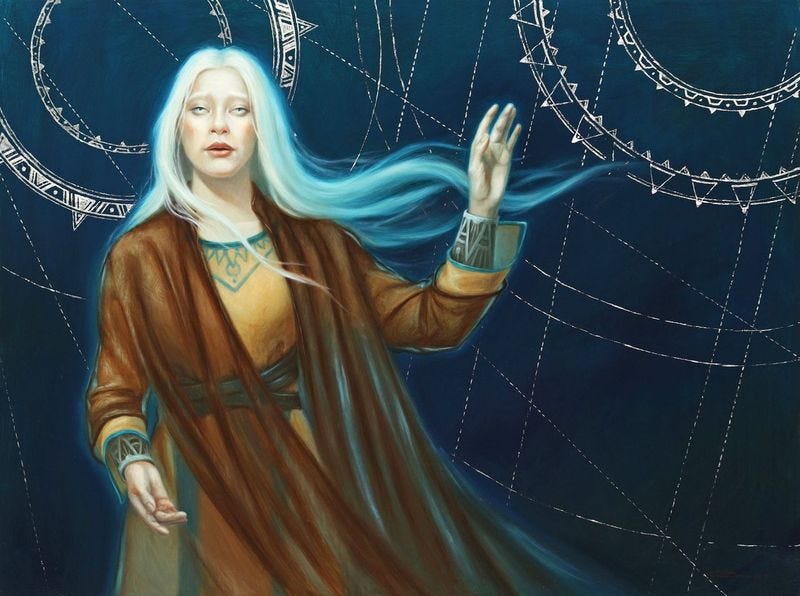
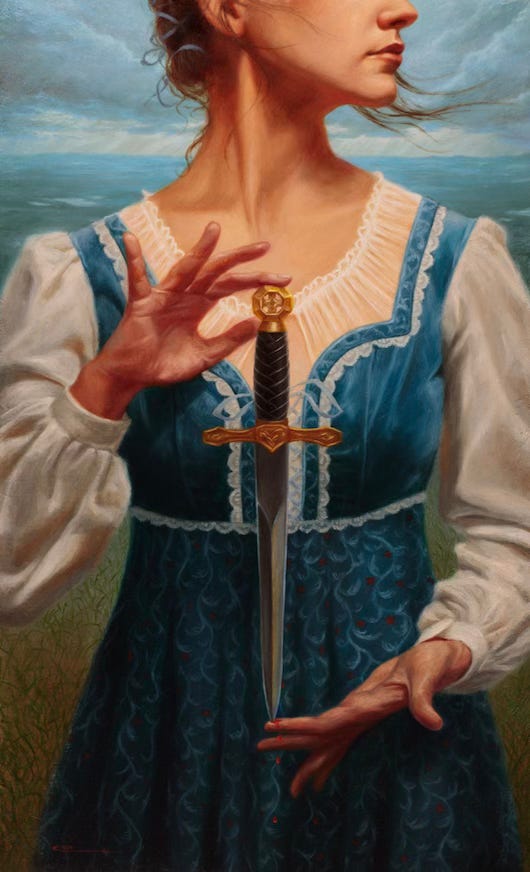
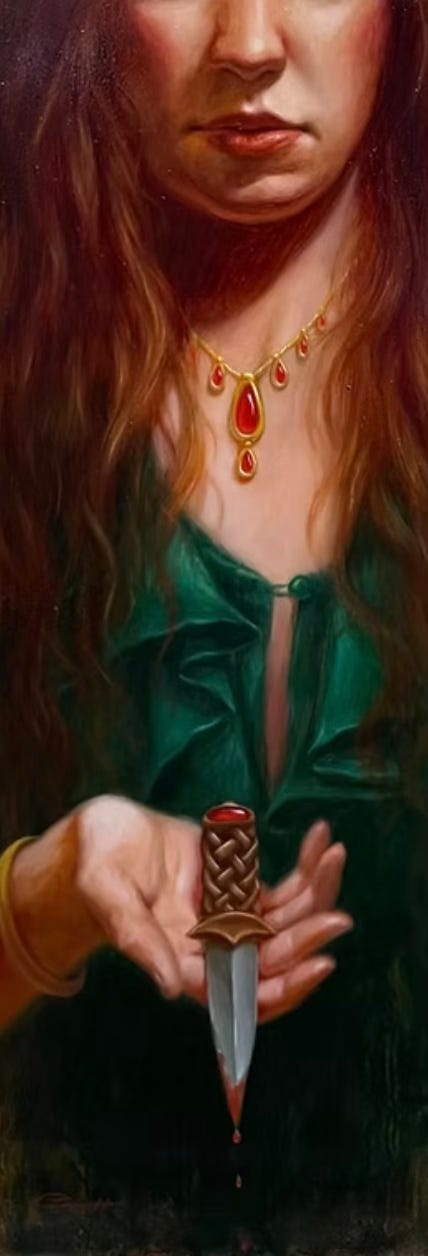
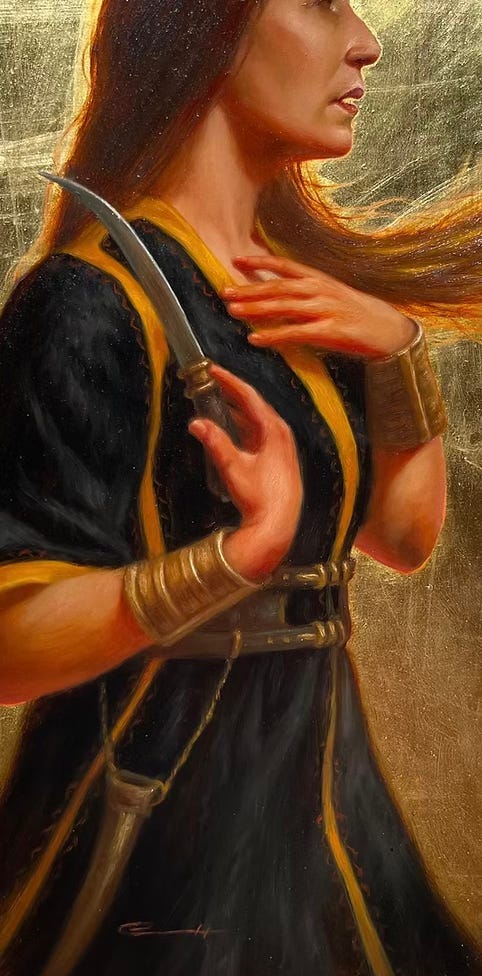
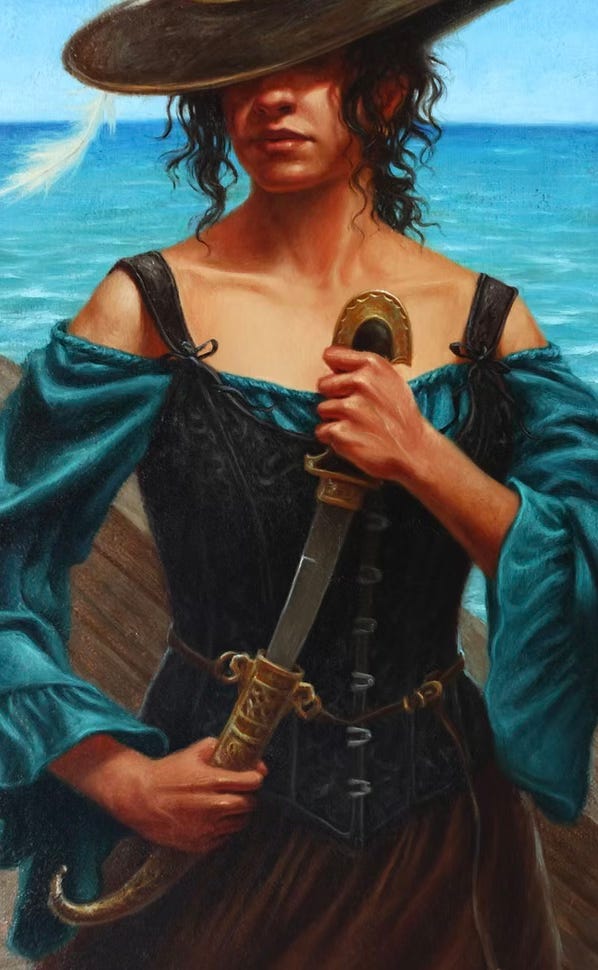
Art by Esther Hi’ilani Candari (@hiilanifinearts), illustrator for Brandon Sanderson, Isles of the Emberdark.
