

“To compose our character is our duty, not to compose books, and to win, not battles and provinces, but order and tranquility in our conduct. Our great and glorious masterpiece is to live appropriately.” —Montaigne, “Of Experience”
Flesh is a fickle medium with which to compose a masterpiece.
Unlike oils or frescos, clay or stone, flesh makes its own demands and follows its own rhythms of production and destruction. Flesh—not just bone, organ, and fascia, but that intangible humanness that Jeremiah warns against when he curses those who make flesh their arm—resists the transformative act of spiritual poiesis. And yet, it has been done: on the cross, in the slums of Calcutta, on Robben Island off the coast of Cape Town, in Birmingham Jail. Perhaps Walt Whitman had such masterpieces in mind when he wrote the preface to Leaves of Grass. If you live filled with love, devote yourself to others, abide with the humble, and re-examine the way things are against the instincts of your soul, then, he writes, “your very flesh shall be a great poem and have the richest fluency not only in its words but in the silent lines of its lips and face and between the lashes of your eyes and in every motion and joint of your body.” I long for such a self. But the work of parenting has newly attuned me to the raw state of the life-poem I am writing.
My second son—Clark—was born abruptly. The face of the nurse performing the routine dilation check registered alarm as she felt her fingers brush against my fully dilated cervix and the wet membrane of a bulging sack. Just try to hold on, she told me while paging a doctor in the emergency room. Every part of my conscious self dissolved into the acute sensations of my body, and I surrendered to the will of muscle and sinew. And then, a surreal softness of skin against my skin, slick with blood and vernix.
Clark was a colicky baby. He woke repeatedly in the night for months on end. The infant sleep strategies that had worked so well with our first child felt fruitless with our second. He fought sleep. Nursing only provided temporary reprieve. If I locked his flailing limbs against my chest and bounced him vigorously for long enough, he would sometimes become drowsy enough to put back in bed. But so often he would wake again, and the whole process would start over. He outlasted all of my attempts to let him “cry it out.” I set timers to force myself to wait longer and longer, crying frustrated tears of my own. I tried to sleep through his crying, but his wails jolted me out of sleep, sending dread down my spine. I didn’t want to feel resentment each time I forced myself out of bed, but my body was so desperate for sleep. I didn’t mean for my daytime self to become irritable, snapping at my two-year-old’s simple requests and speaking passive-aggressively to my husband, but my flesh felt like it was failing me. This was not the self I had intended to make, I thought as I packed crying children into car seats and drove in frustrated, aimless loops, knuckles white on the steering wheel.
How then does one go about creating a masterpiece, whatever the medium might be? In one of his many letters to his brother Theo, Vincent Van Gogh ponders the effort required to breach what he called “an invisible iron wall that seems to stand between what one feels and what one can do.” No amount of frustrated pounding is likely to help, he concludes. “In my opinion one has to undermine that wall, filing through it steadily and patiently.” What does that steady filing look like? In another early-career letter he includes a sketch of a small child in a cradle next to a pipe stove, along with these words: “I hope that by keeping hard at it I shall draw the little cradle another hundred times, besides what I did today.” One hundred repetitions. With reference to another piece, he writes: “Larger compositions must mature gradually, and for a drawing with, let’s say, 3 seamstresses, one might have to draw 90 seamstresses. Voilà l’affaire.” There you have it. Repetition. Perseverance. Patience.
I’m reminded of a few rhyming couplets by an unknown author that hung in the bathroom of my grandmother’s house when I was young. The platitudes printed in neat cursive inside a simple wooden frame matched the aesthetic of the home: the baskets of tough wheat rolls, the home-sewn aprons hanging from the pantry door, the antique foot-pedal sewing machine in the drawing room, homage to the generations of hardy ancestors who trekked to the Rocky Mountain West and farmed their way to relative prosperity.
Stick to your task ’til it sticks to you;
Bend at it, sweat at it, smile at it, too;
For out of the bend and the sweat and the smile
Will come life’s victories after a while.
I suppose this succinctly (if perhaps too tritely) summarizes a philosophy I inherited throughout a childhood of filling tin cans with rocks sifted from the garden, scrubbing our old blue van with sudsy water, and canning quart after quart of applesauce. Applying a little more elbow grease always seemed to work for projects like learning a song on the piano or learning the breaststroke. But are effort and repetition always enough?
I somehow made it through the 250 or so nights until Clark finally learned to sleep through the night, always with one hand winding a lock of hair around and around his fingers. He delighted us with playful wrestling and enthusiasm for the outdoors. However, the same indomitable will that refused to give in to sleep as an infant manifested as a toddler in wholesale commitment to hyper-specific expectations, which, if unmet, led to extreme meltdowns, the intensity of which were beyond anything we experienced with our first child, or later with our third. Something as simple as draining the bath water or not letting him push the red “end call” button on the phone could result in prolonged hysteria. Sometimes the water bottle was the wrong color, or I was walking too far ahead of him, or we couldn’t find his blanket. The toast had butter on it. The toast didn’t have butter on it. Every day brought a fresh round of possible missteps with their ensuing chaos. I knew that in his frame of reference, those things really mattered, and I wanted to honor that. But despite my best efforts, I felt myself getting weaker instead of stronger each time I tried to approach an interaction with patience and love. Instead of growing in my capacity to respond gracefully, I was becoming more and more frazzled.
Sometimes you get stuck in a phase of the creative process that you repeat again and again without the micro-improvements that lead to positive change. It seems that in addition to effort and repetition, technique is also necessary. According to Aristotle’s Poetics, the “essential quality” of poetic components such as form, plot, and rhythm can be analyzed and learned. Mastering techniques means masterful art. As I struggled to learn how to interact with Clark, I listened to parenting book after parenting book. I practiced listening and naming how he was feeling instead of immediately correcting him. I practiced giving alternatives instead of just saying no. Things very slowly got better.
The summer I was pregnant with our daughter Malia, the boys and I went regularly to my grandparents’ house to work in their garden. On one corner of the horse pasture, my grandfather had built a “hoop house” from PVC pipe, welded steel, and thick plastic. It was more than twice my height and 40 feet long, with wooden doors on either end. Oliver would stay for a few minutes before running off to play in the sandbox or climb the apricot tree. But Clark always stayed with me. Something about the hoop house called to him, like it did to me. Together we carefully loosened the root balls of the pepper starts, wound the axial buds of tomato plants around their support cords, and manually pollinated any flowers we found among the prickly zucchini leaves. Despite carefully following the methods my grandparents had perfected over decades of trial and error, it was clear that my gardening techniques could not fully explain the transformation that took place between winter and late summer. Where once there had been a plane of frozen dirt lined with a few browning onion stalks and shriveled potato tubers, by July there was a jungle of leaves and vines sprawling and climbing above my head. Everywhere there was green: the viridian green of strawberry runners, the cadmium green of beans curling up a trellis, the phthalo blue-green of rosemary. There was the deep purple of eggplant and the bright orange of chrysanthemums. There was something so uncannily artistic inside that arched steel frame that I knew my effort alone couldn’t fully account for it.
“There are two ways in which a verse may be written,” writes Japanese literary critic Makoto Ueda; “‘growing’ and ‘making’ . . . a true haiku poet can make his mind transparent, as it were, so that an external object dyes it in its color; this color grows into a poem. A mediocre poet cannot do this, so he has to turn to his intellect, learning, conventional poetic technique, and so on; the poem thus made is inevitably artificial.” Perhaps there is something to a life masterpiece that grit and technique alone can’t produce. Jesus seems to imply as much in John 15: “Abide in me as I abide in you. Just as the branch cannot bear fruit by itself unless it abides in the vine, neither can you unless you abide in me . . . Those who abide in me and I in them bear much fruit, because apart from me you can do nothing.” To abide in something or someone else is to remain together, to continue in united stillness, to dwell conjointly. For plants, it is proximity and connectedness that enables transformation. Significantly, Jesus the carpenter, who could have talked about cutting, sanding, and polishing, instead talked about planting, rooting, and growing. Perhaps work can only take a creation so far before it must be infused with the breath of life to experience full transformation. Perhaps such grace is not ours to command, only to seek out and surrender with the intent to abide. Perhaps all creation is co-creation.
Something changed in me while working in the hoop house with Clark. It wasn’t anything I said. It wasn’t any new proactive parenting strategy. It might have been watching his face light up when he found a watermelon hanging on the trellis, or observing his purposeful stride as he carried oversized cucumbers to the wagon to feed to the horses. But I think it was mostly just peacefully inhabiting the same sacred space, a space where I found unexpected communion with God. I found myself more attuned to Clark’s unique strengths, more connected to him, more filled with love.

I think that learning how effort and grace interweave may be the quest of a lifetime. Too often I try too hard when I ought to surrender, and surrender when I ought to persist. “The bad poet is usually unconscious where he ought to be conscious, and conscious where he ought to be unconscious,” writes T.S. Eliot. To create beauty is to work when lethargy stalks and abide when self-importance encroaches. After all, claims Blake, “eternity is in love with the productions of time.”
But in considering the word “productions,” I find myself stymied again. “Product” has a certain finality to it, a sense of completion that feels unattainable. But then, I question the degree to which I am influenced by a consumerist orientation that views production as a linear assembly line from input to output, where the output is the only part of the process with shelf-stable value. In the Japanese aesthetic tradition of wabi-sabi, this linearity and finality don’t exist. “Often we arbitrarily designate moments, points along the way, as ‘finished’ or ‘complete,’” artist Leonard Koren writes. “But when does something’s destiny finally come to fruition? Is the plant complete when it flowers? When it goes to seed? When the seeds sprout? When everything turns into compost? The notion of completion has no basis in wabi-sabi.” Beauty is instead found in the midst of imperfection and impermanence. There is no static end, only a continuous cycle of being.
And so it is that each morning I rise and try again to practice patience when Clark insists that he will do his reading practice in the middle of the sidewalk in front of our house and nowhere else, and try again to feel compassion when his latest fort gets knocked down and he despairs that it can never ever be built in the same way again. I try to create spaces where I can be still and let God infuse me with the love I need to wrap him in my arms and whisper that I love him “bigger than the whole world.” I try to let the weight of his head against my chest and the twirling of his fingers through his hair remind me that this version of myself, this point in my becoming, is sufficient for this moment.
Maybe that daily cycle of being is changing me, even if it doesn’t feel linear or smooth. The piling up of days feels a little like the Fibonacci sequence, a series where each number is the sum of the two preceding it. Squares with side lengths equivalent to the numbers in the Fibonacci sequence can be tiled in a nesting pattern where each additional square fits precisely against the combined side lengths of a set of the squares before it. If a curve is drawn from corner to opposite corner of each square, it results in a gradually unfolding spiral, albeit one that is kinked where each arc meets the next. And yet, the wider the spiral becomes, the closer it approximates the smoothness of the famous golden spiral found in both organic and man-made art.
One warm afternoon, I took Clark and Malia for a walk. I pushed Malia in the stroller while Clark walked beside us. My intention was to walk the two blocks to a small horse pasture near our home; a linear passage to a clear destination. We hadn’t walked long before Clark circled around the stroller to investigate a hedge that, to his delight, was full of little green berries. He put some in his pockets and some in the stroller’s cup holder. He bounded from tree to gutter to bush, winding and turning around to discover seed pods, interestingly shaped leaves, and several thick mushrooms sprouting in the shade. This particular walk stands out in my memory because of the nest. Clark pulled me from the sidewalk to observe the intricate assemblage of sticks and dried grass that had fallen from the tree above. It was almost as if it had sacrificed its secluded perch to question me: “Why are you in a hurry to get where you are going? Beauty is right here.”
I think I am just now beginning to understand what Jesus might have meant when he taught that the transformation we should seek is to become like little children. Each consecutive round of a spiral, though wider in diameter, still circles around its point of origin, preserving its shape even as it grows in capacity. “Spiritual innocence is not beyond knowledge but inclusive of it, just as it is of joy and love, despair and doubt,” writes poet and essayist Christian Wiman. We are to “mature into childhood,” as Polish writer Bruno Shulz says. As I spend more time with Clark where he is most in his element—in nature—he helps me understand what that means. We are to collect blackened walnuts from the ground like gems, to climb on top of every rock and every stone wall, to laugh unrestrainedly, to look up at the sky; and to do these things even while carrying our fear(s) and frustration(s) and insecurity(ies).
Some months ago my husband and I began a reflective practice at the dinner table. We explained to our kids how they could describe the ups and downs of their day using a rose-thorn-bud metaphor. I expected their “roses” to be about drawing with chalk on the driveway or eating popsicles or going to storytime at the library. But from the very beginning, every day, even on days when I had dragged Clark from the park and forced his car seat buckle too roughly over his shoulders, even on days when I had hid in my room refusing to respond to his kicking on my door, and still now, even on days when I have spoken more harshly than I would like to admit, Clark, without hesitation, and with eyes lighting up, announces: “My rose is Mommy.” Dinner after dinner he makes the same proclamation, and each rose he offers is resplendent with joy, striking in its generosity, stark in its honesty. Maybe the beauty I have longed to create has been here all along. “And now you know how these things are forgotten: / for here before you stands a bowl full of roses,” writes Rilke. But no, there is no bowl of roses, there is just you; again and again, in your flesh, not out of it, through grit and through grace, in the simple now rather than the elusive someday, you are the rose of his four-year-old free verse.
Somehow whole, somehow enough, somehow holding what is.
Aren’t all the roses like that, so self-containing,
If to contain oneself means: to transform the world outside,
And wind and rain and patience of spring
And guilt and restlessness and muffled fate,
The darkness of earth at evening,
Out to the wandering, the flight, the coming on of clouds,
Out to the hazy influence of distant stars
Into a handful of pure inwardness transformed.
Now it lies free of cares in the open roses.
—Rilke, “The Bowl of Roses”
Julie Graham Hollenbaugh is a writer, reader, and mother of three currently pursuing a master’s degree in English at Brigham Young University.
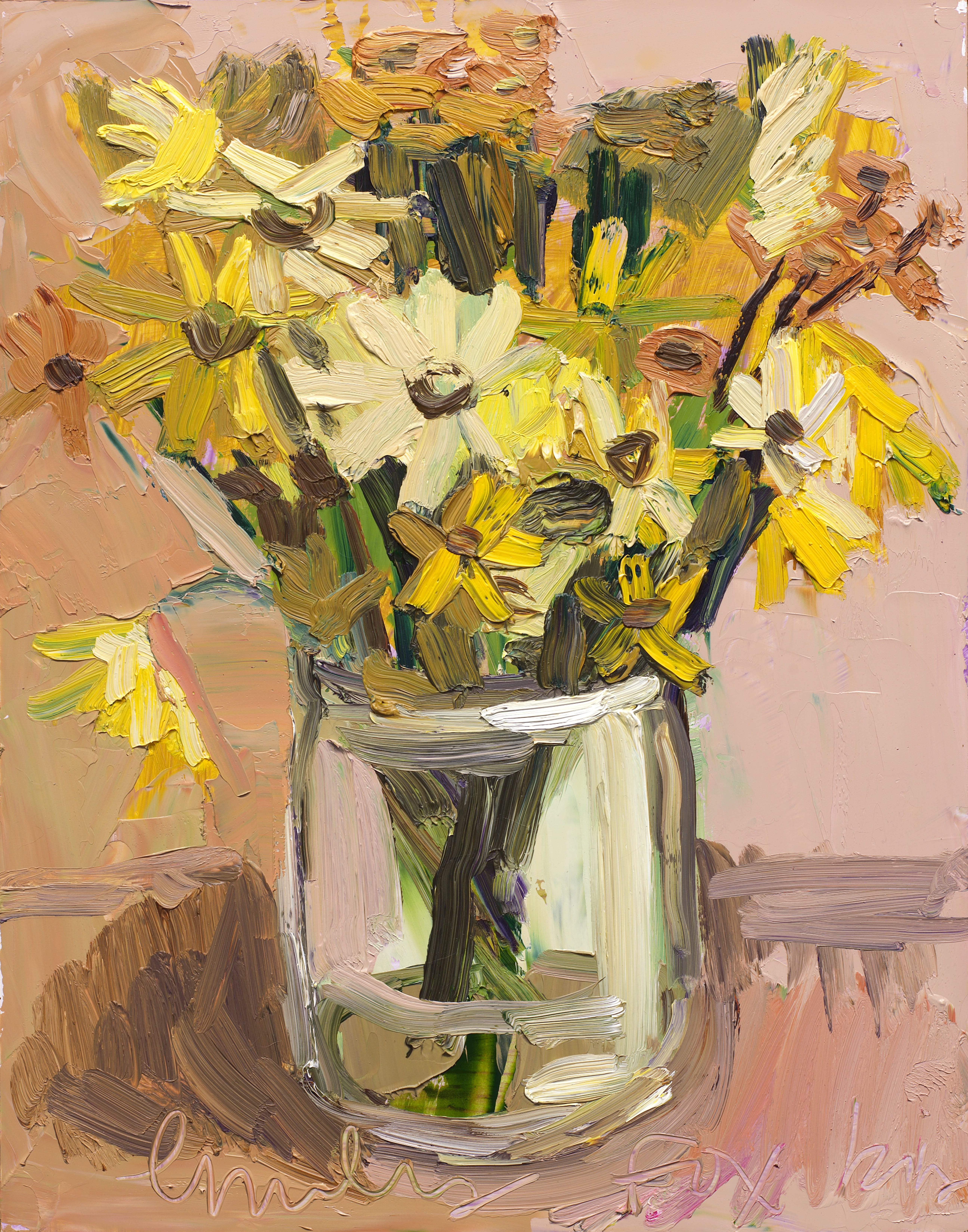
Art by Emily Fox King (@emilyfoxking).
FEATURED
Peacemaking and Democracy

We are called to be peacemakers. And peacemaking is an active endeavor, requiring real effort, true courage, and dogged persistence.
The Vale of Soul-Making

Call the world if you Please “The vale of Soul-making”
Then you will find out the use of the world
—John Keats, 1819


I agree with Clark: You're a rose, Julie.