


Please enjoy three essays on prophecy, all featured in Wayfare issue 6. Keep scrolling to read “Through the Strait Gate: The Transformative Power of Prophecy” by Zohar Atkins, and click the links featured here to read “Hope, Fear, & Creation: Living in Response to Prophecy” by Don Bradley and “The Spirit of Prophecy: The Shape of Jesus in Time” by James Goldberg.
Hope, Fear, & Creation

“Prophecy is more certain than history.”
Dad doubtless meant this assertion to offer certainty in an uncertain world. Prophecy, understood as the declaration of an unalterable fate, represented a rock of stability we might glimpse through the mists ahead.
The Spirit of Prophecy

I. “No man is a minister of Jesus Christ without being a prophet,” Joseph Smith once taught.
When Walter Benjamin was fleeing Nazi Europe in 1940, he reached out for a different understanding of time and agency than the one that seemed to be closing in on him. He wrote: “We know that the Jews were prohibited from investigating the future. The Torah and the prayers instruct them in remembrance, however. This stripped the future of its magic, to which all those succumb who turn to the soothsayers for enlightenment. This does not imply, however, that for the Jews the future turned into homogeneous, empty time. For every second of time was the strait gate through which Messiah might enter.”
In that desperate moment, when prediction had failed catastrophically, when the future seemed foreclosed, he discovered the prophet’s deepest secret. The prohibition against soothsaying wasn’t arbitrary religious law. It protected something infinitely more precious than fortune-telling: the space for transformation itself.
Benjamin understood that the biblical prophet succeeds not by predicting the future accurately but by creating possibilities for people to change it. This insight cuts against everything our data-driven age believes about wisdom and authority. We worship at the altar of prediction: algorithms that forecast consumer behavior, models that anticipate market movements, analytics that promise to reveal hidden patterns in human conduct. But the prophet operates by entirely different logic.
Jonah, history’s most reluctant oracle, proves the point. God dispatches him to Nineveh with words that sound like inevitable doom: “Forty days, and Nineveh shall be overthrown” (Jonah 3:4, JPS). Jonah delivers the message with all the enthusiasm of a man reading his own death warrant. The city erupts in repentance—sackcloth, ashes, fasting. Nineveh survives.
By every contemporary measure of expertise, Jonah failed spectacularly. His prediction proved false. His credibility lay in ruins. Yet this “failure” represents prophetic success at its most sublime. The prediction failed because it succeeded—not as forecast but as catalyst. Jonah’s words didn’t describe an inevitable future but awakened a dormant capacity for change.
This reveals prophecy’s central tension. The prophet speaks about the future precisely to prevent it from happening. Prophetic speech creates space for humanity to turn around, to come home to itself, to become what it was meant to be rather than what it seems destined to become.
Benjamin grasped that this makes prophetic time fundamentally different from soothsayer time. The fortune teller fills tomorrow with magical necessity—what will be will be. The prophet fills today with transformative possibility—what could be if you change. Every second becomes what Benjamin calls a “strait gate”—not because the Messiah will certainly come, but because the Messiah might come if we create conditions for that coming.
Yet where does the prophet get the authority to speak such world-altering words? Amos provides the most honest answer about authority ever recorded: “I am not a prophet nor the son of a prophet” (Amos 7:14, NASB). The shepherd-turned-oracle admits he has no credentials whatsoever. He was tending sycamore trees when the word of God erupted through him like wildfire.
This uncredentialed authority scandalized ancient Near Eastern sensibilities. Mesopotamian courts employed professional diviners—specialists trained in reading omens, interpreting dreams, and advising kings through established protocols. The Israelite prophet claimed something unprecedented: direct divine authorization that bypassed every human hierarchy, every institutional filter, every credential system.
But this divine authorization comes with a terrible requirement: The prophet must use divine authority to challenge human authority. Nathan confronts King David about his adultery with Bathsheba, speaking truth that could cost him his head (2 Samuel 12:7). The prophet’s job description requires speaking truth that disrupts comfortable power arrangements.
Thus the prophet serves power by challenging it. And the worthy leader is the one who accepts the prophet’s critique. David’s greatness emerges not from moral perfection but from his capacity to respond to prophetic rebuke with repentance: “I have sinned” (2 Samuel 12:13). The king who can be corrected proves himself worthy of correction. The leader who remains teachable deserves to lead.
This distinguishes prophetic discourse from advisory discourse. The advisor helps the king achieve his stated goals more efficiently. The prophet questions whether those goals deserve achievement.
Like the artist who ventures into the realm of imagination, sometimes torquing convention to find new means of expression, the prophet functions as a creative force rather than a mere spokesperson. Both prophet and artist embrace productive uncertainty—not because confusion has value for its own sake, but because the most important transformations happen at the edge of current understanding, in that uncomfortable space between what we think we know and what we might discover if we remain open to change. The artist’s canvas and the prophet’s words both become spaces where new possibilities can emerge. Most biblical prophets are not known for their miracles, but instead for their poetry, where meaning is so compressed that it can hardly be paraphrased. The prophet stretches language, transforming conventional speech and summoning us to a different register of attention.

The prophet’s challenge extends into the most audacious realm imaginable: arguing with God himself. Abraham negotiates with the Almighty over Sodom and Gomorrah, bargaining down the number of righteous people needed to spare the cities (Genesis 18:23–32). Moses stands between divine wrath and human destruction after the golden calf incident, interceding so forcefully that God “repents” of planned punishment (Exodus 32:11–14, KJV). The prophet functions as defense attorney for humanity against the court of heaven.
This advocacy reveals prophecy’s deepest commitment: defending human possibility against every force—divine or human—that would foreclose it. The prophet advocates for values that resist measurement, for goods that transcend optimization, for possibilities that calculations cannot capture.
The prophetic voice persists in asking uncomfortable questions that our metrics-obsessed culture prefers to avoid: What are we really optimizing for?
But the tradition itself acknowledges prophecy’s shadow side. False prophets appear alongside true ones throughout biblical narrative. Prophecy itself is vulnerable to manipulation and self-deception.
Jewish tradition recognized that prophecy as direct divine communication wouldn’t and couldn’t continue indefinitely. The Talmudic story of the Oven of Akhnai captures this historical pivot with characteristic wit. In this famous rabbinic tale about a legal dispute over ritual purity, when a heavenly voice intervenes to support Rabbi Eliezer’s legal interpretation, Rabbi Joshua responds with words that redefined religious authority: “It is not in heaven” (Bava Metzia 59b). The Talmud reports that God laughed with delight at being overruled by human reasoning. Divine revelation yields to interpretive community. The age of direct transcendent communication ends; the era of collaborative meaning-making begins.
This transition created profound loss and gain. We lost the immediacy of prophetic authority—voices that could cut through human confusion with divine clarity. But we gained something unprecedented: the responsibility to become interpreters ourselves, to engage collectively in the work of discernment that prophets once performed individually.
Yet something crucial was lost that our age desperately needs: voices willing to challenge the reduction of human complexity to algorithmic simplicity. We need prophetic virtues even if we cannot recover prophetic authority.
These insights about prophecy have fundamentally shaped my approach to education. Most educational technology functions like sophisticated soothsaying—analyzing student performance data to predict learning outcomes and delivering predetermined content through algorithmically optimized pathways. But education rooted in prophetic principles operates by different logic entirely. Like biblical prophets, prophetic teachers refuse to tell students what they want to hear. Instead of confirming existing assumptions, prophetic education challenges those assumptions, probing their foundations and revealing their hidden implications. And just as the prophet seeks to transform rather than merely inform society, great teachers turn students into lifelong learners rather than just “correct answer” machines.
The prophetic model offers essential guidance for anyone wielding authority or influence in our prediction-obsessed age. We face a choice that parallels the ancient decision between prophet and soothsayer. We can build systems that forecast human behavior based on past patterns, optimizing for efficiency and predictability. Or we can create spaces that honor the human capacity for genuine change, that defend dignity against reduction to data points.
We should not reject prediction outright but keep a space open through which “the Messiah might enter.” My argument in favor of transformative prophecy is not an argument against science or empirical knowledge. Rather, it’s a recognition that the most important human realities resist reductionism because they emerge through transformation. The ancient prohibition against predicting the future wasn’t an antiscientific stance, but a normative intervention against fatalism.
Benjamin found in the prophetic and rabbinic tradition that remembrance is not just an act of recalling past facts, but an active engagement with human capacity for renewal. By insisting that redemption is not inevitable, Benjamin recovers the unique power of the present moment, what he calls “now-time” (Jetztzeit) and what Giorgio Agamben, drawing on Paul, calls kairos. When the French revolutionaries shot at the clock towers, Benjamin sees them, in a prophetic mold, following the example of Joshua stopping the sun in the sky, taking aim at linear, “homogeneous,” measured time itself.
The ancient prophets summoned us to agency and potentiality by claiming divine authority. Our question is whether we can cultivate prophetic virtues through human faith and commitment alone. Yet our uncertain conditions are not new. They are intrinsic to the prophetic endeavor. When we abandon the soothsayer’s magic, we don’t lose access to the future. We discover that the future remains open, responsive to our choices. The prophetic art means seeing this very moment as a potential entry point for something genuinely new.
Zohar Atkins is a rabbi, scholar, and poet, and founder of Lightning Studios, an education company devoted to inspiring learning as a way of life. He blogs at “What Is Called Thinking?” and writes a weekly Torah commentary. He podcasts at Meditations with Zohar.
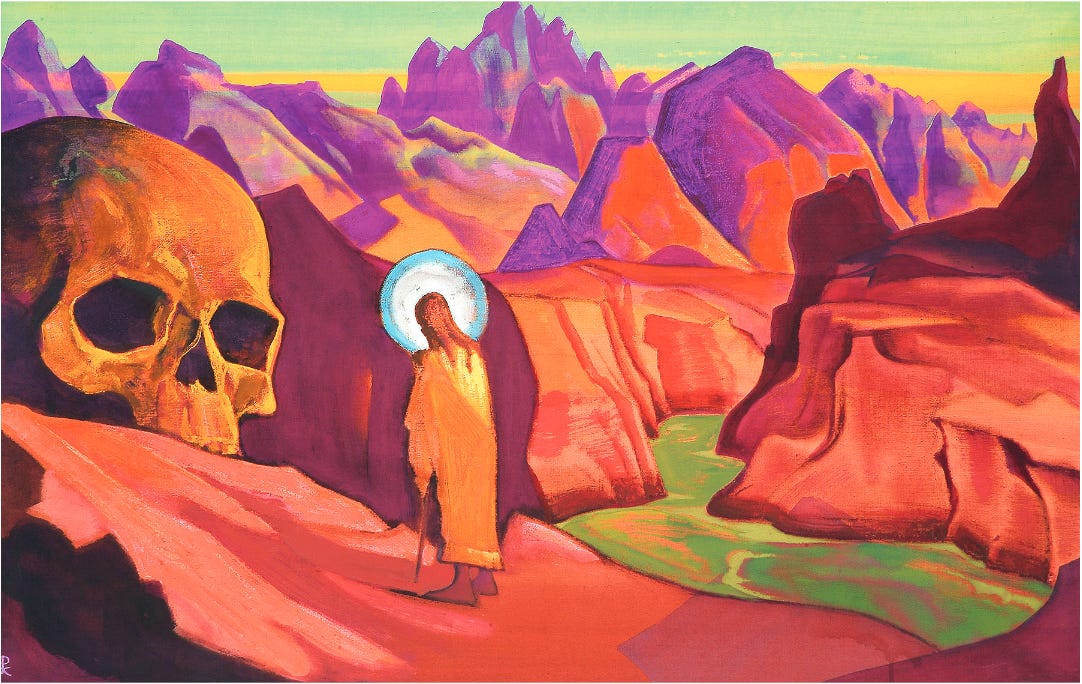
Art by Nicholas Roerich (1874–1947).


"Most biblical prophets are not known for their miracles, but instead for their poetry, where meaning is so compressed that it can hardly be paraphrased."
I was thinking about this yesterday as I read the book of Joshua. Chapter 24 is incredibly poetic, creating a parallelism between Abraham, Moses, and Joshua, who each cross the Euphrates River, Red Sea and Jordan River, respectively. A phrase used in this chapter that also connects these prophets to Moses is, "the other side of the flood." Abraham, Moses, and Joshua, like Moses, all come from the other side of "the flood" into promised lands. It's a wonderful chapter, combining history and the law in a poetic structure.