


“Prophecy is more certain than history.”
Dad doubtless meant this assertion to offer certainty in an uncertain world. Prophecy, understood as the declaration of an unalterable fate, represented a rock of stability we might glimpse through the mists ahead.
My father was then an ardent young convert to the Restoration, which began with fulfillment of prophecy. Hadn’t Joseph Smith verified Isaiah’s ancient prediction that a sealed book would be offered to the learned and then taken to the unlearned (Isaiah 29:11–12)? This incident, in which Joseph sent Martin Harris with characters from the golden plates to Charles Anthon, became a prototype for the fulfillment of prophecy.
Prophecy, the dramatic event assured, was being fulfilled in modern times.
But what assurance could I feel in my childhood world when the certainty offered was that of certain destruction?
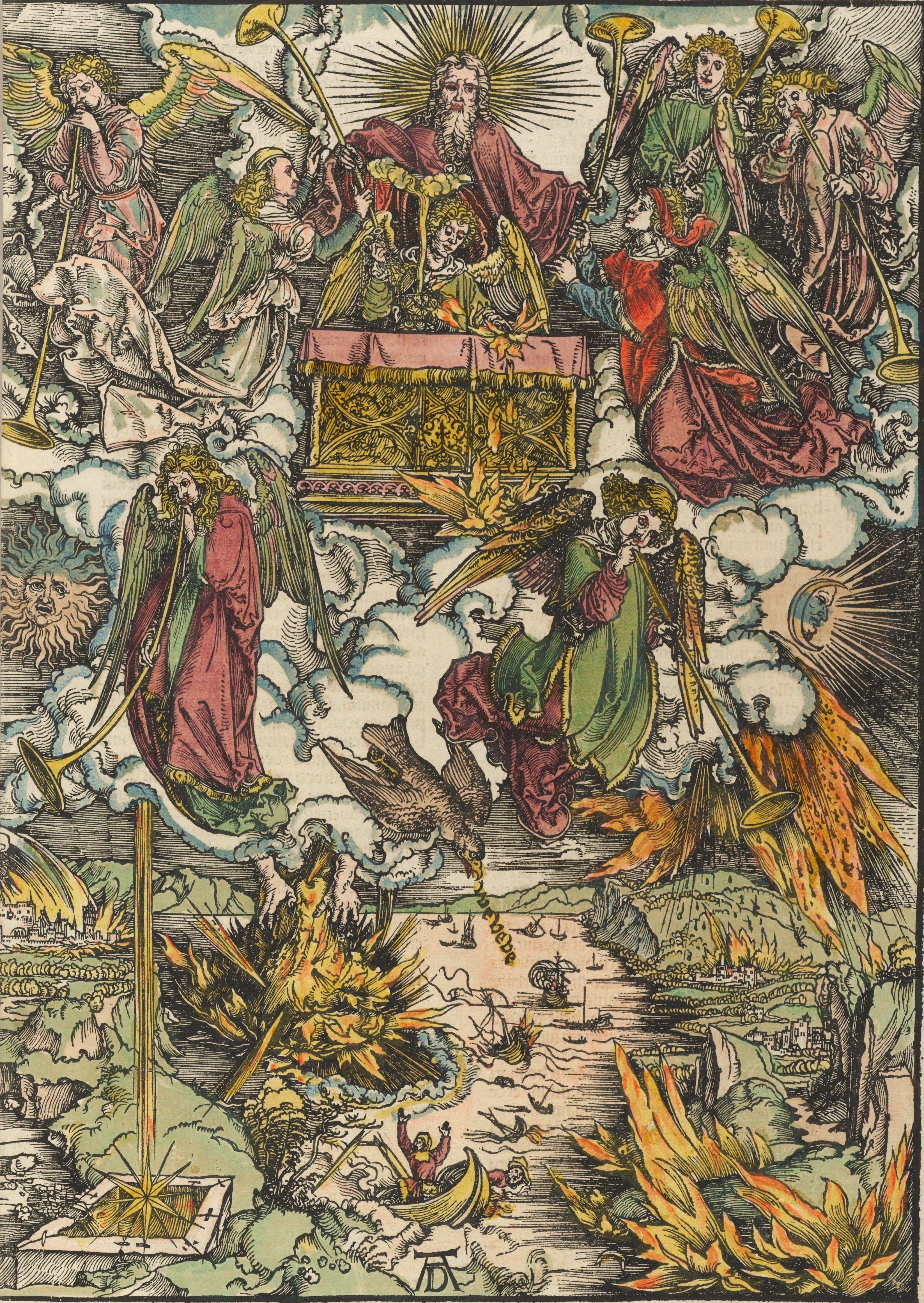
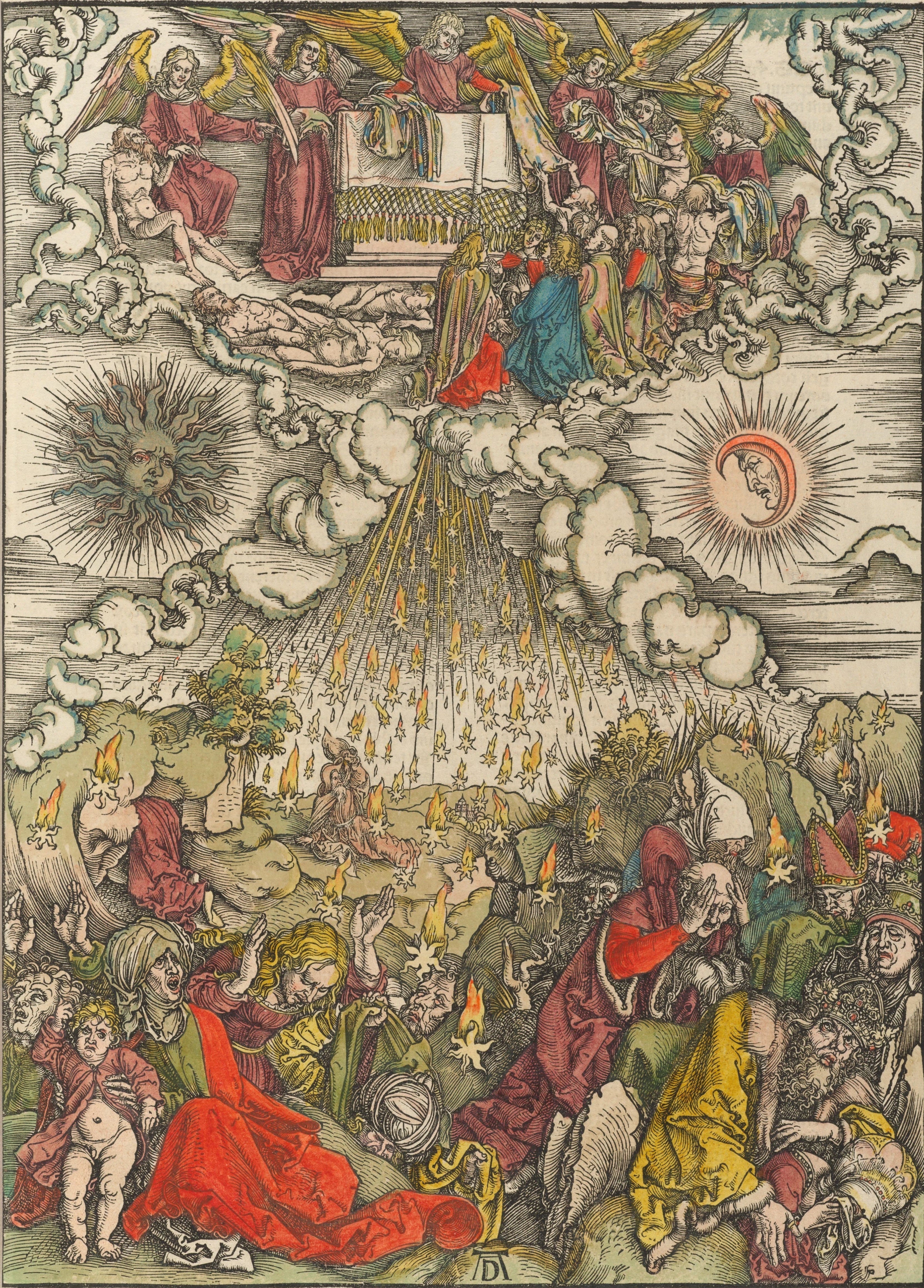
Reading about another “sealed book,” one bound with seven seals, fascinated me—and frightened me. As a twelve-year-old late in the Cold War, I combed through the book of Revelation one Sunday afternoon to figure out when the Second Coming would commence. Having been told repeatedly that I was growing up in the closing of Revelation’s sixth seal, the events it predicted were ones I anticipated in my own lifetime. What, then, might I expect? The sun going black, the moon turning to blood, and the stars falling from heaven (Rev. 6:12–13), “hail and fire mingled with blood” (Rev. 8:7), and monstrosities fit for Mordor—battle locusts
like unto horses prepared unto battle; . . . and their faces were as the faces of men. And they had hair as the hair of women, and their teeth were as the teeth of lions. . . . And they had tails like unto scorpions, and there were stings in their tails: and their power was to hurt men five months. (Rev. 9:7–10)
Such omens did not inspire optimism for my life ahead.
Little did I suspect then that my search of scripture, research into Church history, and experience of life would lead to a vision of prophecy radically different from Dad’s—that prophecy is not a statement of fate but of potentials, potentials either to be realized or to be averted.
That view was still far in the future for my child self. At that point in my personal history, prophecy was still “more certain than history” in the way my father meant it.
At the time, many of the predicted catastrophes were widely anticipated to come from the Soviet Union, through what Bruce R. McConkie described as “the atomic holocausts that surely shall be.”1 The inevitability of prophecy that Dad declared in order to instill comfort was also a cause for dread.
I was left to wonder: Would I, like those before me, have a “normal” life? Would I go to college, have a career, have a family? The pervasive anxiety instilled by the Cold War, and for me intertwined with the fulfillment of prophecy, was captured in the generational anthem “Forever Young” by Alphaville:
Let’s dance in style, let’s dance for a while
Heaven can wait, we’re only watching the skies
Hoping for the best but expecting the worst
Are you gonna drop the bomb or not?
In August 1991, my anxiety soared to its eschatological zenith. A reactionary Communist Party ousted the reformist Soviet president Mikhail Gorbachev. Would they seek to impose communism across the globe, fulfilling scriptural prophecies of destruction? Shockingly, just days later, the coup failed and the Communist Party dissolved.
When by the close of the year the Soviet Union, and the Cold War itself, ended with a whimper rather than a catastrophic boom, I, like the Apostle Paul, felt the scales falling from my eyes. Could we choose hope rather than long-foretold doom? Were prophecies of cataclysm fated actualities that must be suffered or, as I was beginning to warm to, usable warnings of potentialities that could—and should—be avoided?
I turned again to prophecy—this time to prophecies whose fulfillment, or negation, lay in the past. I examined the clearest example of conditional prophecy in scripture, one where destruction was predicted but did not occur because of repentance: the book of Jonah. I found, unexpectedly, that Jonah’s prophecy of the destruction of Nineveh, though it ultimately proved conditional, had been stated unconditionally: “Yet forty days, and Nineveh shall be overthrown” (Jonah 3:4, emphasis added). The people of Nineveh asked, “Who can tell if God will turn and repent, and turn away from his fierce anger, that we perish not? And God saw their works, that they turned from their evil way; and God repented of the evil, that he had said that he would do unto them; and he did it not” (Jonah 3:9–10). The people interpreted Jonah’s unconditional oracle conditionally—hopefully—and thus repented, which is precisely why they were not destroyed. Jonah himself, who appears to have believed every prophecy should be fulfilled regardless of its consequences, was dismayed by this outcome (Jonah 4:1). Yet what concerned the Lord in the narrative was not the prophecy’s accuracy, but its function: God had prophesied Nineveh’s destruction to save it from that very destruction (Jonah 4:10–11).
Awakening from my own Cold War nightmares, I wondered if the intended function of our own “unconditional” latter-day omens of catastrophe was precisely to prompt the change of heart needed to render them moot.
As the Cold War ended in a thaw, the culture around me transformed. Confident predictions of the world’s demise were swiftly replaced with confident predictions of progress. Instead of the fiery end of the world, we were now promised the placid “end of history,” with democracy and freedom inescapably carrying humankind into perpetual peace.2
The song that captured the moment was the British pop band Jesus Jones’s ebullient “Right Here, Right Now.” Where “Forever Young” lamented a beautiful future that would never arrive, “Right Here, Right Now” celebrated the world’s new democratic moment as the messianic future that past generations had awaited—the world’s awakening from history:
A woman on the radio talks about revolution
When it’s already passed her by
Bob Dylan didn’t have this to sing about
You know it feels good to be alive
I was alive and I waited, waited
I was alive and I waited for this
Right here, right now
There is no other place I wanna be
Right here, right now
Watching the world wake up from history
Oh, I saw the decade end
When it seemed the world could change at the blink of an eye
And if anything
Then there’s your sign
Of the times
Even now, listening to this song brings tears to my eyes. It celebrated the dawning of hope.
It was at this optimistic moment that I first became a dad to my oldest son Donnie. Bringing a baby boy into the hopeful post-Cold War world, I believed that in our age of ever-accelerating discovery and invention, my son would be all but assured a long, healthy, happy life. I was wrong.
The world has not unfolded as I dreamed in those heady days. Far from an inexorable ascent toward paradise, the trajectory of recent history marries technological utopia to elements of social and political dystopia.
This raised new questions for me: If the catastrophic prophecies of scripture are not guarantors of destruction, but warnings to provoke repentance, what of paradisiacal prophecies? Do scriptural predictions of the beauties of Zion and the reign of God’s justice mean these are boons we can passively await?
The inevitability of progress is a key myth of capitalist culture—one challenged by both the warning prophecies of ancient scripture and by visionaries of our modern age. Martin Luther King Jr. originally believed the myth that society would inevitably evolve toward greater justice, rationality, and peace. Only when he saw that progress was not inevitable did he take decisive action to create progress.
In his last Sunday sermon, King declared:
Time is neutral. It can be used either constructively or destructively. . . . Somewhere we must come to see that human progress never rolls in on the wheels of inevitability. It comes through the tireless efforts and the persistent work of dedicated individuals who are willing to be co-workers with God.3
The myth of inevitable progress blinds us to what we, individually and collectively, must do. If, as in King’s famous line, “the arc of the moral universe is long but it bends toward justice,” perhaps it is because we take it upon ourselves to thus bend it.
My own illusions of inevitable progress have been shattered with the needless and tragic death of one of the most innocent-hearted human beings I have known—my own dear Donnie.
A poet, a polymath, and a philosopher, with an open heart, mind, and soul, Donnie deserved the best life could offer. Donnie’s suffering and death—too recent, too raw, and too painful for me to yet elaborate—resulted from evils of our world, both natural and social, from which modern society is supposed to protect us. But structures that promise peace and prosperity are often set up with disregard for life, or at least some lives. And the quantitative growth delivered by our economic markets does not always secure quality of life, or justice, as it surely did not for my son.
Yet one of Donnie’s distinguishing strengths has always been hope—not hope that things will just work out, but hope that, again, we can make them work out. In a poetry manuscript that I found after his death, Donnie expressed hope that “we might rend through the doubting a path of light.”4 He saw in the promises and prophecies of scripture a divine project in which we can participate.
More and more, I am coming to see what Donnie saw. This shift in me, prompted by Donnie’s life and accelerated by his death, has also been shaped by Joseph Smith, whom I research as a historian.
A key insight affirming Donnie’s approach to prophecy came from revisiting the prototype of fulfilled prophecy that so impressed my dad—Martin Harris delivering the plates’ words to Charles Anthon. While researching my book The Lost 116 Pages: Reconstructing the Book of Mormon’s Lost Stories, I discovered that as surprising as the 1828 consummation of Isaiah’s prophecy had been for many, Joseph Smith was likely unsurprised by it.5 Martin Harris, unfamiliar with Isaiah’s prophecy about the sealed book before his encounter with Anthon, stumbled blindly into its fulfillment.6 Joseph Smith, by contrast, was intimately familiar with this prophecy and aware in advance of his opportunity to fulfill it.
A first line of evidence that Joseph knew Isaiah 29 long before he sent Martin to Anthon comes from the First Vision. Many Latter-day Saints are aware that Joseph reported the Lord telling him, regarding contemporary religious partisans, “they draw near to me with their lips, but their hearts are far from me,”7 but perhaps few realize the origin of this phrasing:
And the vision of all is become unto you as the words of a book that is sealed, which men deliver to one that is learned, saying, Read this, I pray thee: and he saith, I cannot; for it is sealed: And the book is delivered to him that is not learned, saying, Read this, I pray thee: and he saith, I am not learned. Wherefore the Lord said, Forasmuch as this people draw near me with their mouth, and with their lips do honour me, but have removed their heart far from me. . . . (Isaiah 29:11–13, emphasis added)
Young Joseph, led to this experience by reading his Bible, would have likely recognized the connection, linking him to Isaiah’s prophecy long before he was aware of the Book of Mormon. But we need not merely infer this. That Joseph knew of this prophecy, and anticipated fulfilling it as early as 1823, is stated explicitly by Emily Coburn Austin, an 1830 convert:
He [Joseph] declared an angel had appeared to him and told him of golden plates, . . . and . . . it was that which Isaiah the prophet had spoken of; a vision which should become as the words of a book that is sealed; which was delivered to one that was learned, saying: “Read this, I pray thee.”8
That Joseph knew of Isaiah’s “read this” prophecy and explicitly intended to fulfill it is also reported in his 1835 history, penned for him by Oliver Cowdery. This history reports Joseph knew at the outset that he would have to send characters from the sealed plates to the learned before translating, because the angel told him so in 1823:
[I]t was . . . [his] privilege, if obedient to the commandments of the Lord, to obtain, and translate the same by the means of the Urim and Thummim. . . . “Yet,” said he [paraphrasing Christ from Mark 14:49], “the scripture must be fulfilled, before it is translated, which says that the words of a book, which were sealed, were presented to the learned. . . .”9
How strikingly different a narrative I found here than the one with which I had been raised. Instead of fulfilling prophecy blindly, an unwitting player in the sacred drama, Joseph fulfilled Isaiah’s sealed book prophecy—the prototype of fulfilled prophecy in the Restoration—proactively as a conscious collaborator with God.
Further research demonstrated that Joseph Smith viewed prophecy less like Dad and more like Donnie. Joseph worked to fulfill prophecies, including those of building Zion, of reconciling the hearts of parents and children as predicted by Malachi, and of the establishment of God’s just kingdom prophesied by Daniel. Revelation through Joseph commands the saints explicitly to fulfill Malachi’s prophecy: “Seek diligently to turn the hearts of the children to their fathers, and the hearts of the fathers to the children” (D&C 98:16).” And as he approached the close of his life, Joseph declared his intention to fulfill Daniel’s prophecy: “I calculate to be one of the instruments of setting up the Kingdom of [God prophesied by] Daniel, and I intend to lay a foundation that will revolutionize the whole world.”10 He concluded his prophetic career as he had begun it, cooperating with God’s will by turning prophecy into a plan of action.
As modeled by Joseph, we Latter-day Saints are called upon to be active participants in shaping the outcome of prophecies. Where prophecy speaks of disasters, we are not, like Jonah, to hope for its fulfillment; we are, rather, called to help avert those disasters, as Jonah did inadvertently. Where prophecy speaks of hopes ahead, we are called to be coworkers with God in actualizing them. Scripture is a script. Reading it actively opens us to performing its best lines and avoiding its worst.
Enacting Malachi’s prophecy of reconciling the generations in my own life, as a living link between a father and a son who have both passed on, I can carry on Dad’s legacy through Donnie’s vision. Dad was right to find in the prophecies of scripture a source of hope. Yet, as Donnie saw, this hope need not derive from passively awaiting fate but from purposely collaborating with God. Prophecy, played out in the living present, is more certain than history, the absent past.
Human beings, Latter-day Saint theology distinctively declares, are created to become cocreators. Prophecies of Zion, of the binding together of hearts, and of the reign of God’s justice on earth as in heaven offer us not merely a forecast of the future but a blueprint for creation. We can join in completing the creation of the world, the world as our Father ultimately intends it, the world our ancestors hoped for, the world our children deserve.
I dedicate this paper to the great lights of my life, my sons Donnie and Nicholas.
DONALD PATRICK BRADLEY, SR. (“Don”) is a historian of American religion specializing in the life of Joseph Smith and the origins of the Latter-day Saint Restoration. He is the proud father of Donnie and Nicholas Bradley.
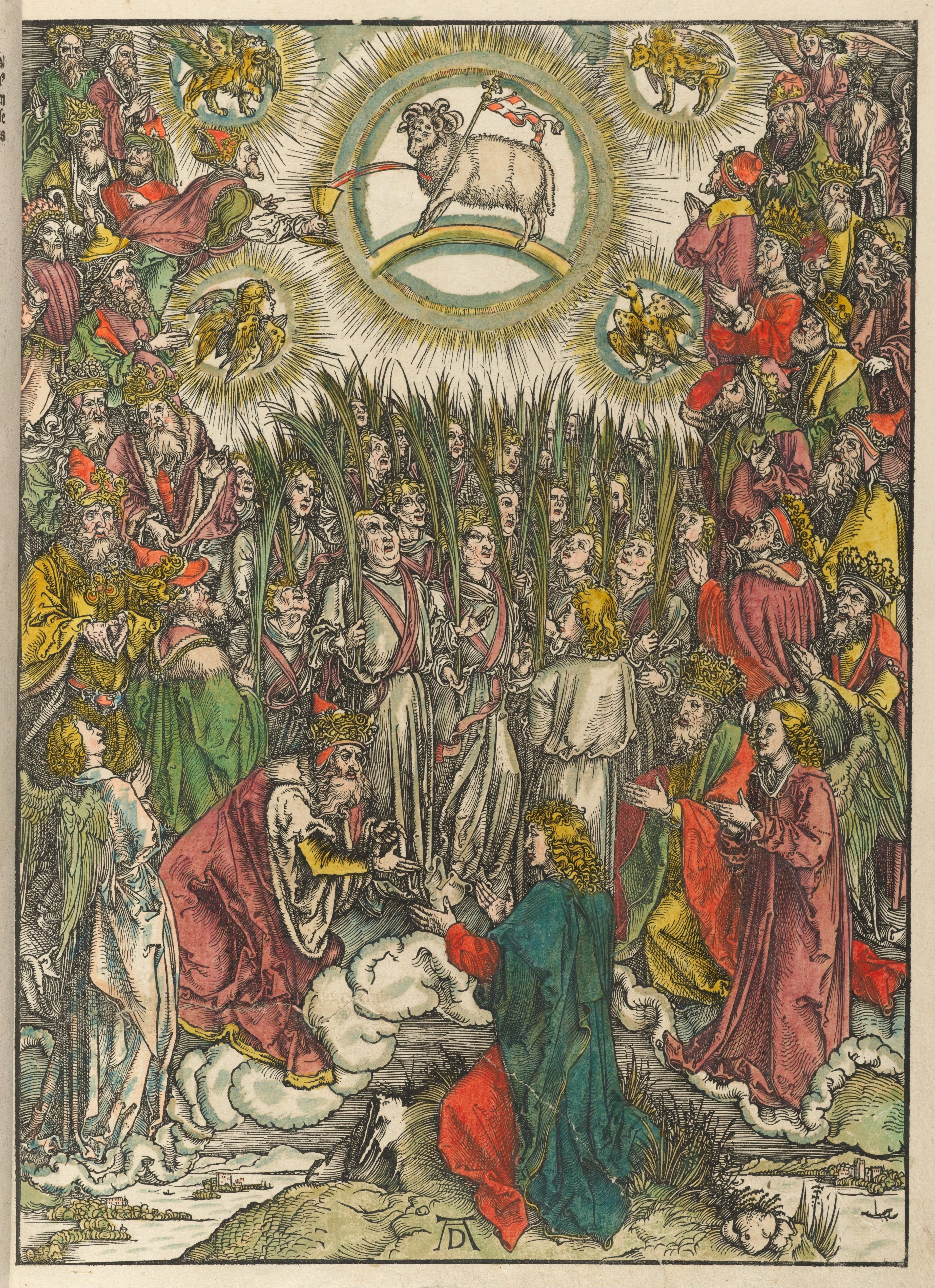
Art by Albrecht Dürer.
Additional notes from the author about the art:
Albrecht Dürer, The Opening of the Fifth & Sixth Seals, from The Apocalypse, 1498. This image portrays, in the human realm, the terror of passively experiencing the fulfillment of destructive prophecy—the darkening of the sun, the bloodying of the moon, and the falling of the stars from heaven (Rev. 6). It also portrays, in the heavenly realm, martyrs who had been crushed by the powers of this world crying out to God for eventual justice to be done on the earth. This image was brought to my attention because my late son Donnie considered it for the cover design of his forthcoming poetry collection Light of an Hour before settling on another, contrasting Dürer image displayed below.
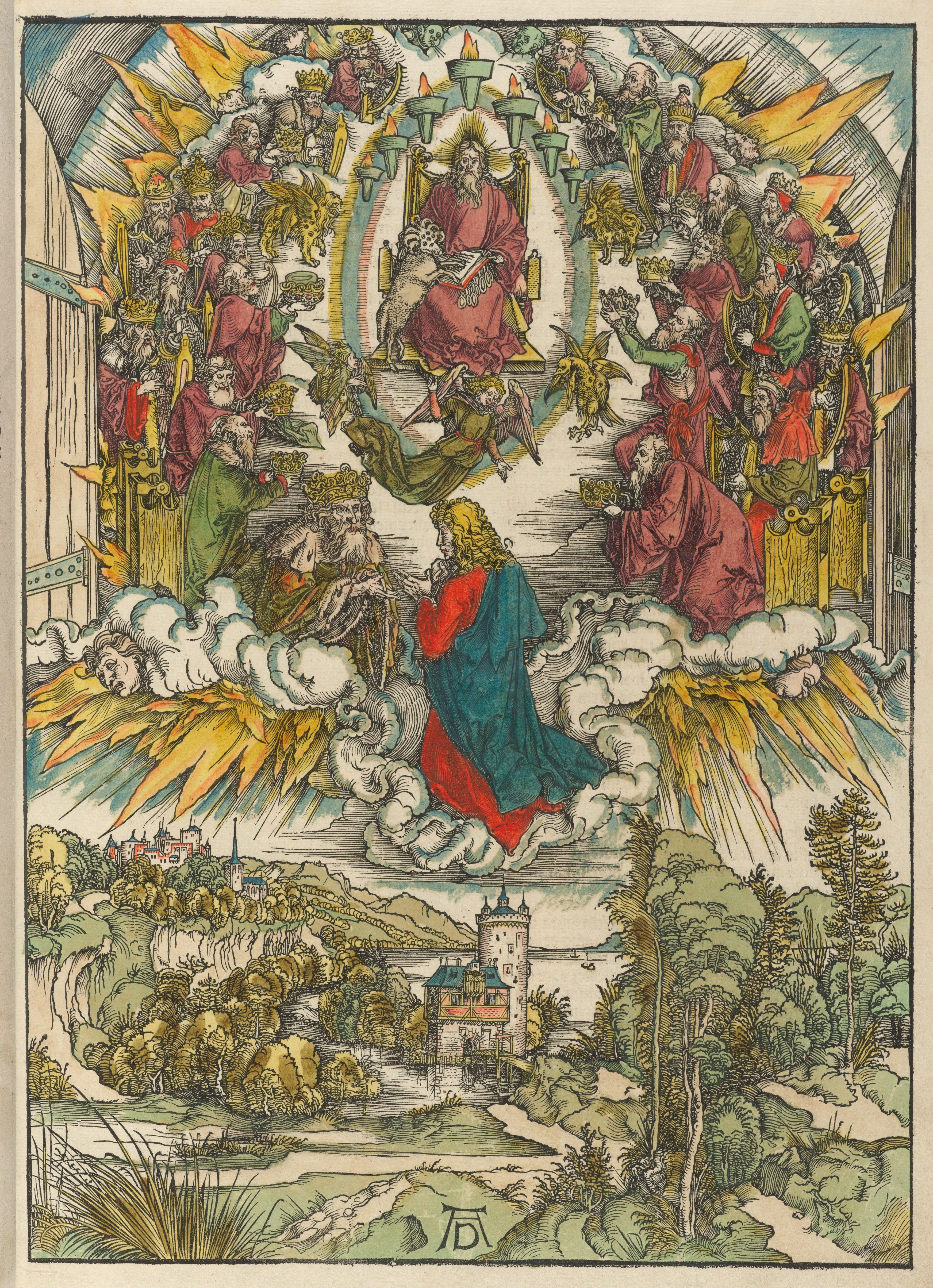
Albrecht Dürer, Saint John Before God and the Elders, from The Apocalypse, 1498. This image, the one ultimately chosen by my son Donnie as the cover image for his poetry collection in place of The Opening of the Fifth and Sixth Seals, coincidentally or serendipitously illustrates one of this essay’s themes. John the Revelator, depicted in heaven with God and “the twenty-four elders” of Revelation 10, becomes here not a mere passive observer of the fulfillment of prophecy but an active consultant in the divine council and a collaborator with God in bringing about his purposes.
Bruce R. McConkie, “Stand Independent Above All Other Creatures,” Ensign, May 1979, 92–94.
Francis Fukuyama, The End of History and the Last Man (The Free Press, 1992).
Martin Luther King Jr., “Remaining Awake Through a Great Revolution,” sermon, Washington National Cathedral, Washington, DC, March 31, 1968.
Donald Patrick Bradley Jr., Light of an Hour (forthcoming). See also donniebradley.com.
Don Bradley, The Lost 116 Pages: Reconstructing the Book of Mormon’s Lost Stories (Greg Kofford Books, 2019).
An interviewer reported talking with Martin: “I asked him if he knew what the prophet Isaiah had said about that event. He said, ‘No,’ but that Joseph Smith had shown that chapter to him after his return.” A[nthony]. Metcalf, Ten Years Before the Mast (n.p., [1888]), 70–73. See discussion in Bradley, Lost 116 Pages, 31.
“History of Joseph Smith,” Times and Seasons, April 1, 1842, 748.
Emily M. Austin, Life Among the Mormons (M. J. Cantwell, 1882), 34.
Oliver Cowdery, “Letter iv,” Messenger and Advocate, February 1835, 80, emphasis added. For a fuller analysis of the Anthon incident, see Bradley, Lost 116 Pages, 15–35.
Joseph Smith, sermon, May 12, 1844, The Joseph Smith Papers.

Thanks, Don. I prophesy that the LDSaints will yet join with billions of people of good will (who yearn with the invisible true spirit of love in them) to revolutionize the whole world including the immense world of spirits so we will not waste this wonderful experiment to improve eternal lives together. Zion ho!
Thank you for this beautiful essay. It touched my soul.