


Time depends on your relationships.
Take years, for example. Are you living in the year 2026? That depends on your relationship to the sun—but also history, geography, and religion. If you follow the Gregorian calendar with its reference to the birth of Christ and its adherence to the earth’s axis around the sun, then yes, you are living in the year 2026. But if you follow the Thai Buddhist lunisolar calendar and its reference to the death of the Buddha and its relation to phases of the moon, it is technically the year 2569. Devotion, ideas, geography, and astronomy all influence conceptions of time throughout the world.
Time depends on more than our relationship with the earth’s axis or the moon’s gravitational orbit. Our own times and seasons change as we grow and age and as our own “human orbits” expand, contract, and shift throughout our lives. Time also shifts as ideas about work, family, and distance change.
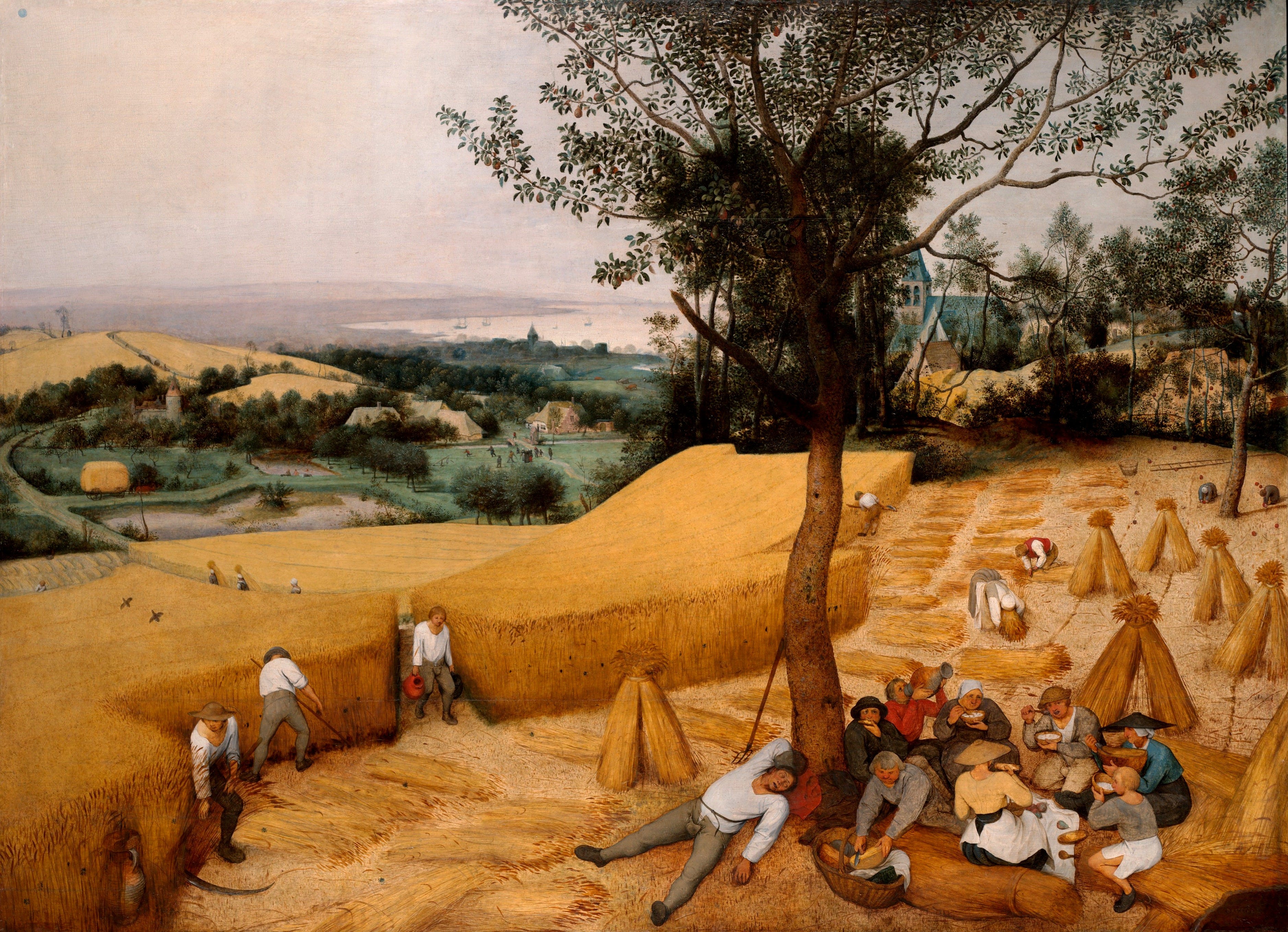
When I taught a survey global history class from the Renaissance to the present, I showed my students the 1565 painting The Harvesters by Dutch artist Pieter Bruegel the Elder to illustrate ways people in the past experienced time differently than we do today. The painting shows a day of harvesting in the lethargic heat of late summer. Some fieldworkers reap and gather the grain; others share a meal together; one man naps under a tree, open-mouthed. There are no wristwatches. There is no boss, telling the workers where to go or what to do. The only indication of time is the shadows of the trees, suggesting it is sometime in the early afternoon. Perhaps the nearby church steeple peals the hour, but most workers seem oblivious to the passing of time and are at home in their own bodies.
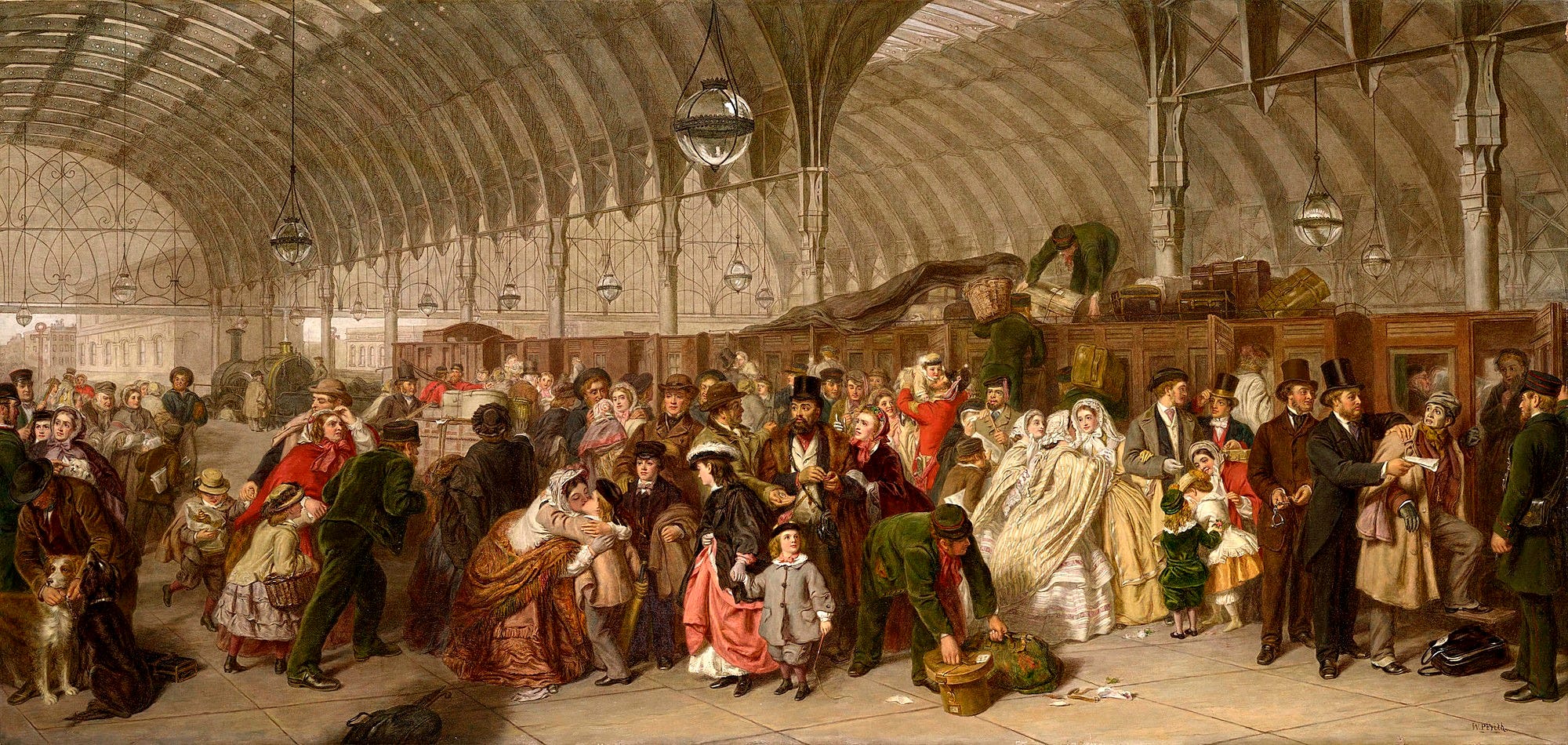
I don’t belong in the world of The Harvesters. Even putting aside the obvious fact that I am not a sixteenth-century Dutch peasant, my ideas about time, leisure, and busy-ness are far removed from that pre-industrial world. Instead, I relate more to the bustle of the panoramic scene of William Powell Frith’s 1862 narrative painting The Railway Station. Compared to The Harvesters, the scene Frith shows is an entirely different world. The Railway Station illustrates a post–Industrial Revolution world, powered by coal and structured by steel rather than by horsepower and wood.
The people in this painting are either going or coming; they move about in the hall of nineteenth-century order: the railroad. The locomotive changed the way time was conceptualized. It standardized times across countries and continents. In The Railway Station, the people congregate around a train, moving this way and that way, mimicking the way the modern era commodified time—their hurry, hurry, hurry shows that they value their time. They have places to go, people to see, time to spend. Everything revolves around the train that has forever changed conceptions of time, the body, and work.
I am a product of this nineteenth- and twentieth-century world of trains, ironworks, and viewing time as consumption. I view time as a commodity—something to hoard, something to lose. I am easily seduced by promises that I can “have it all,” as though time belonged to me. I don’t like that I think this way, but it’s hard to break out of such a mindset. The way I experience time has been socialized into my body; modernity’s demands on the Western woman have etched their way into my neurons. As such, I feel disconnected from my own body in relation to time. I cannot make peace with the time given me. I want more or less—the present eludes me.
I have often heard the adage that we all have twenty-four hours in a day, and the only difference lies in what we do with those hours. Baloney. It is a pithy maxim combining language from the past three centuries—the language of Benjamin Franklin’s time is money, the Victorian language of self-mastery, the big, bold fonts of self-help manuals and slick Instagram reels advertising productivity hacks. But the meaning of twenty-four hours differs greatly from one person to another. My twenty-four hours look different than a garment factory worker’s in Dhaka, or a soldier’s in Ukraine, or a ward member’s with a chronic illness. Even my own twenty-four hours look different today than they did when I was fifteen or twenty-two. My responsibilities, leisure, attitudes, and relationships with myself and others have changed. I am sure time will take on different valences ten years from today, as my children grow, as friends and family move, or as loved ones pass away.
How do I reorient my perception of time to view time as a gift rather than as a burden or as a possession? Perhaps I start with remembering that God has a different conception of past, present, and future than I do. God’s “thoughts are not [our] thoughts, neither are [our] ways [his] ways” (Isaiah 55:8). Time is less about optimization than about acknowledging limitations. Recognizing our dependence on God can allow eternity to pierce the fabric of our current mortal understandings of time, beginnings, and endings.
In the Doctrine & Covenants, the Lord pontificates about the nature of time, saying that he has given “a law unto all things, by which they move in their times and their seasons; . . . and they give light to each other in their times and in their seasons, in their minutes, in their hours, in their days, in their weeks, in their months, in their years” (D&C 88:42, 44). And in the Pearl of Great Price, God shows Abraham that the “reckoning” of these times, hours, weeks, and months depends on the proximity of stars and planets to “the throne of God” (Abraham 3:4–9), suggesting that earthly and eternal rotations are influenced not by size, grandeur, or popularity, but by one’s proximity to God.
All of us have times and seasons in our lives, and we vary in our proximity to God at different times throughout our lives. We were never meant to “have it all” or “do it all” at all moments. We do not all have the same twenty-four hours in a day because of our limitations. Those limitations are meant to help us give “light to each other” and shine in “whatever orbits” we find ourselves. As we turn, the gravity of God’s love pulls us away from self-centeredness and allows us to align our thoughts and ways to God’s, thus seeing our lives, relationships, opportunities, and limitations through the prism of his light.
“Prepar[ing] to meet God” in the “day of this life” requires readjusting my personal axis (Alma 34:32). Instead of relying on my inherited, post-industrial perceptions of time, I can work to increase my proximity to God—especially through devotional practices and holy days, which invite me into spaces without the demands of modern time. Holidays and Sabbath, devotional prayer and temple worship, were “made for” us to change our perceptions of ourselves and of time—to remind us that time is not a consumer product, and neither are we (Mark 2:27–28). Instead of interpreting Amulek’s call in Alma 34:33 to “not procrastinate the day of your repentance” and to “improve our time” as a series of checklists and schedules, I might shift my focus: Where is God right now, in front of me?
That answer will depend, again, on relationships.
I cannot always step away from post-industrial time. I live in this world, and I have responsibilities to people, institutions, and schedules that require respecting the time we have socially agreed to follow. Earth has a gravitational pull on me, too. But my most intimate relationships—with close friends, my family, my spouse, and my children—provide daily ways to see the face of God right here, right now, and improve the quality of my (and hopefully their) time on earth.
I think about my children, who have little conception of modern time. In many ways, I am their time. When I breastfed them, I was both flow and metronome. Even now, when I call out “five more minutes,” this measurement means nothing to them—merely Mom interrupting their play. Even though they are being socialized into our systems of time, seasons, and years, they do not understand structured time. In this respect, they live in a premodern world. They live in the now. They live according to their relationships—with those they love and those who love them.
My children invite me—sometimes force me—into this primordial time. In their presence, I live in both pre-industrial and modern time, and it is hard moving back and forth between the two. I feel the pull of the clock, of a writing deadline, or the upcoming appointment. But my children do not live in my time. Instead, they measure time based on the number of sticks picked up during a walk or how many songs they can cajole me to sing during bedtime.
My relationship with my children—the birth of myself as a mother—has changed my conception of time more than most relationships in my life. If I were to chart my own years and seasons by the birth of relationships—those moments I became daughter, friend, sister, missionary companion, wife–what would that look like? How would my orbits shift? What would be my axis?
With this mindset, my beginnings and endings do not start with birthdays or New Year’s resolutions. Instead, my times and seasons shift based on proximity to people and places that have reoriented my life. There are spots I return to, both mentally and—when possible—physically, to ground myself as time changes me and loved ones. Places where I grew, places where time seemed to open up to eternity—a mountain path in Provo Canyon; a park bench outside a church building in Chevy Chase, Maryland; a kitchen in Donetsk, Ukraine; a doorway threshold in Bangkok, Thailand.
I will never completely understand time. But when I can reject the idea of time as a series of gains or losses and instead look at the now, past, and future as sites of healing and redemption, it is easier for me to feel the beauty of non-modern time, to put aside the clock, to put away the notion of “options” or “maximizing time,” to release the annoyance I feel when my to-do list is disturbed by a child who should long ago have been asleep. Instead, I can see the face of God right now in that child, take her in my arms, and allow myself to feel eternity’s weight and wonder as an almost-sleeping child rests in my arms.
Megan Armknecht is an associate editor for Wayfare. She is a writer and historian and lives with her husband and two children.
Resonate with loads of this Megan--the sorts of things I think about/experience regularly!
(also, a thread of my diss was about "time" in gothic novels and the strangeness of it in terms of this 19thC railroad/secular time that we live in the wake of. i drew on charles taylor and others to think about gothic time as a fusion of secular time and liturgical time, though reading your piece here, i wonder if there'd be something fruitful in expanding/complicating that argument with your insight about time and relationships...often in these gothic novels time is wrinkled through supernatural beings, ghosts of wronged ancestors, saints, demons, etc)