


We asked the captain what course
of action he proposed to take toward
a beast so large, terrifying, and
unpredictable. He hesitated to
answer, and then said judiciously:
“I think I shall praise it.”
—Robert Hass, epigraph to Praise
Imagine a sea captain surveying the southern horizon when a great monster of the deep appears at the ship’s starboard flank. The beast dwarfs his vessel, makes toys of his guns and his instruments. The sight eclipses comprehension. What to do? Before that which utterly exceeds human control, the awestruck captain decides one can only sing its praise.
Then sang Moses and the children of Israel this song unto the Lord, and spake, saying,
   I will sing unto the Lord, for he hath triumphed gloriously:
      the horse and his rider hath he thrown into the sea.
   The Lord is my strength and song, and he is become my salvation:
      he is my God, and I will prepare him an habitation;
      my father’s God, and I will exalt him. (Exodus 15:1–3)
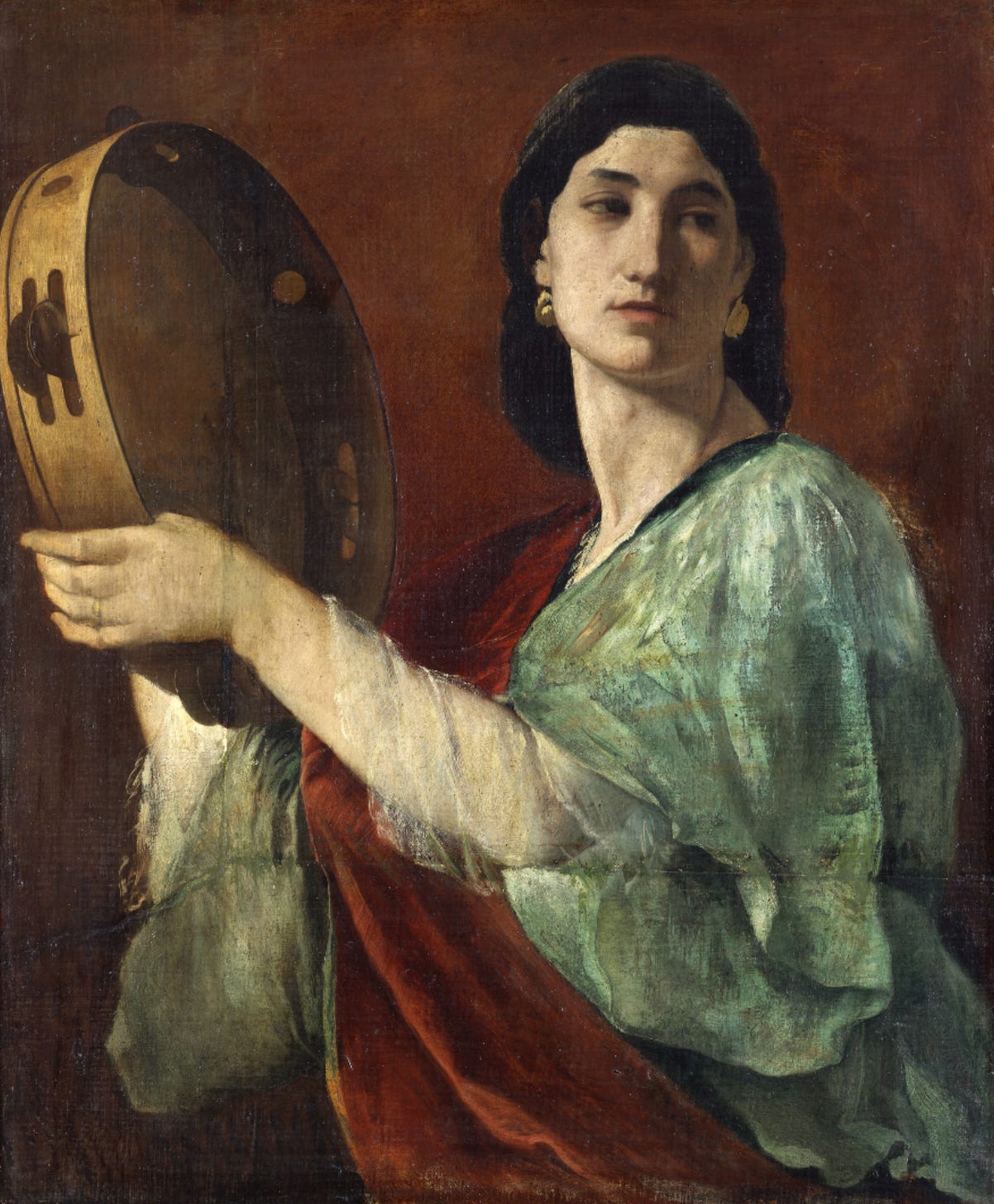
Now imagine Moses and Miriam rejoicing on high ground at the far side of the Red Sea, shouting to be heard above the gale that hurls mighty waves at the shore. Women dance to the rhythm of drums. Their enemy drowns at sea, and their euphoria rises to match the flood. The ocean, awesome and fearful to a landfaring people, has been mastered by a force still more awesome and fearful: the God of Israel. They will praise him.
In the face of staggering power, the sea captain hesitates while Miriam and Moses celebrate. What they agree on, however, is this: Praise is the human response to transcendence.
The poem recorded in Exodus 15, known traditionally as the Song of the Sea, is among the most ancient texts in the Hebrew Bible. In line after line of exultant praise to Jehovah, the song recounts God’s victory over Egypt, his freeing of Israel, and his building of a holy sanctuary where he will plant them and make them flourish. Its three-part story reiterates a core pattern of divine action in the Old Testament: 1) creation, through mastering the ocean’s chaos (see Genesis 1:2 and Psalm 74:13); 2) redemption, as an expression of God’s loving kindness; and 3) restoration of God’s people to his presence in the temple. Each time this pattern appears, it provokes the same response: hymns, dances, songs, poems, and prayers of praise. Just as Miriam dances at the seaside, David dances before the ark (see 2 Samuel 6). Isaiah punctuates the story of a new exodus with hymns of exultation (see Isaiah 51). And the Psalms, Israel’s prayer book, conclude with a great crescendo of unabated praise (see Psalms 145–150).
O tell us, poet, what you do. –I praise.
Yes, but the deadly and the monstrous phase,
how do you take it, how resist? –I praise.
But the anonymous, the nameless maze,
how summon it, how call it, poet? –I praise.
What right is yours, in all these varied ways,
under a thousand masks yet true? –I praise.
And why do stillness and the roaring blaze,
both star and storm acknowledge you? –because I praise.
—Rainer Maria Rilke, “O tell us, poet, what you do,” translated by Walter Arndt
Rilke here announces something else on which the sea captain agrees with the Israelite prophet and prophetess: Praise is the essential work of a poem. The song that Moses and Miriam sing on the banks of the Red Sea is one of the great poems of the Bible. Its enthusiasm is unrestrained:
Who is like you, O Lord, among the gods?
Who is like you, majestic in holiness,
awesome in splendor, doing wonders? (Exodus 15:11, NRSV henceforth)
It is a model of poetic hyperbole:
The enemy said, ‘I will pursue; I will overtake;
    I will divide the spoil; my desire shall have its fill of them.
    I will draw my sword; my hand shall destroy them.’
You blew with your wind; the sea covered them;
    they sank like lead in the mighty waters. (Exodus 11:9–10)
Its imagery is vivid and fresh, even for readers who encounter it many millennia after its composition. Notice how this passage describes the Lord’s power in terms of the elements earth, fire, wind, and ice:
Your right hand, O Lord, glorious in power—
    your right hand [stone or metal], O Lord, shattered the enemy.
In the greatness of your majesty you overthrew your adversaries;
    you sent out your fury [fire]; it consumed them like stubble.
At the blast of your nostrils [wind] the waters piled up;
    the floods stood up in a heap;
    the deeps congealed [ice] in the heart of the sea. (Exodus 15:6–8)
Good poetry, however, does more than create certain effects with language. Its Greek root poiesis means “making” or “creating.” Poetry aims, through the power of invention in the medium of language, to create something—an idea, an image, a mood, or an experience—that did not exist before. It is because poetry claims the power of creation that its essential work is praise. For praise is simply creation itself gathered from the world and reflected heavenward in the form of speech.
Praise is the basic stuff of religious worship—as ubiquitous at church, it can seem, as ambient noise. It is the substance of communal prayer and hymn. Exodus 15 stages its song of praise in the most dramatic possible setting, but song and prayer are often relegated to transitional formalities in Latter-day Saint sacrament meetings. Compared to the sacred choreography of ordinances or the content richness of sermons, expressions of praise, spoken or sung, can fade into the background.
But praise as a category of worship rewards deeper consideration. Scratch the surface, and questions appear. Why would a self-sufficient, self-existent God desire or command praise from his creatures? What possible purpose could it serve? The Restoration reframes God as a relational being, not a self-existent one, but this is little help on the question of praise: What kind of relationship requires one party to constantly extol the other? Wouldn’t such a dynamic be troubling between parent and child, or husband and wife?
These questions assume that praise is one among God’s several commandments, one act of worship alongside the many that fill our creaturely existence. But praise, according to the Old Testament, is not a way to fill our existence; it is instead the best way to experience our existence. Praise is intrinsic to being a creature.
As best I understand the biblical theology, its logic runs like this: In creating and upholding the world, God imbues all of creation with his glory. Think of this glory as an inner light, or as the logos of reality, or as a divine essence in all things. This light is the creatureliness of creation: the quality of created things as divine ends in themselves. In praise, I notice the creatureliness of the world, and I gather its light together in speech. This is what makes it poetry. Then I reflect that light, as praise, back to God. This is what makes it prayer.
Even in a routine sacrament meeting, this logic is quietly at work. Our hymns and prayers notice and gather the radiance of the created world. In well-worn language, we call on all creatures to lift voice, we name the beauty of the earth, we sing of high mountaintops, we acknowledge the beautiful day. We concentrate in language the glory gathered from creation, and together we reflect it back to the heavens. Like the mirrors in a sealing room, praise is the way we focus, amplify, and reflect divine light. In just this way, I believe, praise is the concrete practice by which the glory of God is made present among us in worship.
The same basic practice structures Exodus 15. Creation is the great archetype of the Song of the Sea, which tells the story of the Israelites’ crossing to safety as a replay of Genesis 1: God subdues the chaos of the Egyptian chariots, divides the waters, and makes dry land appear. The poem notices and names horse and rider as they charge forward, sea and depths as they cover and congeal, wind and floods as they swallow the earth. The created order passes through the song in the act of simply being itself. Miriam and her dancing women, together with Moses and the Israelite elders, then gather and offer creation’s light up to God in their song of praise: “Who is like you, O Lord, among the gods? Who is like you, majestic in holiness, awesome in splendor, doing wonders?” (Exodus 15:11).
There’s much more that should be said about praise. In particular, much remains to be said about suffering and praise. Suffering is baked into the created world, and so it, too, must be returned to God, somehow, as praise. The Psalms specialize in this kind of faithful lament, and I’ll pick up this theme in a Reflections essay later in the year. For now, suffice it to say that the sea captain with whom I started this essay is wiser than he knew. The created world is often, indeed, “large, terrifying, and unpredictable.” His hesitation is warranted: The beast does not become less terrifying for being praised. But praise is the only response adequate to the confrontation with transcendent glory. Praise is the spontaneous music of all creatures, great and small, in the presence of their creator’s glory.
Rosalynde Frandsen Welch is Associate Director and a Research Fellow at the Neal A. Maxwell Institute for Religious Scholarship. Her research focuses on Latter-day Saint scripture, theology, and literature. She holds a PhD in early modern English literature from the University of California, San Diego, and a BA in English from Brigham Young University. She is the author of Ether: A Brief Theological Introduction, published by the Maxwell Institute, as well as numerous articles, book chapters and reviews on Latter-day Saint thought. Dr. Welch serves as associate director of the Institute, where she coordinates faculty engagement and co-leads a special research initiative.
Art by Anselm Feuerbach (1829–1880).
The Old Testament Reflections series is published in collaboration with the Maxwell Institute: https://mi.byu.edu/old-testament-reflections.
Thank you for reading Wayfare Theology. If you no longer wish to receive these items in your inbox, click manage subscription under your profile and turn off notifications for this section.


