


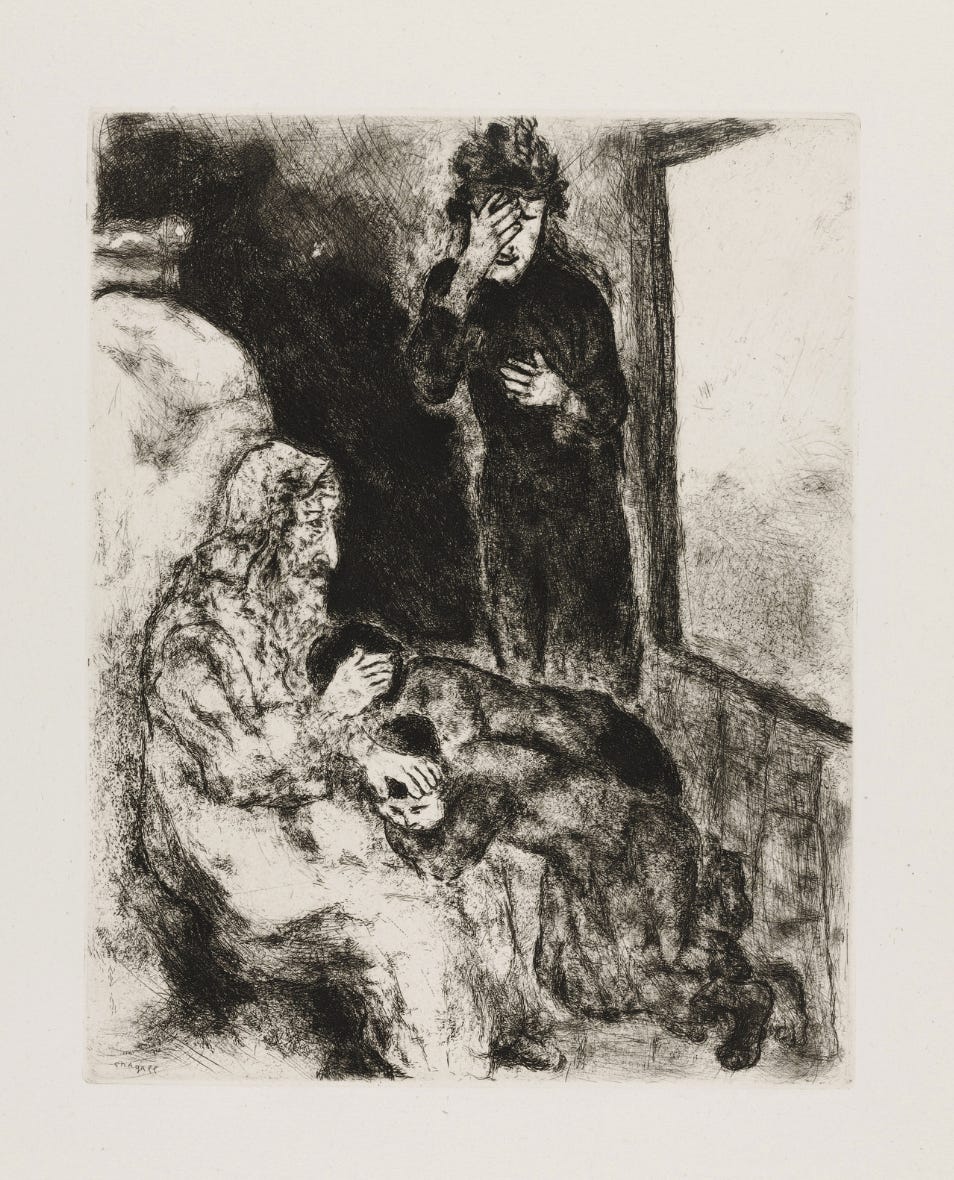
I am a middle child, so I know a little about being overlooked. Even the Bible overlooks middle children! Well, mostly. Judah is a famous exception, as is Miriam. But that’s beside the point. The Bible, especially the book of Genesis, is much more concerned about the older-younger dynamic, and mostly about the younger subverting the place of the older. There is also a lot of favoritism. A middle child notices these things too, because it’s always happening to someone else. I’m over it. I’m just saying that I notice it.
I have been thinking about the question of favoritism in the book of Genesis. Favoritism is tricky, mostly because it seems that God is complicit (see Romans 9:13, quoting Malachi 1:2–3). Well, complicit is perhaps too loaded a term. Let’s just say that there is a theology of chosenness present in the book of Genesis that sets the stage for the rest of the Bible, including the New Testament. Being chosen by God is wonderful, naturally, but it’s sort of a package deal, and the package always has some surprises. Realizing this has been the key to me finding peace with being a middle child! But this isn’t about me. It’s about Joseph, Benjamin, and Jacob (and his other sons), and the persistence of favoritism, and the role of recognition, and reconciliation in Genesis 42–50.
Let’s start with Benjamin, who has an outsized role in the story for someone who says nothing. Firstly, Jacob refuses to send him down to Egypt with his ten other sons, “since he feared that he might meet with disaster” (Genesis 42:4; all quotations from the revised JPS version). Then he refuses to send him on the second journey, referring to Benjamin as “my son” and Joseph as “his brother” (Genesis 42:38), as though Benjamin was his lone surviving son. Only when Jacob’s entire household faces extinction does he let Benjamin go to Egypt, saying, with an air of resignation, “As for me, if I am to be bereaved, I shall be bereaved” (Genesis 43:13–14). Joseph continues the pattern by giving Benjamin a larger portion than his brothers (Genesis 43:34). So, favoritism is still in play even after all the trouble it caused in the first half of the story! What changes is the brothers’ reaction to Joseph and Benjamin and their attitude towards their father, and recognizing this change is ultimately what triggers Joseph to reveal his true identity.
Several kinds of recognition happen in this part of the Joseph story, all essential to its tension and pathos. Joseph recognizes his brothers, but they don’t recognize him (Genesis 42:8). Joseph recognizes that the dreams have not yet been fulfilled (Genesis 42:9) and so orchestrates a way to get all the brothers in his presence at once to fulfill his first dream (see Genesis 37:5–8). Joseph also recognizes that the brothers are contrite or at least feel culpable (Genesis 42:21–24). But notice how it takes the brothers’ contrition to move him to tears, while just seeing Benjamin is enough (Genesis 43:29–30). Finally, though, it is when Joseph recognizes Judah’s compassion towards Benjamin and Jacob (Genesis 44:18–34), that he makes himself known to his brothers (Genesis 45:1). He seems to be waiting for this transformation and not just the fulfillment of the first dream, which already happened earlier (Genesis 43:26; 44:14).
Finally, Joseph recognized God’s hand in his life journey, and so could comfort and reconcile with his brothers, even after all they had done (Genesis 45:3–8). Implicit in this last recognition is a deep understanding that chosenness is not about favoritism. There is certainly blatant favoritism in the book of Genesis (see Genesis 25:27–28). But chosenness is not just about having a special relationship or being preferred, but more about performing a special, life-giving work. Joseph recognized this: “God has sent me ahead of you to ensure your survival on earth, and to save your lives in an extraordinary deliverance” (Genesis 45:7). It took another seventeen years, though, before his brothers recognized that Joseph had genuinely been transformed by understanding this principle of chosenness (Genesis 50:15–21).
Kristian S. Heal is a Senior Research Fellow at the Neal A. Maxwell Institute for Religious Scholarship. His research focuses on the reception of the Hebrew Bible in early Christian literature and worship. He received a BA in Jewish History from University College London, an MSt in Syriac studies from the University of Oxford, and a PhD in Theology from the University of Birmingham. He is the author of Genesis 37 and 39 in the Early Syriac Tradition (Brill, 2023) and co-editor of Ancient Christians: An Introduction for Latter-day Saints, published by the Maxwell Institute. Kristian was also the resident scholar for the Maxwell Institute’s Abide podcast on the Old Testament (50 episodes).
Art by Marc Chagall (1887–1985).
The Old Testament Reflections series is published in collaboration with the Maxwell Institute: https://mi.byu.edu/old-testament-reflections.
Thank you for reading Wayfare Theology. If you no longer wish to receive these items in your inbox, click manage subscription under your profile and turn off notifications for this section.


Kristian, I enjoyed this very much. Looking forward to more. It’s great to hear what a specialist on the patriarch Joseph has to say about these wonderful stories.