


Most of us are entirely unprepared for what has already happened. This may sound more paradoxical than it is. Understanding, after all, always arrives late to the party. All of us were born into a world already on the go, and it often takes us a while to catch up. Still, if there were ever a moment to self-locate and make some changes, this is it. We have to find ways to resist the monster that modernity has made—a monster Paul Kingsnorth calls the Machine.
The idea is not Kingsnorth’s alone, but he selects it because of how aptly the notion describes all that is cold and inhuman and spiritually bereft in this world we inhabit. It captures a widespread reliance on what Jacques Ellul calls technique and what Iain McGilchrist identifies as the dominion of left-hemispheric thinking. Kingsnorth tells us he feels as if he’s been writing this book all his life. All of his work, from his journalism to his poetry to his unpublished and published novels, has included distinct attempts to investigate and understand the Machine.
The Machine is the existential and spiritual equivalent of a cage or prison. In his poem “The Panther,” Rainer Maria Rilke imagines a majestic beast pacing to and fro in a cage, numbed and anaesthetised to its natural ability to sense the world beyond its immediate confines. Rilke writes, “it cannot hold anything else.” To the panther, “there are a thousand bars; and behind the bars, no world.” I thought of this poem often while pondering Kingsnorth’s words, partly because Against the Machine strikes me as a careful attempt to describe many of the bars of the prison we inhabit, but also because Kingsnorth believes, as Rilke does, that there really is a world beyond the cage. Don’t fall into the trap of believing that we have no say in any of this, that we have no agency. Don’t believe for a second that there is no way out.
For Kingsnorth, the Machine is not all there is, despite its pervasiveness. As I concluded reading, the impression I was left with was that we are not without power or ability to improve our situation. I mention this now because in so much of the book, on page after elegantly written page, the picture of the world Kingsnorth sketches is thoroughly depressing. The truth will undoubtedly set you free, but first it’ll grieve you. Such grief would serve as a reminder, however, of the human heart beating in your chest. If you can be horrified by the Machine, you already have a sense of the way out. Many are anguished at the way things are, and it would be a mistake to treat that anguish as irrelevant. It’s a warning. It’s no use staying beholden to what abuses and diminishes us.
Most of us know a whole lot is wrong with the world. It is the oldest and most retold story in the book. Paradise is filled with many trees and much fruit to choose from, and yet we’ll repeatedly gravitate towards that one tree forbidden to us. History contains many reboots of the fall story. We see again and again what happens when people choose the worst over the best, when immediacy replaces ultimacy and they choose to bow to a golden calf, so to speak, instead of to the God who has saved them from slavery. It is an ancient story, but now and then, we need people around us, storytellers and poets and thinkers, to help us understand the seriousness of the situation we find ourselves in. We need those who have the strength of attention to describe the familiar in such a way that it’ll shock us into wakefulness.
Kingsnorth, the poet and storyteller, narrates the most recent iteration of that ancient and tragic pattern. He tells us the story of the Machine. He says, quite rightly, that it is closing around us from all sides, and it is the source of so much pollution. The obvious pollution is environmental. We see skies polluted by smog and lights, so that clouds are tinged brown and stars are rendered invisible. But it would be a mistake to suggest that the Machine is merely external. Climate change is perhaps even more philosophical and psychological than it is meteorological. In fact, I have my doubts about the meteorological aspects, especially given how globalists have taken it up as an excuse to extend the reach of the Machine. Arguably, the worst forms of pollution are implicit, even unconscious. The human mind itself has become machine-like.
But this is all to say that it’s not unexpected when we can’t always see the Machine at work. We are its children and its disciples and emissaries, after all. In a sense, the Machine is us even more than it is beyond us. A renewal of mind is necessary, coupled with a heavy dose of repentance, if we are to be free from it. How, then, can we better recognise what has happened and what is happening around us, in us, and through us? How can we have our blindness healed so that we can see where we are walking?
Of course, in time, thinkers will come along to expose and oppose the Machine. Kingsnorth’s is by no means a lone voice calling out in the wilderness. He adds to the chorus of prophets and seers who have assisted him in making sense of what has gone wrong. You’ll know the names of some of them, I’m sure: René Guenon, Simone Weil, Lewis Mumford, GK Chesterton, Alasdair MacIntyre, Rupert Sheldrake, Philip Sherrard, EF Schumacher, Mary Midgely, Jacques Ellul, Christopher Lasch, Robert Bly, Nikolai Berdyaev, Mary Harrington, Wendell Berry, Yoram Hazony, George Monbiot, Ausguto Del Noce, Jeremy Naydler, Seraphim Rose, Christopher Dawson, Iain McGilchrist, Craig Calhoun, James C. Scott, Carl Trueman, David Caley, and CS Lewis. The gathering of great minds is impressive.
These are, however, by no means the only thinkers consulted by Kingsnorth. I’d understand if you feel, just by looking at that list of writers, that he is trying to cover too much territory and say too much. Perhaps he is. However, at no point in the book did I feel that anything he said was overly hasty or forced or strained. Far from it. Although we are necessarily compelled to grapple with complex and plentiful dark happenings throughout his book, Kingsnorth is a subtle and gentle guide. Despite the manifesto-like title of his book, which I have mixed feelings about, it does not read, thank goodness, like a manifesto.
Nor does the book buy into the Malcolm-Gladwellification of non-fiction, with its story-science-takeaway-repeat structure. There is rage and sadness beneath it, of course, but also hope. And it is so well written. I’ve hinted at this above, but, my goodness, what a joy it is to read someone so articulate and wise. Kingsnorth takes his work personally, and this creates a space for deep existential resonances with the reader. It is possible, as he shows us, to look at all the wild and misguided missteps of modernity with a clear eye for what is valuable and lasting—and even for what is transcendent. It is possible, although not easy, to live in the unlighted belly of the Machine without succumbing to despair.
The book is divided into four parts. In the first, Kingsnorth explains the current Western cultural malaise; in part two, he deals with some history, highlighting certain shifts that have helped the Machine to gain such a powerful grip; in part three, our present experiences of the Machine and its destructive powers are the focus; and, finally, part four offers some practical suggestions for survival and resistance. You’ll know from early on as you read—and you really should read the book—how desperately important it is that we push back against the Machine’s encroachment. And Kingsnorth’s suggestions are superb, even if he leaves much room, perhaps too much room, for us to work out the details for ourselves.
The ultimate temptation would be to listen carefully, to comprehend the desperateness of the situation, and then to walk away and do nothing about it—or worse, continue to support those things that work against our well-being. In fact, many warnings have been sounded before concerning the Machine’s inhuman hold on our hearts, minds, and spirits, and Kingsnorth knows that this hasn’t tended to make much difference. We may deceive ourselves into believing that knowing what’s wrong in our heads is sufficient, when it is not. We must feel the damage, and we must act now.
Throughout the book, certain theological signposts can be found, offering a sense of how Kingsnorth, a former pagan, has come to understand just how intertwined the decay of the West has been with the loss of contact with our Christian realities and roots. Kingsnorth wasn’t looking for God, but God hunted him down, and in the end, he couldn’t say no.
Of course, decent theology serves up a large portion of humble pie. No human arrangement would ever be absolutely perfect. But as long as we remembered God, as long as God was not relegated to the margins of existence or shut out completely, we had the chance of recognising our need for him. We could see our fallenness and brokenness in the context of our desire for redemption, knowing full well that we are incapable of saving ourselves. But Modernity advanced certain conditions of mind and materiality that made it possible to believe in our own sufficiency. We forgot God along with our humility, and in the process, we abandoned our humanity. This was, as mentioned, a replaying of the story of the fall—a recapitulation of seizing the fruit of the tree of knowledge of good and evil. We built our own civilisational Tower of Babel, and now we are watching as everything starts to fall apart. This splintering and shattering is also, sadly, the will of the machine. The more isolated and fragmented we become, the more of a grip the Machine gets.
Without sacredness, without the sacramental, the world becomes hostile. Many are calling for the rescue of the West, which is appealed to as a kind of rhetorical stronghold. Kingsnorth suggests, though, that if it is not already dead, perhaps now is the time to let the West die. This is one of the few points on which I found myself slightly at odds with him. In fact, I’m almost certain he is at odds with himself, since he writes from a distinctly Western point of view, despite his Guenonian attraction to the East. Perhaps we need a distinction between the Greater West and the modern liberal West, the latter now being disproportionately represented in the consciousness of the average Joe and Josephine. The modern liberal West has become an idol, and it is this West, this force against all roots and rootedness, that must die so that the Greater Western tradition, as a perpetual pursuit of truth, might be revived in hearts and minds. I mention this only because there is a hint in Kingsnorth’s book, even if only a small one, that a blank-slate state is possible. But this ideal, the fantasy of a do-over, like a reactionary Great Reset, is Machine thinking par excellence. Kingsnorth knows this, but he could perhaps have made this clearer.
Still, what he shows us is that many of our present troubles, including our culture wars, stem from having no roots. This applies to all sides, really. The ‘everything is political’ crowd are the first to fall for the Machine because they are also the most uprooted. In many ways, this stems from a lack of appreciation for limits. Kingsnorth shows us, via Spengler, just how Faustian the Machine is. Isn’t it interesting that this is a theme that crops up so often in European literature? I think of Karl Ove Knausgaard’s Morning Star cycle of novels as one of the more recent variations on a Faustian theme, which is evident in older works like Shelly’s Frankenstein, Wilde’s Picture of Dorian Grey, and Hesse’s Steppenwolf. The story of Faust strongly communicates something of the bargain beneath the modern Western consciousness. The Machine lives on the belief that you can ignore reality without facing any consequences.
One way to interpret modernity is as a story of the pursuit of freedom. This is most evident in the very name (a misnomer, really) liberalism. Unfortunately, only a negative freedom has prevailed, even though freedom instantly turns into slavery when it is merely a movement away from constraints. Without a realistic sense of boundaries, we end up at the mercy of the reign of quantity, consuming an endless feast of scraps and garbage as if it offers genuine nourishment. In misunderstanding the nature of freedom, we will also succumb to the myth that the Machine is both inevitable and irresistible.
Kingsnorth has a clear purpose in telling the story of the Machine. When we have its origins, nature, and consequences right in front of us, we can more easily see its constructed nature. If we can imagine it, we can imagine a way out of it.
Much of the story we’ve been told is one of evolution. The Machine somehow simply evolved. That’s the myth of Progress in a nutshell. It’s an ideology masquerading as natural inevitability. What has happened was no one’s choice but simply the natural demand of so-called Progress, which is the demonic force that stepped in when God was denied a say in the modern world. It’s a funny story to believe, when you think about it. Every attempt to control the world, built on this stupid idea that we have the power to do so, has ended up convincing us only of our lack of power and agency. This is the left-wing myth manifest in appeals to systems and all things systemic. The irony here is that the modern stress on the will has almost entirely eradicated willpower. Kingsnorth is right to say, however, that want is the acid. He points to Alistair Crowley’s dictum, “Do what thou wilt shall be the whole of the law,” as a symbol of this strange emphasis in modernity. He could perhaps have said something about the roots of this turn to the will, and the reduction of the political to a power struggle, via some history on nominalism, voluntarism, the Lockean inversion of act and potency, and the existentialist inversion of essence and existence, but I suppose you can’t say everything. The mess we’re in is not an easy one to explain, and Kingsnorth does a remarkably good job of covering some of the most vital features of it.
His summary of what’s been going wrong is found in an alliterative list of four Ss. Science. Self. Sex. Screens. All of these emphases involve a fixation on the explicit ego and its preference for representation. St. Paul would describe this as the “desire of the flesh” (Galatians 5:16). In the Bible, the flesh, sarx in Greek, is not always meant negatively. Sometimes it just refers to the body, this living tissue that clothes our skeletons, such as when we read that the “Word became flesh and dwelt among us” (John 1:14). Sometimes it’s a metonym for people, such as when we read that all flesh is like grass (1 Peter 2:24). It could also refer to ethnicity or national identity, which is something we ought not to place too much confidence in (Philippians 3:3). But when Paul uses the term negatively and not just descriptively, he means the part of us that works against the wholeness God intends for us. It’s that lower part of the soul that would seize even what is highest and drag it through the dirt. When we selfishly desire self-gratification, power, and control, we are at the mercy of the flesh.
The antidote to such a fleshly existence is to walk by the Spirit (Galatians 5:16). In Kingsnorth’s book, four Ps counteract those four Ss. Past. People. Place. Prayer. If the Machine discarnates and despiritualises us, and it certainly does, walking by the Spirit incarnates and spiritualises us. Such an incarnation is impossible in merely horizontal terms, without a sense of the vertical. Without a posture that welcomes God’s grace and assistance, we really are doomed. Indeed, this may be one reason why so many attempts to resist the force of the Machine have failed. They have not taken the lived reality of the religious dimension seriously enough. Without a form of life, the Machine soon diminishes the human experience to one of bare life. And bare life, the kind of life that consumes but does not produce, is entirely manipulable.
What Kingsnorth gets to in the end is something we all know about. We need to pick today who we will serve: God or the Machine. It really is that simple and that difficult. It is no use to know the truth and to go on as if we don’t know it. This means rediscovering a way to live a life that is fully and unabashedly God-oriented. Kingsnorth refers to the ancient idea of askesis or asceticism. In recent decades, the same idea has been taken up under other names: spiritual disciplines, or spiritual practices, as part of spiritual formation. The gist is that we need to find a Rule of Life, something Benedictine in a way, that helps us to live out our days as God’s children and not as mere degraded and dehumanised products of the Machine. We cannot be mere nominal Christians or mere respecters of Christianity. The purpose ought not to be to return to Christianity in order to save the West, but to be saved. Whatever comes from being saved, which will no doubt shred any wrongheaded idolising of the West, will be far better than what we have now.
Kingsnorth, God bless him, is by no means as pushy on the religious front as I am in the previous paragraph. He is less theological in his articulations of what must be done than I think he could have been. His religious convictions are deep. Nevertheless, he is mindful, I imagine, that many people in his mostly secular audience will find any gesture towards a definite religious posture strange and even alienating. In reality, there is no way of accessing what faith reveals apart from the act of faith. However, one of the great lies of the Machine has been that faith and public engagement should remain isolated from each other. Faith should remain private, we are told, or led to believe. I think it’s safe to say, though, that this is simply untenable now. Being on the defensive is no way to live when the situation is as desperate as Kingsnorth has quite rightly made it out to be. His book is already remarkably honest, admitting, against the grain, that he has been found in Christ. He’s been bold, but perhaps being even bolder is the next step.
Even if Kingsnorth could have been more theological, in my view, and perhaps more mindful of certain subtleties in the history of the Machine that often go unnoticed, what he has written remains magnificent and important. The book is jam-packed with astute and timely observations, and there are so many intriguing avenues for thought that anyone hoping to go deeper will have some excellent ideas for where to look. I do not doubt that anyone reading it and taking it seriously would have a much clearer sense of where we find ourselves, as well as having some good ideas for how we might plot a course for survival and escape. Yes, the situation is bleak. But it is not so bleak that we do not even know how bleak it is. Especially with Kingsnorth’s help, we can see exactly what is happening.
Duncan Reyburn—Professor, Christian Platonist, Connexion Man, Dissident Metaphysician | The philosophers have only changed the world in various ways; the point, however, is to interpret it.
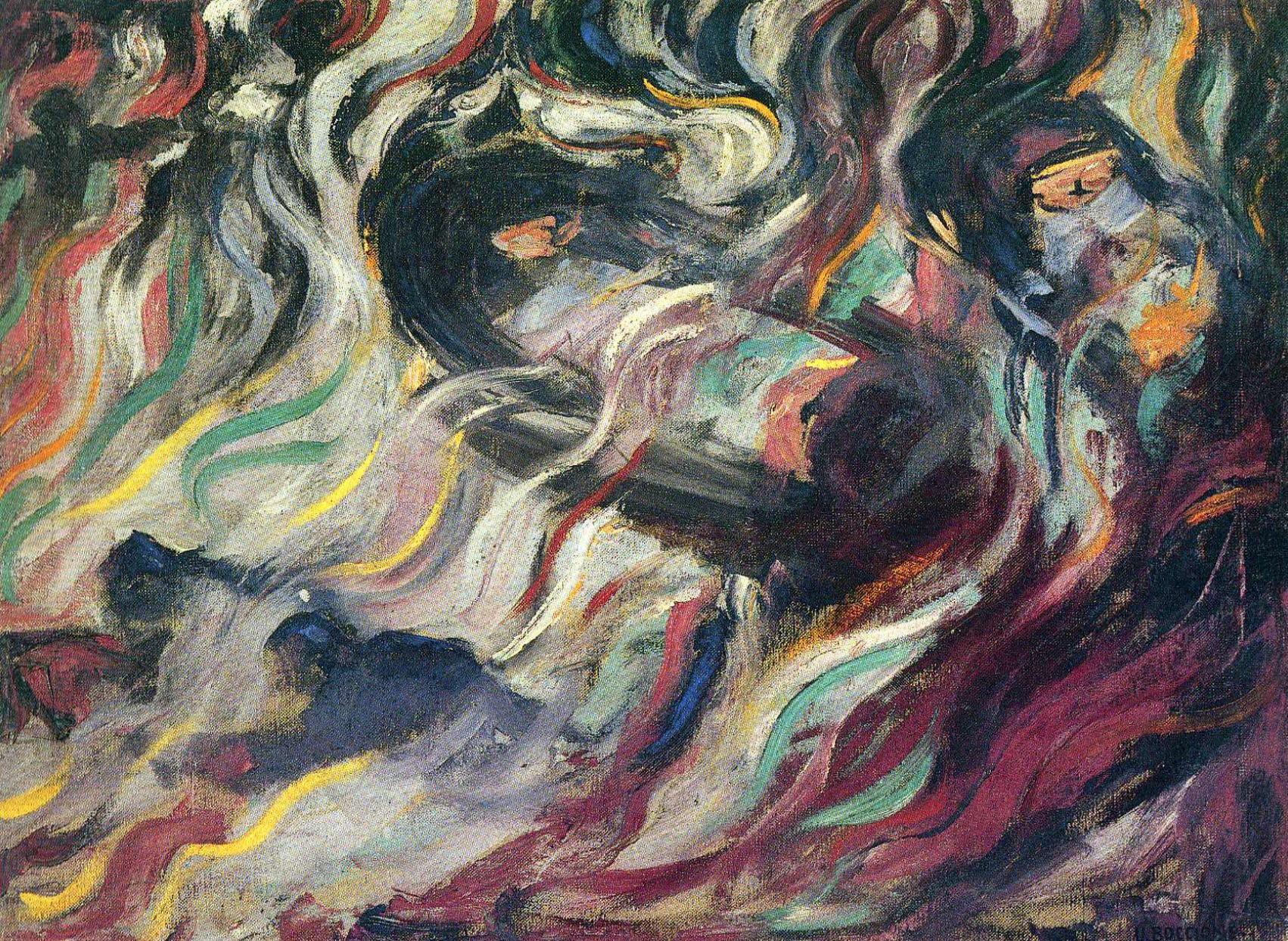
Art by Umberto Boccioni (1882-1916).
Please enjoy another review of Against the Machine published by Wayfare editor Ryan Fairchild.
The AntiChrist Is Hiding Inside Your Smart Fridge

In his 2025 book, Against the Machine, Paul Kingsnorth’s enemy is no less than the Antichrist. But Kingsnorth, to use the words of another Paul, “wrestle[s] not against flesh and blood, but against principalities, against powers, against the rulers of the darkness of this world, and against spiritual wickedness in high places.” For Kingsnorth, the Antic…
