

We are in a nexus of profound scientific, technological, and spiritual change. After centuries of separation, this is the moment to reintegrate two of humanity's great projects: the cultivation of spiritual wisdom and the advancement of scientific knowledge.
With the support of the John Templeton Foundation, and under the editorial direction of Maddy Peterson, James Ungureanu, and Benjamin Peters, Wayfare will begin publishing a series of essays that offer pathways for this reintegration of religion and science, culminating in a special issue on this theme coming out early next year.
To receive new essays in this series in your inbox, turn on notifications for the New Creation newsletter in your subscription settings.
To receive the beautiful print issue and support our mission, become a paid subscriber by clicking the link below.
And now, enjoy this first essay from the series, both playful and poignant, examining how we all participate in the story of creation.

BE A GOOD MAMMAL
by Kyra N. Krakos
Introduction
The front page of my evolution course webpage shows a meme of a stern-looking Galápagos iguana with the caption “You are the product of 3.8 billion years of evolutionary success. Act like it.”
As a professor, I begin and end every semester with the same reminder to my students: Be a good mammal. Good mammals take care of themselves, one another, and their planet. It sounds simple, but it carries the weight of both evolutionary history and theological meaning. Though humans are a young species, we inherit the evolutionary wisdom of mammals—warm-blooded, social, adaptable beings whose survival depends on cooperation, care, and ecological reciprocity. This is not sentiment; it’s biology. And it’s also scripture. Latter-day Saint theology names the same pattern stewardship—to see the body as temple, the community as covenant, and the Earth as a living partner. To be a good mammal is not merely biology. It is a theology of stewardship.
Evolution is the ongoing creation story, the universe still speaking itself into being. The same forces that shaped iguanas and birds and sea lions on volcanic islands shaped us, too. Cooperation, adaptation, and ecological reciprocity are not accidents of natural history; they are the scaffolding of life. Mammals learned early that survival is a communal act, that thriving requires relationships. In this light, stewardship and evolution are not opposites but reflections of the same truth: Life endures through connection, through care, through love disguised as biology. Our role in that story is both simple and demanding—to take care.
Stewardship is the sacred form of that truth, the theology that grows from the science. Its practice unfolds in three directions: care of self, care of others, and care of the Earth. Each is a covenant, and together they describe what it means to be a good mammal.
Good mammals take care of themselves.
Care begins close in with the body, that small ecosystem of breath and boundary. Mammals know that neglecting the body endangers the whole herd. To rest, to nourish, to move, to heal . . . these are not luxuries but acts of ecological responsibility. In Latter-day Saint language, the body is a temple. In evolutionary terms, it is our first habitat. To tend it well is an offering to both biology and divinity.
To bring this closer to home, I will tell you a story. A dreadful thing happened to me at age forty-three: I got dead drunk, entirely by accident. My husband and I were on vacation in Mexico, fresh from a morning of hiking Mayan ruins in the dark-green jungle. While he went off for a nap, I settled by the beachside pool and ordered the minty, ice-cold coconut drink I’d grown fond of. I assumed it was from the “family-friendly” menu, but a language barrier and my own naivete conspired for a different result. Thirsty from the heat, I drank three tall glasses quickly, unaware that the sweetness was masking a healthy pour of rum.
In short order, the world tilted. Dizzy and confused, I called my husband in a panic, convinced I had sunstroke or worse. With a few questions, he diagnosed the true issue, laughed heartily, and came to collect my sorry, tipsy self from the pool. I learned a few lessons that day: first, that the Word of Wisdom holds up well, and second, that wisdom itself may need updating for the modern mammal.
We may not drink much rum by accident, but we do live intoxicated by busyness, sugar, stress, and neglect. The covenant of care should maybe ask harder questions now: Do you eat enough leafy greens? Limit sugar? Move your body? Get your medical checkups? Protect your skin? Vaccinate? Floss? And, perhaps most sacred of all, are you caring for your mind—that evolutionary wonder that made us what we are? Without it, we’re slow-running, clawless snacks on the savanna; with it, we’ve become caretakers of worlds.
To be a good mammal is to care for yourself without apology. Honor your body as sacred matter, evolved and sustained by Earth. Every breath, every bite, every heartbeat ties us back to soil, sea, and starlight. Remember that, and half of theology resolves itself.
Good mammals take care of one another.
No mammal thrives alone. From the earliest social species to human communities, cooperation has always been the strategy of survival. Mutual care is the oldest covenant, written not just in scripture but in shared breath and warmth. In this light, neighbor love and kin selection speak the same truth: We are built for connection. To take care of each other is to practice the evolutionary art of belonging and to glimpse Zion in miniature.
Once, I held a stranded hummingbird in my hand and felt its featherlight tongue drink sugar water from my fingertips. I whispered to the fragile, frightened creature, “You are safe. It will be OK. I will not hurt you.” When it finally gathered enough strength to fluff its wings and buzz away, I was left in stillness and full of wonder.
In that moment, I understood what my research keeps teaching me: Care is the oldest language on Earth. In the way pollinators cooperate with their floral partners, in the way herds shelter their young, the pattern repeats—life depending on life. Cooperation isn’t a lofty theory; it’s the quiet engine of existence.
From a scholarly lens, both evolution and theology tell this same story. Evolution’s cooperative mechanisms—mutualism, adaptation, resilience—mirror the moral architecture of Zion. Both depend on shared care across scales of being. In the Latter-day Saint context, continuing revelation works like ecological adaptation: a living system learning, refining, expanding through relationship. To be a good mammal is to live inside that process with awareness and to recognize that the laws of survival and the laws of love have always been the same. Though this might seem in conflict, perhaps even a paradox, understanding science makes space for it all.
Watching the pollinators and their floral partners, I’m reminded that life itself is a long conversation of giving and receiving. Every creature survives by tending to another. Humans are no exception; our thriving depends on how faithfully we honor that same covenant of care.
The old biblical question still hangs in the air: Am I my brother’s keeper? The answer has never changed. Yes. We are. We are herd animals, evolutionarily adapted to belong. Civilization’s morality can still be measured by how it treats its young, its elderly, its vulnerable. Tribalism carried us far, driving invention, identity, and culture, and yet the same instinct now fractures us. It is time for a new story, one that expands the circle of our human tribe until no one stands outside it, one species bound by shared breath and shared responsibility.
It’s a lesson our own people tried to live. I was never one to get misty about pioneer stories—too much dust, too many bonnets, too much tuberculosis, and more hymn singing than any sane person could stand. I used to think my Mormon ancestors were reckless and a bit foolish to leave civilization and go West, probably a little gullible to follow men who promised heaven in the desert. But they were also idealists—people who believed in something so fiercely that they left comfort behind with a vision and a hope that life could be better. The very best reason, the most inspiring reason, to go into the wilderness: to fight for a better world.
They believed in Zion. “And the Lord called his people Zion, because they were of one heart and one mind, and dwelt in righteousness; and there was no poor among them” (Moses 7:18). I believe in that too. That is a world worth fighting for, hoping for, reaching for.
Now I see my ancestors differently. They are precious to me. They were evolution in motion, humans daring to imagine a more cooperative future. That same drive—to build a just, caring community—remains the heart of sacred stewardship.
Zion, like any ecosystem, must adapt or die. It is not somewhere we go but something we make. It is a living process built each time a community chooses generosity over scarcity, connection over fear. We are meant to flourish together. To be a good mammal is to remember that Zion doesn’t end at the edge of the campfire or the chapel. It extends into the soil, the rivers, the air we share. Zion is not a distant city; it’s a living process, a verb disguised as a noun.
Good mammals take care of their planet.
Every act of life depends on the generosity of the planet—its air, soil, water, and light. To care for Earth is not an abstract environmental duty, it is the continuation of our own survival story. Earth is our shared body, our mother, our oldest covenant partner. Stewardship, in this sense, is simply remembering what mammals have always known: that care is reciprocal. The planet sustains us only as well as we sustain it.
About 3.8 billion years ago (as the iguana meme so helpfully reminds my students), in a daring and audacious move, the first cells twitched to life. They carried genetic code and an unrelenting directive: survive and reproduce. From that spark onward, evolution took the reins—life experimenting, diversifying, filling the planet with improbable abundance. At least five times, extinction scoured the slate nearly clean. Five times, life began again, persistent in its pursuit of biodiversity.
And now, here we are. A strange young species called Homo sapiens, armed with a never-before-seen brain and a dangerous knack for storytelling, perched at the top of a web we barely understand. But our ecosystem is not a hierarchy. It’s a body. If the web collapses, so do we. Earth has endured those mass extinctions. The top predators never make it through. Take the lesson. Saving biodiversity isn’t charity. It’s self-preservation.
My oldest son, Jack, took an early stab at ethical coexistence with life on this planet. At five years old—a good mammal, testing out his first moral narratives—he announced that he would no longer eat mammals. When pressed for his reasoning, he proclaimed, “Because I am a mammal, so I will not eat the others.” I honored his sound logic. It lasted two months. Then Grandpa visited and made bacon. Fair. Many of us have surrendered nobler intentions to the lure of bacon.
Still, I was struck by his clarity. Even at that age, Jack understood something most of us forget: that we are part of the web we consume and that belonging carries responsibility.
That same truth runs through the world’s sacred texts. In Annie Dillard’s poetic rendering of a verse from the Qur’an, Allah asks, “The heaven and the earth and all in between—thinkest thou I made them in jest?” (Surah 21:16, quoted in Pilgrim at Tinker Creek). Genesis 2:15 echoes, “The Lord God took the man, and put him into the garden of Eden to dress it and to keep it.” This was never ownership. It was trust and stewardship. We do not possess Earth; we are responsible for it. And there will be an accounting, to our God, to our descendants, to our own souls.
But suppose the Master Gardener has returned, and the first question of the millennial interview is “So . . . how is Earth? How is my glorious creation?”
I imagine myself standing there, hands twisted together, wishing for better news. “Lord,” I’d have to say softly, “we lost some things . . . the tigers, the elephants, the whales . . . and more beauty than I can name.”
I hope I never have to say that.
Caring for the planet is not a side project or a sentimental virtue. It is a covenantal duty. Reverence made practical. Stewardship is responsibility without dominion, care without conquest. Earth was never given as property, but entrusted as inheritance: sacred, fragile, alive.
Do we see our planet as a covenant partner? The way we answer will tell the story of our souls. To honor creation is to honor its Creator.
To practice the spirit of collaboration, I’ll invoke other brilliant, sacred minds on our spiritual mandate to be responsible stewards. E. O. Wilson, a great naturalist and advocate for Earth, said in his book Consilience that he believed the world needed a new environmental ethic where science and religion could be united around the shared purpose of conservation. “People need a sacred narrative,” Wilson wrote. “They must have a sense of larger purpose, in one form or another, however intellectualized. They will find a way to keep ancestral spirits alive.”
The Prophet Joseph Smith said much the same thing in his own language of revelation, often quoting Proverbs 29:18: “Where there is no vision, the people perish.” Both men knew that without a living sense of purpose and a story large enough to hold us, humanity loses its way.
Science tells the story of deep time; revelation tells the story of divine purpose. Put them together, and you get a vision large enough to live inside—a sacred narrative of stewardship, kinship, and care. Earth’s covenant and our own are the same promise: to protect what gives us life, to make beauty where we can, to keep faith with the living world.
Conclusion
Genesis 1:31 ends the creation story with the quiet declaration, “And God saw every thing that he had made, and, behold, it was very good.” It is good. Scripture says so, and I believe it.
Earth is good. You are part of that creation; therefore, you are created good. That blessing was sealed upon all living things. What remains is our choice: What will we do with that goodness? I have hope that we can be good mammals.
Creation didn’t end at Eden. It continues in every act of care: when we tend our bodies as sacred, when we make kin of strangers, when we guard Earth as a covenant partner. Zion is not yet found, but we glimpse it, reach for it, and bring it closer with each breath, each act of hope, each piece of work well-done. To call on one last voice, I offer a statement by environmental activist Anthony D. Williams:
We are here to heal, not harm.
We are here to love, not hate.
We are here to create, not destroy.
Be a good mammal.
Take care of yourself, one another, and your planet.
In doing so, you join the Creator in the oldest, most beautiful work there is: the ongoing creation of a world worth saving.
Kyra is a Professor of Biology and Program Director for the Sustainability Program at Maryville University, and a Research Associate at Missouri Botanical Garden. Her lab focuses on the need to understand the dynamics of the natural world in a changing environment. You can find her TEDx talk from 2015 under “Plants, People and Pollinators: A Love Story.”
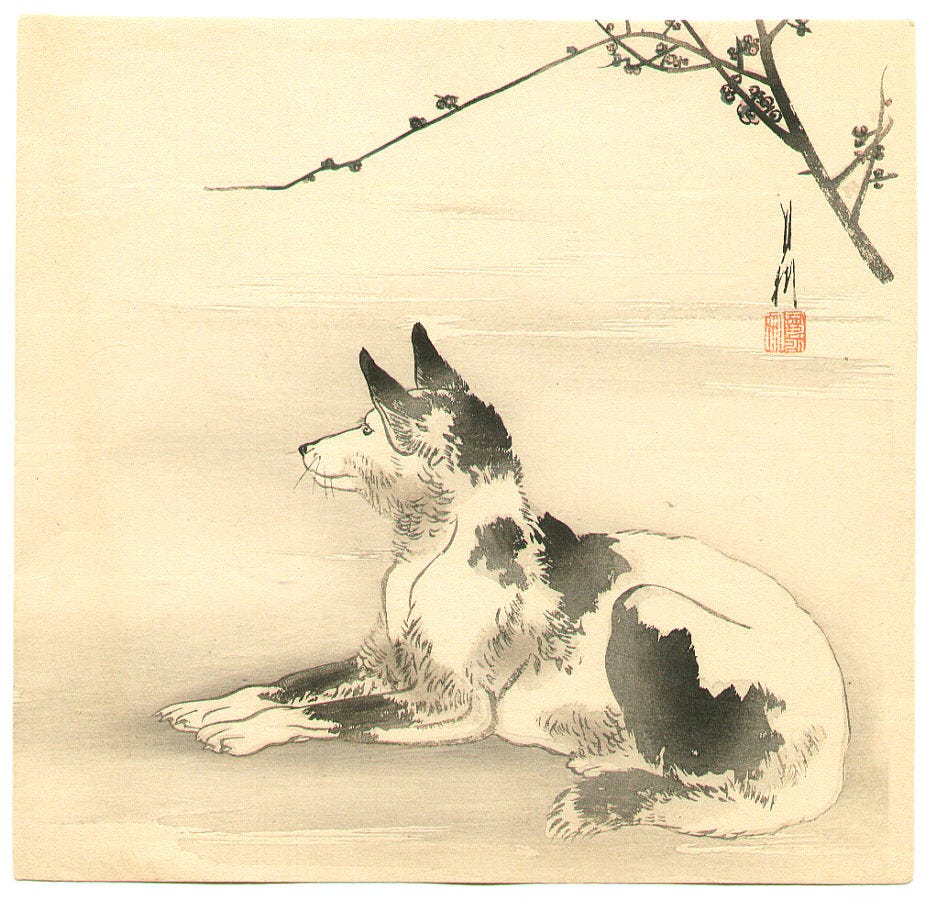
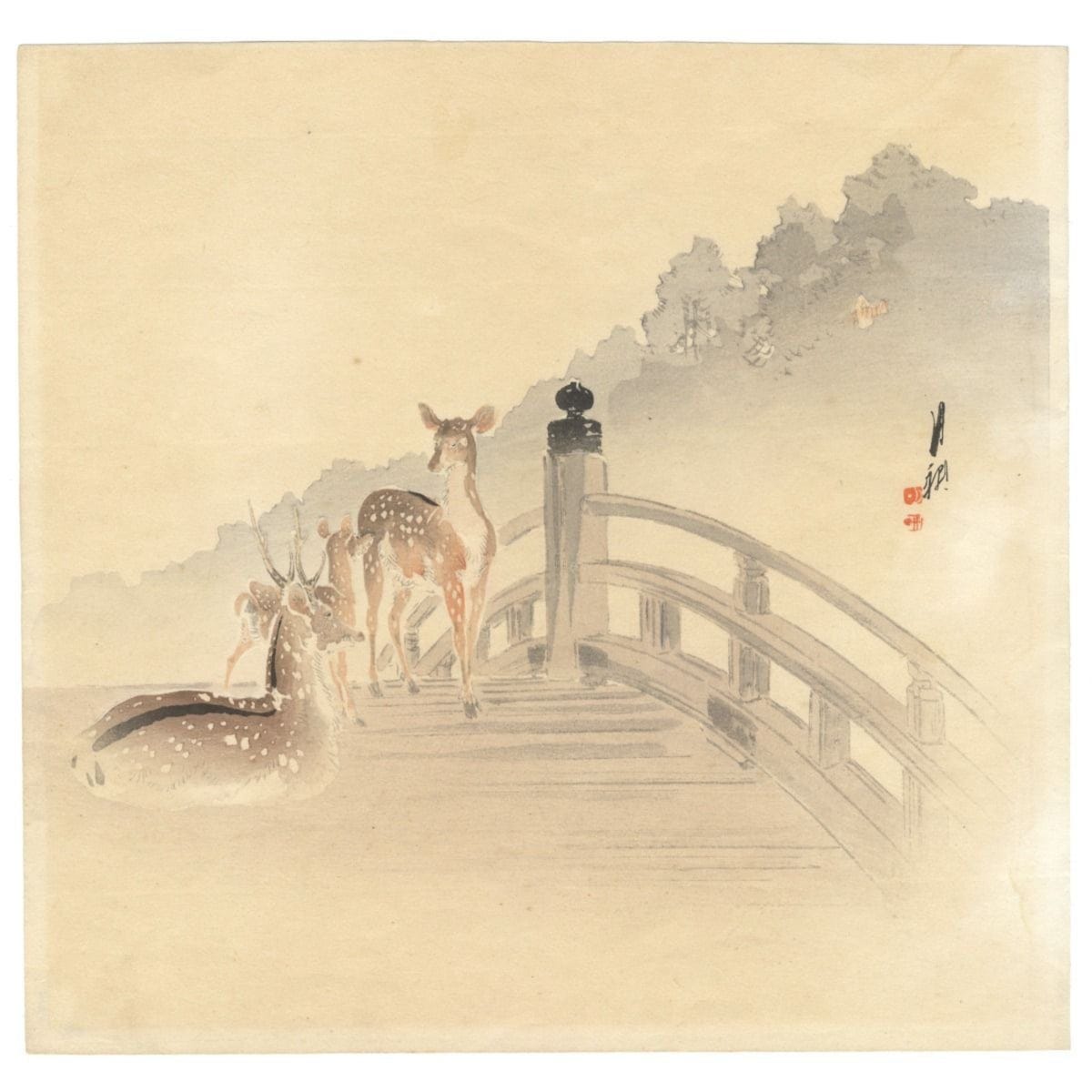
Art by Ogata Gekkō (1859–1920).
JOIN WAYFARE AT RESTORE


Thoughtful. Motivating. And moving.
Really love this. Will be coming back to it.