


Translated by Daniel G. Call
The roads carved by the constant treading of heavy feet over the ages had long since faded away. Not for lack of travelers, but rather, for the abundance of them. These were days of widespread war and rage, where others were enemies just because they were others. Any prudent traveller knew to keep away from them if he desired to keep his life.
Ivar and his wife had skirted alongside these paths, under cover of treeshade and running hunched over in the clearings, hoping to avoid hostiles each time they arrived at the following grove. Something was guiding Ivar, seeing as how they had made their way to the northernmost coast and now found themselves facing the sea without any setbacks, only having to hunt a bit, like moles or a red squirrel, fighting off hunger and the cold, both of which increased the further north they advanced.
The wind whipped through Ivar’s long hair and the salt air parched his lips, a sign of the nearby sea. He remembered, as he walked, how they were forced to run when their village was attacked, hiding, he taking only his sword and a bag with some belongings, and she the quiver with a handful of arrows and the bow.
“Gakk út þadan, Ivar! Come out! See your people here, your people!” shouted a captain, pointing his sword toward the kneeling prisoners, all lined up. “Your people need you. I promise to free them if you show yourself,” he mocked between the complicit hoots from others who held their arrows pulled back, ready to fire.
“Get out of here, Ivar!” yelled a captive, joy in his voice, eyes trained heavenward while everything around him burned. “Here come the valkyries, dróttinn.”
The captain silenced him with a slash to the neck.
“Come, dróttinn,” the captain repeated in mockery, looking around in circles, “and the others won’t have to ascend to heaven today.”
“My love,” Ilda whispered to him, frightened as she witnessed the scene from the trees.
“We have to leave, ást min; they won’t suffer, they die in innocence,” said Ivar, turning around and falling back further into the trees.
As he turned his back, he heard how the captain went on monologuing, preaching of cowardice and freedom and foreign gods, until finally, after screams of terror and defiance, he heard no more.
A silence forced by arrows. Then howls of war and triumph.
Survivors: That’s what Ivar and Ilda were, escaping from the south and the wars they themselves had tried to stop. Their children had been slaughtered. “Foolish Vikings,” thought Ivar as he recalled those experiences. He shut his eyes and out streamed tiny tears with each step. He recalled the horror of burning homes, friends in flames, blades that disemboweled children’s corpses and stripped women of that which was most sacred, to later use their remains as a trophy.
They had arrived at the stony seaside crags. Ilda tripped, falling to her knees, wounding herself.
“Ást min, just a little further,” he said to his wife, after raising her back up, lovingly caressing her braids to the side. “We are so close.”
She threw up what little breakfast she’d had that morning. Ivar looked upon her admiringly: That wasn’t from the exhaustion of the inhuman journey that they were on, but rather the proof that a child was taking form in her womb. He had already suspected it. That’s why he couldn’t allow himself to be killed; that’s why he chose to flee rather than perish together with his tribe. Something higher than he and his Viking pride was just over the horizon.
Since when had his people gone from being farmers to raiders? Had they strayed so far from their roots? Ivar remembered how, when he was young, the tribes began to fight among themselves, and how to the south there rose up an empire, which, as it expanded its territories, devastated everything in its way. Ivar knew that the internal wars, when added to the external ones, would be the end of them. He warned them; he told them; he pleaded with them. And they didn’t understand. Pride, arrogance, and traditions had blinded them. Roots run beneath the earth and all that sits above lives because of them. His own people had become the enormous serpent Nidhogg, hatefully biting at the roots of the mighty tree Yggdrasil. They had caused their own demise.
To the north they now went, not just for safety, but for a specific task. Afterwards they would turn west, toward the place where their enemies would surely go first to look for them.
They arrived at the north coast beside the sea, and upon a stony hill, Ivar began digging with his sword. “By Odin,” he thought with no faith in those gods. The earth was frozen. He spent hours breaking through the soil. Ilda went looking for loose stones with smooth sides, and she brought them close to where her husband was digging. It was the third day and if they didn’t find water soon they would die.
“Are we the last living branch of a fallen people?” Ilda asked as she touched her belly, her lips cracked by the salt air.
“Yes,” he answered, leaning on his sword. “This is why we are going to be grafted to a mightier tree. The past, ást min, only tells us where we come from, not where we are going. And as a branch torn off, we will escape being thrown into the fire.
After a while the freezing winds let up. With effort and help from his wife they filled the hole with the stones, turning the interior into a sturdy box. In her tongue, she began singing a sad tune, but one that carried a message of hope:
Brutu mik
Ek em brotin grein
Vindr berr mik
Helgi viðr minn brennr
Eitr lagði Níðhǫggr
Rætur hans deyja
Sjái eigi lengr þessi fjǫll
Vex eigi í þessum, mínum dǫlum
Vindr berr mik
Frá eldi
Hann býðr mik yfir mar
Þar verð ek gróin
Í nýju heimkynni mínu
As she sang, Ivar knelt with some effort and pulled out of the bag that which he had salvaged from his clan and which was wrapped in skins: a weighty book, not too thick, made of skinny sheets of silver, held together by rings of the same metal—a technique acquired through trade with the Islamic caliphates. What he was about to hide up needed to last for ages. It was written in runes and Celtic symbols gathered from other cultures. Engraved on the first page one could read the following runes:
ᚢᛅᛏᛏᚱ ᚼᛁᚾᛋ ᚼᛁᛚᚴᛅ ᚴᚱᛁᛋᛏᛋ
“Váttr hins helga Krists.” Into the box he also placed a knife with his name carved into the handle, two clear small stones: one white in color, the other black, attached to his helmet; also, an unadorned gold crown, the armband of his clan, and several dírhams. Then he covered it with an enormous stone. Kneeling together, they offered words to a god known to few of the northern peoples and who, in coming years, would be introduced to them by swordpoint from the south, just as Ivar had prophesied.
They departed towards the west and below, alongside the mountains; then they would venture across the great waters. The Guiding Spirit, which had helped Ivar, told him that there awaited a boat ready to set sail for a new land, flowing with milk and honey.
Jonatan Walton was born in Pergamino, Argentina. He loves reading, writing, and drawing. He has studied photography, graphic design, and archery. He started writing when he was young, but it is only recently that he has begun to truly prioritize this passion of his.
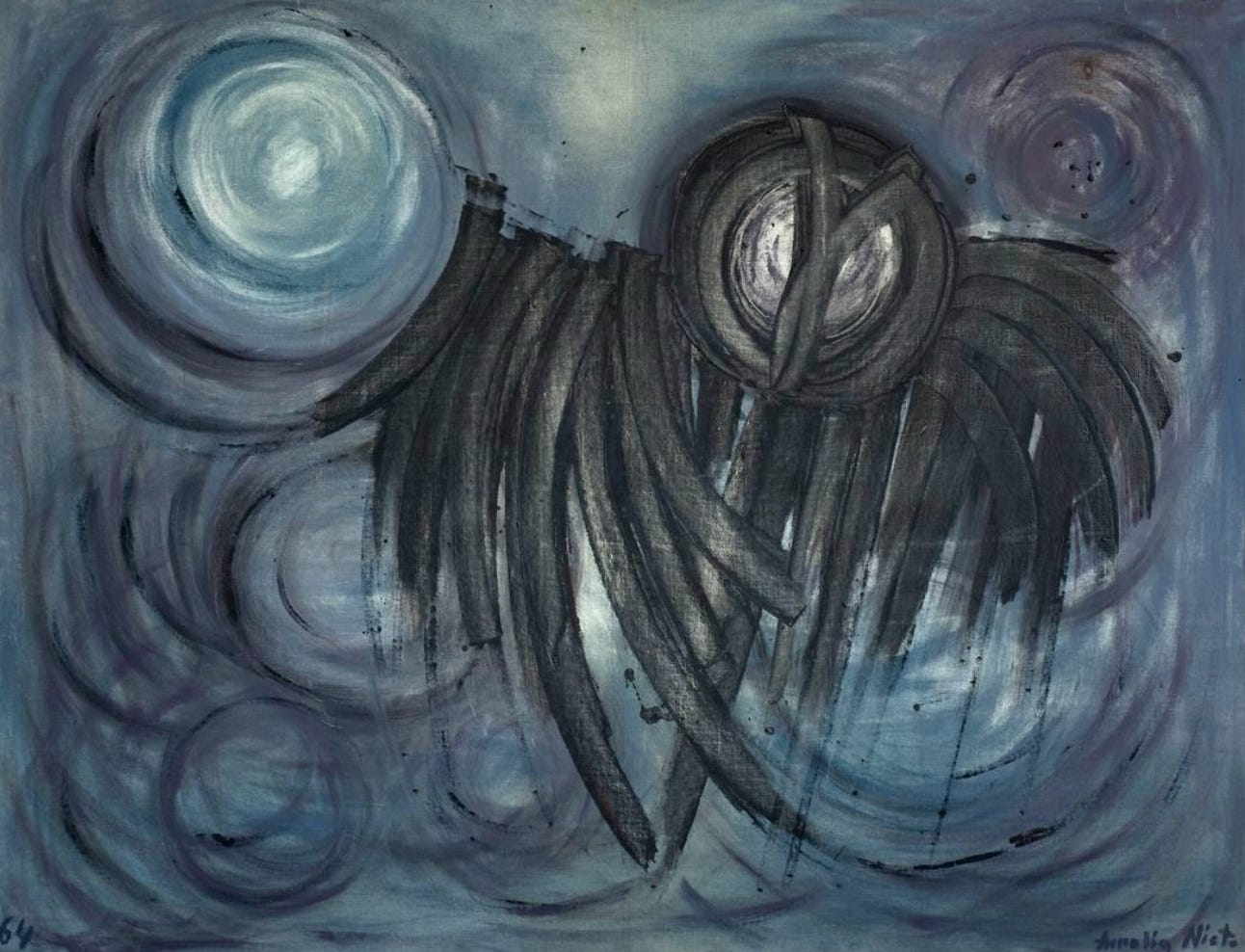
Art by Amalia Nieto (1907-2003).
“Celebrations” is a newsletter that celebrates sacred moments throughout the calendar and liturgical year. To subscribe to this newsletter, first subscribe to Wayfare, then click here to manage your subscription and turn on notifications for “Celebrations.”
Una Rama de Yggdrasil

La huella de los caminos formados por el paso constante de pies pesados hacía tiempo se había desvanecido. No por falta de pies, sino por exceso de ellos. Eran tiempos de guerra y cólera generalizada, donde el otro ya era enemigo por ser otro. El viajante precavido sabía que debía abandonarlos si quería salvar su vida.
Reorienting Zion: Latin American Voices

In 1925, the Church formally took root in Latin America when it opened a South American mission in Buenos Aires, Argentina. To celebrate the hundred-year anniversary of this monumental event and its expansive spiritual and cultural implications around the world, we offer a special series of essays by Latin-American authors.
