


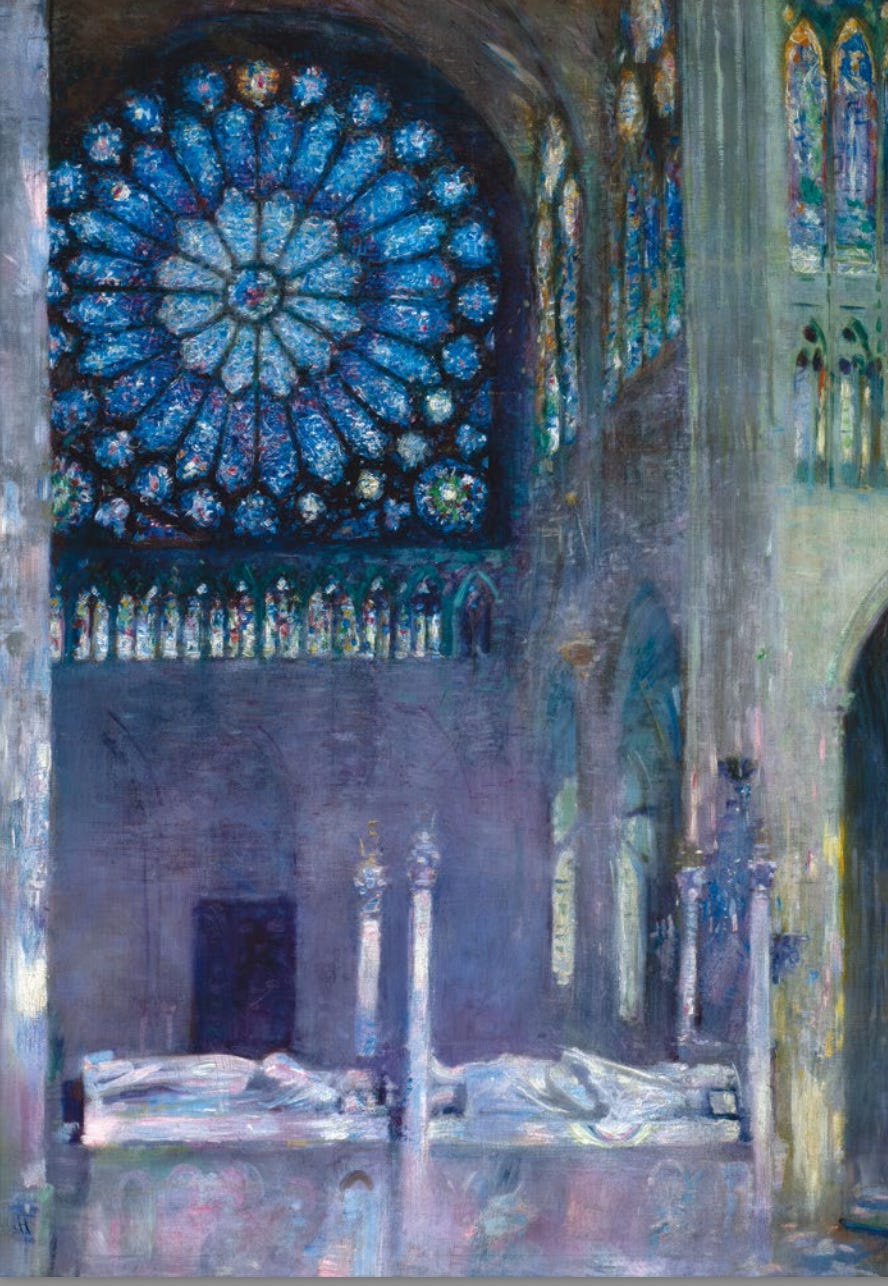
If you were living in France in the eleventh century, no one could blame you for thinking that the world was ending. Feudalism, once a stable (if highly unequal) political order, was fracturing. Kings struggled to assert control over nobles, many of whom built castles, raised private armies, and essentially became local warlords, terrorizing the countryside. Bandits and thieves roamed free, making travel perilous. The rise of merchants and towns caused massive economic change and dislocation. And the Crusades were underway, leading to depopulation and apocalyptic anxieties.
Extreme weather changes and the resulting crop failures were common. The French monk Adémar de Chabannes wrote about a famine in Limoges: “The corpses of all who are now dying there lie unburied over the land throughout the streets in every place. Many have now become food for the birds of the sky and the beasts of the land, because there is no one to get rid of them.” While food was often in short supply, what was plentiful was fear—fear of starvation, fear of death, and fear of divine judgment.
The Church was hardly a safe haven from anxiety. It was racked by scandals and crises such as simony (the buying and selling of church offices), lay investiture (secular rulers appointing bishops and abbots), and widespread clerical marriage and “concubinage.” Even the clerics not distracted by political ambition or mistresses tended to give homilies that ratcheted up the fear. They emphasized guilt, damnation, and the coming end of days. One of the most common artistic motifs was the hellmouth—a giant gaping jaw lined with monstrous teeth, ready to swallow sinners whole.
Church architecture reflected this angst. Churches were built like fortresses: heavy stone walls, squat profiles, narrow windows that let in only the faintest light. The weight of the stone pressed down on the worshipper like the threat of divine judgment.
One of these Romanesque churches was the abbey of Saint-Denis, just north of Paris. The abbey had been founded in the seventh century by the Frankish king Dagobert in honor of St. Denis, the first Bishop of Paris and the patron saint of France. It became the place where French kings were educated and buried.
In 1081, a boy named Suger was born to peasant parents but quickly revealed unusual intelligence. At age ten he was brought to the abbey of Saint-Denis to be educated (and essentially adopted) by the monks. His closest friend and schoolmate at the abbey was Louis Capet, who became King Louis VI in 1108. King Louis quickly appointed his brilliant friend Suger to be his advisor, and Suger was soon mediating diplomatic conflicts, negotiating alliances, reforming the tax system, and even acting as regent when the king left on the Second Crusade.
But Suger was not just a statesman. He was a dedicated and imaginative Christian disciple and mystic. He was especially enamored by the ideas of a mysterious fifth-century Christian writer known as Dionysius the Areopagite, who described God as pure light—radiant, overflowing, and cascading down the hierarchy of creation. Light, for Dionysius, was the most apt symbol of divine love: It illuminates without exhausting itself, warms without being diminished, and spreads without violence.
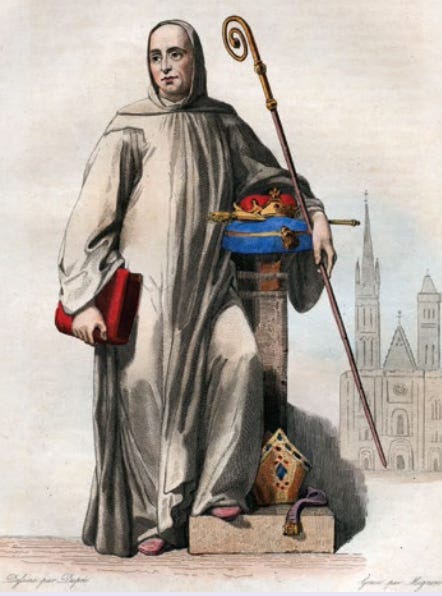
In 1122, Suger was appointed abbot of Saint-Denis, inheriting a dark, cramped, and decaying building on the verge of collapse. It was also too small to hold the crowds of pilgrims who attended on feast days. As Suger complained in a letter, “the narrowness of the place forced the women to run toward the altar upon the heads of men as upon a pavement with much anguish and noisy confusion.”
Most leaders in Suger’s position might have merely patched the roof, reinforced the walls, and prayed for stability. Instead, Suger began to dream. He dreamed of a building that could embody Dionysius’s ideas of divine light and renew his nation through beauty.
He began imagining a spacious church filled with windows rather than walls. A church where stone opened itself to light rather than blocking it. A church where worshippers would be lifted upward rather than pressed downward. A meeting place between heaven and earth that would shine with what he called lux nova—the new light.
Despite his rapture for theology, Suger knew that ideas truly become alive and transformative when represented in the physical world, writing that “the dull mind rises to the truth through material things.” Working with master craftsmen, Suger introduced a revolutionary set of architectural ideas. Pointed arches to channel weight downward more efficiently, allowing structures to rise higher. Ribbed vaults, which distributed pressure across thin ribs, allowing more open interior spaces. Flying buttresses that freed the walls from bearing the church’s weight, enabling massive stained glass windows that transformed sunlight into a kaleidoscope of spiritual luminosity.
And he delighted in getting his hands dirty in the work. One story tells of how craftsmen needed twelve immense beams to construct the roof. They searched the nearby forest but found none. Suger joined them in prayer. Wandering deeper into unfamiliar woods, they discovered exactly twelve perfect trees—straight, tall, suitable for their sacred purpose. Suger took it as a sign of divine blessing upon his project.
Suger was also attentive to the need for the abbey to serve everyone, not just elites. He hired artisans and artists to create statues—including gargoyles and chimeras—and other forms of decoration for both the interior and the facade of the structure, not only to add visual delight, but also to offer those who couldn’t read scripture a way to meaningfully engage with the sacred. The statues and stained-glass windows contained biblical stories, symbols, and signs to anyone passing by or entering these churches, a luminous theology lesson.
But Abbot Suger knew that the beauty of the cathedral was merely an arrow pointing to the divine source. “Marvel not at the gold and expense but at the craftsmanship of the work,” he wrote. “The work should brighten the minds, allowing them to travel through the lights to the true light, where Christ is the true door.”
The rebuilt abbey of St. Denis was dedicated in 1144. The result was the first Gothic church in the world. Those who entered gasped. The space seemed to dissolve into radiance. The vaulted ceilings lifted the gaze heavenward. Color danced across the walls and floor. A worshipper stepping into Saint-Denis walked into a vision of the world to come. For a people battered by violence, famine, and fear, this was a spiritual revolution.
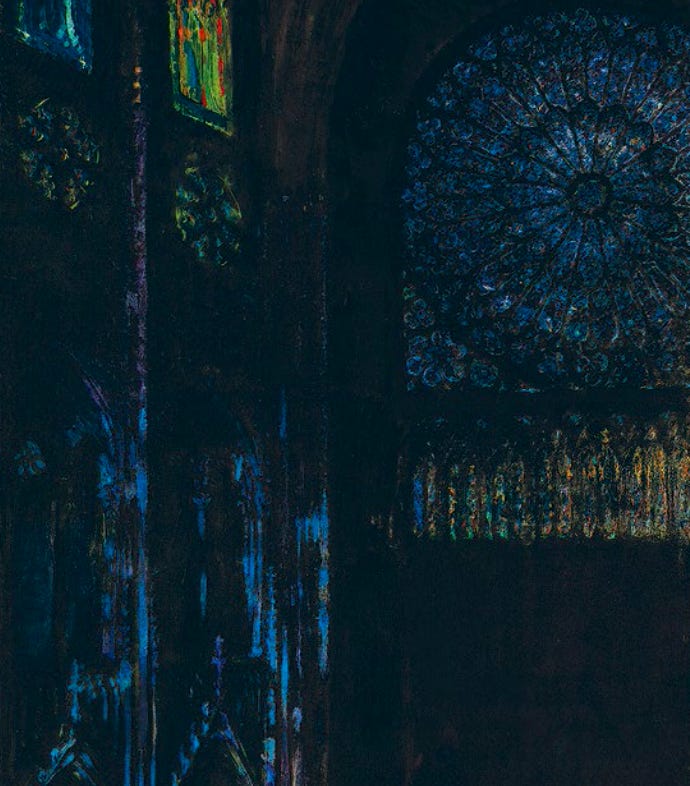
Suger’s vision was contagious. Within decades, the principles he pioneered spread across France and then throughout Europe. Abbeys and cathedrals rose like mountains of light: Chartres, Notre-Dame, Amiens, Reims, Bourges, Canterbury, Cologne. Each sought to surpass the last in height, illumination, and theological imagination. The Gothic cathedral became the defining artistic achievement of the Middle Ages.
Abbot Suger exemplifies the power of spiritual imagination. He lived in the very heart of political crisis and cultural collapse. He did not deny the darkness and fear of his age. But where others saw inevitable decline, Suger envisioned the conditions for rebirth. He rebuilt a crumbling abbey not as a monument to the past but as an act of prophetic hope. He did not abandon tradition; he transformed it.
Like the time of Abbot Suger, our world too feels like it’s ending. And in many ways it is. We face intersecting crises of trust, of mental health, of ecology, of technology. Institutions are fraying, political life is poisoned, and many feel spiritually homeless. Our young face rising loneliness and despair. The order we inherited is collapsing. But becoming saints in the last days is precisely what we’re called to do. To live with courage at the end of one world, and help midwife the birth of a new.
This is what Christians have always done in times of upheaval: care for the sick, welcome the stranger, build churches and schools, write hymns, plant gardens, tell stories, and create sanctuaries of beauty where the weary can rest. In Christ all things are made new, and we are invited to join him in that great and joyful work.
This essay and the first essay below appeared in Wayfare issue 6.
Zachary Davis is the Executive Director of Faith Matters and the Editor of Wayfare.
A House of Many Spirits

We can’t see the wind, but with mature eyes we can perceive it in the rustling leaves. Skilled sailors partner with the wind, and it carries them across the world. Gardeners and builders plant windbreaks to create islands of warmth and stillness or channel the breeze to refresh and cool a courtyard. Almost everything important is similarly invisible: the stories of the past, the outline of the future, the unutterable feelings locked in every heart, the flame of desire that burns in each of us, the waves of collective captivation that draw our attention as one. Wise people watch for rustling leaves and billowing sails, and they learn to work in the world of invisible things. Seen with clear eyes, all things are spiritual; all visible things have an invisible reality concealed behind them (D&C 29:34). If so, then learning to see the world as spiritual is not a surrender to fantasy. Instead, it may be the most time-tested way of immersing ourselves meaningfully in the real.


Imagining more beauty, more goodness, more truth. You inspire this, Zach. William James said his best word for God is MORE. Creativity from imaginations to mutually persuasive social councils to new worlds . . . without end. Of course, we sempiternal souls have designed veils of forgetfulness to make 'more' feel original, surprising and delicious . . . not just more.