



And there stood one among them that was like unto God, and he said unto those who were with him: We will go down, for there is space there, and we will take of these materials, and we will make an earth whereon these may dwell; And we will prove them herewith, to see if they will do all things whatsoever the Lord their God shall command them. (Abraham 3:24–25)
The state of the human soul and the environment are interconnected, each affects and influences the other. (Elder Marcus B. Nash, “Righteous Dominion and Compassion for the Earth”)
It is increasingly clear that contemporary technological inventions, and the forms of reason and logic that motivate them, are coming to look less like advancements and more like detriments to human life. Many technological developments deplete attentional resources, induce anxieties, and undermine the general welfare, while still others raise the threat of human extinction. Nuclear weapons, the brewing climate catastrophe, and artificial intelligence all, in their own ways, herald a future of humanity at existential risk.1 These threats bring to the foreground the enormous costs of our often unthinking commitment to technological advancement. Even the term has its own rhetrickery, its own way of imposing on us an optimism about the direction it’s heading without feeling any need to count the costs. The general process of modernization and what David Martin’s book The Future of Christianity has called “dangerous nouns of process” associated with it, such as industrialization, urbanization, and rationalization, are all motivated by forms of reason that displace faith, hope, and love, and center our attention on technical capacities and political machinations.2
At least since Heidegger, philosophers have been minding the gap between the logic of technological advancement and the freedom of being. In the domain of ecology, the Gaia hypothesis first articulated in the 1970s by James Lovelock and Lynn Margulis invites a rethinking of human freedom in relation to the earth. The hypothesis posits that the earth is a self-regulating superorganism, that “living things are part of a planetary-scale self-regulating system that has maintained habitable conditions for the past 3.5 billion years.” As Bruno Latour and Timothy M. Lenton have argued, “Gaia is simultaneously a hypothesis, a testable theory, a summary of highly specific facts, a worldview, and a philosophy of nature all mixed together.” The Gaia hypothesis “might be the name of a shift in understanding how to approach many phenomena previously lumped together in the notion of nature.” Yet what is most urgent about the Gaia hypothesis, in their words, may well be its “possibility,” its “radicality,” and the way it “focuses attention on the uniqueness of the situation at hand—a uniqueness that [they] believe has not attracted enough scrutiny.” The uniqueness of which they speak is this garden planet of possibilities we inhabit, and the critical zone, the thin layer of rock, soil, water, air, and organisms that sustain terrestrial life.
To translate this overtly into Latter-day Saint theological terms, the modern view of science since Francis Bacon has broadly conceptualized matter as a thing to be acted upon (see 2 Nephi 2:14). Even knowledge came to be defined as the power to manipulate things for our own advantage. The modern techno-scientific revolution has cultivated powers of acting upon matter for a wide variety of advantageous outcomes. The Gaia hypothesis, on the other hand, raises the possibility that our planet is not merely a thing to be acted upon, but a thing that acts.3
Our thinking, especially our ecological thinking, shifts dramatically when we come to see the climate crisis in spiritual and theological terms, rather than seeing it purely in techno-political terms. What follows is a reading of Restoration scripture that cracks open the door to a new way of thinking about planet Earth as an agent, the mother of men, together with all her attendant pains and sorrows (see Moses 7:48). The scriptures and prophets teach that the earth has a spiritual purpose, and this purpose ought to inform how we act and care for her. Restoration scripture contains a unique perspective on the earth that links its rest to the covenant power of its Creator. This message, once understood, can transform our relation to the Creator and creation in such a way that the task of being human is revitalized, born again in the Creator’s image.
Earth’s Purpose
Working out the optimal combination of human and planetary agency is, in fact, a perennial problem. We live as if caught between an earth we helped create and a world we inherited. The earth is unfinished while the world is broken, contingent, error- and sin-prone. The earth itself is no perfect thing, but it is as close to perfect for human needs as any planet could be. When we focus on the brokenness of the world, including the crises facing our climate, one common response is dread.4 Yet when we remember the power we have to choose and to act in concert with creation, new possibilities come into view.
Restoration scriptures teach that the one who was like unto God led us in making “an earth whereon these may dwell,” and our task is to continue to make and remake the earth where we and future generations “may dwell.” It is precisely these possibilities that should most animate us now: the possibilities of refusing lust and greed, embracing compassion and love, and working out new ways to “organize [ourselves]” and “prepare every needful thing” (Doctrine and Covenants 88:119). The need to refuse aspects of our own nature and to embrace the compassion and love potent within us is the epic struggle that forms the core of the earth’s meaning and purpose. The earth was made for us to dwell on in order that we might learn how to dwell on the earth forever. Or as Elder Marcus B. Nash said, “May we care for this earth—our present and future home—well.” Covenant human action is the means that God has ordained for the earth to achieve a state of rest. Ecological despair reflects a failure of theological imagination, but Restoration scripture offers us a clear understanding of the earth’s purpose, as well as some clear directions and reasons for having faith that the earth’s creation is not in vain, that the earth’s ecology can and will be redeemed.

It would be difficult to find a better example anywhere in the world of walking this talk than the work of the Office of the Presiding Bishopric under the direction of Elder Gérald Caussé over the last decade.5 Just days following the conclusion of his service as the Presiding Bishop, newly ordained apostle Elder Caussé spoke at Brigham Young University. In his address, “Caring for God’s Creations,” Elder Caussé describes the “intimate, sacred conversation between God and Moses” in the first chapter of the book of Moses. After beholding God’s magnificent creations, Moses learns that the earth was made for God’s own purpose: “For behold, this is my work and my glory—to bring to pass the immortality and eternal life of man.” Elder Caussé adds:
That says it all! The creation of this magnificent world was never an end in itself—it is the means by which our Heavenly Father’s eternal designs can be fulfilled. This earth and all that it contains—mountains and caves; deserts and tundra; oceans and forests; the endless variety of plants, insects, birds, and animals—everything, absolutely everything, was created for one sacred purpose: to provide the setting where God’s children could learn, choose righteousness and ultimately inherit immortality and exaltation within eternal families.
Understanding the purpose of the earth shapes what we, speaking of humanity collectively, ought to be striving for with respect to the earth’s possibilities.
Emphasizing the priceless gift of creation, including the temporal elements needed for our success and the “breathtaking beauty” of creation, Elder Caussé spends the bulk of his remarks addressing our earthly stewardship and the creative ways the Church is addressing these obligations as they flow from a revelatory understanding. “The Church itself seeks to live by these divine principles through its own practices of caring for natural resources, promoting the safety and well-being of all people and preparing for natural disasters and other hardships.” He articulates six areas in which the Church’s efforts are enhancing the well-being and daily lives of many around the world. These include caring for natural resources; adopting renewable energy sources; avoiding waste through material reduction, reuse, and recycling; managing trash; improving access to clean water; and addressing climate change and preparing for natural disasters. After providing numerous examples of how the Church is acting in these different areas to care for the earth, Elder Caussé also invites all to act in our communities with awareness of the broader world around us while “remaining grounded and actively engaged in the places where we live and serve.” One might be tempted to see in all of this merely evidence of corporate greening practices, but Elder Caussé is clear that the motives are theological. The immortality and eternal life of human beings includes a new heaven and a new earth (see Isaiah 65:17; 2 Peter 3:13; Revelation 21:1). Our covenant-making and covenant-keeping now is part of what will prepare the way for human and planetary renewal, and this includes all the practical things Elder Caussé mentioned in his speech: increasing energy efficiency, conserving water, avoiding material waste, improving resiliency, adopting renewable energy sources, and reducing emissions from transportation.

Earthly Orientations
The book of Moses offers further reasons to reflect more deeply on earthly ecologies and the way they are tied up with covenant-making and covenant-keeping communities. In the seventh chapter of the book of Moses, a rich chapter for exploring Theo-ecology, a conversation between Enoch and God is recorded in which Enoch repeatedly and urgently asks God, “When shall the earth rest?” (Moses 7:54, 58). This question, which Enoch repeats, is not in fact his own question, but one posed by the earth herself to Enoch (Moses 7:48).
After a glorious vision of the coming of the “the Son of Man, even in the flesh,” Enoch looks on the earth and hears a voice from the bowels thereof, saying:
Wo, wo is me, the mother of men; I am pained, I am weary, because of the wickedness of my children. When shall I rest, and be cleansed from the filthiness which is gone forth out of me? When will my Creator sanctify me, that I may rest, and righteousness for a season abide upon my face? (Moses 7:48)
The earth is expressing weariness and pain because of human action. Seeking sanctification and righteousness, the earth awaits her Creator.
Upon hearing the earth mourn, Enoch’s first reaction is to weep. His second reaction is to cry unto the Lord, saying: “O Lord, wilt thou not have compassion upon the earth?” Enoch likely recognizes that human and earth futures are inextricably linked and that salvation for one is salvation for the other. The Lord reveals that the “Messiah, the King of Zion” will come—and still Enoch asks, “When the Son of Man cometh in the flesh, shall the earth rest?” Enoch’s care for the earth seems almost to supersede his concern for human salvation. As the account unfolds, the connection between human and planetary salvation becomes clearer.

The vision expands, and Enoch sees the Son of Man on the cross, sees the heavens veiled, and sees that
all the creations of God mourned; and the earth groaned; and the rocks were rent, and the saints arose, and were crowned at the right hand of the Son of Man, with crowns of glory; And as many of the spirits as were in prison came forth, and stood on the right hand of God; and the remainder were reserved in chains of darkness until the judgment of the great day. And again Enoch wept and cried unto the Lord, saying: When shall the earth rest? (Moses 7:56–58)
Enoch hears great and marvelous things, but his mind remains fixed on the fate of the earth. The redemption of Christ is intermixed here with not only the salvation of humankind, but also the salvation of the earth. These verses are flooded with the theology of Christ’s redemption of all creation. Witnessing the crucifixion, all creation mourns and the rocks are rent. The earth herself is a witness and an actor, a suffering mother, weary because of the wickedness of her children. A mother longing for rest, cleanliness, and sanctity. Enoch hears that cry and immediately weeps with and for the earth, joining her in her mourning. And then Enoch advocates for the earth with the Lord, asking repeatedly and urgently when and by what mechanism the earth will find rest—but the Lord has already prepared for this eventuality. By careful listening and by insistent questioning, Enoch comes to a fuller understanding of God’s plan. Indeed, it is precisely Enoch’s care and concern for the earth that enables us to begin to grasp how the earth’s coming to rest is the form of human salvation itself.
Enoch asks if God will come again on the earth, and he is told that the Lord will come to fulfill his oath in the last days. Moreover, the Lord tells Enoch that before the day the earth shall rest, it will be covered in darkness, the heavens will shake, and there will be great tribulations “among the children of men.” Furthermore, a great gathering will take place to a Holy City called Zion, a gathering of the righteous in a New Jerusalem—and a great reunion will take place uniting Enoch’s city with this new city—and the Lord himself will there abide; then finally the earth will rest (Moses 7:60–64). Through Enoch’s weeping and mourning with the earth and his advocacy for “the mother of men,” he comes to understand that the fate of all humanity is linked with the fate of the earth, which will rest only when the gathering of the elect from the four quarters of the earth is complete and the Lord abides in Zion.

Conclusion
The Restoration of the gospel of Jesus Christ offers a cosmovision that transcends the worldview of modernity. Modern techno-logics have revolutionized the world, but they cannot supersede the plan of salvation and its attendant account of the Earth’s purpose. Covenant confidence and faith in that purpose transforms our view of Mother Earth and links all her transcendent possibilities to the Atonement of Jesus Christ and the covenants it guarantees. Our faith in the Lord’s oath to prepare the way for the earth to rest is tantamount to our faith in heavenly rest for us and our families. Talk about turning the hearts of the children to the parents—Father God and Mother Earth—and the hearts of the parents to the children.
David Charles Gore is a professor of Rhetoric & Public Affairs at the University of Minnesota Duluth. He loves swimming in Lake Superior and hiking along her shores.
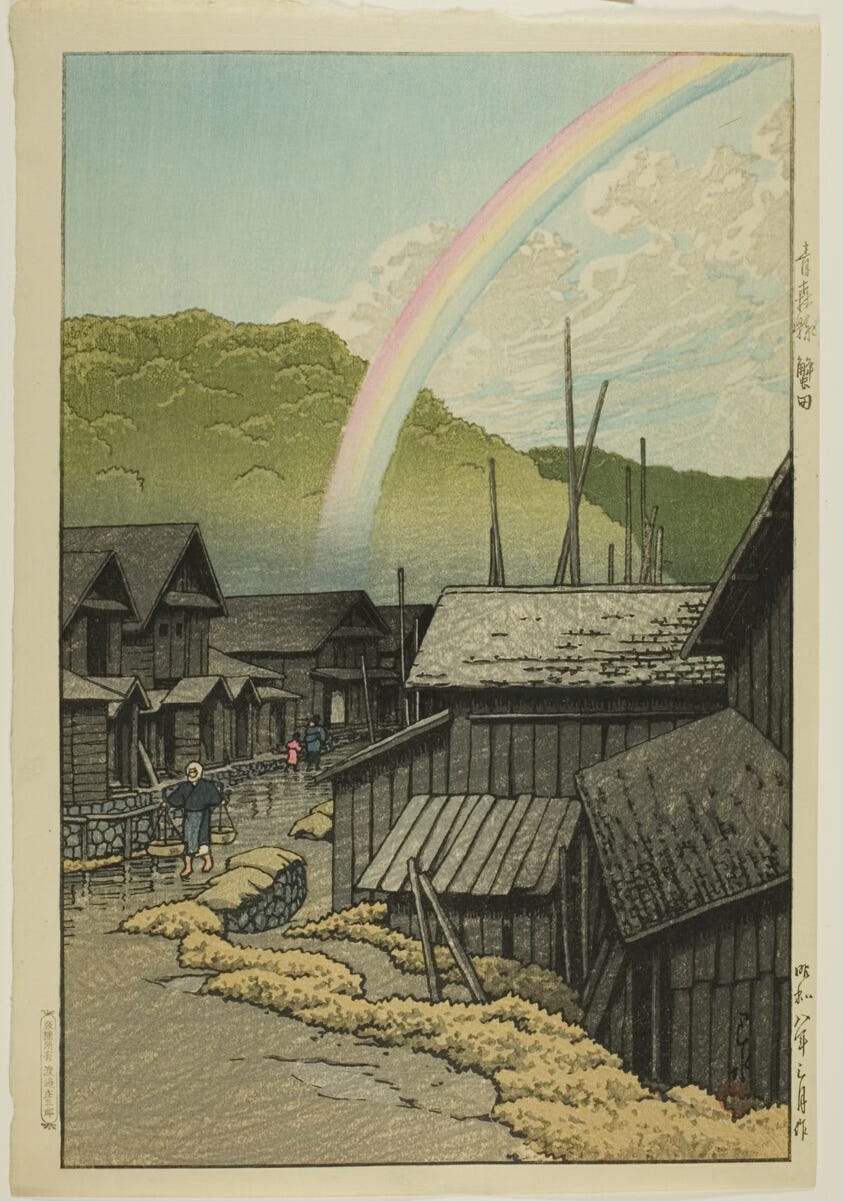
Art by Kawase Hasui (1883–1957).
For more on this threat, see Toby Ord, The Precipice: Existential Risk and the Future of Humanity (Hachette Books, 2020).
David Martin, The Future of Christianity: Reflections on Violence and Democracy, Religion and Secularization (Ashgate, 2011), 5.
Earth systems science seems to confirm the reality of the earth as an agent. See especially Clive Hamilton’s book that forwards the claim that the earth is a political actor, Defiant Earth: The Fate of Humans in the Anthropocene (Polity Press, 2017).
See David Theo Goldberg, Dread: Facing Futureless Futures (Polity Press, 2021).
For a solid rundown of this work, listen to Church News podcast, episode 223, “Church’s Sustainability Manager on the Sacred Responsibility to Care for the Earth,” January 14, 2025.
