


How can teachers in the Church teach more effectively in just twenty-five minutes? How do we both prepare better as well as engage more quickly?
This sample lesson plan offers one model of how to teach open questions anchored in text.
With this recent announcement, teachers will start teaching second-hour church lessons in twenty-five–minute increments in September 2026. This change (down from fifty minutes) raises opportunities as well as challenges. One opportunity is to bridge discussions week to week with thematic questions, thus creating more frequent and sustained themes. We aim to meet many of the implied challenges by elevating and accelerating the following teaching standard: Teachers should model how inspiring, open-ended questions invite the class to interpret scripture (to see a new question in the text). Teaching succeeds when it models and invites class participants to use scripture to raise and address questions to which they do not already know the answer. In short, may we aim to teach open questions anchored in text.
Excellent teaching leads to fewer “Sunday School answers” in Sunday School, Relief Society, and elders quorum; it deepens literacy, the dignity of standing in uncertainty, and testimony.
In what follows we offer just one of many possible lesson plans for twenty-five minutes. (There are many other ways to teach, many of them surely preferable!) What all twenty-five–minute lesson plans have in common, again, is that they focus on teaching open questions anchored in text. Here’s just one flexible way to do so. The flexibility: please scale the number of specific question prompts (for example, A–C below) to match the number of small discussion groups in your class; for example, small classes might just have one text-specific prompt (A) while larger classes might have more (A–G). Scaling the prompts to the class size makes sure each class member has the opportunity to interpret scripture.
The sample lesson also includes teaching tips and whiteboards that help visually set up learning in three parts: (1) big picture on top, (2) text specifics on bottom, with a (3) literal middle space or gap for the class to fill in between the questions (top) and the text (bottom). If the lesson plan below succeeds, everyone in class will have had a chance to read scriptures (or the assigned text), ask non-obvious open questions, and explore the text and their thoughts with at least a neighbor.
In twenty-five minutes, that’s saying something!
Lesson Plan Start
A Teacher’s Timeline: 0:00 to 25:00
0:00 Introduction (about four minutes)
4:00 Set the Story (about four minutes)
8:00 Discussion Launch (less than a minute)
9:00 Internal Group Discussion (five minutes)
14:00 Group Reporting & Class Discussion (less than ten minutes)
23:00 Closing (about two minutes)
In the weeks before the lesson: Work with your fellow teachers and teaching leadership to organize bridging questions that create thematic connections from week to week. One example might be a single question that bridges across three or four weeks of readings. Another might be a series of weekly questions that build on one another. These provide continuity over time between discussions, especially when time is short for in-person discussions.
In the days before the lesson: As you read the assigned scriptures and Come, Follow Me manual, look for three passages that are short yet dense in substance: These might be pivot points in the narrative, surprising phrases, or other curiosities. These make excellent anchoring passages. When in doubt, supplement with BYU Professor James W. Faulconer’s excellent The Scriptures Made Harder series (accessible for free here: Old Testament, New Testament, Book of Mormon, Doctrine & Covenants), which consist almost entirely of text-anchored questions.
In the minutes before the lesson, prepare the board and, if relevant, privately invite people to offer opening and closing prayers. Find a template board below. It has three spaces: 1. Bridging questions at the top. 2. Class discussion comments in the middle. 3. Anchoring passages and questions on the bottom. The teacher prepares 1 and 3 before the class. The class provides 2 in discussion.
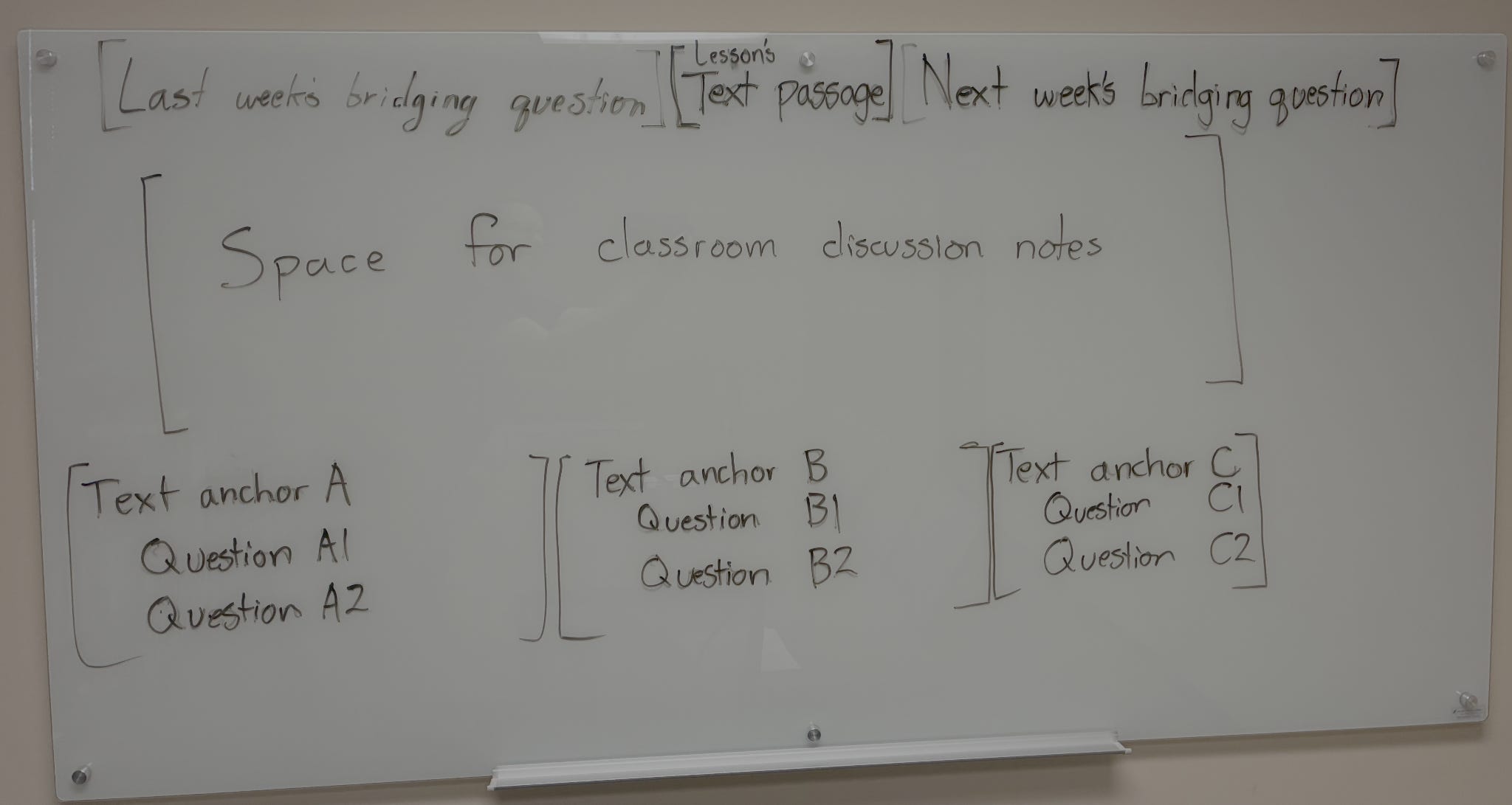
Photos of boards will model a sample lesson below. The class participants might walk into class to see the following on the board).
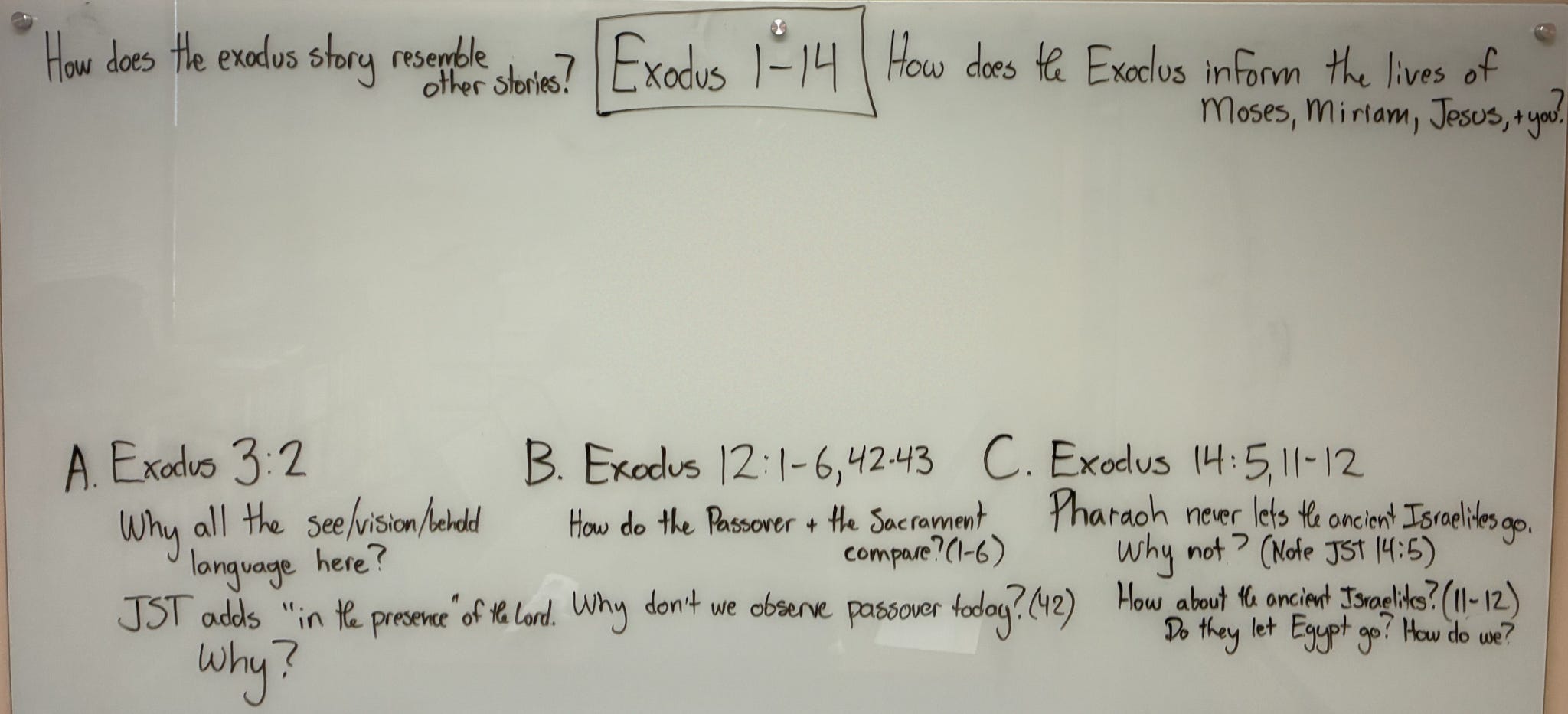
0:00: Introduction: The teacher welcomes the class, circulates announcements by paper or digital means only, invites any new friends who wish to introduce themselves, and briefly invites the class to share thoughts on the bridging question on the board from their home scripture study since last week.
Tip: The first few minutes set the tone for participation. If at least 20 percent of the class says anything in the first 20 percent of class (five minutes), conversation for the last 80 percent will be (much) easier to spark and sustain. Repeat the bridging question from last week on the board, and invite thoughts from the home scripture study.
4:00: Set the Scene with a Prepared Story: The teacher briefly presents a big-picture arc of the scriptural story at hand—without drawing any conclusions. To read out loud for four minutes, prepare a bit more than 500 words.
Tip: Start with a hook. Deliver a specific, engaging, brief rehearsal of the whole scripture story this week. Paint the story like a cinematographer, starting at the height of action and then cutting away before resolution. Along the way, plant a few choice details (preferably from an easily understood translation) to establish enough context to follow the story without knowing how it ends. Ideally, the prepared story should invite the class to inhabit the scripture story through different actors’ shoes. Leave the listeners hanging. Invite them to respond only after reading (the next step).
8:00: Discussion Launch: With the setting established, the teacher now refers to three specific anchoring passages (A, B, C), together with two open-ended questions (A1 and A2, B1 and B2, C1 and C2) for each anchoring passage on the board.
Tip: Use open-ended questions—often beginning with “what,” “when,” “why,” “how,” or even “under what conditions, if any” and the like—to invite extended reflection based on specific scriptural texts. If it can be answered in a phrase, don’t ask it.
(See the sample board above.)
9:00: Internal group discussion: The teacher then invites self-organizing groups of class participants to choose one or two of the three anchoring passages listed on the board—A, B, or C—and then to read these passages together, read the surrounding bits if needed, and then report their thoughts back to the rest of the class. They have five minutes—no more: ready, set, go!
Tip: If your open-ended questions are written on the board, you do not need to read them out loud. They alone will guide the small groups to choose and respond appropriately. When it is time for groups to respond, instead of repeating the written questions, simply welcome their thoughts in light of the reading.
14:00: Group Reporting and Class Discussion: Each group selects its own spokesperson, who then briefly summarizes to the class the group’s discussion.
Tip for group reporting: The teacher repeats each group’s report in a way that raises a new question or repeats its main principle, writing that question or principle on the board, and asks if anyone else from the group who has not spoken has comments. Then the teacher moves briskly to the next group report.
Tip for class discussion: Welcome each comment, and reclaim the best part of it, whenever possible in ways that connect to other comments. (If the comment is off the rails or longwinded, reclaim the question behind it or repeat the most useful moment from it.) Model how class members are in conversation with one another. Name class participants whenever possible.
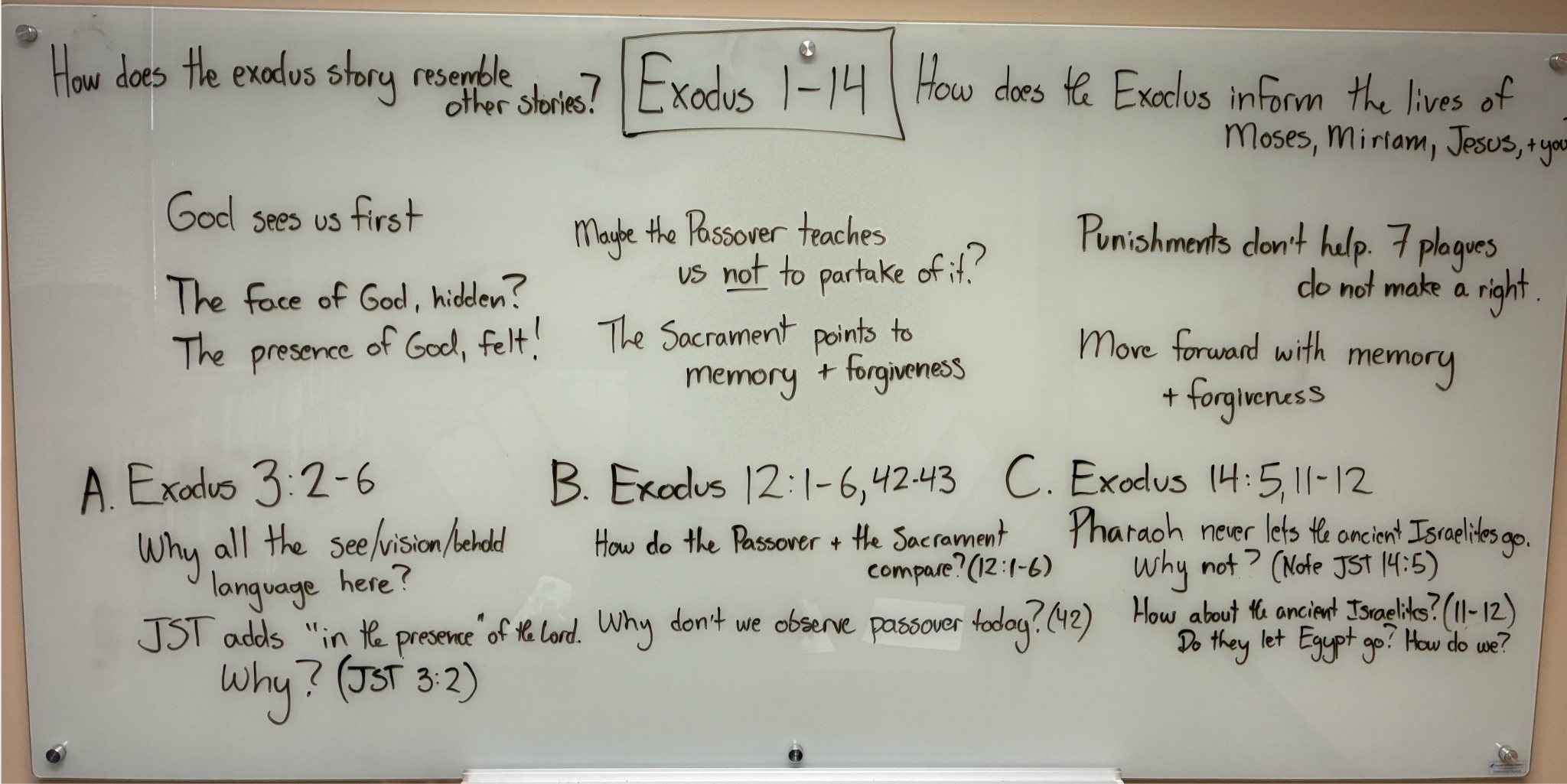
(The board above now includes comments summarized from class discussion. The teacher might close by drawing connections between the different main points, such as with the circles below. Typically, the teacher will find better connections back to the bridging questions at the top than between the group comments in the middle; but with practice, that may change.)
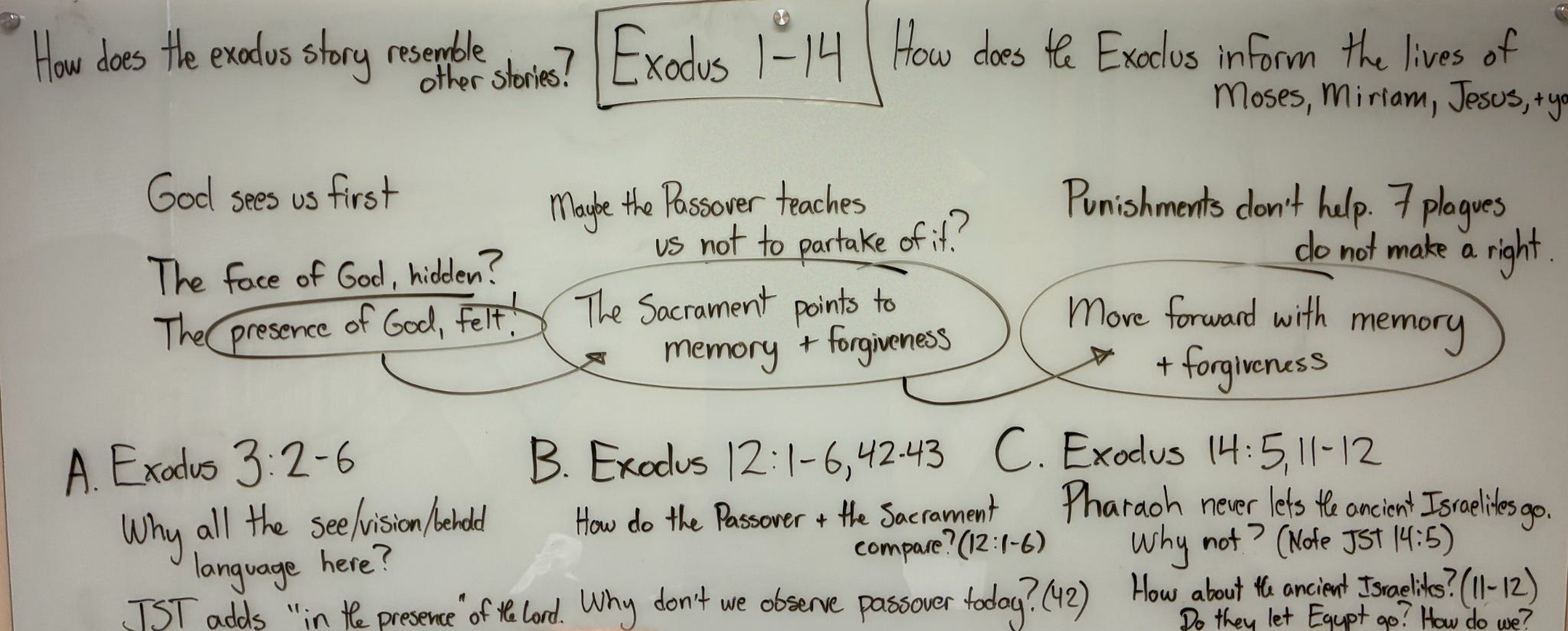
23:00: Closing: The teacher thanks the class for their discussion, repeats the bridging questions that the group reading is addressing, repeats the reading assignment for next week, and promises to lead with the bridging question (on the right) next week. The teacher then bears very brief testimony on the bridging question’s theme and dismisses the class.
Lesson Plan End
Supporting Teaching Tips:
Wait time. Silence is strength (especially when class feels rushed). Use it deliberately. Even a single second of silence can make some class participants nervous; use that to serve them. Take confidence in standing in silence after asking a question. Waiting to speak at least five seconds after asking a question and at least five seconds after someone answers a question encourages deeper responses. Better yet: ask a question, wait a full ten seconds (this can feel like a very long time), and then ask the question again using new words—and then wait even longer again before responding. Eventually, almost all classes will participate. It can be helpful (to both teacher and students) to explain after asking a question, “I’ll wait a few moments to let you think about your responses.”
Don’t use class time to read out loud in a row. Don’t do “round robin” reading: in other words, do not take time to have class participants read from a passage sequentially. Sequential reading aloud, while common, is generally not a desirable teaching practice. (It weakens comprehension while raising anxiety among participants.) Instead, invite class participants to read alone, to read in small groups, or to listen to a skilled and fluent reader (chosen ahead of time) while focusing on an answer to the question. (With youth and Primary students, asking them to draw something related to the question while they listen to a reader is a good strategy for focusing attention.)
Use eye contact to facilitate discussion. While one person in a group is responding, direct your attention to the others in the group. Avoid making eye contact only between speaker and teacher; use your eyes to invite others to participate.
Open a single response into broader discussions. After receiving a response, acknowledge their response gratefully and then immediately turn to the class, asking, “Does anyone have anything to add? How has your experience been different or similar? When, if ever, might it be helpful to see it in still another way?”
Extend discussion by asking questions like these often:
“Beautiful, so what makes you say that?”
“Thanks so much, can you say a bit more?”
“Help me understand this better. Who can elaborate?”Have transitions and closing statements ready: Teachers may help class participants adjust to the new schedule with transition and closure phrases. Model courage, curiosity, and discussions spanning months.
“We are now about halfway through our short time together today.”
“We can bring this discussion into the bridging question next week.”
“That’s a good place to pause, not because we’re done but because we are not.”
“Let’s hold that tension until next week. It’s healthy and good to think.”Without pressure, encourage all people to speak (often the shy have the best things to say):
Ask a question, promise to cold call folks randomly, and note that anyone may simply “pass” without follow-up. Then ask the question again.
Ask a question, and invite everyone to “turn and talk” to the person next to them, promising to cold call on a pair to briefly report on their discussion, noting that any pair may also “pass” for any or no reason.
Invite people to write briefly their own responses. These responses may be shared anonymously or kept private.
Teach open questions anchored in text. When in doubt, consult Faulconer’s texts linked above.
These tips for teachers were gathered by Wayfare editors with decades of teaching experience in Sunday School and in various professional contexts.
Benjamin Peters is an editor-at-large for Wayfare.
Art from the Circle of Pontormo (about 1494–1557).
Thanks for putting this together, Ben. I know I've enjoyed being a student in your classes you've taught where I've seen you implement many of these tactics. Always productive and I've stolen a few of them for my own teaching.
Thank you for sharing this, Benjamin. I find it both useful and thought-provoking. I am especially dedicated to the idea of getting better at reading and commenting on scripture together, and I’ve been looking for tools that support my determination to frame the change as an opportunity. This helps tremendously.