


.png)
Several years ago, essayist Rod Dreher penned a provocative book called The Benedict Option. The book’s thesis was that American culture specifically, and Western culture more generally, had grown so morally corrupt that a dedicated Christian could no longer participate in them in good conscience. He called specifically for those who follow Christ to largely withdraw from the world and find meaning, purpose, and comfort, instead, in separate Christian communities.
Dreher’s argument has never convinced me, for multiple reasons. First, I disagree with his gimlet-eyed view of modernity in the sense that I don’t believe things are quite so threatening to Christians and Christianity as he supposes. Beyond that, however, I think he largely gets the Christian mandate backwards. While it’s true that Christians are meant to be apart from the world in some important ways, the overriding message I find in Jesus’s gospels is that we are meant to plunge into the world so that we can lift, love, build, and bind it up—not abandon it.
Nonetheless, in the nearly ten years since the book was published, I’ve become convinced that there is one sense in which something like the “Benedict option” may be necessary: I believe that, in order to maintain our independence, and in order to hold onto our collective moral clarity, we may need to opt out of social media and a great deal of what is offered on the internet.
This is not because I believe the internet generally, or even social media specifically, is “evil.” Indeed, we can imagine a world where the internet might be beautiful, bountiful, soulful, and life-giving. This world remains within our technological and cultural reach, and I very much hope we will one day claim it. For now, however, I fear that the internet’s structure and the effects it has on our collective neurobiology and cultural mores are such that the longer we remain in the thrall of social media, the more fully we abandon ourselves to the whims of a small group of oligarchs and the world they create in their drive to accumulate profits and power.
Social media, it seems to me, has become the primary way in which, to quote Wordsworth, “the world is too much with us.” And, increasingly, it is the route by which we sell both our attention and even our morality to the highest bidder—often without even knowing we are doing so, and almost always without real consent or regard for the impact that sale will have on ourselves and on society. I believe this is true not because those who use social media do so with untoward motives—I do not this this is so—but, rather, because the infrastructure of social media warps how we see ourselves, those around, our choices, and the wider world.
It’s unclear whether social media feeds ever really represented the lives of the people about whom we care; but if they ever did so, they certainly do not now. We want to imagine that Instagram and Facebook largely function as ways to keep us informed about what is happening in our loved ones’ lives. We want to believe that X is a forum for helpful conversation. We want to dream of a world where we can hop online to be lifted up and participate in a meaningful exchange of ideas—that the internet can become the ultimate public square.
But those dreams constitute little more than a mirage, for multiple reasons.
First, the internet has morphed into a hellscape of advertising. It is a slippery and vaporous terrain where the landmarks around us come and go, growing and receding, appearing and disappearing according to whatever the lords of online commerce believe we want—or, even worse, according to what they want us to want. This is simple arithmetic. Nothing in the world is provided (at least for long) for free. The reason so many online offerings—especially nearly every form of social media—appear to be free is because what we do not pay in monthly subscription fees we pay for with our attention. Increasingly, studies show that most of the time we spend on any social media forum is devoted not to looking at photos of family or participating in meaningful conversation but instead being exposed to advertisements that are curated and arranged for each individual viewer. At day’s end, after all, our attention is one of the very few things we really own—and increasingly, we are sacrificing it on the altars built by the internet’s merchants of attention.
What’s more, as we become increasingly accustomed to this steady stream of advertising, we also become numbed to the fact that, too often, social media also functions as a forum for us to advertise ourselves. In this way, capitalization drives so much of what we do on social media. Social media, after all, allows us to transform just about every event and person in our lives into capital, whether financial, social, or reputational. Social media thrums as an engine allowing us to atomize the arc of a life into a series of posts fit for likes and resharing. I know this is true, for me, anyway because I know that when I used to use social media, no matter how good my motives, I was always thinking somewhere, on some level, “How will this impact how others see me?” Or, “How many likes will this get? How many times will this be shared?” We risk an inestimable and ineffable loss when we convert the shared moments that make up a life—birth, first steps, first words, starting school, graduation, dating, and marriage; never mind estrangement, rupture, break-ups, and death—into capital for endless personal advertising campaigns. This is not to say social media can never cultivate meaningful online community but only that the co-mingling of community and capitalization freights our social media interactions with something unsavory, superficial, and more than a little concerning.
But, hard as it might be to believe, this is the lesser of the problems which confront us online. What strikes me as much more deeply insidious than the question of exposure to advertising is that social media feeds are almost entirely controlled now by AI-powered algorithms that work in ways too subtle, complex, and effective for us to even really notice, let alone fully understand. If ever there was a day when Google—or any other internet company—truly acted with “don’t be evil” as its primary driving imperative, that day has long since receded into the past. Instead, we are confronted now with a universe where a small number of internet companies control vast swaths of the attention economy. But what we perhaps don’t remember often enough is that their only drive is to consolidate money and power. If they can achieve those aims by poisoning public discourse, or by fostering polarization and division, or by turning friends into enemies, or by sexualizing everything, or by degrading trust in public institutions, or by setting loose termites to gnaw at the foundation of democracy, or by spreading misinformation—then so be it.
The collective cultural effect of this is hard to overstate.
The resulting degradation happens as informational flows come to us like drugs dripped slowly into our veins—the veins of each of us individually and of all of us collectively—with an effect that is as invisible as it is inexorable. The levels of these cultural toxins have been building in our body politic, our shared national soul, and our collective consciousness for so long, and their accumulation has been so subtle and so pervasive, that I fear we long ago lost track of just how deeply they are affecting us. Even George Orwell and Aldous Huxley might have had some difficulty believing that we would so willingly—eagerly, even enthusiastically—pair ourselves with incessant little delivery mechanisms of these IV drugs: smartphones that we never leave at home, filled with “feeds” that quite literally never end. Such is our predicament that we imbibe the slop—the soma?—these feeds offer us while at the same time celebrating our independence and thoughtfulness.
And now we are confronted by the advent of AI, which is accelerating—if not wholly transforming—this collective digital addiction by being woven into the algorithms that control much of the internet, and thus so much of what we consume. Two of the most defining features of LLMs, after all, are these: they predict what we want with frightening accuracy, and they are endlessly, seemingly irrepressibly, obsequious. The first of these features is the very thing that has made LLMs suddenly ubiquitous: their ability to predict our desires makes them enormously useful. The second is the thing that makes LLMs seem “friendly” when they function as “therapists,” “friends,” or even “significant others.” But the combination of these two features is also the very thing that will render the poison of social media ever more toxic: as we come to rely on the LLMs ever more—for everything from help with homework to assistance with buying plane tickets to obtaining advice about how to live our lives—we will increasingly find our own desires and worldviews endlessly corroborated and infinitely buttressed. In ways far too sophisticated and subtle for us to ever really be aware of, LLMs and the media they control will forever suggest to us that whatever we think, whatever we want, whatever we desire, is not just acceptable, but right. By virtue of this endless positive feedback loop, LLMs are likely to worsen everything from narcissism to political polarization. The balkanization that has worsened with social media will be supercharged by LLMs as each person will silently enter into his own moral and even existential universe—an atomized crowd of one, entirely convinced that he is right and that those who disagree really just don’t understand reality at all.
In this way, succumbing to the allure of LLMs as a controlling force in our lives will be very much like assenting to the very opposite of a classical liberal education. A liberal education is meant to purposefully expose pupils to oppositional ideas so that a war of words (and thus never bullets) leads students to decide which ideas merit most serious consideration; life under the spell of an LLM is, instead, likely to expose consumers to ever-narrower bands of ideas such that the entire universe of thinking will begin to constrict around a given individual’s preconceived notion—like the informational equivalent of the people who starve in hell because the spoons are too long and they cannot learn to feed one another. We will increasingly be, to borrow Sherry Terkle’s phrase, “alone together.”
Of course, the ready reaction to all this might be moderation—however bad social media has become, after all, surely there must be a way to harvest the good and avoid the bad. But increasingly I am convinced that may not be true. For many of us it seems likely that battling against the power of the algorithms would take such constant vigilance, such determined focus, and such unyielding fortitude that attempting it would likely be a fool’s errand. And, in any case, if most of the time we dedicate online unavoidably goes to enrich those who already have too much and to empower those who already act as oligarchs—wouldn’t it be better to simply bow out altogether?
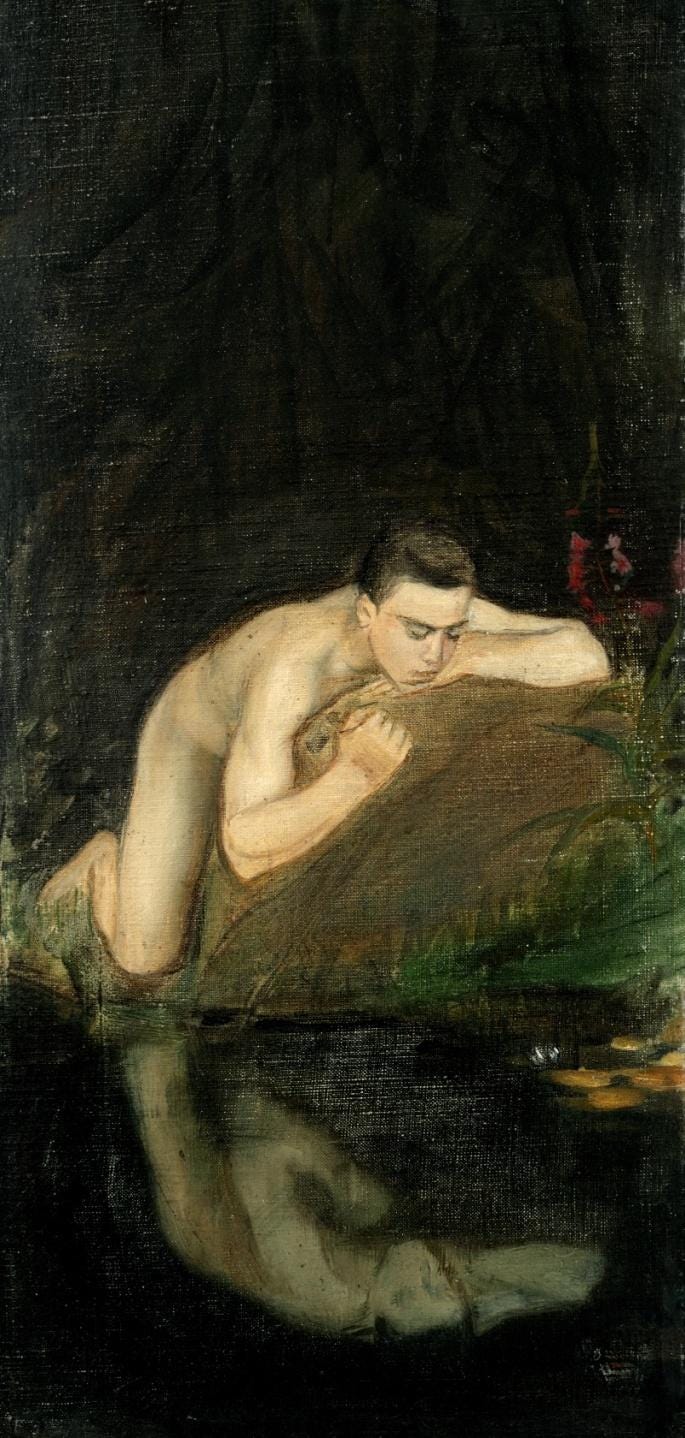
Increasingly, we are confronted at every turn with a state of affairs predicted more than a hundred years ago by Christian philosopher G. K. Chesterton. In his book Orthodoxy, Chesterton shares a parable of a man who, like Narcissus, becomes increasingly obsessed with his own appearance and his own affairs. Finally, the man becomes imprisoned within himself, unable to acknowledge the pressing reality of those who surround him. Summing up the importance of breaking free from this self-obsession, Chesterton shares words that strike me as prophetic—and as a needed antidote to our predicament in 2026:
How much larger your life would be if your self could become smaller in it; if you could really look at other men with common curiosity and pleasure; if you could see them walking as they are in their sunny selfishness and their virile indifference! You would begin to be interested in them, because they were not interested in you. You would break out of this tiny and tawdry theatre in which your own little plot is always being played, and you would find yourself under a freer sky, in a street full of splendid strangers.
Tyler Johnson is a medical oncologist and associate editor at Wayfare. To receive each new post to Tyler’s column by email, first subscribe to Wayfare and then click here to manage your subscription and select On the Road to Jericho.
Art by Magnus Enckell (1870–1925).