


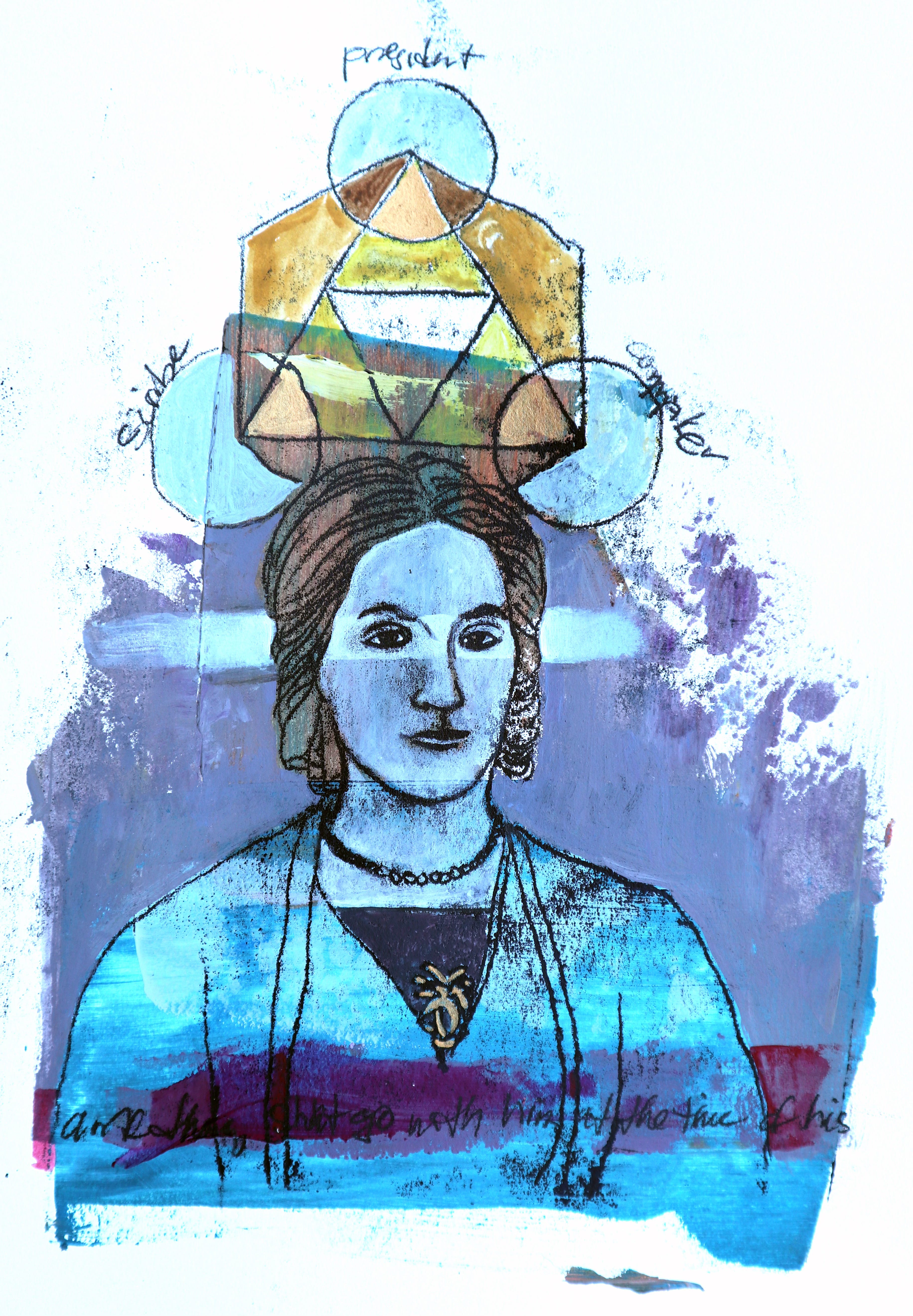
In discussions regarding the status of women and their relationship to priesthood in the Church of Jesus Christ of Latter-day Saints, the term “ordain” has sometimes been a flashpoint. After all, longstanding Church policy stresses that women “are not ordained . . . to priesthood office.” Nevertheless, LDS scripture contains a revelation given to Emma Smith in 1830 that includes a divine promise that: “Thou shalt be ordained” (D&C 25:7).
Typically, the explanation for this apparent contradiction has rested on an argument that the nineteenth-century Latter-day Saints “sometimes used the term ordain in a broad sense, often interchangeably with [the phrase] set apart.” This suggests that the use of “ordain” in 1830 likely meant “set apart.” However, since Emma’s promised ordination appeared in a divine revelation that used the word “ordain,” it is worth more carefully considering the intentional choice of the term.
This essay argues that the use of the term “ordain” in Doctrine and Covenants 25—when considered in the context of related revelations—established a foundation of real ordination for LDS women in 1830.
CONTEXT
D&C 25 came amid a series of revelations regarding the earliest church organization, offices, and functions in 1830. For instance, D&C 20 laid the groundwork for a church in April 1830, which was further elaborated by D&C 24, 25, 26—a trilogy of revelations in July 1830 that established a remarkable gender equality. Then D&C 27 celebrated the fulfillment of D&C 25 in August.
In these early organizational outlines, D&C 20 and 24 prescribed ministry offices for men —namely elders, priests, teachers, deacons, bishops, apostles (”an apostle is an elder”), plus a “First Elder” and “Second Elder.” In 1830, all these offices were “ordained,” yet they were New Testament lay Christian offices, not priesthood offices. No one was being ordained to “priesthood” in 1830; ordination was, instead, to lay ministry roles. Elders were lay ministers tasked with preaching the gospel, baptizing, confirming, and leading meetings. Their authority came from God and the Spirit, evoking Christian discipleship rather than priesthood. “Every elder, priest, teacher or deacon is to be ordained according to the gifts and callings of God unto him . . . ordained by the power of the Holy Ghost which is the one who ordains him” (D&C 20:60).
The first “priesthood” ordinations began a year later in June 1831 with a new office of “high priest.” Joseph and Oliver were Elders, not priests—until they were ordained “high priests” in 1831. Also, there was no priesthood order to reframe and encompass the men’s ministry offices, until a “new order” of “high priesthood” was envisioned in 1831. This new order was not defined or named (as “Melchizedek”) until 1835 (D&C 107).
The development of women’s lay ministry followed a pattern similar to that of the lay ministry of men. D&C 25 prescribed a New Testament ministry office for women, the “Elect Lady.” In 1830, this office was “ordained” but it was a New Testament lay Christian ministry office, not a “priesthood” office. However, an order that would reframe and encompass women’s ministry offices “after the pattern of the priesthood” came later in 1842—which was defined and named as “Relief Society.”1
Historically, Emma’s ordination and the office of “Elect Lady” haven’t been viewed as equivalent to the ordination of Elder because the Elect Lady was not a priesthood office. However, in 1830, ordinations to the offices of First Elder and Second Elder were not priesthood ordinations either. Rather, D&C 25 established an “ordained” lay women’s office of church ministry in a parallel equality with the men’s ordained lay offices outlined in D&C 20 and 24.
In 1830, both men’s and women’s offices were based on early Christian ministry in the New Testament—not on Old Testament priesthood. Joseph Smith was “Called of God & ordained an Apostle of Jesus Christ to be the first elder of this church” and Oliver Cowdery was “called of God, an apostle of Jesus Christ, to be the second elder of this church.” (D&C 20:2-3) These were New Testament lay Christian offices. Likewise, Emma Smith was “called” of “the Lord your God” as “an elect lady” who “shalt be ordained” to “exhort the church.” The Elect Lady was a New Testament lay Christian office as well.
ELDER AND ELECT LADY
D&C 25 brought the Elect Lady into direct parallel with the First Elder in D&C 24, using the New Testament gender pairing found in 2 John 1: “The elder to the elect lady and her children whom I love in the truth.” Thus, the Latter-day Saint “First Elder” and “Elect Lady” restored two high offices of ancient Christian leadership found in the New Testament.
D&C 24 and D&C 25 were parallel revelations, both received in July 1830, which “called” and “ordained” Joseph and Emma (and Oliver) to the highest offices in the LDS Restoration at that point. Joseph and Emma were the subjects of these two revelations, which canonized their ordinations and offices. D&C 24 discussed both Joseph’s and Oliver’s offices, yet it mainly elaborated on Joseph’s divine calling and duties as the First Elder. Likewise, D&C 25 elaborated on Emma’s divine calling, office, and duties as the Elect Lady.
In 1830, the First Elder, Second Elder, and Elect Lady were the three highest positions in the LDS Church, with no others in that category. They evoked a triune leadership, like a primitive first presidency. Out of this proto-presidency, the male “presidency” of “high priesthood” came later in 1832 (D&C 81), and a female “presidency” of Relief Society came later in 1842—in parallel, as Joseph and Emma presided over each. That parallel began in 1830, when D&C 24 and D&C 25 established Joseph’s and Emma’s top offices with strikingly similar roles, duties, and authority.
The parallel nature of these revelations and the roles they outline is evident in the excerpts below:
D&C 24 (First Elder):
Behold, thou wast called and chosen to write the Book of Mormon, and to my ministry . . . . Magnify thine office . . . continue in calling upon God in my name, and writing the things which shall be given thee by the Comforter, and expounding all scriptures unto the church. And it shall be given thee in the very moment what thou shalt speak and write . . . go speedily unto the church . . . and they shall support thee . . . . Attend to thy calling and thou shalt have wherewith to magnify thine office, and to expound all scriptures, and continue in laying on of the hands and confirming the churches . . . and also all those whom thou hast ordained, and they shall do even according to this pattern. Amen.
D&C 25 (Elect Lady):
Behold . . . thou art an elect lady, whom I have called . . . the office of thy calling shall be . . . unto my servant . . . be unto him for a scribe . . . . And thou shalt be ordained under his hand to expound scriptures, and to exhort the church, according as it shall be given thee by my Spirit. For he shall lay his hands upon thee, and thou shalt receive the Holy Ghost, and thy time shall be given to writing, and to learning much . . . thy husband shall support thee in the church; for unto them is (thy) his calling . . . . And it shall be given thee, also, to make a selection of sacred hymns . . . as it shall be given thee, which is pleasing unto me, to be had in my church . . . . And verily, verily, I say unto you, that this is my voice unto all. Amen.2
ELECT LADY AND BIBLICAL WOMEN
As I noted above in reference to 2 John, the biblical “Elect Lady” was a prominent female leader in early Christianity, and the only woman in the New Testament with an epistle addressed to her. Likewise, Emma Smith was the only woman in the D&C with a section addressed to her. This gives similar exceptional status to both women.
D&C 25 used the Elect Lady as a prototype for Emma and LDS women. It also correctly interpreted her as a real woman, rather than as a metaphor for the church. This revealed in 1830 what feminist theologians would later assert in the 1980s—that the “Elect Lady” was a leader, and “her children” were the church. In 2025, a BYU scholar also interpreted 2 John 1 as addressing a real “lady” whose name was “Eclecte.” These scholars have reinforced the D&C 25 interpretation of the Elect Lady as a female leader, not a metaphor.
Specific roles assigned to the Elect Lady in D&C 25 further ground the office in biblical precedent. The revelation called Emma to “make a selection of sacred hymns as it shall be given thee, which is pleasing unto me, to be had in my church . . . the song of the righteous is a prayer unto me” (D&C 25:11–12). Emma’s hymn book was an official church liturgy used by all, thus one way to “expound scriptures” and “exhort the church.” Also, “the song of the righteous” evoked the biblical role of Miriam and Deborah, female prophets who led their religious community in music—and whose songs are the oldest texts in the Bible. “Miriam the prophetess . . . took a timbrel in her hand; and all the women went out after her with timbrels and with dances.” (Exodus 15:20–21)
CONFIRMED, ORDAINED, AND SET APART
D&C 25 promised Emma both confirmation as a member and ordination to office—two separate roles and ordinances, paired together: “He shall lay his hands upon thee, and thou shalt receive the Holy Ghost . . . And thou shalt be ordained under his hand” (D&C 25:7).
Interestingly, to “confirm” and “ordain” and “set apart” all use the same form—a laying on of hands to confer a specific status, calling, or office. Each is being “called with a holy calling, and ordained with a holy ordinance” (Alma 13:8).
As others have pointed out (see here), the word “ordain” was used in different contexts from 1829 onward, yet its basic meaning was the same. For instance, in LDS scripture, the phrase “ordained of God” in Alma 13, D&C 20:60, and D&C 50:26 all reflect similar connotations. Likewise, in the 1830 revelations, the word “ordain” meant ordination to lay ministry, for both men and women. It did not mean ordination to priesthood.
Both the terms “ordain” and “set apart” were applied to men as well as women, in different settings. Yet “ordain” and “set apart” also were used together, suggesting they held different senses of meaning. “Ordain” carried a more specific connotation than “set apart”—meaning, what God has ordained; while set apart meant to separate or assign. In 1831, there were “bishops to be set apart unto the church,” since “he is called and set apart and ordained, bishop or high priest” (D&C 68:14, 19, 22). In 1842, Joseph’s teachings in the Relief Society minutes stipulated that “wherein [society members] are ordained, it is the privilege of those set apart to administer.” In 1850, Louisa B. Pratt was “called, set apart, and ordained” to serve a mission.3 The use of both “ordain” and “set apart” together posed them as mutually related and needful.
D&C 20, 24, 25 explicitly used the word “ordain” rather than “set apart” to convey that these ministry offices were divinely instituted by God. Likewise, in 1842, the word “ordained” was used for Relief Society “offices” to convey their divine authority.4 And in 1843, women were “ordained” to offices in the “holy order” of God in the temple.5 D&C 25 was the first of three ways that LDS women were “ordained” to offices in ministry—first in 1830, followed by repeated instances in 1842 and 1843. The ordination to “Elect Lady” was the first step in a female ordination path that continued in Relief Society and culminated in the temple endowment. Thus, there is no reason to reject the word “ordain” for women and replace it with “set apart.”
Emma’s ordination to high church office was very rare in 1830 America. At the time, although some women participated in lay preaching, only a few had a ministerial position or preached from a pulpit, and those were low-level and limited in scope. Only Mother Ann Lee, who led the Shakers, held a high church position similar to Emma’s—both formally instituted and recognized by their church, and titled as “elect lady.”6
D&C SECTION 26
“The law of common consent” or D&C 26 completed the July 1830 trilogy of revelations that established an uncommon gender equality in LDS canon. “And all things shall be done by common consent in the Church” (D&C 26:2). This meant all members could vote, including women. D&C 20 had stipulated that “no person is to be ordained to any office in this church . . . without the vote of that church” (D&C 20:65). Thus, Joseph and Oliver were ordained First and Second Elder and approved “by an unanimous vote” at the organization of the Church on April 6, 1830.
This raises a question: Was Emma’s ordination to office approved by member vote? It wasn’t reported in her private sacrament meeting in August of that year, nor in the September Church conference. Yet an approval vote of Emma’s ordained office did occur—when she was elected by female members of the church, at the Relief Society organization on March 17, 1842: “Mrs. Emma Smith be chosen President—passed unanimously . . . elected to preside.”
Joseph verified this: “[I] read in the New Testament & Book of Doctrine & Covenants. concer[n]ing the Elect Lady. & Shewed that Elect meant to be Elected to a certain work &c, & that the revelation was then fulfilled by Sister Emma’s Election to the Presidency of the Society, she having previously been ordained to expound the Scriptures.
This clarified that Emma’s office was approved by a Church congregation. D&C 25 canonized Emma’s office and ordination, and the Relief Society minutes canonized her election by member vote.
D&C SECTION 27
Following the July trilogy of D&C 24, 25, 26, Joseph received D&C 27 for Emma’s promised confirmation at a private sacrament meeting in August. Joseph “set out to go to procure some wine for the occasion . . . and received the following revelation . . . ‘It mattereth not what ye <shall> eat or what ye shall drink when ye partake of the sacrament if it so be that ye do it with an eye single to my glory’” (D&C 27:2).
Joseph recounted, “We partook together of the sacrament, after which we confirmed these two sisters [Emma Smith and Sally Knight] into the church.” Curiously, Joseph didn’t mention Emma’s ordination, which would have happened immediately after her confirmation. He may have omitted it from this personal history (written a decade later), or her ordination may have been done privately.
Yet, Joseph indeed ordained Emma in 1830, as he attested in 1842: “She was ordain’d at the time, the Revelation was given.” This implied her ordination happened when D&C 25 was received in July of 1830, rather than when it was performed in August of that year; but Church policy put confirmation first, ordination second. In 1842, “at the time” could have meant “in 1830”; and the comma, as pause, could mean because the revelation was “given” i.e., it was official.
Whenever her ordination occurred, Emma stepped into a high office of ministry. Also, the Elect Lady in D&C 25 (like the First Elder in D&C 24) had a dual role as both an ordination to church lay ministry in 1830, and later as an office in an order of “priesthood.” In 1842, Joseph cited D&C 25 as verifying that Emma “was ordain’d . . . to expound the scriptures to all, and to teach the female part of community.” This validated Emma’s 1830 ordination to ministry office, yet it also elevated that office to “preside” over a women’s order in 1842—“a kingdom of priests.” Emma’s authority to expound scripture “to all” evoked a Church-wide ministry, while her role to teach “the female part” of community evoked specific leadership over the women.
“MY VOICE UNTO ALL”
D&C 25 promised “this is my voice unto all,” regarding Emma’s call to membership and confirmation, ministry, and ordination. This suggested that all women could obtain those same blessings of ordinances, leadership, and offices in the Church.
Like Emma, her counselors in Relief Society were ordained to offices presiding over the women of the Church. And, her successors, Eliza R. Snow and Zina Jacobs also held the title of “Elect Lady” along with the Church office of Relief Society President. Eliza was “ordained,” but Zina was “set apart.” The “Elect Lady” title ended with Zina.7 Thus, the office of “Elect Lady,” established by revelation from God, lasted nearly a hundred years (from 1830 to 1910) then disappeared into history—while the office of Relief Society President continues today.
Although Emma, her counselors, and successors were “ordained” to their “offices,” today women are “set apart” to “callings.” However, the offices occupied by men have continued to be ordained, thus resulting in a gender asymmetry of status. The terms “ordain” and “office” have changed for women, but their ministry roles have continued. Yet D&C 25 persists in calling us to understand Emma’s real ordination to both Elect Lady and President. This section bears testimony of women’s ordination in the LDS Restoration—an historical reality we have yet to recover.
Note: This essay is excerpted from other articles I’ve presented on Emma’s 1830 ordination as the first step in a triune ordination path of: lay ministry, the order of Relief Society, and the Endowment. I first explored this model in my 1992 book, Women and Authority, then presented it in feminist groups, and later in 2011 at church meetings, 2012 Sunstone symposium, 2013 Mormon Stories podcast, 2014 workshops, 2016 MHA paper, 2017–2019 Church dept. discussions, 2018 BYU paper, 2018 Sunstone symposium, 2019 Dialogue journal, 2025 Dialogue podcast and other podcasts.
Maxine Hanks is an historian and theologian whose work has focused on women’s history and feminist theology in Mormon studies, Christian liturgy, and religion. She lectured in gender studies at the University of Utah and was a Harvard Fellow in ministry, theology, and liturgy. She has published several articles and books on Mormon history, feminist theology, women’s studies, and gender in religious culture.
Art by James Rees.
“I will organize the women under the priesthood after the pattern of the priesthood.” Joseph Smith, quoted in Sarah Granger Kimball, “Auto-biography,” Woman’s Exponent, Sept. 1, 1883, 51. “The Society should move according to the ancient Priesthood, hence there should be a select Society . . . holy — Said he was going to make of this Society a kingdom of priests.” Nauvoo Relief Society Minute Book, p. 22, The Joseph Smith Papers, https://www.josephsmithpapers.org/paper-summary/nauvoo-relief-society-minute-book/45.
D&C 24, 25 from “Revelation Book 1,” p. 33–35, The Joseph Smith Papers, https://www.josephsmithpapers.org/paper-summary/revelation-book-1/17. A powerpoint comparison of the wording in D&C 24 and 25 was presented at the 2018 MHA by Don Bradley.
Louisa Barnes Pratt, The History of Louisa Barnes Pratt: The Autobiography of a Mormon Missionary, Widow, and Pioneer, ed. S. George Ellsworth (Utah State University Press, 1998), 115.
“Those ordain’d to lead the Society, are authoriz’d to appoint to different offices as the circumstances shall require.” Nauvoo Relief Society Minute Book, p. 40, The Joseph Smith Papers, https://www.josephsmithpapers.org/paper-summary/nauvoo-relief-society-minute-book/63.
“You, my sisters, . . . will become Queens of Queens and Priestesses unto the Most High God.” (Eliza R. Snow, “An Address,” Woman’s Exponent, Sept. 15, 1873, p. 62.); “Anointed & ordd. [ordained] to the highest and holiest order of the priesthood.--(&. Companion <d[itt]o.” Joseph Smith, Journal, September 28, 1843, page 110, The Joseph Smith Papers, https://www.josephsmithpapers.org/paper-summary/journal-december-1842-june-1844-book-3-15-july-1843-29-february-1844/116.
“Mrs. Lee, also known as the Elect Lady or Mother of Zion, and the head of that people called Shakers.” The Albany Gazette, New York, 1784. https://blog.shakervillageky.org/mother-anns-mission-calling-and-controversy/ ; see Clair Barrus, Maxine Hanks, Joe Geisner, “Gender, Religious Authority, and the Elect Ladies: Jemima Wilkinson, Ann Lee, and Emma Smith,” at Sunstone Symposium, July 2018,
https://sunstone.org/gender-religious-authority-and-the-elect-ladies-jemima-wilkinson-ann-lee-and-emma-smith; Catherine A. Brekus, Strangers and Pilgrims: Female Preaching in America, 1740–1845 (University of Nor Carolina Press, 1998), 343–46; Nicholas Miller, “The Ordination of Women in the American Church,” 2013.
“We welcome Sisters Eliza and Zina as our Elect Lady and her Counselor.” Jill Mulvay Derr, “Mrs. Smith Goes to Washington,” Juanita Brooks Lecture Series, 2004, https://library.utahtech.edu/special_collections/Juanita_Brooks_lectures/2004.html. For Zina as “set apart” and as “Elect Lady,” see Emmeline B. Wells, letter to Zina D. H. Young, April 24, 1888, in Jill Mulvay Derr et al., eds., The First Fifty Years of Relief Society (Church Historian’s Press, 2016), 536,
https://www.churchhistorianspress.org/the-first-fifty-years-of-relief-society/part-4/4-18.
I’m brand new to substack, but I hope to offer more essays here.