


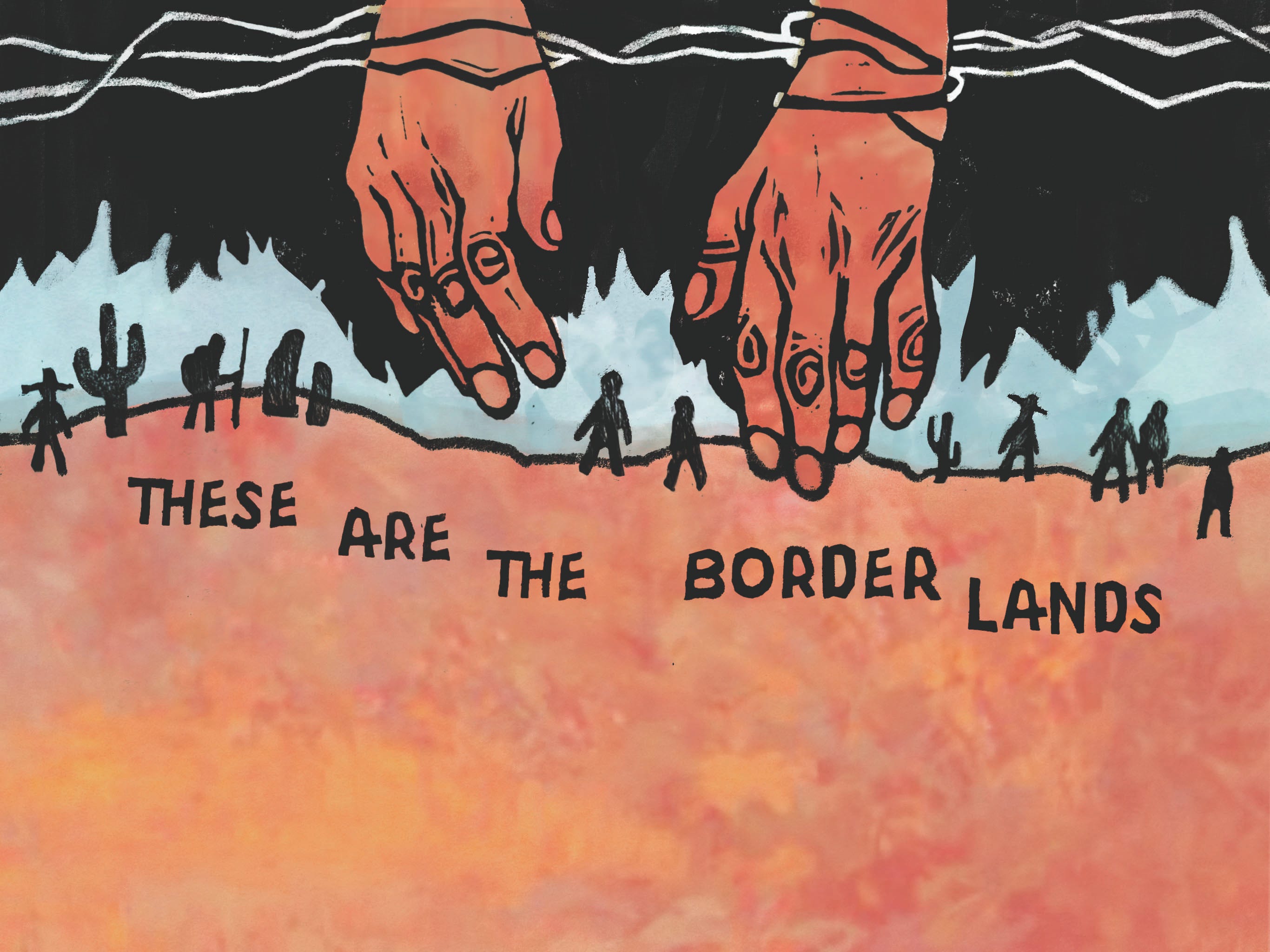
After a three-hour journey on a winding highway that parallels the border wall, we arrive in Mexicali, a small municipality whose name was formed from the first two syllables of Mexico and California as a gesture of international friendship. “Borders are places of revelation,” Brother Keith, my professor, told me in our last Zoom meeting before our pilgrimage. I wonder what the border will reveal to me.

Reflecting theologically on the issue of migration is not only an outer journey, but also an inner journey into the human heart. If we allow it, the migrant experience can become a sacred text as we seek to understand the emotional and spiritual terrain of their inner landscape. The outer journey of a migrant—leaving behind the familiar, facing uncertainty, and seeking a place of safety, security, and rest—mirrors the inner journey of the soul in profound ways. Both journeys demand resilience, faith, and a willingness to embrace the unknown.
I approach this topic as a human being, a Christian, a member of The Church of Jesus Christ of Latter-day Saints, a chaplain, and a student of theology. As a human being, migration speaks to me as the plight of my brothers and sisters in search of a more dignified life. As a Christian, migration speaks to me as both a blessing and a test of Christian faith, highlighting my calling to love the stranger. As a Latter-day Saint, migration speaks to me as a profound covenant challenge, reminding me of the responsibility I have to mourn with those that mourn and bear others’ burdens, perhaps particularly the burdens of the vulnerable and marginalized. As a chaplain, migration speaks to me as an issue that demands a pastoral response rooted in love, justice, and inclusion. And as a student of theology, I seek to open a sacramental window into the migratory nature of our universal spiritual journey, looking to our border-crossing Savior who left his homeland, entered into our mortal territory, and “journeyed through the borderlands of our broken existence to lay down his life on the cross and to give himself for the salvation of all.”1
There is perhaps no better text through which to examine the complex inner terrain of migrants than that of the Psalms. Indeed, just as the “forced migrant-Psalmist”2 in biblical exile once lamented his plight beside the rivers of Babylon, so now do refugees weep in their own experience of exile, seeking relief from violence and oppression and yearning for freedom, self-expression, and a sense of community and belonging. Making up the “great hymnbook in the heart of the Bible,”3 the Psalms invite us to consider the full dimensions of the mortal experience. They invite us, as does Jesuit priest Walter Burghardt, into a “long, loving look at the really real,”4 offering a window into both the bright lights and the dark corners of the human soul.
As we consider the “graced-human interplay”5 between the lived expression of modern-day migrants and the Psalms, we must ask ourselves, “How do our migrant brothers and sisters find hope amid some of the most hopeless of situations? How do they find life in the midst of death? And how do they ‘trust in God within some of the most seemingly godless of experiences?’”6
These are the borderlands—and places of revelation.

“Keep me safe, my God, for in you I take refuge.”
Psalm 16:1
We arrive at our destination: Posada Del Migrante, or “Inn of Migrants.” The concrete building’s exterior is painted pink, with a cheerful sign that reads “amor, esperanza y caridad.” Love, hope, and charity. A heavy iron gate with a large padlock seals the entrance. We wait quietly, taking in our surroundings for a few moments before we are greeted by twinkly-eyed Catholic Sister Suzanne Jabro. Unlocking the gate, Sister Suzanne leads us up several steps, and we find ourselves in a dusty courtyard. A brightly painted two-story concrete structure that resembles a low-budget motel forms one side of the courtyard; a tall, gray concrete wall flanks the other. Rusted iron railings line the outdoor hallway of the second floor, and sheets of fabric are strung over the top of the courtyard, offering a small barrier from the heat and the occasional rainstorm. A simple outdoor kitchen is located on the ground level. Children run to greet us. Adults sit quietly on stoops and worn lawn chairs. The atmosphere feels heavy and somber.
Sister Suzanne gives us an overview of the shelter’s history, which began when a local woman named Altagracia Tamayo Madueño started offering free lunches to the community. During the COVID-19 pandemic and its resulting logjam, a daily community meal grew into the acquisition of this shelter and an additional one for hundreds of migrants in transit. “People needed a place to stay,” is how Sister Suzanne describes Altagracia’s impetus for such an ambitious project. “It filled a critical need in a critical time.” Sister Suzanne is the founder of Border Compassion, an all-volunteer nonprofit that is now the engine behind Posada Del Migrante. Her ministry is remarkable and life-giving, providing food and shelter to up to 300 migrant individuals and families here in this space of liminality. Sister Suzanne points out that despite the incredible work of Border Compassion’s ministry, migrant shelters like this are meant to function as temporary accommodations, not as permanent dwellings. Shelters offer a thin line of protection, but they are not ideal.
While we are greeted kindly by the migrant families, stress and worry are palpable. We learn that many have been waiting here for months for an appointment date secured through the CBP One app, a primary tool used by asylum seekers at the US–Mexico border to schedule appointments and start the process of claiming asylum protections. Most of these individuals and families have fled cartels, violence, poverty, and persecution, and returning to their home countries is not possible. Just three days prior, the CBP One app was shut down without explanation, and questions abound.

With us today are several immigration attorneys from San Diego, who have volunteered their time to go over each individual’s case and answer questions. The majority of the adults meet with the attorneys in the courtyard, and I go with some of the children to the makeshift classroom on the upper level of the shelter. The kids are eager to have visitors. I don’t speak Spanish, but the language of common humanity connects us. We draw pictures of flowers, butterflies, and hearts. We play card games. I play a dozen riveting rounds of Connect Four with a young boy who has created his own set of rules. We growl, squeal, and giggle. Despite the momentary distraction, I am aware of the reality that these children are not in school. They do not leave this iron-clad place to walk around the block or play soccer, and they know in their very sinews the deep spiritual pain of homelessness, exile, and nonbelonging. This is pain I do not know. “Behold your little ones,” Jesus taught. Today, beholding these precious little ones causes me to ask how we got to this point as a human community.
“Hear my cry, O God, listen to my prayer!
From the ends of the earth I call; my heart grows faint.”
Psalm 61:2-3
From below, I hear a sound—a guttural howl that takes my breath away. It is a mother, doubled over, clutching a lawn chair as she sobs in the courtyard. She has just been told that there isn’t a path forward for her and her children to obtain legal entrance into the United States. Today’s news is unbearably grim for her and so many others. Anguish fills the air like a dense fog. Gradually, each of the children leave the classroom and quietly rejoin their families. I feel, in this liminal space of profound suffering, that the migrants have joined the Psalmist as they cry out in their pain.
“Hear me and answer me. My thoughts trouble me and I am distraught…
My heart is in anguish within me; the terrors of death have fallen on me. Fear and trembling have beset me; horror has overwhelmed me.”
Psalm 55:2-5
Several Catholic deacons arrived while I was playing with the kids. They are here to bless any and all who desire it, and I watch now as men, women, and children form lines to receive a blessing. Sister Suzanne appears at my side, urging me to “go to the front.” She nudges me forward. “Here,” she whispers. “You stand here. Touch each person. You can bless them, too.” As the deacon’s hands are placed on bowed heads, my hand rests on their shoulders. Tears flow audibly and freely. I cannot understand the words being spoken, but I feel their impact as I offer my own raw, generative, ungendered priesthood power to this moment of great need. Crossing borders of can’ts and don’ts, beyond questions of who and how and when, I glimpse, in that blessed moment, my full potential as a covenant woman of God. Blessed are the poor, the suffering, the persecuted, the stranger. This is who Jesus came for, who he died for. This woman, who shakes as she weeps. This dark-eyed girl, who studies me with a soft smile before bowing her head. This young man, who looks to be my son’s age and is here alone. You are blessed, and you, and you. Every trembling soul. Our God who dwells in both abundance and particulars is present in this pain. This is a God who is reaching into their inner journeys, crossing the border from heaven to earth in order to succor his people.
With my hands touching shoulders, I stand quietly and humbly not only as a participant in the act of blessing, but as a witness to the holy labor of lament. Stirring cries reveal pain, giving “utterance to the God who hears the cries of his people, accompanies them in their pain, and offers a sense of justice when all meaning is lost.”7 Just as the Psalmist was not afraid to speak to God about sadness, devastation, injustice, anger, and grief, the beloved people around me are naming their inner terrain and giving voice to this fundamental need for self-expression. Indeed, the recurring theme of lament is woven through the fabric of the doctrine of Christ’s Atonement. From Jesus’s cry on the cross to our tears for his suffering, and from our sorrow for sin to the grief we feel for the world, we are reminded that we can express our deepest sorrows to the One who understands grief. When we feel forsaken, he has felt forsaken too. In the saving, there is sorrow, and lament—like the Atonement—is a gift of grace.
“You prepare a table before me in the presence of my enemies;
you anoint my head with oil; my cup overflows.”
Psalm 23:5
It’s noon, and the kids are hungry. Eager to help, I ask what I can do to assist in preparing lunch. Several women insistently motion for me to sit at a special table prepared for today’s visitors at the shelter. They want to serve me. A sudden sense of reverence accompanies the recognition that I am experiencing a profound moment of radical hospitality. These women, pushed to the edge of their human vulnerability, have lost their homes and everything that is familiar to them. They are in crisis. Many have been separated from their children and loved ones. They have endured violence and exploitation. They are experiencing not only physical homelessness, but legal homelessness, cultural homelessness, and social homelessness, with all of the accompanying trauma. And yet, here in this moment, they are the hosts, and I am the guest. I am the stranger being welcomed. I am the foreigner being given a meal. I am the outsider who is being invited with open arms to come, sit, and dine. These women did not choose nor do they deserve the dire circumstances they are in, just as I did not choose nor do I deserve the comfortable, privileged life that I enjoy. This profound realization is revelatory.
I think of the banquet described by the Psalmist. Here in the Posada Del Migrante shelter today, this folding table has become the common ground where the Divine meets humankind and humankind meets the Divine. As is the case in so many table scenes, Jesus, as both host and guest, offers radical hospitality to the rejected of the world. He is known for eating with sinners and publicans—the disenfranchised of life. Jesus’s table is often a scene of divine leveling, where hierarchies, legalistic purity codes, and power dynamics are abolished through radical acts of friendship and fellowship, crossing borders created by narrow interpretations of the law. And here, today, in a most profound encounter, it is the very people who are disenfranchised and who have been rejected who are the hosts. In choosing to offer me hospitality, these women are exercising a form of agency in the midst of their powerlessness. Revelation in real-time expands my understanding of Jesus’s mortal ministry of persistent, subversive reordering. Jesus never plays by our rules. Like the disciples on the road to Emmaus, my heart burns within me as I begin to see. The last shall be first and the first shall be last.
A blessing is offered on the food, and bread is broken. The table, the feast, the guests, the hosts—all seem symbolic, a Eucharistic bending of time and understanding. This is Christianity in its lived, shared, eaten, and spoken fullness.

“This is the day the Lord has made; let us rejoice in it and be glad. Lord, grant salvation! Lord, grant good fortune! You are my God, I give you thanks; my God, I offer you praise. Give thanks to the Lord, for he is good, his mercy endures forever.”
Psalm 118:21-25, 28-29
After lunch, mismatched chairs are pulled into a cluster, and a large portable speaker emerges. To my surprise, laughter erupts in the courtyard as both children and adults circle a row of chairs, their steps quickening with the lively beat of the music. When the sound suddenly cuts off, chaos erupts—everyone lunges for a seat, some sliding in just in time while others collapse in playful defeat. One player is eliminated with resounding cheers and groans, and the game continues, excitement building with each round. After a winner is declared with triumphant whoops, our eyes turn delightedly to a brightly colored piñata swaying from the upper railing of the shelter’s stairway. Shouts and laughter fill the air as children and adults take turns swinging, their blindfolds adding to the fun. With each near miss or glancing blow, the crowd cheers and teases until a final, mighty swing sends candy showering to the ground. Children scramble in joyful chaos, while the adults chuckle, watching the sweet reward of their shared excitement unfold.
I stand all amazed as I witness the energy and effort of deliberate joy taking place in the midst of heavy sadness that feels gravitational. Joy, in a theological sense, is more than mere happiness—it is an act of resistance against despair, injustice, and oppression. In the Psalms, joy often arises in the midst of suffering—a movement from places of pain to places of faith, gratitude, trust, confidence, and love. This kind of joy is not passive; it is a defiant affirmation of hope, a refusal to let darkness have the final word. It is the assurance that God’s kingdom is breaking into the world, even when circumstances seem bleak. To practice such joy is to proclaim that love and hope are more powerful than fear and destruction. To behold it today feels like a current of grace, leaving me with a silent, sacred recognition of the Divine at work.

“O LORD, you hear the desire of the afflicted; you will strengthen their heart; you will incline your ear to do justice to the fatherless and the oppressed, so that man who is of the earth may strike terror no more.”
Psalm 10:17-18
Back at my hotel in San Diego after our four-day pilgrimage, I can’t sleep. I finally give up and head to the little gym on the ground floor as dawn breaks gently, painting the sky in soft hues of lavender, rose, and gold. No one else is there. I put in my earbuds and turn on the treadmill, hoping to get in a good workout to start my day.
This is not to be. After no more than a minute, tears form in my eyes and then begin to slide down my cheeks. I wipe them brusquely and try to keep running. Another minute passes, and out of my soul comes a ragged sob. One after another after another. I stop the treadmill and fall to my knees on the floor of the gym. Pain pours out of my soul. I cannot unsee what I have seen. I cannot unhear what I have heard.
“Increase your spiritual capacity to receive revelation,” President Russell M. Nelson has pleaded. Often we are culturally conditioned to think that revelation is only possible in austerity; in quiet, clean places carefully curated for optimal outcomes. But today, I learn that revelation from God can inbreak amidst low, wracking sobs on a dirty hotel gym floor, allowing me the opportunity to have my heart cracked wide open in solidarity with the pain and suffering of our migrant brothers and sisters. As I feel called into this solidarity, the revelation I receive here at the borderlands is that of anger—white-hot rage, in fact, at the globalized indifference of society towards the marginalized, victimized, and persecuted. Anger, I think, is more virtuous than indifference.
My experience might best be described as an intercessory prayer. Much like the Psalmist who expressed trust in God’s power and called on God’s presence in times of need, my petition is a plea to God to cross the border into my own heart, to break the chains that keep me isolated and separate from others, and to shatter me out of the paradigm that is centered on a pious pursuit of individual worthiness, salvation, and exaltation. My intercessory prayer is for the individuals whose interior lives had, for a brief moment, crossed into my interior life. “I am not free until they are free. I am not saved until they are saved.” This statement arises again and again as I pray and weep, and it continues to reverberate in my soul.

Jesus, the divine migrant, calls us to the kind of gritty, challenging, embodied love that transcends all prejudices, all petty interests—a love that rests on the “premise that our lives are ultimately interconnected and interdependent with each other.”8 Jesus’s divine love and divine anger challenge us to engage. He calls us to name and then close the gap between pious religious isolation and the “fundamental task of life, which is to work out the healing, just ordering, and integration of our relationships.” Christ, distressingly disguised as the poor, the hungry, and the migrant, is asking us to see, to care, and to act. What is at stake is our humanity, our journey through this world, or, in a word, our salvation.
These are the borderlands—and places of revelation.

Jenny Richards recently received her Master of Theological Studies degree from the Franciscan School of Theology at the University of San Diego. She began a chaplain residency in Salt Lake City in Fall 2025. Jenny writes at @walkingtheroadtojericho
Art by Sarah Hawkes: @sarah.hawkes.art / sarahhawkesart.weebly.com
Daniel G. Groody, The Theology of Migration (Oxford University Press, 2021), 9.
Groody, 102.
N.T. Wright, The Case for the Psalms (HarperOne, 2013), 34.
Burghardt, Walter J. “Contemplation: A Long, Loving Look at the Real.” Church, vol. 14, no. 4, Winter 1998, pp. 16–17.
Groody, 103.
Groody, 104.
Groody, 122.
Groody, 54.

This was so moving. Thank you. Your words are poignant.
Dear God. Jenni, this took my spiritual breath away and gave Christlike life and compassion to my overly politized biases. "Crossing borders of cants and don'ts, beyond questions of who and how and when, I glimpse, in that blessed moment, my full potential as a covenant woman of God.". My final question is "what is to be done?" about such pain for so many of God's children?! God bless you for these words. 🙏🏼❤️