


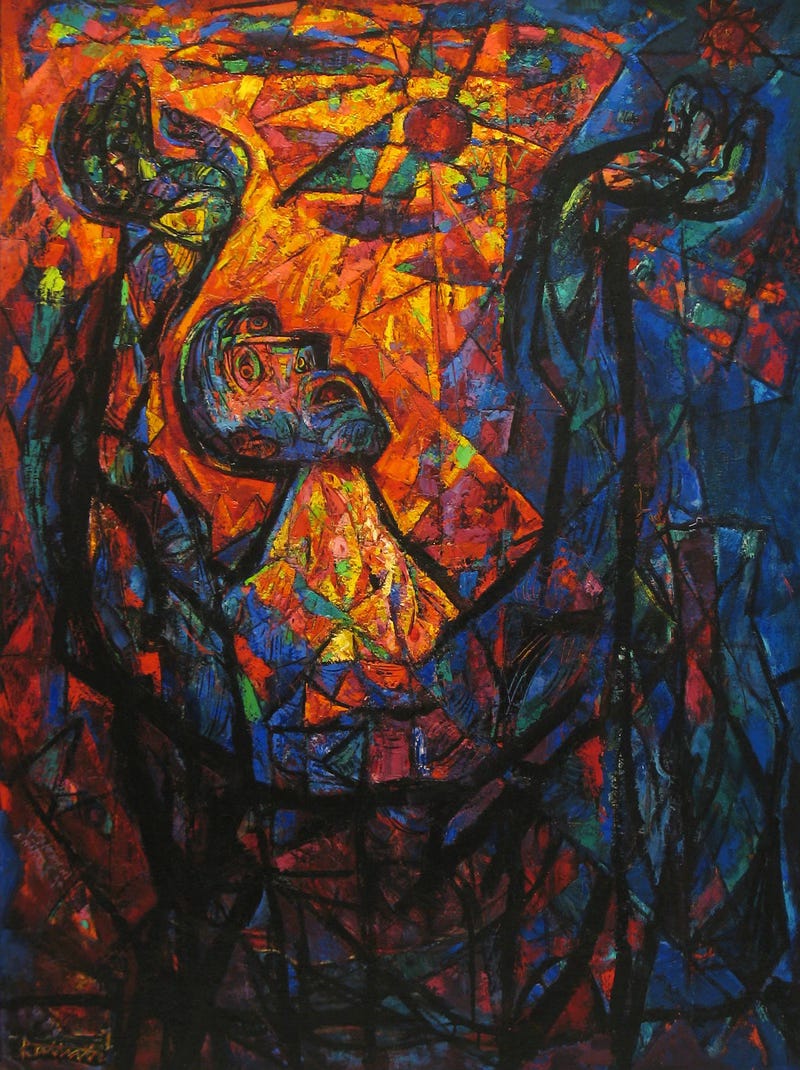
The book of Job has become a touchstone for me. Like all great scripture, it’s not so much the answers it provides as the questions it raises for our consideration. As a scientist, as a writer, as a teacher, all, it’s always been questions that open new worlds and present promising vistas that help me navigate the complexities this earth life confronts us with. Job is all about questions.
Job opens with an imaginary frame-story signaled by, “And one day . . .” the ancient Middle Eastern equivalent of “Once upon a time . . .” in which hassatan, the satan, the adversary, is visiting the divine court (don’t equate the satan here with the Satan we are familiar with later in the scripture; in this story he is the divine prosecutor). God opens with a question, “From where do you come?” and he answers, “From roaming the earth and walking about in it.” Then God asks the ominous question, “Have you paid heed to My servant Job, for there is none like him on earth, a blameless and upright man, who fears God and shuns evil?” And we are off to the races. The adversary points out that it’s no wonder that he’s so righteous; you’ve blessed him with everything. If you take that away, he will curse you post haste. God says something like, “Have at him. Do your worst.”
And that the satan does. In short order, he strikes Job’s livelihood and kills his livestock, then his children, then, noting that Job still hasn’t cursed God, he is sent a plague of skin sores that leave him suffering immensely. His suffering is so egregious he wishes he had never been born. A group of Job’s friends gathers to “comfort” him. They all “know” that suffering does not come willy-nilly into life. Suffering comes from unrighteousness, so they enjoin Job to figure out what he’s done wrong. He must have acted badly because everyone knows God blesses the righteous and curses the sinners. Job is angry and confused. He knows he did nothing to deserve this, and yet he is suffering (Job’s legendary patience is not in the canonical book; it comes from later responses to the book). God seems to have been lying down on the job. Job demands redress and decides to take God to court and demands he appear to answer Job’s accusation of neglect of earned blessings. His wife mourns the loss of all that she had worked for, as the canonical text says in Job 2:9, “Do you still cling to your innocence? Curse God and die.” A cold statement, yet what is often unacknowledged is that she, too, has just lost all she loves and has worked for.
However, in a variant in the Greek translation of the text called the Septuagint, we see her suffering a little more clearly: “How long will you persist and say, ‘Look, I will hang on a little longer, while I wait for the hope of my deliverance?’ For look, your legacy has vanished from the earth—sons and daughters, my womb’s birth pains and labors, for whom I wearied myself with hardships in vain. And you? You sit in the refuse of worms as you spend the night in the open air. As for me, I am one that wanders about as a hired servant—from place to place and house to house, waiting for when the sun will set, so I can rest from the distresses and cries that have now beset me. Now say some word to the Lord and die!” (Job 2:9–9e).
She is essentially a slave forced to watch the loss of all her offspring and all she has hoped for. She wants it to end. Her suffering is so profound she wants her husband to do the hard work of accepting his fate, cursing God, and ending all their suffering.
The rest of the chapter, in beautiful poetry, depicts his friends trying to admit that all of his and his wife’s suffering is because of something he’s done or not done. Job insists God has wronged him. God needs to give an account of his failure to keep his promises.
Suffering is one of the most profound and heartrending aspects of existence. We all know this. We all have suffered. I find it strange that as I get to know anyone in any depth, it becomes apparent to me that they have suffered. They have faced darkness. A place empty of joy that creates agony, terror, pain, and hurt of the deepest kind. And so often it seems pointless. And the “why” is rarely answered.
And in Job, sort of unexpectedly, God answers the summons to stand trial for his crimes, or at least to explain himself for this mess. And what does the Lord do? Does he offer a treatise on suffering? Its whys and wherefores? Send comforting messages enjoining patience and hope? No, he arrives as an ancient Middle Eastern storm god, addresses Job from a whirlwind, is dressed for battle, and offers a detailed tour of his creation.
He first asks Job some questions to show that he is not going to give an account of himself to the likes of Job:
“Gird your loins like a man,
	that I may ask you, and you can inform Me,
Where were you when I founded earth?
	Tell me if you have understanding.” (Job 38:3–4)
The chapter continues with God’s questions. God then shows him his ignorance and how little Job understands of his ways:
Have you ever commanded the morning, / appointed dawn to its place . . . ?
Have you come into the springs of the sea / in the bottommost deep walked about?
Did you take in the breadth of the earth?
By what way does the west wind fan out?
Who split the channel for the torrent, . . . to rain on a land without man?
Can you tie the bands of the Pleiades / or loose Orion’s reigns?
Then, in chapter 39, God gives Job a test over his knowledge of the animal world, questioning Job, like a seasoned Biology 100 professor at BYU:
Do you know the birthing times of mountain goats?
How long are they pregnant?
How did onager asses get free agency?
Can you get a cord around a wild ox?
What do you know about the way ostriches lay eggs?
Can you explain the power of the warhorse?
How does a hawk fly?
How does an eagle build its high nest?
Then God introduces two monsters, beasts of such power and magnificence that only God can confront their might: Behemoth and Leviathan. (I’ve got another essay coming on these strange and fantastic creatures—a couple of the most interesting aspects of creation in all of scripture, but for now, let’s think about how Job wants God to address suffering.) However, God says nothing on the subject. He just doesn’t. Not directly. He puts Job on the back foot. The message the Lord delivers is, “You are not ready for that question. You are incapable of understanding. The creation is beyond you—how much more so when you consider the deeper reasons for the universe’s existence.” I’ve felt that message in my own life. Like you, suffering has been a part of my life. As it has been for God. In Doctrine and Covenants 19:15–18, we read:
Therefore I command you to repent—repent, lest I smite you by the rod of my mouth, and by my wrath, and by my anger, and your sufferings be sore—how sore you know not, how exquisite you know not, yea, how hard to bear you know not.
For behold, I, God, have suffered these things for all, that they might not suffer if they would repent;
But if they would not repent they must suffer even as I;
Which suffering caused myself, even God, the greatest of all, to tremble because of pain, and to bleed at every pore, and to suffer both body and spirit—and would that I might not drink the bitter cup, and shrink—
Back to Job. I’ve seen hints of what Job may have learned as he considered God’s menagerie and the details of his diverse and beautiful creation. Moses seems to capture something in the Pearl of Great Price:
And it came to pass that Moses looked, and beheld the world upon which he was created; and Moses beheld the world and the ends thereof, and all the children of men which are, and which were created; of the same he greatly marveled and wondered.
And the presence of God withdrew from Moses, that his glory was not upon Moses; and Moses was left unto himself. And as he was left unto himself, he fell unto the earth.
And it came to pass that it was for the space of many hours before Moses did again receive his natural strength like unto man; and he said unto himself: Now, for this cause I know that man is nothing, which thing I never had supposed. (Moses 1:8–10)
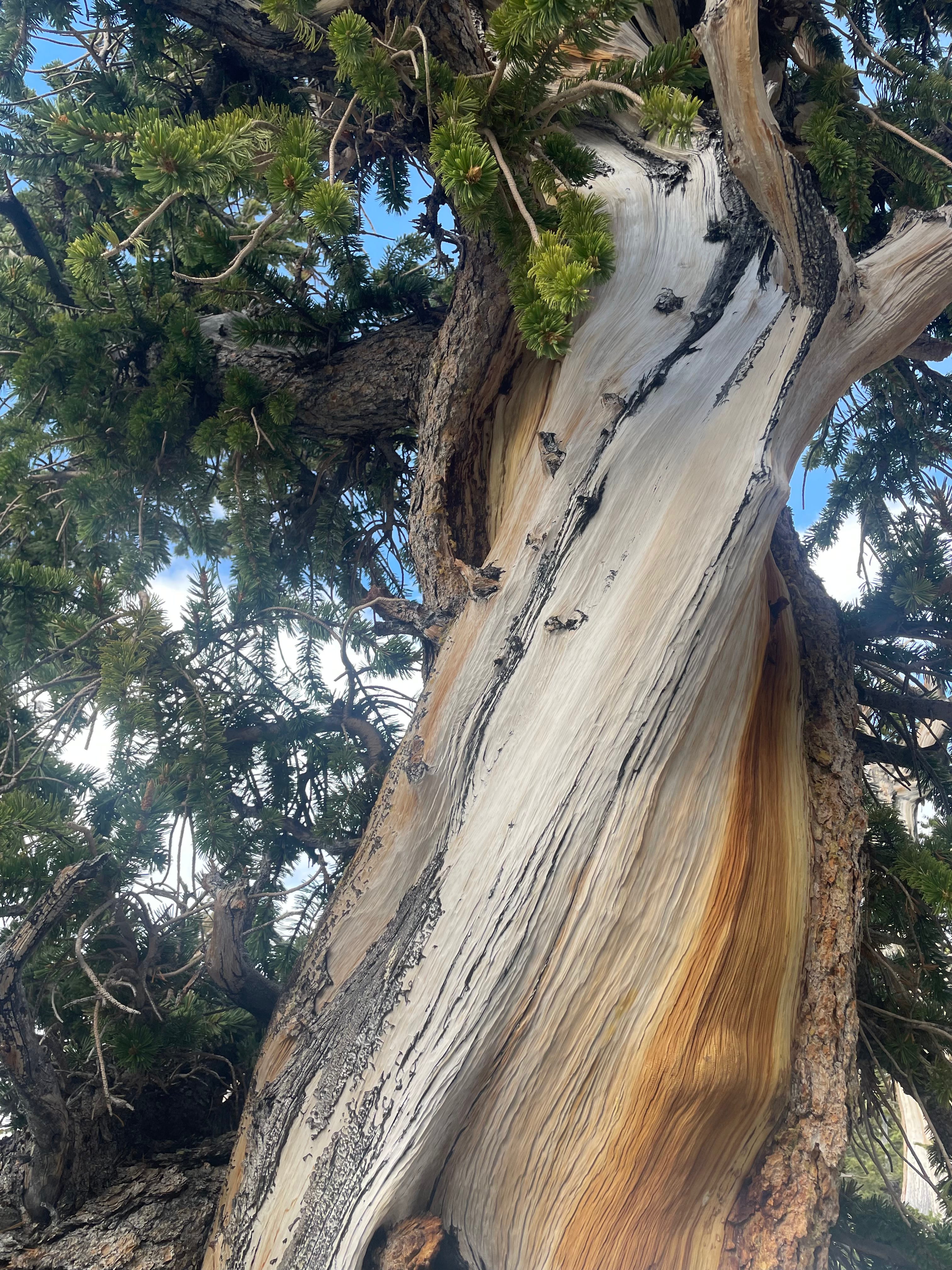
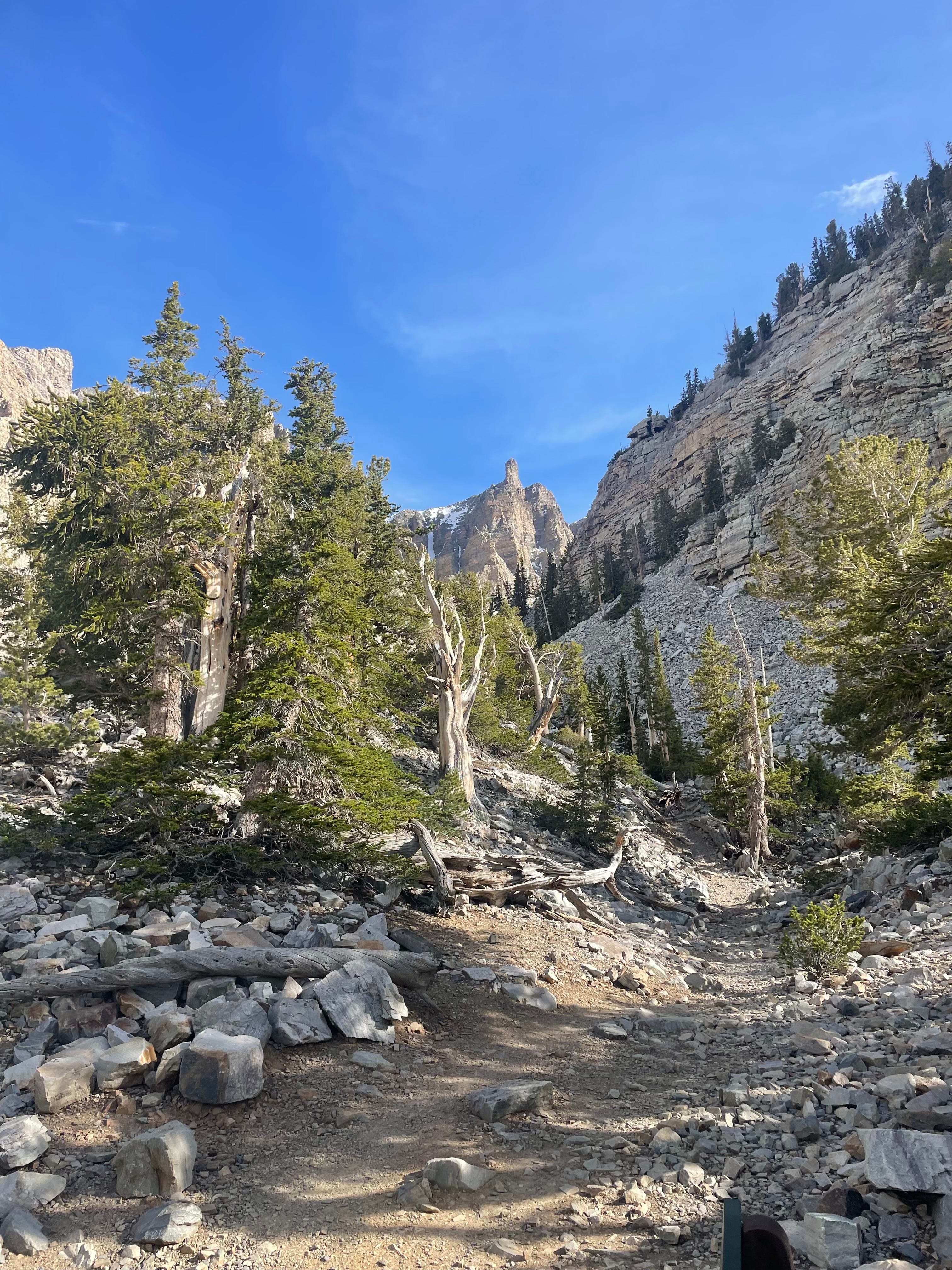
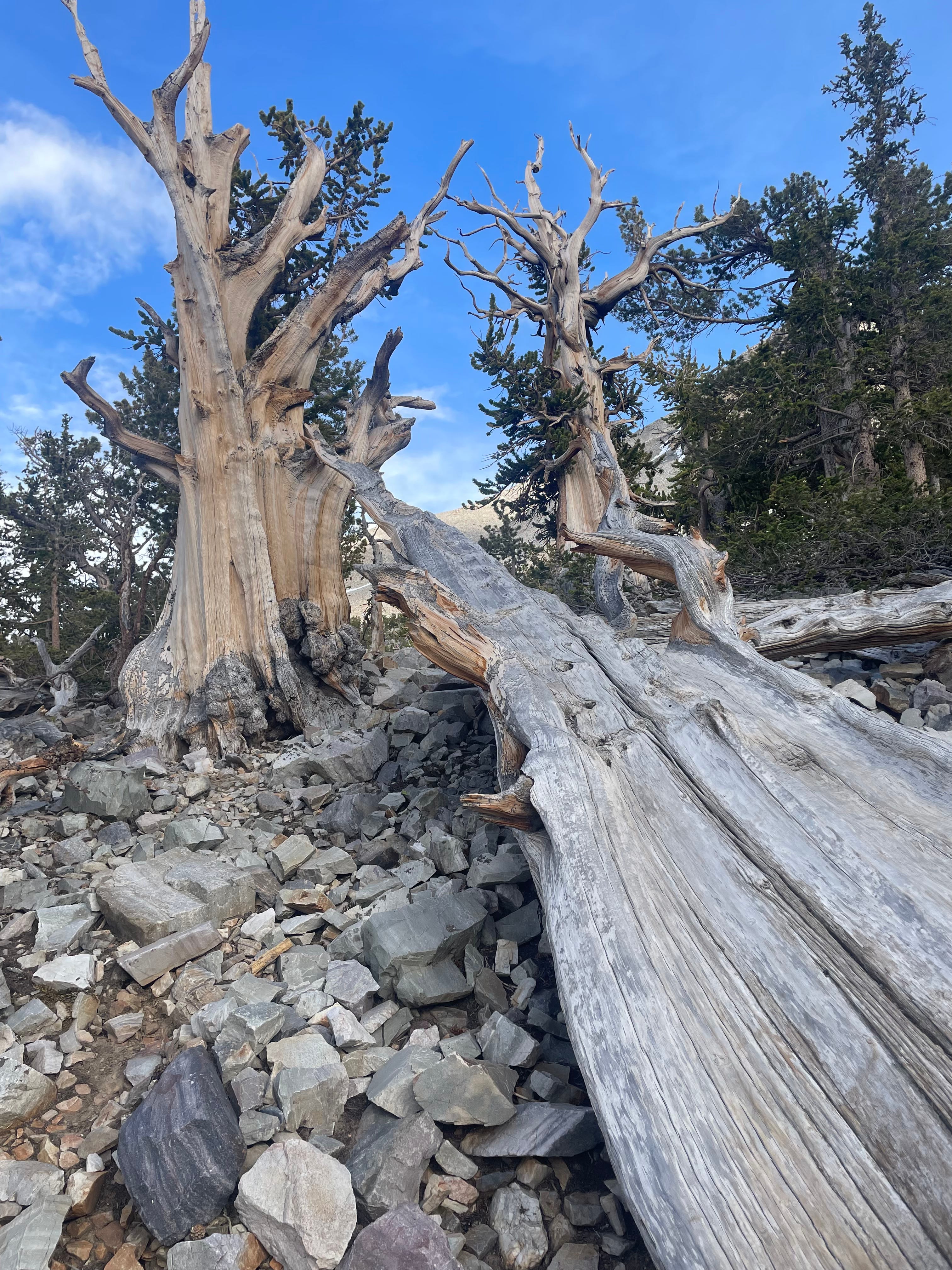
Recently, I visited some of the oldest living things on Earth. The bristlecone pines are found high in the desert mountains of the Great Basin. Seeing them has been on my bucket list for a long time. In 1963, a graduate student was doing tree-ring studies of these trees, whose age was known to be old, but exactly how old had not been ascertained. He suspected that they might be old enough to help him reconstruct ancient climates. Not knowing quite what he was doing, he tried to take a core sample and broke the metal increment borer on the tree’s hard heartwood, so he decided just to cut it down. The sad ending for a 5,100-year-old tree that had survived so much before meeting the saw of an errant graduate student—including drought, storms, lightning, insect, and fire. It turned out to be one of the oldest trees of this species ever found.
I have wanted to visit these for a long time. A population of these Malthusian pines in Great Basin National Park is now struggling due to the rapid pace of anthropogenic climate change in ways they have never encountered in their thousands-of-years history. However, my encounter was different than anticipated. I recorded this as I set up field recorders designed to capture the high-altitude ecological soundscapes.
I think I expected to find a sense of holiness in this place, a place of wonder and enchantment, being among the oldest living things on the planet.
But I find here a sense that all of my life and the life of humanity is but a passing moment. There’s no concern about me at all. There’s no sense that something knows me or feels me.
These trees are beyond me in ways that I don’t really understand, that I can’t even comprehend. And I feel like I’m staring at the vast sea of being and haven’t yet been able to capture even a drop in that ocean.
This is an amazing place. I am so happy to be here, so happy to experience the wonder of this place, the magic at my level. Not at the level I expected. I expected to somehow partake of the ancientness of the trees or the feeling of grandeur and holiness, but all I can feel is a sense of inadequacy and a sense of a kind of loneliness—that these beings are beyond me and far beyond whatever I am.
On the same trip, I encountered ants ranching mealybugs. At the tips of young pines, ants were protecting them from predators and harvesting the sweet honeydew they exude to rid themselves of excess sugars, which the ants then use to feed their colony.
And there on the edge of the Great Basin’s dry frontier, I had an inkling of Job’s confrontation with the divine. Yes, there is suffering. None escape it. Not even our heavenly parents, who at the very least lost a third of their children, and who must have suffered in ways I cannot comprehend. I can, however, sense the depth and importance of this creation, and despite the pain and suffering, and the groaning of creation, as the Apostle Paul calls it, there is something at its heart. Something that goes beyond, or through, or above, or below, or within existence that grounds all the reasons that so easily escape us in our walk through a landscape that neither Job nor we can scarcely comprehend. Yet somehow, as the Lord so vividly describes, this “something” depends mightily on mountain goats, ostriches, and bristlecone pines.
Sources
Robert Alter, trans. The Hebrew Bible. Vol. 3, Ketuvim: A Translation with Commentary. W. W. Norton & Company, 2019.
Michael P. Cohen. A Garden of Bristlecones: Tales of Change in the Great Basin. University of Nevada Press, 1998.
Mark Larrimore. The Book of Job: A Biography. Princeton University Press, 2013.
Steven L. Peck is an associate professor in the Biology Department of Brigham Young University and has published over fifty scientific articles in evolutionary ecology, ecological mathematics, and the philosophy of biology. He is currently a fellow of the Maxwell Institute for Religious Scholarship, working on the interface between faith and science. As a writer, he was awarded the 2021 Smith-Pettit Foundation Award for Outstanding Contribution to Mormon Letters for his award-winning novels, short stories, and nonfiction books on faith and science.
Art by Abraham Rattner (1895–1978). Photos courtesy of Steven L. Peck.
The Old Testament Reflections series is published in collaboration with the Maxwell Institute: https://mi.byu.edu/old-testament-reflections.


