


Hello. My name’s Eric. I’m a member of the Berkeley Ward but I was invited to speak to you because I have a stake calling where I’m supposed to be useful to the wards’ Sunday Schools. Which isn’t an easy thing to figure out how to do. But I love Sunday School and I’m excited that this year’s course of study is the Old Testament because I love the Old Testament. It has a lot of classic stories and it has a lot of . . . really weird stories. I think both are great.
I’m guessing you had a recent Sunday School lesson about Genesis chapter two, which includes this formula for the soul:
The Lord God formed a person from the dust of the ground,
and breathed the breath of life into his nostrils;
and that person
became:
a living soul.
This ties into one of the funny little ideas we got from Joseph Smith that make us unique among churches even though Genesis literally just said it. Here’s D&C 88:15:
The spirit and the body are the soul of man.
Sometimes we’re a little down on our bodies. I mean, they’re always getting us into trouble or catching the flu or bleeding or something and the idea that our soul is both our spirit and our body sometimes isn’t as easy to believe as imagining our sweet innocent spirit someday floating away on its own, untouchable, safe, harmless—our true soul.
But that’s not what scripture says.
In fact, Joseph Smith even taught that “The devil has no body, [that’s] his punishment.”
So shake your neighbor’s hand and celebrate because that handshake proves you have power over the devil.
But why are bodies so important? We know our Heavenly Parents have bodies and we know that Jesus’s resurrection is one of his key accomplishments—not just because he resurrected himself but because he also made it so we will all be resurrected someday.
Because we need these bodies—both dust and breath.
But why?
Here’s one reason:
We need our bodies in order to discern truth.
Because our bodies do tell us the truth. Not always, but we’ll get to that in a minute.
First, imagine that, right now, a 12-foot-tall Kodiak grizzly bear walks through those doors in the back of the chapel—right now!—then chomps down on the shoulder of someone right there on the back row. What are we all going to feel? Fear, maybe? And we’ll feel it alllll through our bodies, won’t we?
And won’t that fear be the truth?
You bet it will.
Our bodies will definitely have an opinion on a bear in the chapel, just as our bodies totally give us important information all the time—they tell us when it’s time for a sandwich or when it’s too dark out. Because our body knows.
But, also, sometimes our body is wrong. Sometimes we crave a sandwich when we’ve already eaten—and we could stand to lose twenty pounds. Sometimes we’re afraid of the dark but we’re not in a forest listening to wolves—we’re lying in our own bed, safe and sound.
So we have to learn how to discern.
Recently in Sunday School, we heard the story of Satan coming to visit Moses. Happily, Moses was able to discern that Satan was a) not God and b) bad news, but that’s not always easy to do.
Yet Moses was prepared. He’d just been talking to God himself—actual God, not Satan’s poor replica. Moses had studied God and heard his words and intended to live them, so when Satan showed up, Moses could not be fooled. He knew who God was. And this was not God. Moses was ready to roll. But not with this guy.
Practicing goodness is how we become good. We get better at being good the more we try to be good. We also get better at recognizing the Lord’s voice as we practice. And we practice by acting—by using our bodies and acting on the word of God.
During the last few weeks of my mission, the Spirit told me to do something very strange.
My companion and I were teaching one of the lessons to a beautiful girl our age, 수윤. That detail is relevant. I promise. It was us and her with her older sister and a guy friend of theirs, who had both been baptized in the last year or so.
I was wearing one of those CTR rings. Do you know these? Just rings with the letters CTR on them, a reminder to always Choose the Right.
Now this is where the Spirit got weird. Because it told me to take off the ring, explain its meaning to 수윤, then give it to her and tell her to keep it as a reminder—until God answers her prayers and tells her to get baptized.
Let me restate this spiritual prompting for you:
The Spirit was saying to me, a twenty-one-year-old missionary, Give your ring to a pretty, twenty-year-old girl.
This is not proper missionary behavior. Nine hundred and ninety-nine times out of a thousand, missionaries should not give pretty girls rings. Not even that often. And so I spent most of the lesson saying, Haha, can’t fool me! to the Spirit of God.
But, finally, I did listen.
I don’t know that I could have received such a peculiar prompting twenty months earlier; and if I had been given that prompting, I don’t know that I could have recognized that such a weird, weird prompting actually came from God.
But I had had a lot of practice by that point in my mission in acting, and finally I did what I was told and I gave her the ring.
About three months after I came home, I received an envelope from Korea. 수윤 wrote me all about her spiritual journey to baptism and returned my ring, bringing a conclusion to this particular (peculiar) prompting.
The Lord—let me tell you, friends—the Lord moves in mysterious ways.
Because it’s not hard to imagine a story where that feeling I felt about giving my ring to a girl was about something other than baptism. I think you can imagine that other story too, am I right?
Romantic love is an interesting test-case for what we’re talking about here. Our body tells us some of the most important truths of this life, truths that are felt deep, deep in our bodies, through this thing we call “romantic love.” But how many of us know someone whose life was thrown off a cliff by their body telling them a lie about love?
We have to learn how to discern between the soul—body and spirit—and just the body.

There was a wonderful woman who was born way back in 1098. She dedicated her entire life to God. She also saw visions her entire life. She described them like this:
I observe them in accord with the shifting of clouds . . . . I do not hear them with my outward ears, nor do I perceive them by the thoughts of my own heart or by any combination of my five senses . . . but I see them wide awake, day and night. And I am constantly fettered by sickness, and often in the grip of pain so intense that it threatens to kill me, but God has sustained me until now. The light which I see thus is not spatial, but it is far, far brighter than a cloud which carries the sun. I can measure neither height, nor length, nor breadth in it; and I call it “the reflection of the living Light.”
One modern scientist read this and said, yeah, looks like Mother Hildegard suffered from a lot of migraines.
I read the description and, yeah, maybe.
But even if they were migraines, she lived a holy life and did a whole lot of good in the world and her words and her music have brought many people to Christ over the centuries.
Who says God can’t send you a holy migraine?
Understanding how spirit and body interact—and how the Holy Spirit interacts with our body-and-spirit soul—is the work of a lifetime. I’m still working on it. You’re still working on it. We’ll all keep working on it. Maybe, even after we’ve been resurrected, we’ll still work on it. I don’t know.
But how do we grow? How do we learn how to understand what our body—as part of our soul—is telling us?
When Joseph Smith was translating the Book of Mormon, his assistant, Oliver Cowdery, wanted to try translating as well.
It was a righteous desire. The work was holy and Oliver just wanted to help. Well, he was helping—he wrote down every word Joseph said—but Oliver wanted to translate too. And why not? As the translation went on, Joseph and Oliver would receive the Aaronic Priesthood; Joseph and Oliver would perform baptisms; Joseph and Oliver would receive the Melchizedek Priesthood. They were working together to perform this great work.
So Oliver got permission to try and . . . nothing happened. Nothing at all.
Well, the Lord does explain that Joseph was called to translate while Oliver was just called to write stuff down, but then why did Oliver even get to try?
Maybe so we could have the revelation that came as explanation. Here’s one part of it:
Behold, [Oliver,] you have not understood;
you have supposed that I would [just] give it unto you,
when you [yourself] took no thought save . . . to ask me.But, behold,
I say unto you,
. . . you must study it out in your mind;
[and] then you must ask me if it be right,and if it is right
I will cause that your bosom shall burn within you;
therefore, you shall feel that it is right.But
if it be not right
you shall have no such feelings,
but you shall have a stupor of thought that shall cause you to forget the thing which is wrong;
therefore, you cannot write that which is sacred
save it be given you
from me.
This is a very popular description of how the Spirit works with the body among Latter-day Saints, but I wonder if we’re misunderstanding it a little.
Jesus is talking to Oliver Cowdery here. He’s not talking to me or you or our bishop here. He’s talking to Oliver Cowdery. And how does Oliver Cowdery’s body tell him when something is true? His bosom burns within him.
But elsewhere in the Doctrine & Covenants, we learn about other ways people feel the Spirit. Joseph Smith feels his mind enlightened. That doesn’t sound the same to me as a burning bosom. Joseph also experiences peace. Of course, you can feel peace and feel a burning bosom at the same time, but that doesn’t mean they’re the same thing. Sweet and sour chicken is sweet and sour because it is sweet and it is sour.
Joseph also talks about something strongly pressing against his feelings. That sounds like stress to me. Not a feeling we often think of as one of our favorites. But that feeling led to the revelation about baptism for the dead, so I say hallelujah for Brother Joseph’s stress.
And then, two thousand years ago, just before the resurrected Jesus visited the Nephites, they heard
a small voice [that] did pierce them that did hear to the center
That feels quite different from a burning bosom to me. What does it feel like to be pierced to the center? I bet if you know, you know.
So, they heard
a small voice [that] did pierce them . . . to the center, insomuch that there was no part of their frame that it did not cause to quake; yea, it did pierce them to the very soul, and did
Oh, look at this!
did cause their hearts to burn.
I’ve always thought of that moment like this:
There was a small voice and they, all of them, every individual person at the temple that day, were pierced and quaked and burned.
But it doesn’t quite say that.
That might be how it was.
But it might also be that when that voice spoke to them, some of them were pierced and some of them quaked while others of them felt their hearts burn.
And that’s okay.
No matter how their body expressed it, that was the Spirit of God. And they all, then,
saw a Man descending out of heaven;
and he was clothed in a white robe;
and he came down and stood in the midst of them;
and the eyes of the whole multitude were turned upon him,
and they durst not open their mouths, even one to another,
and wist not what it meant,
for they thought it was an angel that had appeared unto them.And it came to pass that he stretched forth his hand and spake unto the people, saying:
Behold, I am Jesus Christ, whom the prophets testified shall come into the world.
Even with all that piercing and quaking and burning—even then, they mistook Jesus for an angel.
It takes a lifetime and more to learn how to commune with God.
But I want you to know, right now, today, in this room, the Spirit is here speaking to you. Listen to your body. What is it saying? How does it understand the Spirit?
Maybe it’s a burning or a quaking or a piercing or a pressing or an enlightening—or maybe it is something else altogether. But God loves you. He talks to you. Jesus came to this earth to live and die and resurrect so he could take you home with him to our Heavenly Parents.
Believe that.
Feel that.
Feel it with your body.
Listen to your body.
What is it telling you right now?
How is it telling you?
Your body and your spirit make your soul. And they both, together, are vital, vital parts of your eternal soul.
Love them and listen to them both.
Learn how to discern.
We’re all in this together.
And we’re in it together with our Saviour, Jesus Christ, the God of this world.
In his holy name we hope and pray,
Amen.
Influences this talk accepted:
https://www.wayfaremagazine.org/p/translating-the-flesh
https://en.wikipedia.org/wiki/Hildegard_of_Bingen
https://www.churchofjesuschrist.org/study/general-conference/2019/04/27homer?lang=eng
Eric W. Jepson is, under another nom, author of the novels Byuck and Just Julie’s Fine.
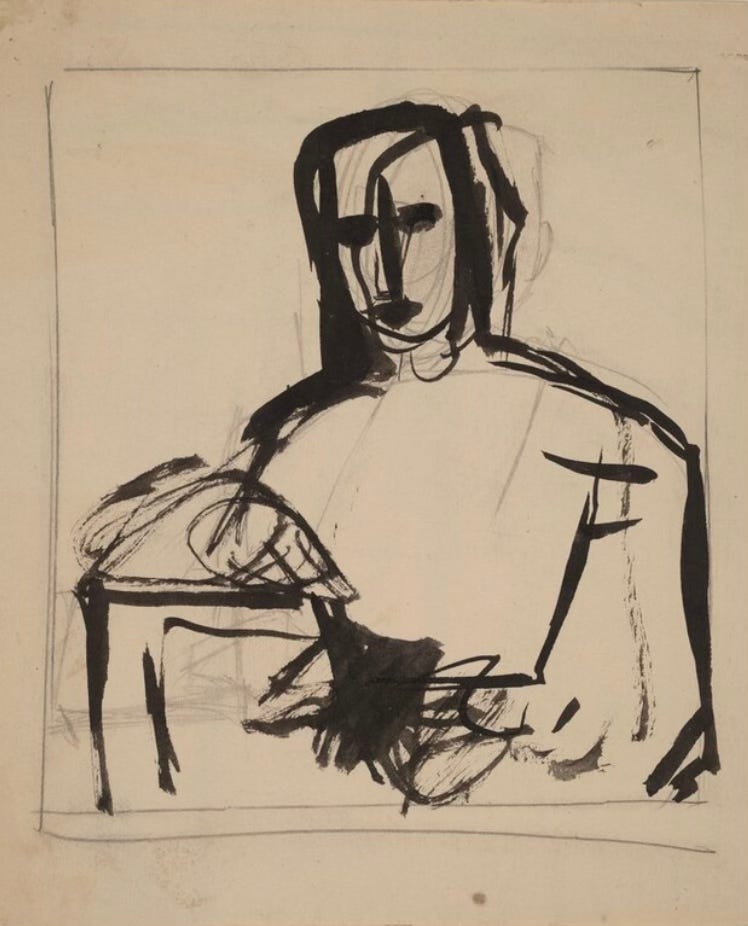
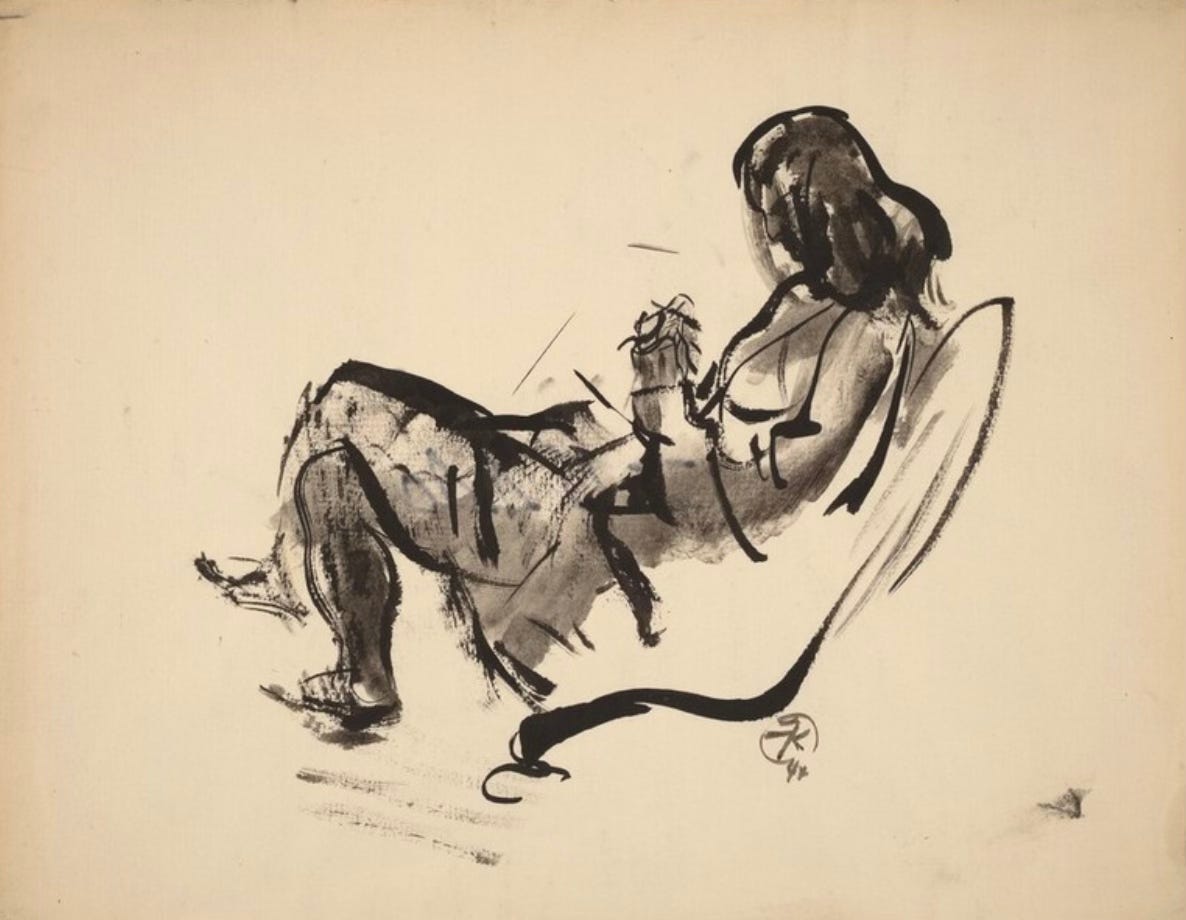
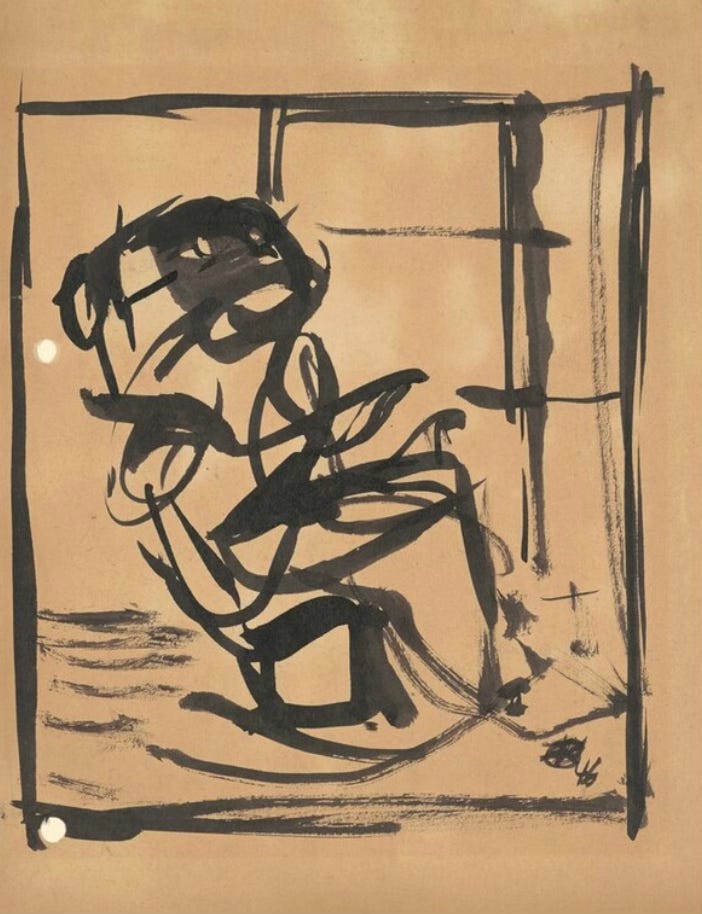
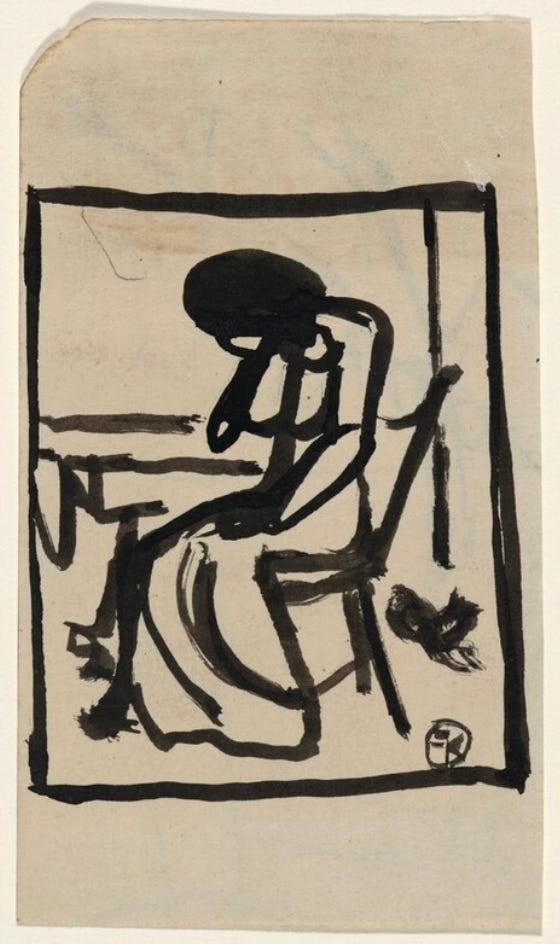
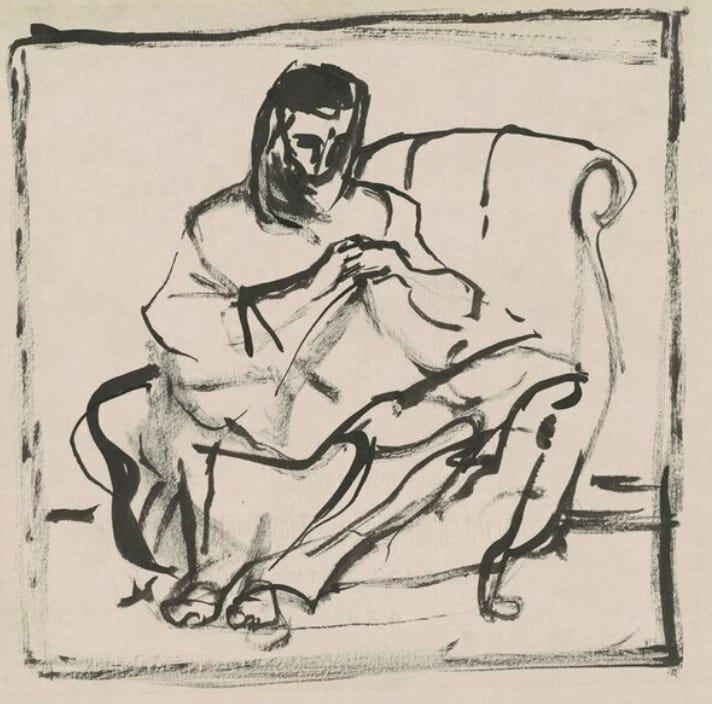
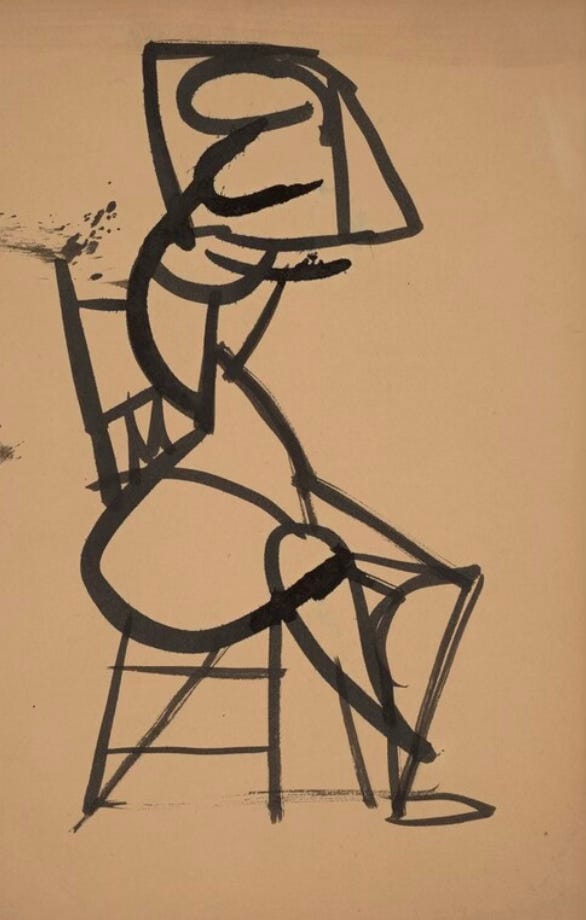
Figure studies by Franz Kline (1910–1962), courtesy of the Art Institute of Chicago.
