


This essay first appeared in Issue 7.
How does God watch the suffering in this world? I will leave the question unanswered. For me, Rose’s death revealed a God who willingly suffers with us—not a God with answers. When tragedy unraveled the God I knew, I discovered the value of God’s unshakable witness.
Weary teens collapsed on our rigid dining chairs. Some shared stools at the kitchen island, leaning over the cold counter. Some lay fetal on the floor, wiping tears. Others leaned against cabinets, the weight of their heads drooping forward. A few shared favorite memories of Rose, but most just listened, swaying back and forth or staring into space. One looked at pictures of Rose on her phone; tears met and dripped from the bottom of her chin. Another sat straight in a chair, his knee bouncing fast, eyes red and swollen.
Staring at my feet, I heard the occasional sniff or rustle of a shared tissue box. Today Rose was murdered, my seventeen-year-old neighbor and friend of six years. Many in my kitchen had known her since childhood. My breath shook as I got up to open the front door for those yet to arrive. Alone and trembling, I stared outside, palms over my mouth.
We had lost our Rose. In that emptiness, I had also lost the God who would keep children safe, a God who could protect, a God I had been certain about. I had always prayed to a God who knew the future and could rescue, and more importantly, a God who wanted to.
What kind of a God would only watch?
She died at a nearby park, less than a block from my house. Flowers in her memory wilted under the park pavilion for weeks after her death. Every day after, I walked through that park with clenched fists and teary cheeks, squinting at the cloudless summer sky. Rose had plans. She was bright, brave, funny, and determined. My trust in God emptied; I couldn’t seem to pray and the silence sealed my grief. Often sleepless, I stared at the moon—shrouded in hazy mystery or harshly present in a cold dark sky. How could I mend a relationship with a God who felt just as indifferent and distant?
After one fitful night, I watched my room fill with dawn’s warming light. Sitting up, I opened my scriptures to Nephi’s psalm, hoping to find renewed trust. I read, then bowed my head, mouth agape, and attempted words. I felt small, unknown, unseen—as if facing a stranger on an awkward first date. Swallowing, I tried again, but words felt out of reach, above a thick fog or buried deep. Eyes closed but twitching, I thought, who are you? My throat tightened, forcing me to swallow. The God I knew dissolved so fast, I flinched.1
With an exasperated exhale, I walked to my back porch, peered at the sky, and thought, I need a new God. Trees rustled, birds chirped their new-day chorus, and leaves tossed in the fall breeze.
Kneeling in prayer seemed out of reach, like the disconnect I sometimes felt as a parent—when what I was able to give or perceive and what my children needed didn’t match. I decided to pray during my daily walk. Forward movement allowed me to walk beside God rather than desperately stare at their backs. My old way of praying no longer fit, like trying to force a shoe on the wrong foot.
I had believed that if I obeyed, if I was good, if I worked hard, if I had enough faith, if I stayed in safe places, and if the people I loved stayed in safe places, then bad things would not happen to me or those I love. Mistakenly, I must have believed that I could control God’s blessings and ensure God’s protection with my behavior. When this idea shattered, I was left with a God who felt undeserving of my trust and love—a God who left. False ideas about God clung, like a heavy throat unwilling to clear.
Rose had registered as a donor, so her family kept her at the hospital for a few days. The day after Rose’s death, we took groups of girls to her hospital room so they could say goodbye. I walked in, hearing the oxygen’s rhythmic wheeze. A sterile chemical smell permeated the room. White gauze and tape bandaged more than half her face. “Come on in,” her mother beckoned, nodding, tissues in hand. Her father stood looking out the window, arms folded, chin trembling. I patted Rose’s motionless feet through the sheets and thin blanket. Girls hugged, wishing they could hug Rose too.
Accepting Rose’s death forced me to reconcile with the God who didn’t stop it—a God who watched.
During walks, my once-colorful wonder about God appeared muted, stern, and gray, like an old black-and-white photograph with thin frowns. I kept my awe in the pink sunsets, mossy tree roots, and soothing bird songs. Rather than telling God what I needed or wanted, prayer became giving God my regrets, my rage, my wish that this world could be different—all in one silent ache. I listened to the wind skitter through trees and looked up at the sky through the patches of thinning branches, snow ready to fall.2
God seemed to sense my distrust and wove their way back into my life, like a timid vine peering through an outside window. Slowly, one by one, God sent people from my neighborhood for me to watch. It began the day a dear friend sat next to me on the church foyer couch. Already full of God’s silence, wadded tissues in hand, my broken heart fell open to her pain. I watched the gripped fist of a faithful woman tell how she was deserted after forty-five years of marriage and felt my knees shake. Her pain heaped onto my broken heart, pooling into cracks. Soon another friend confided her husband’s betrayal; then a friend’s spouse died unexpectedly; then a neighbor’s beloved parent’s death. Later, I watched my next-door neighbor, seventeen-year-old Joseph, limp to my pantry door because of an inoperable tumor on his hip. My shoulders buckled as I watched Joseph’s parents urgently try to stop his approaching storm. And there was more. God watched with me while I witnessed the pain of so many in my community, month after month, year after year. I still couldn’t form words for God; I still wasn’t sure how God watched such a world each day, but my clenched fists softened with love for my neighbors.

As I watched my neighborhood face our worst fears, God and I became friends. This God didn’t change circumstances based on obedience or righteousness. In fact, the circumstances of all these good people remained. Joseph died a slow, painful death. Widows remain lonely. Wives still feel betrayed. But I discovered God’s compassionate witness. They watched each person’s suffering, felt their pain, absorbed and understood their anger, and stayed. I often felt God witness them in real time—with awe and aching. As one translation reads, “The Word became flesh and blood, and moved into the neighborhood” (John 1:14, The Message). The more I reached out to neighbors, the more I encountered God’s witness next to mine. A hope sprouted that God had been right next to our Rose, in her last and worst moment.
Two years after Rose died, still silent in my walking prayers, I walked the labyrinth at the Chartres cathedral in France. Arches soared above me with a rose-shaped stained-glass window at one end, ablaze despite the cloudy sky. As I walked the labyrinth in the chilled air, hearing a choir’s soft singing in a distant room, I thought of my brave adult daughters, facing a world that promises to hurt them.3 I stepped carefully, moving forward, following the lines before me. My breath slowed and evened; time seemed more irrelevant with each step.
A friend’s shoulder brushed mine, and God’s love seemed to pour through me at that moment. My weighted heart vaulted past the roof, free of burden. It was as if life was over, and everyone was done—walking weightless. Through cloudy tears, I saw that no one had walked alone. We had all suffered and walked the same twisted path of life. With each step, the Divine Family walked beside us all. They saw the suffering, the unfairness, the fears, wishes, and heartaches. Every tear we shed was paired with theirs (Moses 7:28). We risked our worst moments, our worst fears coming true, but we all moved forward nonetheless—accompanied souls4 on the walk of life. With time paused inside the labyrinth walk, I found the God who waited for me to trust their witness, and in that timeless moment, their witness seemed to be all that mattered.
My silent, walking prayers became an act of courage—a belief that we aren’t alone, that a power exists beyond us, that this power witnesses our struggle. When I let go of God protecting everyone, God became a confidant, an inner knowing that I could trust with my worst moments. Rather than someone who didn’t help, God became someone who never leaves. Rather than someone who will prevent tragedies if we are good, God became someone walking beside every person, bearing the weight. Soon, God became the steadfast presence prompting urgent action for my neighbors—one by one (3 Nephi 11:15; 17:21). Though I used to believe God protected the righteous, now I see that God stays with the broken. As must I.
At Rose’s funeral, the family offered blue bracelets to each person. At first, I wore the bracelet to remember Rose—my memories with her, my regrets for not knowing, my wish that I could have prevented her death. Today, I wear it to remind me of all the Roses and Josephs I get to love and watch, even if my time with them is shortened. With the hope that God notices and witnesses all, sees and holds every pain and tear and shortened life, the bracelet is my reminder to partner with God and watch.

My prayers used to assume a degree of transaction—a way to ask for what I want, the timing I want, the way I want. Now, prayer is trusting surrender—letting go of what, why, how, and when. Prayer is my way of saying yes to watching those who suffer; it is the way I learn to submit to God and neighbor—and to see the sacred in every person, every living thing. Like a spring leaf letting go of its branch in autumnal wisdom, once I let go of a God I controlled, I found a God willing to be tossed with me, my family, my neighbors, the world.
Instead of suffering being deserved or something to prevent, suffering is an inevitable part of every person’s path. Rather than “Christ’s vicarious suffering as a suffering in place of us,” Adam Miller teaches that we can see “Christ’s vicarious suffering as a suffering with us.” When we find the Christ who suffered “with us,” we find the God with endless empathy and release the God who wields a gavel or measuring stick.
Learning to trust God’s witness and learning to witness the people along my path, flung and scattered into the wind, changed my prayers and my heart.5 My question changed from, How does God watch the suffering? to Who does God want me to watch? My silent aching prayers teach my broken heart how to love God and neighbor—with eyes red and swollen. Now when I open my door, I give the suffering to an ever-watchful God—a God who won’t change it, but a God who attends and asks me to follow.
This essay appeared in Wayfare issue 7.
Katie Lewis is the digital editor for Wayfare magazine and the senior editor at BYU Studies.
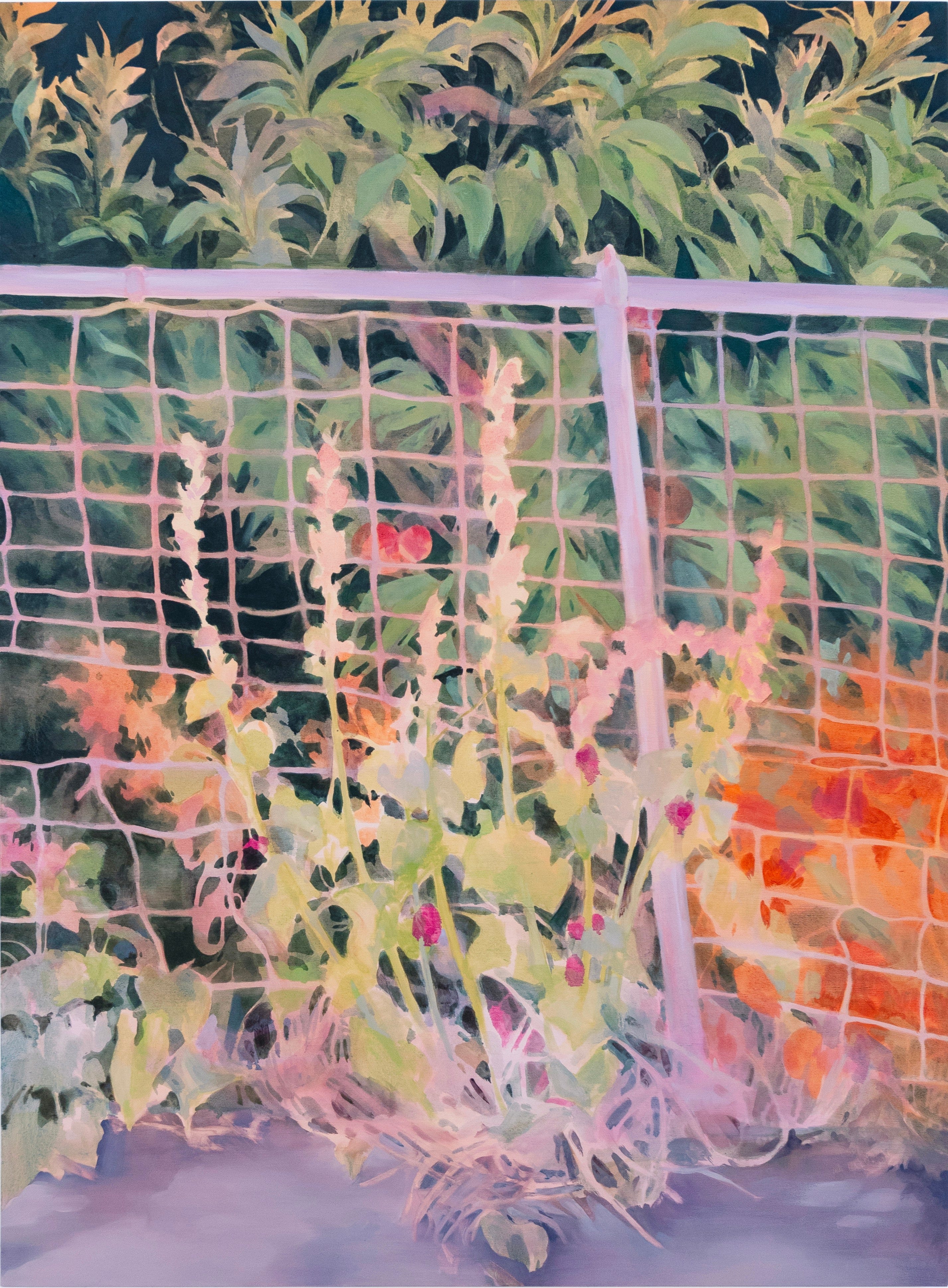
Art by Maddison Colvin.
C.S. Lewis wrote, “Not that I am (I think) in much danger of ceasing to believe in God. The real danger is of coming to believe such dreadful things about Him. The conclusion I dread is not ‘So there’s no God after all,’ but ‘So this is what God’s really like.’”
In Man’s Search for Meaning, Victor Frankl wrote: “When we are no longer able to change a situation, we are challenged to change ourselves.”
One in three Utah women experience domestic violence. One in five Utah girls experience sexual assault.
This idea stems from Marilynne Robinson’s Housekeeping.
“No surprise that the Christian icon of redemption is a man offering love from a crucified position! . . . There is a straight line between love and suffering. If we love greatly, it is fairly certain we will soon suffer, because we have somehow given up control to another.” Richard Rohr, “Love and Suffering,” Center for Action and Contemplation, August 14, 2022.