


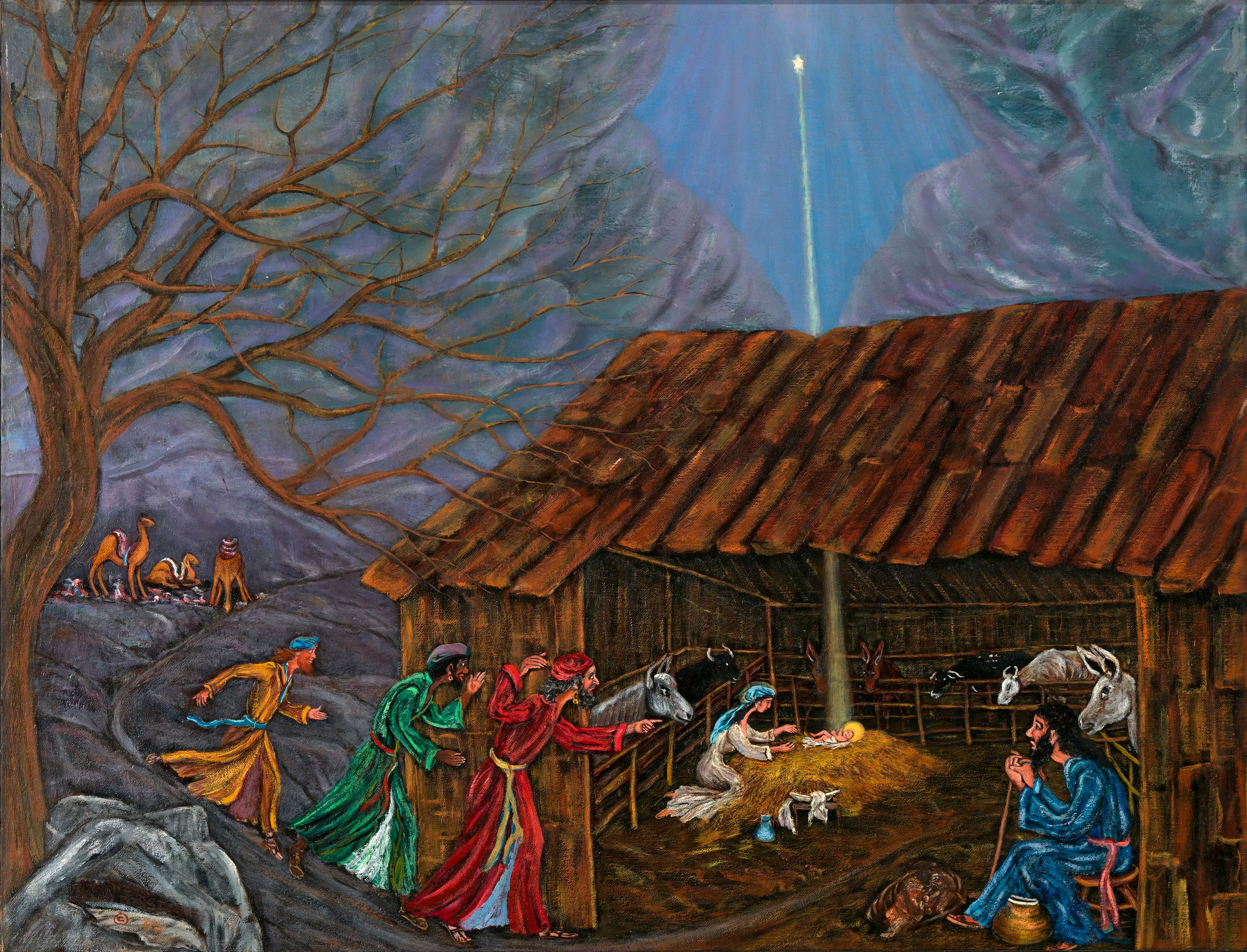
What did the heavenly hosts have in mind when they proclaimed “Peace on Earth” to the shepherds?
For many of us, the peace we want is passive. We want peace to be a state of being, a feeling; we want someone or something to change so that we experience peace. And we seek the kind of justice that avenges, punishes, and destroys.
But Jesus offers us an active peace rooted in how we see and act in the world. When we experience conflict, he calls on us to change. When he calls for justice, he calls for the type of justice that restores, reconciles, and makes us whole. It is in this frame of mind that I am brought to think about the paradox of a heavenly king finding warmth on his first night on Earth in a meager manger, in an otherwise little-known town.
It makes sense to me that God’s highest manifestation of love is an innocent, houseless child born in a stable filled with filth and straw.
I suspect on that night, if we were to stand outside that stable as Mary gave birth, we could hear both her weeping and her shouts of joy (see Ezra 3:9–11). There is always pain before a child is born, and in this child, God’s love becomes tangible in the midst of suffering. Peace is made flesh.
Jesus came into the world, not to give us the peace we want. Instead, he came to give us the peace we need.
Jesus was born into a dangerous world. His community was also in social, political, and religious conflict. The Roman Empire occupied Jesus’s homeland with violence and cruelty. Families faced divorce and estrangement. Poverty and disease ran rampant. Political, religious, and ethnic polarization divided the people of Israel. The Romans punished political dissent with death.
Like today, many of Jesus’s contemporaries assumed the end was near and prayed for deliverance from the conflicts that surrounded them. People felt helpless and begged God to send a Messiah who would save them, destroy their enemies, and usher in a time of peace, power, and prosperity.
During his first public sermon, Jesus drew upon a Messianic scripture in Isaiah to give us our first clue about how he would approach the topic of peace.
The Spirit of the Lord is upon me, because he hath anointed me to preach the gospel to the poor; he hath sent me to heal the brokenhearted, to preach deliverance to the captives, and recovering of sight to the blind, to set at liberty them that are bruised, To preach the acceptable year of the Lord. (Luke 4:18–19 KJV)
Jesus spoke of peace, hope, justice, forgiveness, and reconciliation at a time when his congregation was suffering deep, intractable, violent conflict. The people of Israel were being crushed by the Roman empire. They wanted their Messiah to fight their enemies, not love them. A Messiah preaching 70 × 7 was audacious in all the worst ways. What use did they have for a Messiah who loved Romans and sinners and encouraged the people of Israel to turn the other cheek?
In Nazareth, Jesus invited people with heavy grievances to minister to the spiritually, economically, and socially wounded. He asked them to let go of their grudges and animosity and to show forgiveness to those who hurt them. He called them to do everything in their power to make things right for those they had hurt.
The people in his hometown of Nazareth responded by attempting to throw him off a cliff. He was offering them the peace they needed, not the one they wanted.
Neither we nor Jesus were born into a world of fairness, justice, or peace. Nevertheless, Jesus, the Prince of Peace, offers a way through the destructive conflicts that plagued his day and ours. Jesus responded to the conflict that engulfed his world in ways that would bring more than a temporary respite from the ravages of war and enmity. He taught that the root cause of conflict derived from the human heart. He was concerned that “because of the increase of wickedness, the love of most will grow cold” (Matt. 24:11–12 NIV). Jesus was interested in ushering in a new kingdom, the kingdom of heaven. Yes, he would be a Messiah. Yes, he would offer liberation and salvation, not in the way we want, but in the way we need.
In his teachings and parables, Jesus made clear that the kingdom he was interested in was more concerned with the “least of these”—those that were most vulnerable to the conflict that was engulfing them—than amassing political, military, or economic power.
He taught people who were mired in destructive conflict to love their enemies, to not be angry with each other, to turn the other cheek, to forgive, to stop casting stones at others, and to instead look inward. He asked us to love each other the way he did: unconditionally, graciously, and without fear.
Jesus understood that we can’t work towards heaven on earth when we see each other as enemies that should be vanquished instead of brothers and sisters to be loved.
Where his contemporaries saw enemies, Jesus saw children of God. Where others advocated violence as a legitimate form of social and political change, Jesus chose nonviolence and assertive love as the path to sustainable peace. While others gathered an army to liberate people, Jesus called people to be peacemakers so that their hearts would be liberated from the bondage of hate, fear, and trauma. He rejected a culture and theology rooted in fear that leads to hostility, aggression, and coercion toward others. He taught and lived a culture and theology rooted in love that leads to kindness, humility, and compassion toward others. He said that the way we love one another, especially those who are different from us, shows the world “that you are my disciples” (John 13:35 NIV).
Jesus’s message invites us to reject the peace we want, and to lose our lives striving for the peace we need.
“To follow Jesus does not mean renouncing effectiveness,” writes Mennonite theologian John Howard Yoder. “It does not mean sacrificing concern for liberation within the social process in favor of delayed gratification in heaven, or abandoning efficacy in favor of purity. It means that in Jesus we have a clue to which kinds of causation, which kinds of community-building, which kind of conflict management, go with the grain of the cosmos.”
What does it mean to be peacemakers like Jesus when we are enmeshed in a challenging conflict with a family member, neighbor, coworker, or church member? How can Jesus’s path help us navigate larger social and political conflicts?
Jesus’s way is the gospel of “love and peace, of patience and long-suffering, of forbearance and forgiveness, of kindness and good deeds, of charity” in a world that is often filled with hatred and war, impatience and victimization, and impulsiveness and resentment. Jesus’s way is proactive: He invites us to de-escalate conflict and move toward healing and reconciliation.
Jesus is not asking us to submit to violence or succumb to conflict. He teaches us how to engage in peace in a way that transforms our hearts and those of our sisters and brothers we perceive as enemies.
To quote theologian Adam Miller, Jesus invites us to “give whatever good is needed, regardless of what’s deserved: give what is good. Return good for good and good for evil. . . . The goal of justice is to continually redeem the world from all evil, empowering everyone in it to be more just. Justice is accomplished when evil things become good, good things become better and better things become best.”
That is how we achieve a just peace.
In these times, when so many of our personal and collective efforts to be peacemakers have fallen short, Jesus’s call to be peacemakers has never been more urgent or relevant.
The poor need blessing;
The brokenhearted need healing;
Those that are captive need deliverance;
The blind need sight and the bruised need liberty;
The world needs jubilee—a restoration of all things.
Jesus’s call that day in Nazareth is the clearest and earliest distillation of his ministry. He taught principles that can empower us to transform destructive conflict. Can we take him at his word?
Can we embrace Jesus’s call to embrace the peace we need, not the peace we want?
For all of those who hope to embrace Jesus’s call, he has a word for you. The word, in Greek, is makarios. And it means supremely blessed—or that your life is and will be incredibly blessed or good.
Blessed are the poor in spirit
Blessed are those that mourn
Blessed are the meek
Blessed are those that hunger and thirst after righteousness
Blessed are the merciful
Blessed are the pure in heart
Blessed are the peacemakers
May you practice the peace that is needed because you are the light of the world. May your love become tangible in the midst of suffering and pain. May your peace become flesh. And like Mary and the blessed, houseless child born in filth and straw, may you weep loudly and shout joyfully so that the people cannot distinguish between the sounds of your sorrow and those of your joy.
Chad Ford is an international conflict mediator, facilitator, and peace educator. Chad is also the cofounder, along with Patrick Mason, of Waymakers, a nonprofit organization dedicated to bringing hope to those struggling to make a way out of no way and helping those in conflict find their way back home.
Art by Edward B. Webster (1900-1977).
