


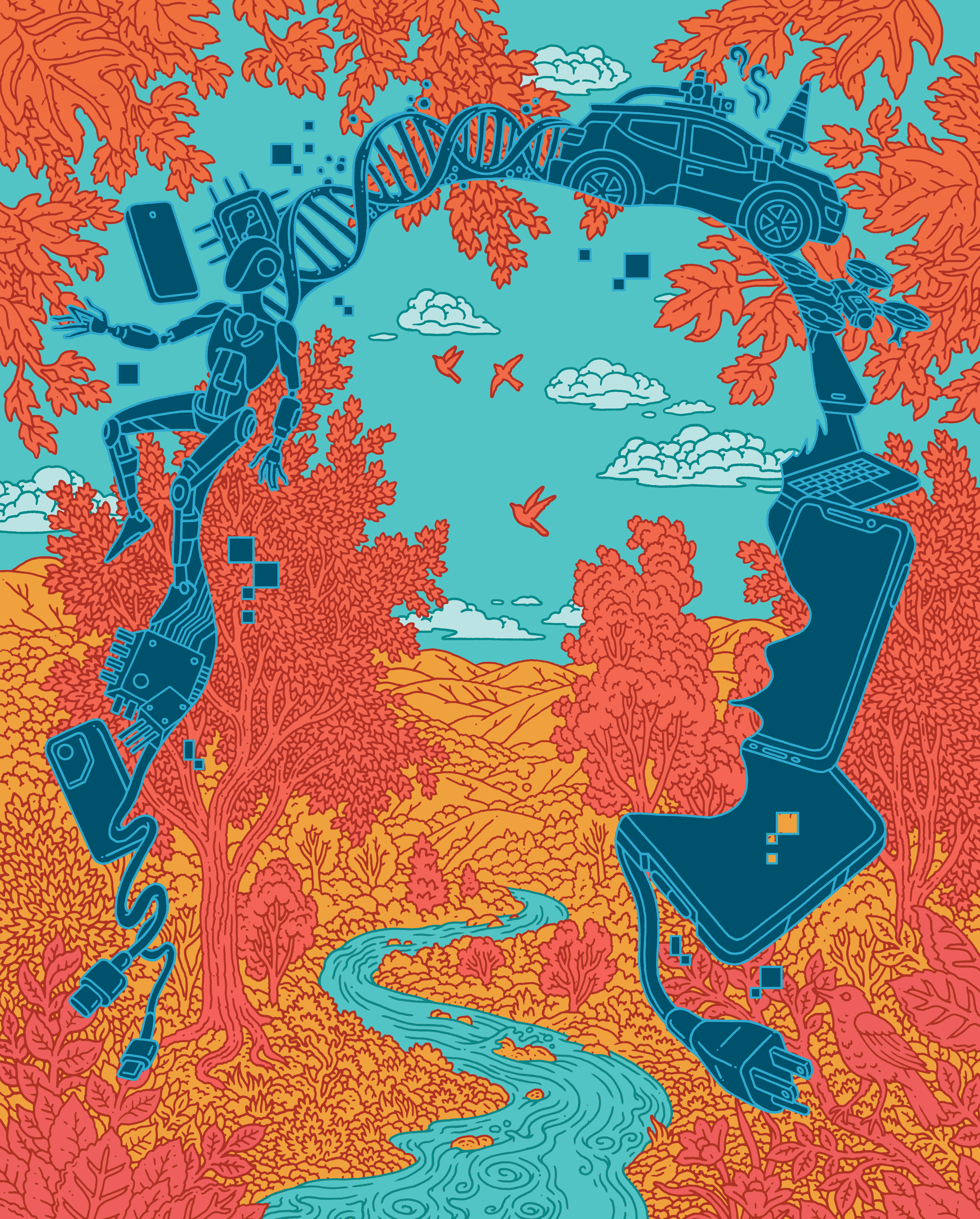
In 2015, August Lamm dropped out of Wesleyan University and moved to Berlin to learn how to draw and give her dream of being a freelance artist a serious go. She’d never been to art school and had no gallery connections, but she had two secret weapons: (1) verve and (2) complete digital fluency.
Since she unwrapped her first iPhone on Christmas Day five years earlier, Lamm, then a sensitive, artsy fourteen-year-old, had lived her life fully immersed in the endlessly enticing glow of the phone. A loner in school, she found connection as she swiped, tapped, and clicked her way through every fascinating corner of the internet.
Now in a foreign country and nineteen years old, she instinctively turned to her phone for company and began posting her daily sketches on Instagram—pine cones, coffee cups, fire hydrants. Initially, likes were few and far between, but after aggressively posting fawning praise on hundreds of other artists’ accounts, her following began to steadily grow. After a year, she had ten thousand followers and started making money selling custom artworks and prints directly to her audience.
But keeping up with the comments and customer service turned into a full-time job as anything less than “high engagement” resulted in lost sales and followers. Moreover, the trends on the platform were constantly changing, requiring Lamm to adapt her personality and posts to whatever hashtag was taking off that week. The algorithmic beast was ravenous, and it demanded constant feeding.
She noticed the one consistent path to clicks was emotional vulnerability. In 2018, she shared a small drawing of a shark with the caption “Crying nonstop & blowing my nose on my shirt. Thank you all for being my internet family, I truly need that in my life.” Sales spiked after posting pity traps like these, and naturally, Lamm kept tapping the lucrative content mine of personal pain. By 2020, Lamm had 170,000 Instagram followers and was making a modest but sustainable income selling art, enough to consider herself a “professional” artist.
More accurately, though, she was an art influencer. She secured paid partnerships with art supply companies for sponsored content. She spent hours carefully creating, captioning, and promoting her posts. But all of that time was time spent alone and lacked any inherent pleasure. She was popular online and completely isolated in real life. “I could appreciate reality only as a source of content—a pleasing image, a compelling story—to share with others,” Lamm wrote, recounting her experience in The Free Press. She had to be online all day to make a living, and her work, life, and social media had become so entangled that separating them became unthinkable.
In the summer of 2022, Lamm was getting ready to publish her first book (a how-to guide for crosshatch drawing) and suddenly found herself inexplicably locked out of her Instagram account. Customer service was unable to resolve the issue, and promoting the book and selling art the only way she knew how became impossible. It was months before Lamm regained access. But the abrupt halt to her illusion of connection forced Lamm to face the depth of her dependency, misery, and isolation, and the fact that she was compulsively addicted to her phone. She suffered from anorexia, and her health was deteriorating. In her crisis, she turned to her phone one last time to post a YouTube video of her speaking into the camera for half an hour, describing how social media had destroyed her life. That same day, she deactivated her Instagram account.
But disconnecting was easier said than done. Even without an Instagram logo to tap, she still couldn’t stop herself from constant phone usage. She tried other techniques to loosen the hold her device had on her—turning the screen to grayscale, deleting the most addicting apps, and installing screen time limits. But the itch remained. She’d be on a date or at a yoga class and she’d find herself pining for the glow of her screen. And she found ways around her self-imposed limits.
Eventually, she realized there was only one lasting solution: ditch the smartphone and get a dumb phone. In her case, a used Nokia flip phone—a device that could do little more than call or text. Which was exactly the point.

Lamm isn’t alone in her experience. Most people recognize that their relationship with their smartphones and social media are unhealthy. Americans spend an average of about five hours a day on their phones, with Gen Z rates even higher. Yet few people are prepared to follow Lamm’s example of abandoning their devices cold turkey. That’s why several companies have come up with middle-ground solutions: devices like the Light Phone, a minimalist alternative built for calls and texts but stripped of social media, email, and other attention traps.
And the demand for phones like these is part of a broader recognition of the harms of our screen-mediated culture. Jonathan Haidt’s crusade to remove phones from schools is spreading. Currently, thirty-six states and Washington, DC, have policies aimed to reduce cellphone use at school. The Financial Times reported that social media use appears to have peaked and is in decline worldwide. Online, the subreddit r/digitalminimalism is hugely popular, with more than 119,000 weekly visitors.
And young people are in many ways leading the effort to take back control from the screens. Last year, Harvard students launched the delightfully named appstinence movement to persuade Gen Z to ditch their phones and “restore the fiber of the human experience.” A youth-led group called #HalfTheStory runs Social Media U, a program that teaches teens “emotional resilience, algorithmic awareness, and healthy digital habits.” More mischievously, several months ago, an antitech group in New York gathered at Manhattan’s High Line park dressed like gnomes and smashed iPads. Efforts like these appear to be working.
Other movements with an environmental bent are taking root. Eco-villages like Earthaven near Asheville, North Carolina, are an increasingly popular option for people looking to live with greater intentionality with the Earth and their neighbors. There are even new educational institutions, such as the Strother School of Radical Attention, that aim to build a “movement to push back against the fracking of human attention by coercive digital technologies.” My personal favorite of technology resistance is the anti-automation protesters Safe Street Rebel in San Francisco, who placed orange traffic cones on Waymo driverless cars to immobilize them.
After all, humans have always pushed back against what they see as the overreach of technology.

I’ve noticed that when someone wants to sound sensible while expressing even a mild critique of some technology, their remark is almost always prefaced by “Now, I’m no Luddite, but . . .” Given how frequently they are disavowed, I assumed Luddites were idiotic antiprogress fanatics. But it turns out the actual Luddites were not unthinking technophobes but well-organized guerilla activists who keenly understood the threat that mechanization posed to the meaning of their lives and the quality of their craft.
The Luddite movement began in England during the Napoleonic Wars, which had caused economic stress and widespread unemployment. Food was scarce and expensive. On March 11, 1811, in the textile manufacturing center of Nottingham, a crowd of textile artisans gathered to protest the rise of cheap factory-produced goods that threatened their source of income and their dignity. British troops were deployed to violently disperse the crowd. That night, these angry workers smashed textile machinery in a nearby village. Attacks on machinery spread to more cities, and these vigilantes began claiming that their leader was Gen. Ned Ludd, an apocryphal textile apprentice who smashed a stocking frame with a hammer after criticism from a superior. But contrary to popular perception, Luddites were not opposed to all new technology, just those they believed produced faulty or inferior goods.
The British government did not appreciate the subtlety of this distinction. Fearing a mass uprising and further economic disruption, thousands of troops were dispatched to defend vulnerable factories. In 1812, Parliament passed a law making machine-breaking punishable by death. The following year, dozens of men were executed and scores more sentenced to prison in Australia. Over time, the term “Luddite” became a rhetorical weapon to dismiss any and all critiques of technological power as irrational windmill tilting.
Today, some—including Lamm—are reclaiming the name and legacy of the Luddites. In 2022, a group of teenagers in New York City made national news when they decided to put away their phones and just live. They met each week at a park, screen free. “Some drew in sketchbooks. Others painted with a watercolor kit,” The New York Times reported. “One of them closed their eyes to listen to the wind.” Calling themselves The Luddite Club, they have since started a snail-mail newsletter, been the subject of a documentary, and formed a 501(c)(3) nonprofit with chapters in more than twenty-five cities worldwide from London to Santa Barbara, California. Their motto is simple: “Unplug.”
