


In the days leading up to Christmas, many Latter-day Saint families will unfold Nativity scenes from dusty newspapers, as my mother did, and stand shepherds on one side and wise men on the other. Then on Christmas Eve many of them will sit and listen to a grandparent or a bishop or a child in the ward Christmas program read from one or both of the two New Testament accounts of Jesus’s birth—one in the Gospel of Matthew, the other in the Gospel of Luke.
The Nativity scenes, of course, are a confabulation born of the page flipping required to merge the stories in these two Gospels. Matthew doesn’t mention shepherds, Luke doesn’t mention wise men; Matthew doesn’t say much about Mary, Luke doesn’t mention Joseph’s visions; there are no inns in Matthew and no stars in Luke.
It’s common to speculate that these Gospels are so distinct because they interpret Jesus somewhat differently. For Matthew, Jesus is the Hebrew Messiah; for Luke, his mission reaches past Israel to the world. And yet, for both, Jesus’s birth is utterly miraculous, announced by angels, and, to quote Luke, “impossible.”
Once you realize it’s there, it’s impossible to miss that the Nativity stories, and the Gospels that follow them, are threaded with the uneasy fact that what has happened in Jesus is incomprehensible.
Mary, his mother, is puzzled by the proclamation of his birth.
Herod, King of the Jews, is taken entirely by surprise.
The shepherds idle on the hillsides until the angels come to them.
And the Gospel of Mark does not describe Jesus’s birth at all. Jesus simply appears, suddenly, a mysterious preacher from Nazareth wielding miracles and proclaiming the kingdom of God. And he continually tells those he heals and teaches that they should not repeat stories about him, should not even tell anybody else about him. And in the oldest versions of Mark’s Gospel, he vanishes as strangely as he appears. These manuscripts of the Gospel conclude with the empty tomb, but no trace of the body within it.

Scholars of the New Testament will tell you that what we can know about the historical Jesus, the person about whom all the stories in the Gospels are told, is scanty, scraps and suppositions based on likelihoods and close readings that try to get past the contradictions among and blank spaces within the Gospels. But that lack can make the power of Jesus all the more compelling.
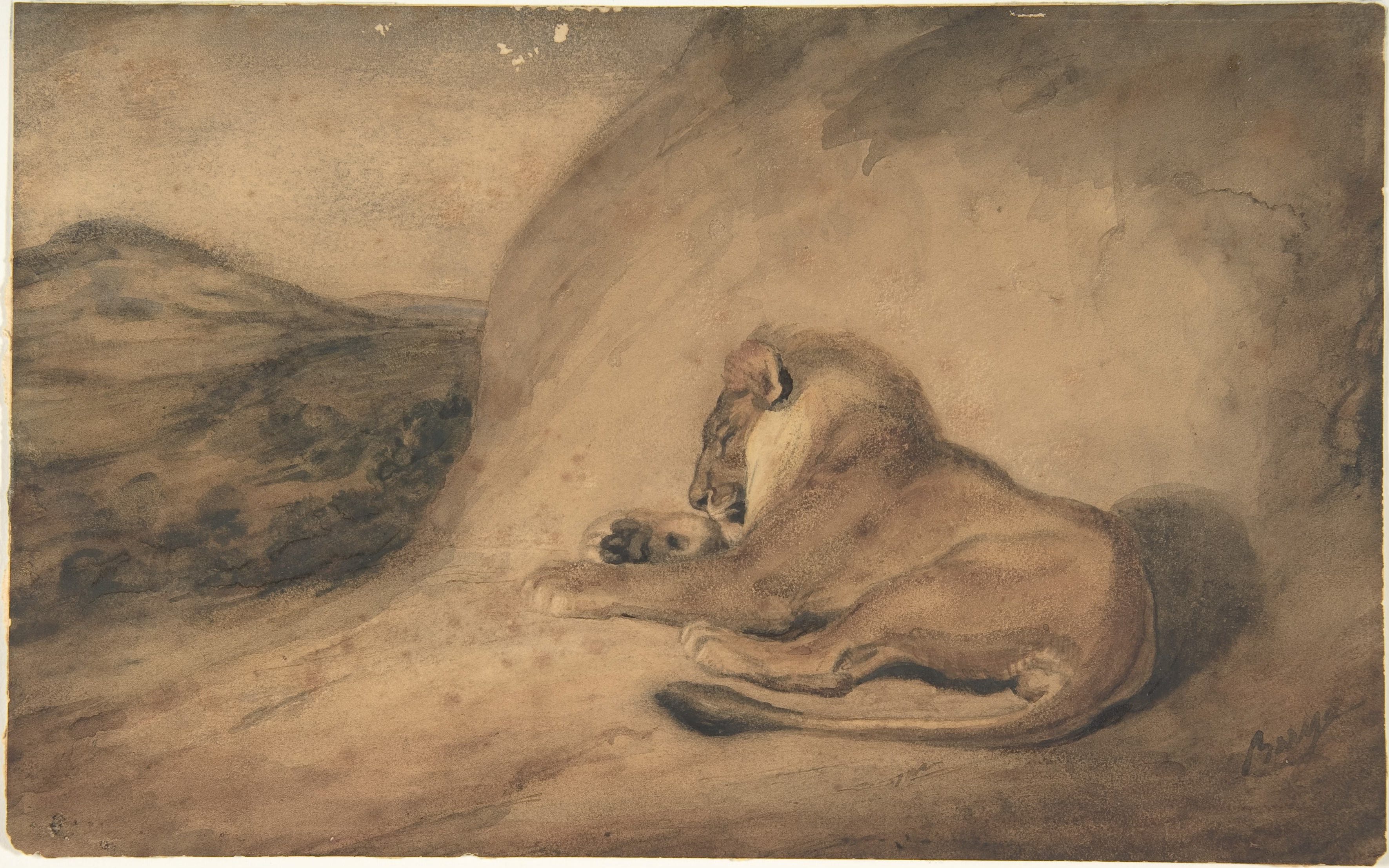
In his children’s book series The Chronicles of Narnia, C.S. Lewis famously says that Aslan, the great cat who is the incarnation of Jesus in Lewis’s fantasy world, is “not a tame lion.” He resists control, reduction, definition, predictability. Just as Jesus in the Gospels, Aslan is overwhelming and elusive both.
Much of the work of Christianity has been the work of taming the lion.
Of course, it’s too simple to say we should just stop trying and let Jesus be free, because it’s impossible not to tame Jesus. Even modern writers who try to liberate him by reading him as a philosopher or rebel who never intended to create a “religion” see him through a post-1960s culture instinctively suspicious of tradition and institution. And that’s taming him in its own way.
So it’s inevitable that we tame Jesus, because taming him means making him comprehensible. Even the Gospel writers do it by depicting him as the Hebrew Messiah or healer of the sick or minister to the poor. It’s an act the premise of the Incarnation invites us to perform. We see him choosing to be wed to a specific body in a specific time and a specific place, and hence be made into a figure capable of transforming ancient Palestine. Or modern America, or Mexico, or Thailand. Or anywhere.
In fact, the apostle Paul claims that the great miracle that makes salvation possible is an absolute God taking upon himself the limitations of humanity.
In one loose translation (the New Living Translation), Paul describes it like this:
Though he was God,
he did not think of equality with God
as something to cling to.
Instead, he gave up his divine privileges;
he took the humble position of a slave
and was born as a human being. (Philippians 2:6–7)
The enigma of the Incarnation teaches us that to sense the possibilities of Jesus, we must both grapple with and celebrate the fact that our attempts to understand him are always partial. And that might show us that the very presumptions we have about what it means to be religious in the first place are also limited, born of our culture as much as of Jesus himself.
In fact, I think that looking at the ways Latter-day Saints have understood Jesus is a small window into the different possibilities for what it means to be Christian.

A hundred years ago the American theologian Richard Niebuhr published a book called Christ and Culture describing various ways Christians might approach Jesus. I’ll focus on two and show their analogues among the Saints in the past century or two.
One of the Jesuses Niebuhr describes is that of the teacher and benevolent sage. He observes that some Christians emphasize Jesus as an ethical example and a devoted guide, a constant companion who offers encouragement, direction, and a model for how human beings should live.
This Jesus was particularly popular among some Protestants in mid-twentieth-century America. They were not the evangelical Protestants worried about sin and salvation, but rather mainline Christians in an optimistic and wealthy society less and less comfortable with the ideas of hellfire and condemnation and more and more interested in human progress and moral growth. In that they found allies in the Latter-day Saints.
Over the course of the twentieth century, a certain reading of the idea of “eternal progression” moved to the center of Latter-day Saint teachings. Church leaders like B. H. Roberts and James Talmage synthesized what it meant. Their basic supposition was that human beings were placed on earth to prove their capacity for moral growth and development. That growth would come by following the teachings of Jesus. It was made possible by Jesus’s Atonement, surely, but it was dependent upon human choice to try to emulate him.
This assumption united Church leaders whom members of the Church might casually label “liberal” or “conservative.” Bruce R. McConkie’s stern admonitions against belief in evolution or the use of playing cards were grounded in faith that human beings could in fact obey every one of Jesus’s commandments if they wanted it hard enough. But at the same time, David O. McKay’s gentle optimism was equally rooted in faith that humans have vast potential if we could just muster the will to harness it.
This was the Jesus Russell M. Nelson seemed to believe in. In one of his last, most famous sermons, Nelson exhorted hearers to “think celestial.” He suggested that it was up to human beings to obey Jesus’s teachings, and that we should all dig in and focus on doing so. “Your eternal life is dependent upon your faith in Him and in His Atonement,” Nelson taught. “It is also dependent upon your obedience to His laws.”
The religion of this Jesus is mainly ethical, concerned with making the right choices. It is a religion of self-discipline, of aspiration, of accomplishment, born of the confident, meritocratic world of the post-war United States. It echoes the myth of bootstraps self-creation that has thrived in the United States since the nineteenth century. And because of that it helped the Church become celebrated as a truly American religion by the end of World War II.
But by the twenty-first century, to some people it became a religion of self-doubt and worry and scrupulosity. Jesus the teacher became Jesus the grader, someone constantly measuring whether his followers were living up to his expectations.
And so in 1990, Stephen Robinson told a story about his wife that called forth a different Jesus. “I can’t do it anymore,” Janet told her husband, according to Robinson’s famous book Believing Christ. So far as Janet was concerned, obedience was exhausting.
Stephen and Janet Robinson might point us to another of Niebuhr’s Jesuses. The theologian also spoke of a Christ above culture, a Jesus whose grace saves us from a world that’s ultimately broken beyond our ability to fix on our own. This is the Jesus of Martin Luther and the Puritans. He is less a sage whose advice can help us succeed at getting the job or optimizing relationships than he is a healer who can fix the wounds our failures inflict.
Robinson’s book sold incredibly well. That same decade, several professors at Brigham Young University began a formal dialogue with the faculty at several evangelical colleges like Fuller Theological Seminary. These ideas began to percolate. And by 2015, Dieter Uchtdorf, then of the First Presidency, declared in general conference that “even if we were to serve God with our whole souls, it is not enough.”
Instead, Uchtdorf invoked a Christian word that would explode in popularity in the Church in the twenty-first century. “His grace refines us. His grace helps us become our best selves,” Uchtdorf said. He urged Church members to focus not on their “own righteousness” but rather “to confess our faults, plead for God’s mercy, and shed tears of gratitude.”
By the 2010s, more and more Church leaders began adopting the language of grace. Indeed, in the first three decades of the twenty-first century, it was uttered three or four times more frequently in general conference than it was in the hundred years before. Of course, they did not discard Jesus the teacher, but the stories about him they told shifted.
When Church leaders like Nelson or McKay described Jesus as a teacher, they made human beings the protagonists. The work of our salvation and exaltation rested on our own shoulders. As Nelson put it, Jesus’s work “allows each of us to choose how we will live here on earth and where we will live forever” (emphasis in original).
But when Robinson or Uchtdorf praised Jesus the grace-giver, Jesus became the actor. The work of salvation is his, a gift he gives to human beings.
A good example is Emily Belle Freeman, president of the Young Women’s organization, in whose work the language of grace has found its fullest articulation. By the time of her call, Freeman had long engaged with evangelical Christians in Bible study groups and various online forums. Freeman’s Jesus is a constant actor in her life, an endless well of recovery, strength, and guidance that does work for her that she cannot do on her own. “His saving grace rescues us, heals us, delivers us, and helps us overcome death, sin, and the weakness of mortality. His exalting grace enables progression, increase, and transformation,” Freeman writes.
The religion of Emily Belle Freeman is a religion of comfort and personal peace. It is a religion conversant in the late twentieth- and early twenty-first-century American therapeutic language of healing, resilience, and joy. It is in some ways quite different from the religion of Russell Nelson, and for that, it’s useful. It can illustrate for Church members that religion can be far more than simply a list of behaviors Jesus wants them to accomplish—that religion can in fact be many things.

This is not to say that Nelson is wrong or Freeman right. Far from it. Nor is it to say these are the only two Jesuses we might describe. (Niebuhr delineates five and happily would acknowledge more.)
Certainly, both these Church leaders would say that their Jesuses are the same, and in many ways that is true. But it is also true that in these differing emphases we can see the inexhaustibility of the Jesus Christ of scripture, and more, that as we fit him into this language or that, into labels like healer and teacher and savior, there will remain parts of him unrevealed.
G.K. Chesterton wrote, “The thing which keeps life romantic and full of fiery possibilities is the existence of these great plain limitations which force all of us to meet the things we do not like or do not expect.”
The stories of Jesus in the Gospels are, often, stories of limitations. His disciples repeatedly misunderstand, betray, and fail him. His parables emphasize over and over the mundane frustrations of stony ground, burned-out lamps, thistly bushes. The Gospels are stories about the pain of embarrassment, of hunger and thirst and exhaustion. But somehow, the mystery of the New Testament is that this Jesus is presented as at the same time divine. His frailty and strength were—as they often are in our own lives—bound into each other, inseparable, and even the product of one another.
Comparing the Jesuses of Nelson and Freeman is useful, then, not to expose the limitations of one or the other. Instead, it’s to show that these respective emphases can help us to learn one aspect of the possibilities Jesus offers. We might embrace these possibilities, but be aware also that the very limitations of our ability to fully comprehend Jesus makes him powerful. Limitations help us understand our own frailties and hence seek to mend them—and Jesus’s story is more than anything else a story about how frailty can point to inexhaustible restoration.
Matthew Bowman is Howard W. Hunter Chair of Mormon Studies at Claremont Graduate University and the author of The Mormon People: The Making of an American Faith and The Abduction of Betty and Barney Hill: Alien Encounters and the Fragmentation of America.
Art by Antoine-Louis Barye (1810–1875).
