

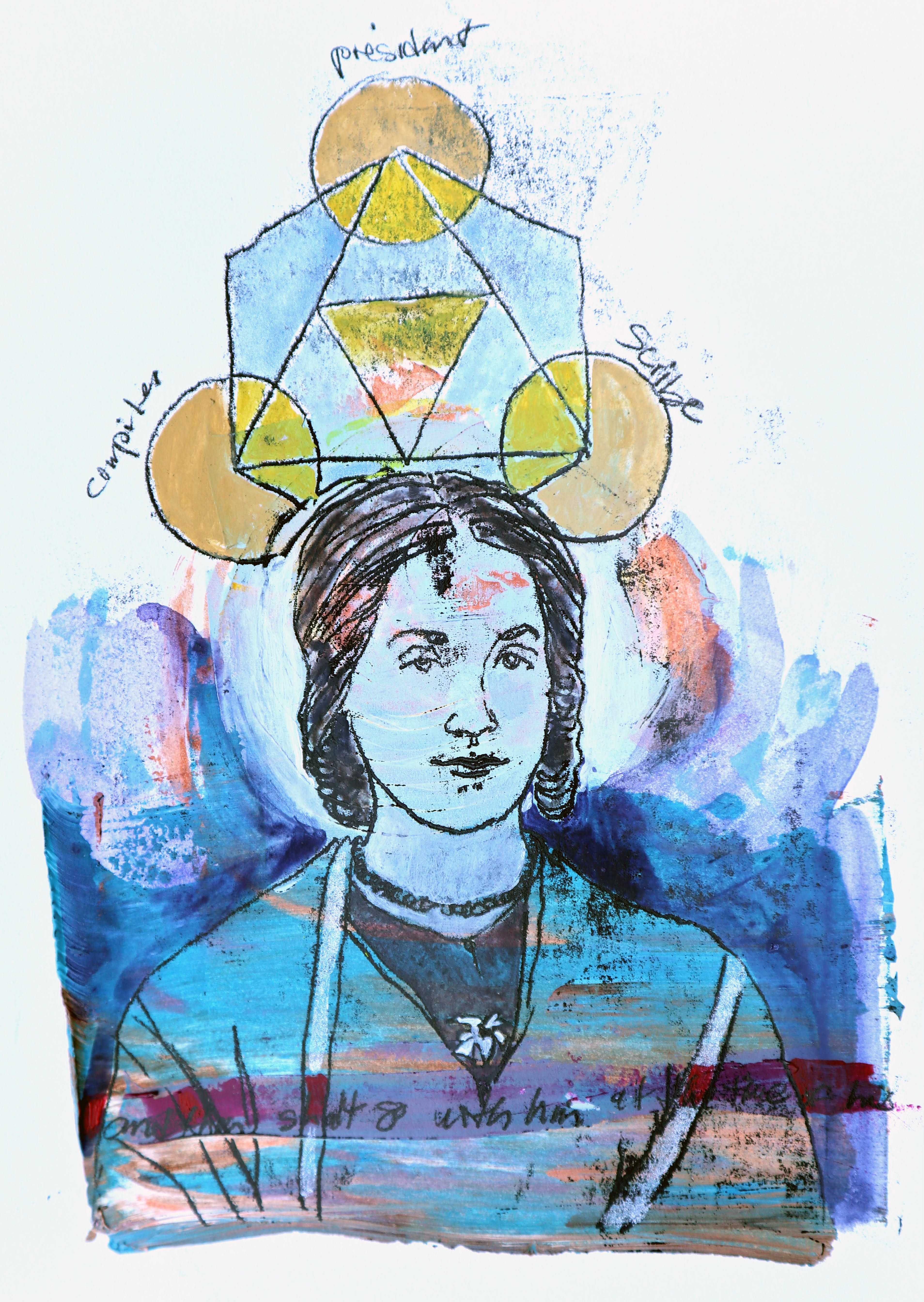
“Mother of all living” and “Elect Lady” are compelling titles for two significant women whose memories have been both tainted and celebrated in Latter-day Saint memory, identity, history, and scripture. Eve and Emma were named by their husbands: Adam called his wife the “mother of all living” at the bidding of Elohim (Genesis 3:20; Moses 4:26), and Joseph voiced the appellation “elect lady” by the word of the Lord (Doctrine and Covenants 25:1, 3). When placed in parallel positions, Eve and Emma act as portals linking the beginning of mortality with the last days. They connect the Creation, the Fall, and the Restoration: Eve initiating the mortal separation from God, and Emma covenanting to return to his presence when she became the first woman initiated into the Holy Order.
A close reading of creation accounts and revelation provides understanding of the connections, complementary natures, and divine assignments of Eve and Emma. Their relationships with God, their helpmeet husbands, their offspring, and their distinct roles suggest participation in redemption, compensation, and grace. Eve and Emma are archetypes connecting God and his children—from beginning to end.
Relationships
“It is not good that the man should be alone,” the Gods assert in the Garden of Eden. They caused a deep sleep to fall upon Adam, then formed a woman or a “help meet”—defined in Hebrew as ezer, a strong protector or a rescuing force that is “meet”—suitable, proper, or sufficient in old English. Adam described her as “bone of my bones, and flesh of my flesh,” then named her Eve, the “mother of all living.” Eve was not named until after she was created—after she acted independently. The Hebrew meaning of the name Eve is significant. According to a nineteenth-century Bible commentary, Eve comes from Chavvah: life or living; breath. Eve is a living soul who produces life. Joseph Smith’s translation adds, “for thus have I, the Lord God, called the first of all women, which are many” (Moses 4:26; see Abraham 3; Moses 3–4; Genesis 2–3). Eve, most certainly, has become a type for all women and men.
Several dispensations later, the angel Moroni told Joseph Smith that his divine assignment required the “right person” to accompany him to receive the plates.1 He could not become the prophet of the Restoration without a helpmeet. God called her “an elect lady” (D&C 25:3). In Hebrew, Eh-ma is the word for “mother” or “mom.” The Old Germanic word Ermen signifies whole or universal; entire; all-embracing—an interesting commentary on what the Lord told Emma: “this is my voice unto all” (D&C 25:16). Emma also serves as a type for women and men.
Eve and Emma left Eden and Harmony to unite with their husbands. One flesh. One companionship. At-one. While Eve was created by the Gods for Adam, then led him out of the garden, Joseph envisioned Emma through his seer stone.2 On January 18, 1827, they eloped, against her father’s wishes, preemptively following the 1830 instruction of the Lord: “Thou shalt go with him at the time of his going” (D&C 25:6). Emma went with Joseph to New York, then back to Pennsylvania, then left for Ohio in early 1831. She never saw her parents again.
Eve and Adam and Emma and Joseph experienced thorns and thistles. Both Eve and Emma found their desires inclined to their husbands. While we don’t have Eve’s words to Adam, Emma was to be a “comfort” to Joseph “in his afflictions” (D&C 25:5). When the Smiths were separated by Joseph’s travels or imprisonment, correspondence reveals an intimate connection. After he left Kirtland in April 1837, Emma wrote, “I cannot tell you my feelings when I found I could not see you before you left.” A week later, she opened a letter to him: “Ever affectionate husband.” Joseph wrote to her from Independence: “My dear and beloved companion of my bosom, in tribulation, and affliction,” then closed, “Oh my kind and affectionate Emma I am yours forever, your husband and true friend.”3 They became bone of bone and flesh of flesh.
The two women completed their partnerships where the men were lacking. Eve, daringly, courageously, ate of the fruit of the tree of knowledge, because she desired to “be as gods” in whose image she was created. She then convinced, encouraged a hesitant Adam to partake, that together they would know good from evil. But God discovered their transgression, and she and Adam were cast out of the presence of God and out Eden (Genesis 3; Moses 4).
Eve and Emma; Eden and Harmony. Emma, too, had multiple sorrows. She was also beholden to her husband and his visions and possession of the plates. Like Eve, she was told that her office—her assignment—was to comfort her husband with consoling words in meekness (D&C 25:5). She, too, would submit to a prophet who had received sight, instruction, and authority, to watch him offer sacrifices, like Eve. Emma was told to “murmur not because of the things which thou hast not seen, for they are withheld from thee” (D&C 25:4). Adam and Eve both “heard the voice of the Lord,” but “saw him not” (Moses 5:5).
Emma covered Joseph and the scriptures he brought forth. They did it together. She helped him hide the plates and provided a linen cloth to cover them.4 He could not translate when they were not in agreement. While he was Liberty Jail, she carried his translation of the Bible across the frozen Mississippi in two cotton bags sewed to a band around her waist under her skirts.5
As an educated, refined woman, Emma compensated for many ways in which Joseph lacked. Emma’s divine appointment was this: “The office of thy calling,” God said, “shall be for a comfort unto . . . thy husband” (D&C 25:5). The word is comfort, not support or sustain—not submissive, but vertical. She reached down to comfort him, wraps herself around him. Another Comforter is what Christ promised his disciples before his death—assumed as the Holy Spirit. “I will not leave you comfortless,” he promised. “I will come to you” (John 14:18). Then, as Jesus suffered in Gethsemane, an angel appeared from heaven, “strengthening him” (Luke 22:43). Did Emma embody the Holy Spirit or the strengthening angel for her husband? Did she empower Joseph from her own internal place of power?
Twelve years later, on April 28, 1842, Joseph taught the Relief Society that an increase in virtue would expand hearts. “Do like Jesus, and carry your fellow creatures to Abram’s bosom.” He encouraged women to treat others “with mildness and affection. When a man is borne down with trouble—when he is perplex’d; if he can meet a smile, an argument—if he can meet with mildness, it will calm down his soul and soothe his feelings. When the mind is going to despair, it needs solace.” Did this council come from personal experience? On June 9, he expanded this Christian apotheosis: “Nothing is so much calculated to lead people to forsake sin as to take them by the hand and watch over them with tenderness.” Perhaps, then, the consoling words and comfort from Emma’s instructions were directions to embody Christ. Joseph continued: “The nearer we get to our heavenly Father, the more are we dispos’d to look with compassion on perishing souls—to take them upon our shoulders and cast their sins behind our back.” Emma, having been counseled twice in her revelation to be meek, may have been Joseph’s impetus in instructing the Relief Society. Perhaps Joseph voiced his hope for Emma’s meekness and support. Or perhaps Emma’s office was to embody Christ in her relationship with her husband.
A third way in which we can examine relationships is through offspring. God commanded Adam and Eve to multiply and replenish the earth, which could not happen until after they were cast out of Eden. It wasn’t until after the Fall that Adam called Eve “the mother of all living” (Genesis 1:28; 3:20). Eve literally had leave the garden, experience the Fall, then forge a life in the wilderness to bear children and fill her title role.
Multiplied seed meant multiplied sorrow. Eve experienced multiple sorrows in the fatal encounter of her sons Cain and Abel (Genesis 4). Emma’s first baby did not survive. Shortly after, Martin Harris lost the Book of Mormon manuscript pages, scribed by Emma. The manuscript was also Emma’s seed, and it, too, was dead. Her next biological pregnancy was also lost with the death of twins. Of the nine children she bore, only four lived. Of the two adopted, only one survived. One died as a toddler. One struggled with a debilitating mental illness, perhaps due to prenatal PTSD as his father was murdered while he was in utero. These losses devastated Emma.
Right before Emma died in 1879, she recounted a dream: Joseph brought her to a beautiful mansion. There, in a nursery, she found her son Don Carlos, who had died as a baby. Joseph promised her that she would soon have the rest of her children.6 They would all be restored—at-one.
Personal Missions
Eve and Emma were foreordained to certain tasks (Alma 13:3–4; D&C 138:39, 55–56). Eve partook of the fruit of the tree of knowledge, and, as modern Latter-day Saints believe, chose to enable the fall, or separation from God. “Were it not for our transgression,” Eve later wisely said to Adam, “we never should have had seed, and never should have known good and evil.” She continued, associating good and evil with “the joy of our redemption, and the eternal life which God giveth unto all the obedient” (Moses 5:11). Eve’s choice allowed Emma—and all men and women—to choose.
Another charge extended Emma’s office to her husband. Joseph’s calling was to the church, but the pronouns in Doctrine and Covenants 25 give pause for examination: “Thy husband shall support thee in the church.” Does this mean that he and the church would financially provide for Emma and her children? On 18 May 1834, Joseph wrote to Emma “a few lines to you to let you know that you are on my mind and that I am sensible of the duties of a Husband and Father.” At least he was mindful of his familial responsibilities, even if he wasn’t always present. Just a few weeks later, he sent money and a letter: “I want you to make use of the money I send you in wisdom, for such things as you need, and make yourselves comfortable and contented as you can and continue to pray to the Lord to hasten the day when we shall be permitted to behold each other’s face again and enjoy the blessing of the family circle.”
Or does it mean that he was to support her in her ecclesiastical office? Both with her selection of hymns and as president of the Nauvoo Relief Society, Emma expounded scripture and exhorted the church (D&C 25:7, 11–12). John Taylor, in attendance at the first society meeting, suggested that Emma “preside and dignify her Office.” Emma’s election gave her and the women new authority. At the first meeting, she remarked, “We are going to do something extraordinary. When a boat is stuck on the rapids with a multitude of Mormons on board we shall consider that a loud call for relief. We expect extraordinary occasions and pressing calls.”7 On March 31, Emma taught the women, “we were going to learn new things. Our way was straight. Said we wanted none in this society but those who could and would walk straight and were determined to do good.” Perhaps Emma turned a key to them, so to speak, opening the door, leading the way for them to be the Word, just as Eve opened a door to women.8
As Emma gained momentum with Relief Society, Joseph expanded his network of plural wives. This caused some difficulty, privately and publicly. Did Emma, like Eve, strain to keep her bone-of-bone and flesh-of-flesh with her? She required that Joseph bend his ear to her, as had Eve of Adam.
Another responsibility for Emma came with the restored endowment, figuratively entering the presence of God and receiving a “crown of righteousness” (D&C 25:13). On 28 September 1843, she became the first woman initiated into the Holy Order by her endowment. In this way, Emma restored Eve’s separation from God. The development of temple ordinances evolved for Joseph, and the highest rites could not be received until after the Relief Society, or order of women, was organized. In turn, the Elect Lady then led other women into the Order.9 The endowment gave Latter-day Saint women a new understanding of their role, as equal partners to their husbands—a proper form of unification—in the plan of salvation and in the church.
Eve and Emma—the “mother of all living” and the “elect lady”—both probably best known for their husbands, but both vital contributors to the plan of salvation and the restoration. As daughters of heavenly parents, wives of prophetic heads of dispensations, and mothers of generations and of orders of women, these two women exemplified their assigned responsibilities.
Unfortunately, time and memory have decimated both Eve and Emma to women dependent upon their husbands. A Washington Post article affirmed that “the story of Eve in the book of Genesis has had a more profoundly negative impact on women throughout history than any other.” By 1845, Brigham Young had developed a distinct rancor toward Emma, the Relief Society, and Eve. He officially shut down the Nauvoo Relief Society in a speech to the High Priest’s Quorum: “What are relief societies for? To relieve us of our best men—They relieved us of Joseph and Hyrum.” He then threw Eve into the mix: “God knew what Eve was. He was acquainted with woman thousands and millions of years before.”
While Young’s position on Eve and Relief Society shifted over time, he maintained a public animosity toward Emma, publicly condemning her for denying polygamy and not following the body of Saints to Utah. He also accused her of attempting to murder Joseph in anger and surreptitiously causing his death, calling him back to Nauvoo, then Carthage.10 As a result, many Utah Saints also carried this disdain. As much as her actions contributed to the restoration, Emma’s reputation was deeply marred. On the fiftieth anniversary of the Relief Society, 17 March 1892, women gathered at the Salt Lake City tabernacle for a jubilee celebration. Displays on the organ pipes included life-sized portraits of Joseph Smith, Emma Smith, Eliza R. Snow, and current president, Zina D. H. Young. While some worried about the propriety of acknowledging Emma in the celebration, church president Wilford Woodruff responded that “any one who opposed it must be very narrow minded indeed.”
Careful analysis of the story of the Creation and the Fall and section 25 provide insight into two powerful women. Their relationships with God, their husbands, and their children provide archetypal patterns, as do their distinct assignments. In 2027, the Salt Lake Temple will be reopened, and while attendees will not experience a “live” depiction of Eve, they will see her visual representation. And they may also see a portrait of Emma Smith, the first lady of the Church—Mother of all Living and Elect Lady, restored to their divine positions.
Jennifer Reeder is a historian/curator with Historic Sites in the Church History Department. She has a PhD in American history from George Mason University. She was the lead historian-editor on the collection of Eliza R. Snow discourses found on the Church Historian’s Press website and in the book, Rise Up and Speak: Selected Discourses by Eliza R. Snow. She published a biography of Emma Smith in 2021, First: The Life and Faith of Emma Smith.
Art by James Rees.
Joseph Knight, Reminiscences, 1, Church History Library; Joseph Smith, journal, 9–11 Nov. 1835; Joseph Smith, history, 1844–1845, book 3, [12], CHL.
Knight, Reminiscences.
Spelling and punctuation standardized.
Joseph Smith III, “Last Testimony of Emma Smith,” Saints’ Herald 31, no. 2 (21 June 1884): 396.
F. M. Cooper, “Spiritual Reminiscences in the Life of Sister Ann Davis,” in Marietta Walker, ed., Autumn Leaves (Reorganized Church of Jesus Christ of Latter Day Saints, 1888–1932), 18; Emma Bidamon to Joseph Smith, 2 December 1867; Edmund C. Briggs to R.J. Hawkins, 28 March 1908, Community of Christ Library, Independence, MO.
Joseph Smith III, sermon, 1 July 1903, Bottlineau, ND, Community of Christ Library, Independence, MO.
Emphasis in original.
Joseph Smith taught the Nauvoo Relief Society, “I now turn the key to you in the name of God and this Society shall rejoice and knowledge and intelligence shall flow down from this time.”
In December, Emma initiated Phebe Woodruff, Bathsheba W. Smith, Fanny Murray, Lucy Morely, Permelia Lott, Sally Phelps, and Catherine Spencer into the Holy Order. Wilford Woodruff, journals and papers, 1838–1898, journal, January 1843–December 1844, 23 December 1843, CHL; Bathsheba W. Smith, Deposition, 8th Circuit Court Testimony, 1892, CHL.
See “36th Semi-Annual Conference, Bowery, G.S.L. City,” Deseret News Weekly 10 October 1866; Richard Lyman Bushman, Joseph Smith: Rough Stone Rolling: A Cultural Biography of Mormonism’s Founder (Knopf, 2005), 498.