


In this essay, I am going to put forward a simple argument: that members of the Church of Jesus Christ of Latter-day Saints have a moral obligation to think critically about what is happening in the world. Furthermore, because of the ongoing evolution of communication technologies, fulfilling that obligation will increasingly require both a broad sense of the prevailing forces that challenge truth-seeking and critical thinking and a commitment to countercultural personal habits that facilitate both practices.
First, we must establish this: by covenant—and in response to both scriptural and modern prophetic injunction—Church members are meant to do everything possible to make the world a better place. When we are baptized, for example, we covenant to become the kind of people who natively mourn with those who mourn and comfort those who stand in need of comfort. Likewise, covenants made in temples include being willing to sacrifice on behalf of others, live the higher law of Jesus’s love, and consecrate all we have and are to building up the people and the world around us. The ultimate objective of a Christian disciple’s life must be to make the world a better place.
In addition, modern Church leaders have made clear that part of this covenant commitment entails positive participation in the political process. For Church members who live in a representative democratic republic, like the United States, some might participate by running for office or directly contributing to the political system. But the large majority of Church members will never run for office yet still bear the responsibility of participating constructively in their representative role. This is a point that has been made for decades in a letter from the First Presidency read across the pulpit in sacrament meeting, and which has received special emphasis in recent years from President Oaks.
All of this might seem uncontroversial, even blasé. We have been reminded of this so frequently and forcefully that it can hardly come as a surprise. What is perhaps less obvious, however, is the degree to which positive participation in the democratic process is becoming increasingly fraught and complicated as we move deeper into the twenty-first century. Of course, there has never been some societal Eden to which we are striving to return. A two-party system, like we have in the United States, has always been driven by factionalism, a prominent feature of our governmental system. Additionally, over two centuries, our democracy has seen the rise and fall of party bosses, Tammany Hall, various forms of corruption and scandal, the rise of unfettered influence from monied interests, and multiple other forms of interference in the democratic project from people and forces who unquestionably bring with them ulterior motives. Buying influence from or currying favor with politicians is not new in 2026.
Nonetheless, the pervasiveness of such influences over time does not excuse our need to critically examine the impact of such influences now. This is particularly so because those influences now operate in ways that are arguably subtler, more pervasive, and more corrosive than at any time before.
Although every generation bemoans the threat of novel technologies that eventually fade into irrelevance, one feature of our current digital technology landscape that is unmistakably new and different is the degree to which we are tethered to our smartphones and the willingness with which we remain entranced by what we find there. We already know in our bones—without repeating all the startling statistics—how much time we spend on our phones and how much of our attention we devote to things like social media. There has never been a time in the history of humanity, when so many people so eagerly devoted so much of their time and energy to a single medium comprised of personally customizable information streams.
The second defining feature of our new informational age is that the technologies powering our experience on our phones are intimate, compelling, powerful, and subtle. The new digital economy is so unfathomably lucrative for the few mavens in control because a person’s “feed” can be precisely tuned to content that will most effectively keep that person engaged (whether entertained or angry). Today, it is not the megahits that appeal to everyone that make all the money. Rather, what makes billions of dollars for corporations today is finding ever subtler and more sophisticated ways to tailor what a person sees, hears, and reads online to that person’s pre-existing preferences and beliefs.
This innovation introduces grave dangers for the preservation of a republic like the United States. Despite its many failures and even though it largely and too often represented a somewhat monolithic view of the “progress of history,” the news media of decades past at least sought to tell a public story that conformed to facts on the ground. But in this era of supercharged and sophisticated algorithmic decisions about which content to serve to whom, the digital gods making decisions about the information that enters our brains care more about satisfying our lust and confirming our preconceived notions than they care about articulating the truth, let alone speaking truth to power. Journalists have been slowly pushed out of the attention loop and replaced with an attention-grabbing slop circus.
Of course meaningful media outlets dedicated to the pursuit of truth still operate. And value exists in more than a single version of history or a monolithic interpretation of current events or policy proposals. But the rise of algorithms that care most about making their proprietors money, combined with our collective devotion to and fascination with our screens, means that politics today are increasingly based on the whims of people whose information has become untethered from the truth.
Similarly, while the democratization of publication has unquestionably allowed a wider variety of people to broadcast their views, that same process of democratization has disconnected much of what passes as “news” from the facts. Whatever a person thinks of the op-ed pages of The New York Times or The Wall Street Journal, and even though both publications and others like them have published tragic exceptions, those exceptions precisely prove this rule: most often, legacy media outlets consider themselves accountable to the facts and invest heavily in ensuring they report what is so. There is no such guarantee when it comes to “news” that is served up in our social media feeds and whose provenance is often questionable and murky. This state of affairs will unquestionably divide democracies against themselves, which—as scripture says—means they cannot stand.
This brings us back to the covenant responsibility we have as members of the Church of Jesus Christ of Latter-day Saints. One of the fundamental tenets of our faith commits us to seek, strive toward, find, share, and never yield from all that is true. In the second quarter of the twenty-first century, the current state of affairs serves as a potent reminder that truth and good cannot be severed. If we wish to work toward a better world, we must begin with an ironclad commitment to seeking to know what is actually so.
Seeking to do what is good therefore means routinely seeking reliable information that informs and even corrects our views, including proactively searching for voices that contradict our preconceived notions with evidence, reason, and good intention—not in the sense of seeking out shadowy conspiracies or the kind of “truth” that is breathlessly advertised as having been “hidden” all along. That type of advertising usually connotes a different set of ulterior motives. Rather, we are most likely to find truth by seeking it out from reputable news sources that prioritize facts, objectivity, and data. We cannot, for example, abandon ourselves to the nihilism suggested by the recent movie You Can See Everything, whose subtitle might as well be “But You Can’t Be Sure if Any of it Is Real.”
Algorithms profit off of feeding our personal thirsts and beliefs—therefore we must continuously strive to seek reputable sources of knowledge that correct and improve our beliefs. We must ask relentlessly, “Is it possible that I am wrong?” We must be willing to take in information that unsettles us and that brings together the most reliable and most deeply scrutinized information available.
Challenging our implicit habit of confirming our own biases—and the tendency of algorithms to exacerbate that mental tic—is vital to our ability to do good in the world. But it is not vital as an end in itself. Neither is it vital because we are meant to take what we would natively tend to believe, seek out a different thing that someone else believes, and then try to stake out a position in the “middle” of those extremes.
Rather, the seeking out of unsettling opinions is an exercise in seeking truth in the furtherance of justice—full stop. We do not seek out differing opinions to try to land between them; we seek out differing opinions to try to figure out what is true. Indeed, at the final account, we are not seeking “opinions” at all, but rather, we are meant to use differing opinions to determine what actually is. Thus, in addition to escaping our own algorithms, our dedication must be to becoming versed in how to appraise and weigh evidence, and then in looking for ways to, on a daily basis, best discern from the cacophony of voices what is true.
Indeed, in this vein we see that the very founding act of the Restoration of the gospel was Joseph Smith showing us precisely how much this matters. After all, do we not see some modern parallel in his description of things as they were in 1820: “for a scene of great confusion and bad feeling ensued—priest contending against priest, and convert against convert; so that all their good feelings one for another, if they ever had any, were entirely lost in a strife of words and a contest about opinions?” (Joseph Smith—History 1:6). Does that not reflect our media environment of late, even if our contentions and confusion are about matters other than the details of religion?
But in this we find a shining example. Joseph studied things out in his mind. He read all he could. He studied from every (often meager) resource available to him. And then he was willing to seek and accept truth, even when it was hard. He founded a school, and his followers eventually founded more schools and universities.
In all of this, expertise will become increasingly important. It is true that experts can lie. And, of course, experts can also have ulterior motives. Nonetheless, field-wide consensus from experts committed to evidence and truth-seeking remains the most durable and reliable means we have of ascertaining what is most likely to be true.
What all of this amounts to is a recognition, as I posited in this essay’s first paragraph, that in 2026 the habits we use to collect, digest, and incorporate information have become some of the most foundational aspects of our covenant commitment to advancing the common good. If we wish to make the world a better place, we have to start by daring to challenge our partisan leanings, to accept truth, even when it is inconvenient, and to be willing to change what we thought we knew when presented with information that shows it to be false.
Tyler Johnson is a medical oncologist and associate editor at Wayfare. To receive each new post to Tyler’s column by email, first subscribe to Wayfare and then click here to manage your subscription and select On the Road to Jericho.
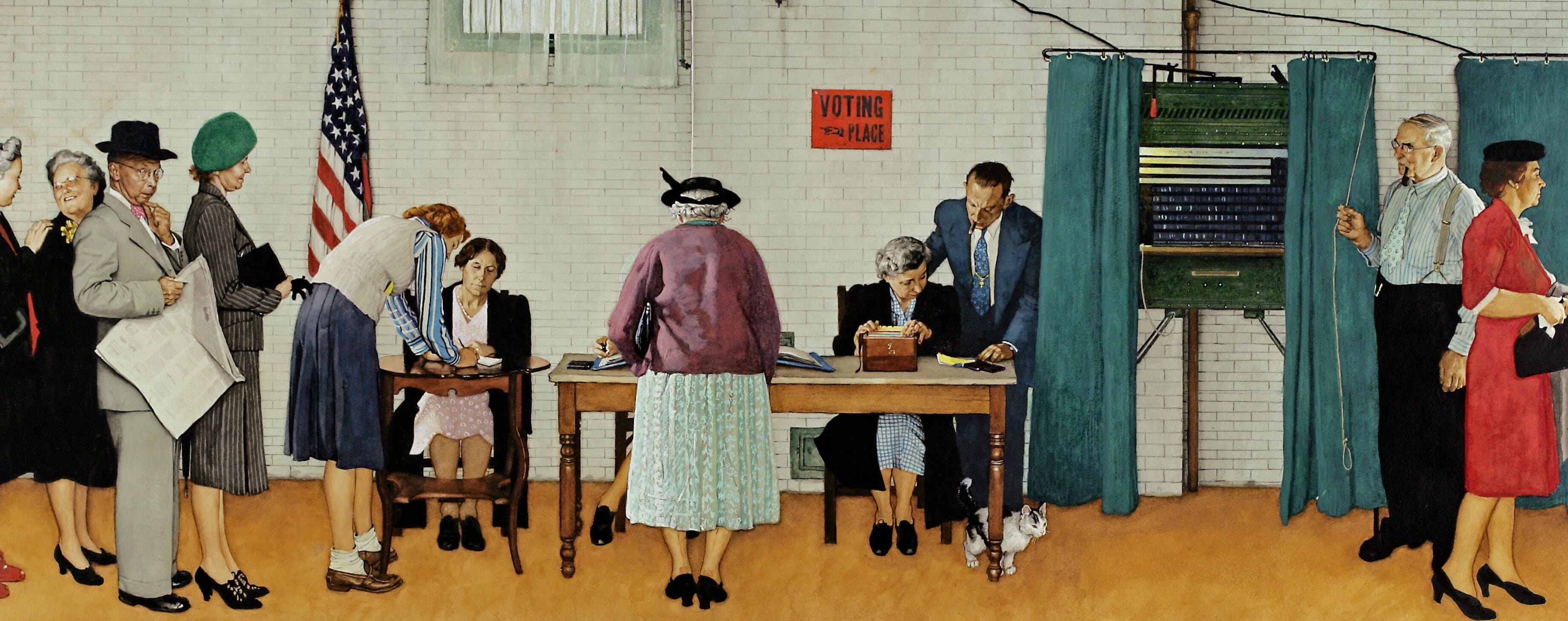
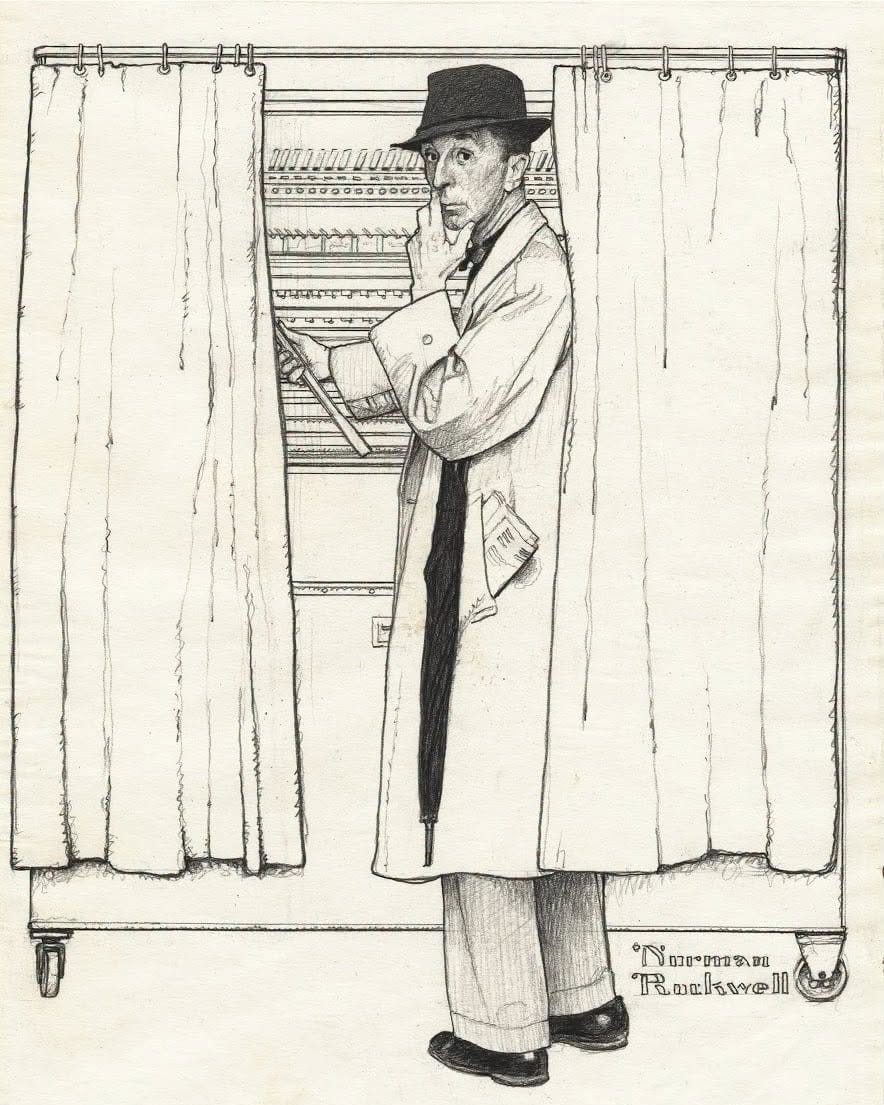
Art by Norman Rockwell (1894–1978).
You make a great point about covenants meaning we as Latter-Day Saints have to put some real tangible effort into making the world a better place. There would be no end to how much good we could do in the world if everyone really tried.