


Moral Visions: Ethics and the Book of Mormon
Edited by Courtney S. Campbell and Kelly Sorensen
University of Illinois Press, 2025
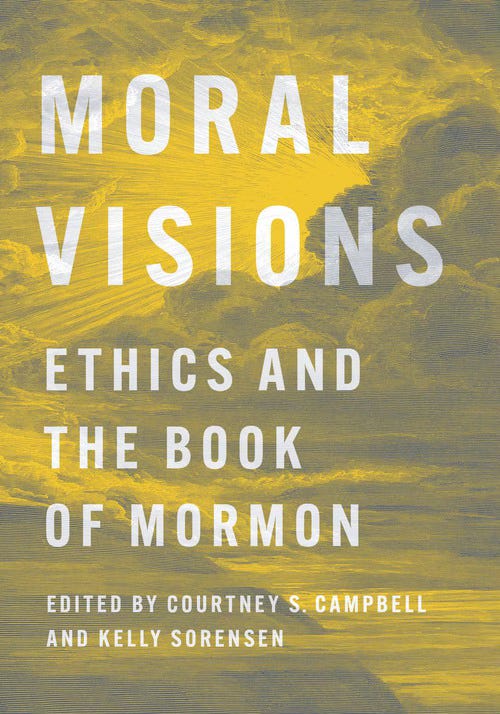
Moral Visions: Ethics and the Book of Mormon, edited by Courtney S. Campbell and Kelly Sorensen (University of Illinois Press, 2025), is a groundbreaking collection of essays that presents the Book of Mormon as a text worthy of serious ethical inquiry. The volume explores how the Book of Mormon can inform and contribute to contemporary moral philosophy and religious ethics. The book is organized into two broad sections: “Ethical Foundations” and “Practical Applications.” The first focuses on theoretical or conceptual issues (moral psychology, moral conflict, moral epistemology, moral agency, etc.), while the second turns to concrete ethical themes within Book of Mormon narratives (moral choices in community life, social justice, authority, memory, and so on). This structure allows the editors and contributors to address both abstract philosophical questions raised by the text and the lived moral practices depicted in it. Moral Visions seeks to read the Book of Mormon neither to indict nor to vindicate, but to understand how its content and characters intersect with modern moral thought. The contributors represent a plurality of perspectives and myriad methodologies, and all share a commitment to treating the Book of Mormon as a serious source for moral reflection.
Engaging Contemporary Ethical Theory
One of the most significant contributions of Moral Visions is the way several essays explicitly put the Book of Mormon in conversation with current philosophical issues. A clear example is Joseph M. Spencer’s chapter, “What Is the Good and How Does One Know It? Ethics and the Book of Mormon.” Spencer tackles foundational questions of moral ontology and moral epistemology through a close reading of two sermons in the Book of Mormon given by two separate figures: Alma2 and Mormon2.1
Strikingly, Spencer finds that the text itself contains a productive internal diversity on these questions: The sermon of Alma, directed to skeptics seeking truth, offers an ethical naturalism—an analogy between nurturing faith and a growing “seed”—whereas the sermon of Mormon, addressed to an already believing community, teaches reliance on the “Spirit of Christ” to obtain a “perfect knowledge” of good and evil. As Spencer observes, the Book of Mormon thus “sets forth two different ethical ontologies and two different ethical epistemologies,” seemingly “diametrically opposed”—one a more naturalistic, experiment-based path to knowledge of the good, and the other a revelatory, Christ-centered epistemology. By drawing out this tension, Spencer not only illuminates the complexity within the scripture but also connects it to philosophical discourse on how we know the good (for example, reason and experience vs. divine illumination).
Another standout dialogue with contemporary theory is Ryan Davis’s chapter, “Do Values Depend on Other Persons? The Book of Mormon’s Apocalyptic Solitude.” Davis brings the narrative of the end of the Nephite civilization (as experienced by the final prophets, Mormon and Moroni) into conversation with philosopher Samuel Scheffler’s thought experiment about the importance of a “collective afterlife” (xi) for our values. Scheffler hypothesizes that if one knew humanity would disappear soon after one’s own death, many of one’s values and projects would lose their meaning, implying that the continued community matters more to us than personal survival. Davis uses the Book of Mormon as a testing ground for this thesis. Nephi, the first prophet–author in the book, writes with an eye to future readers and a “reconstituted social world” (85), seeming to affirm Scheffler’s communal value thesis that meaning depends on future community. Moroni, the final writer, is ostensibly alone after his society’s destruction. He initially despairs but comes to learn that his salvation is independent of any community. From these stories, Davis draws a provocative conclusion about the theological virtues of faith, hope, and charity: In a scenario of civilizational collapse, faith and hope may fail as appropriate responses, but love must remain.
Daniel Becerra’s chapter, “Moral Psychology and the Book of Mormon,” similarly bridges scripture and ethical theory. Becerra shows that the Book of Mormon writers have a richly holistic view of the human person that doesn’t privilege intellect over other faculties. For example, the Book of Mormon does not treat the “mind” as the master of the self in the way some Western philosophy does, but rather presents cognition, emotion, and volition as interconnected in moral agency. Becerra systematically catalogues teachings about virtues, vices, and the process of moral development. Using examples such as the exhortation in Mosiah 3:19 to “put off the natural man,” or Mormon2’s insistence in Moroni 7 regarding the indispensability of “real intent of heart” (Moroni 7:9), or even Jesus’s sermon to the Nephite peoples wherein Jesus maintains that alms, prayer, and fasting should not be done vainly or conspicuously (3 Nephi 13), Becerra argues that moral character is defined within the Book of Mormon as fundamentally dispositional: “a disposition to think, feel, desire, and act in virtuous ways” (14). Becerra’s chapter stands out for bringing moral psychology and virtue ethics directly to bear on Latter-day Saint scripture, citing contemporary psychological literature on moral development alongside scriptural exegesis. It exemplifies the volume’s effort to draw connections between scriptural text and scientific knowledge: Here the connection is between scriptural teachings about changing one’s heart and the psychological concept of character formation.
Not every chapter explicitly invokes outside philosophers, but even those grounded more in narrative or theological analysis have philosophical relevance. Kimberly Matheson’s essay on “Epic History, Ethical Pedagogy: The Book of Mormon’s Scene of Instruction” uses narrative theory to argue that the Book of Mormon’s form—its self-aware presentation as an ancient record addressed to future readers—is itself a vehicle of moral instruction. By inscribing its audience into the story, the text invites a moral vision of the present laden with covenantal responsibilities and “regenerative possibilities” (xii). Matheson’s chapter thus dialogues with moral pedagogy and the philosophy of education: how do sacred narratives move people to act ethically? She introduces Mark Jordan’s concept of “scenes of instruction” (117) to illuminate how the Book of Mormon teaches not just through explicit commandments, but through its very storytelling strategies.
In a complementary way, editor Kelly Sorensen’s own chapter in Part I compares several Book of Mormon stories as a kind of case-study exercise in moral agency. Sorensen identifies three sets of narratives: communities escaping oppression, decisions about defensive violence, and prophetic confrontations with skeptics, and he then analyzes how different choices in similar moral situations lead to different outcomes. He finds that the morally superior outcomes in these stories tend to involve what he calls an “agentic and participatory ethics” (xii), essentially a “gospel of agency” (xii) wherein humans actively collaborate with divine help. Sorensen emphasizes the plethora of moral possibilities in the Book of Mormon: It offers multiple moral visions rather than a single monolithic code. This outlook is a welcome nuance that pushes back against stereotypes of scripture as ethically uniform or simplistic.
Practical Ethics, Authority, and Moral Critique
The second half of the book turns to practical ethical issues and demonstrates the relevance of Book of Mormon narratives to contemporary moral questions, including some that are quite pressing within Latter-day Saint communities. A notable chapter here is Rachel Esplin Odell’s “Moral Agency, Resistance, and Resilience in the Story of the People of Anti-Nephi-Lehi.” Odell reads the account of the Anti-Nephi-Lehies (a group of converts who renounced violence and were willing to die rather than take up arms against their former brethren) through an indigenous and decolonizing lens. She argues that readers today have an obligation to grapple with the Book of Mormon as a tool used for assimilation. Within the text, however, Odell finds a subversive strand: The Anti-Nephi-Lehies, who are often lauded for their pacifism, can also be seen as resisting the dominant Nephite culture. Odell points out that the primary Nephite narrators themselves misunderstand or neglect key aspects of this minority group’s ethics. Yet, when we read with decolonizing eyes, the story becomes “the prophetic voice of warning to the dominant group” (154), displaying ethical alternatives in the text that critique oppression. This chapter is methodologically bold, bringing in postcolonial critique and highlighting voices that the text itself marginalizes. It shows the volume’s diversity of perspective: Not all its contributors draw lessons that align with traditional interpretations. Some, like Odell, challenge readers to face the text’s complicity in historical injustice (for example, the text’s role “as a settler-colonial text” [144], which has provided theological resources to indigenous or racial erasure) and to find within it resources for repentance and change.
In Ariel Bybee Laughton’s chapter, “The Perils of Apparel: Clothing and Dress Ethics in the Book of Mormon,” the focus shifts to questions of social ethics and religious norms, using the seemingly mundane topic of clothing as a window into communal morality. Bybee Laughton provides a sweeping survey of how dress and apparel figure into Book of Mormon moral discourse. She finds that concerns about “fine” or “costly” apparel in the text are consistently linked to social inequality and pride (177). Prophetic figures in the Book of Mormon condemn those who adorn themselves while neglecting the naked and needy; thus, clothing becomes a symbol of either righteousness (care for the vulnerable) or wickedness (elitism and vanity) in society. Bybee Laughton then makes a pointed connection to contemporary Latter-day Saint practice: She notes that current LDS Church teachings on “modest” dress (often aimed primarily at women and emphasizing or alluding to sexual purity) are at odds with the egalitarian ethic of dress found in the Book of Mormon (190). The scripture’s guidelines on clothing, she argues, emphasize economic modesty and solidarity and are a far cry from the gendered standards of hemlines and sleeves taught today. This is a striking example of the Book of Mormon confronting the communities of its readers today. The chapter’s philosophical contribution lies in its examination of moral critique from within a tradition: it raises questions about how religious communities discern which norms are truly grounded in their sacred texts’ ethical visions and which norms might be later accretions. In doing so, Laughton’s work is an exercise in what has been called prophetic ethics—using the foundational scripture’s moral principles to critique present practices.
Perhaps the most provocative chapter in terms of challenging the community’s self-understanding is Michael D. K. Ing’s “An Ethics of Authority and the Authority of Ethics: The Book of Mormon Talks Back.” Ing addresses a tension at the heart of religious ethics: the relationship between moral authority and ecclesiastical authority. In Latter-day Saint culture, deference to Church leaders is strongly emphasized—so much so that, as Ing argues, the community sometimes lacks a robust discourse of “moral deliberation” (39) independent of pronouncements from authority. Ing contends that true moral authority in the Book of Mormon is always grounded in Christlike virtue and ethical integrity, not merely in one’s institutional position. He articulates moral limits on ecclesiastical authority, arguing that loyalty has been overemphasized at the expense of conscience. Fittingly, Ing ends with a kind of adapted serenity prayer for the Latter-day Saint context, petitioning God for “the courage to question [our] leaders,” (195) for leaders to have humility to admit wrongs, and for a culture that fosters open ethical reflection within the Church. This chapter’s significance for religious ethics is clear: It leverages scriptural narratives to advocate accountability and ethical pluralism in a contemporary faith community. It exemplifies a strength of the volume’s approach: a willingness to ask hard questions and to propose critiques of current Church leaders and practice.
The penultimate chapter, Courtney S. Campbell’s “The Ethics of Memory in the Book of Mormon,” brings the discussion full circle to a high-level reflection on the moral role of memory, history, and covenant. Campbell explores how “remembering” is repeatedly enjoined in the Book of Mormon as a sacred obligation—not merely to remember God, but to remember moral lessons from the past and to carry those forward for future generations. He identifies a “textual and communal imperative” (xiv) of remembering that spans prophetic preaching, covenant-making, and the compiling of records. Drawing on concepts reminiscent of ethicist Avishai Margalit’s work on the ethics of memory, Campbell argues that by remembering past deliverances and failures, a community forms its moral identity and is thereby motivated to improve. By anticipating a future judgment or record, the community behaves with accountability to those who will come after. Courtney suggests that the Book of Mormon is consciously designing a moral people, and its final redactors express anxiety that their attempt may fail, even as they leave a roadmap for moral progress. The idea that scripture is a moral project spanning generations reinforces the book’s overarching thesis: The Book of Mormon is not only a theological testament but also an ethical one, intended to cultivate virtues in its readers.
Moral Visions: Ethics and the Book of Mormon is a significant milestone in Latter-day Saint scriptural ethics. By treating the Book of Mormon, a book of scripture sacred to so many millions throughout the world, with the same explicitly philosophical seriousness that scholars have long applied to the Bible or Qur’an in the field of religious ethics, this volume fills a notable gap. For philosophers of religion and theologians, it offers a model of how to engage scripture philosophically without flattening scripture’s distinctive voice. The contributors succeed in bringing the Book of Mormon into dialogue with moral psychology, virtue ethics, narrative ethics, and even an analytic philosophy of value. Importantly, they do so in a way that remains accessible to an educated reader who may not be an expert in either philosophy or Mormon Studies. At the same time, the volume does not shy away from insider language and commitments when appropriate. Many authors write as faithful participants in the Latter-day Saint tradition, and they adhere to academic standards of argument and evidence. This balancing act is handled well overall.
The inclusion of voices like Odell’s and Ing’s also shows courage and breadth. A “moral vision” drawn from the Book of Mormon need not be triumphalist or even comfortable for the tradition; it can be self-critical and even suggest correction. This elevates the volume above an apologetic broadcast of only uplifting, comfortable themes; it is an engagement with the actual text which builds trust with its readers by addressing its challenging issues in plain view.
If there is a methodological challenge, it lies in the breadth vs. depth trade-off inherent in any anthology. In covering so many themes, the book sometimes sacrifices the opportunity to go deeper into any single issue. Some readers may wish, for example, for more direct engagement with the philosophical literature on just war theory or peacemaking (touched on in Odell’s chapter) or a more systematic treatment of economic justice (present in Laughton’s discussion of wealth and poverty). These are topics raised but not fully resolved, pointing to future research avenues. Sorensen’s concluding chapter explicitly calls for “further visions” (239) by sketching additional ethical questions one could explore in the Book of Mormon. This volume is a beginning, not the final word. Moral Visions has successfully broken ground for further plumbing of the Book of Mormon’s untapped riches for ethical reflection.
Establishing the Book of Mormon as a source of moral philosophy is an ambitious goal. Religious texts are not philosophy textbooks, and the Book of Mormon is a heterogeneous compilation of narratives, sermons, and editorial asides. Yet Moral Visions demonstrates that when read attentively, patterns and principles emerge that can dialogue with moral theory. Campbell’s identification of two types of morality in the Book of Mormon—a basic morality of commandments enabling agency, and a higher “gift-based” (225) covenantal morality of charity and communal flourishing—is one such distilled principle. It echoes long-standing philosophical distinctions between minimalist and maximalist ethics. Likewise, when Ing argues that the text separates priesthood office from moral authority, he effectively introduces a proto-theory of authority grounded in virtue—a contribution to religious political philosophy drawn out of scripture. These are real theoretical contributions, not just devotional commentary. While a skeptic might argue that the Book of Mormon’s ethical import is only accessible if one presupposes its truth, Moral Visions shows that, even on purely literary or conceptual grounds, the Book of Mormon can stand alongside the Bible or other world scriptures as a source to think with.
Erik Summers is a PhD student in Philosophy and Religion at Claremont Graduate University in Claremont, California.
Art by J. Kirk Richards (@jkirkrichards).
The abbreviation system and reference guide to names in the Book of Mormon allow for less digressive historicizing mid-paragraph, which is a helpful element of this book that is at once introducing readers to characters while at the same time comparing and contrasting them with many others, some of whom even share the same name, as is the case with Alma2 who is the son of Alma1, the first figure in the story named Alma. Mormon2 is the primary anthologizer of the text of the Book of Mormon, and author of a short book within the Book of Mormon that bears his name.
