


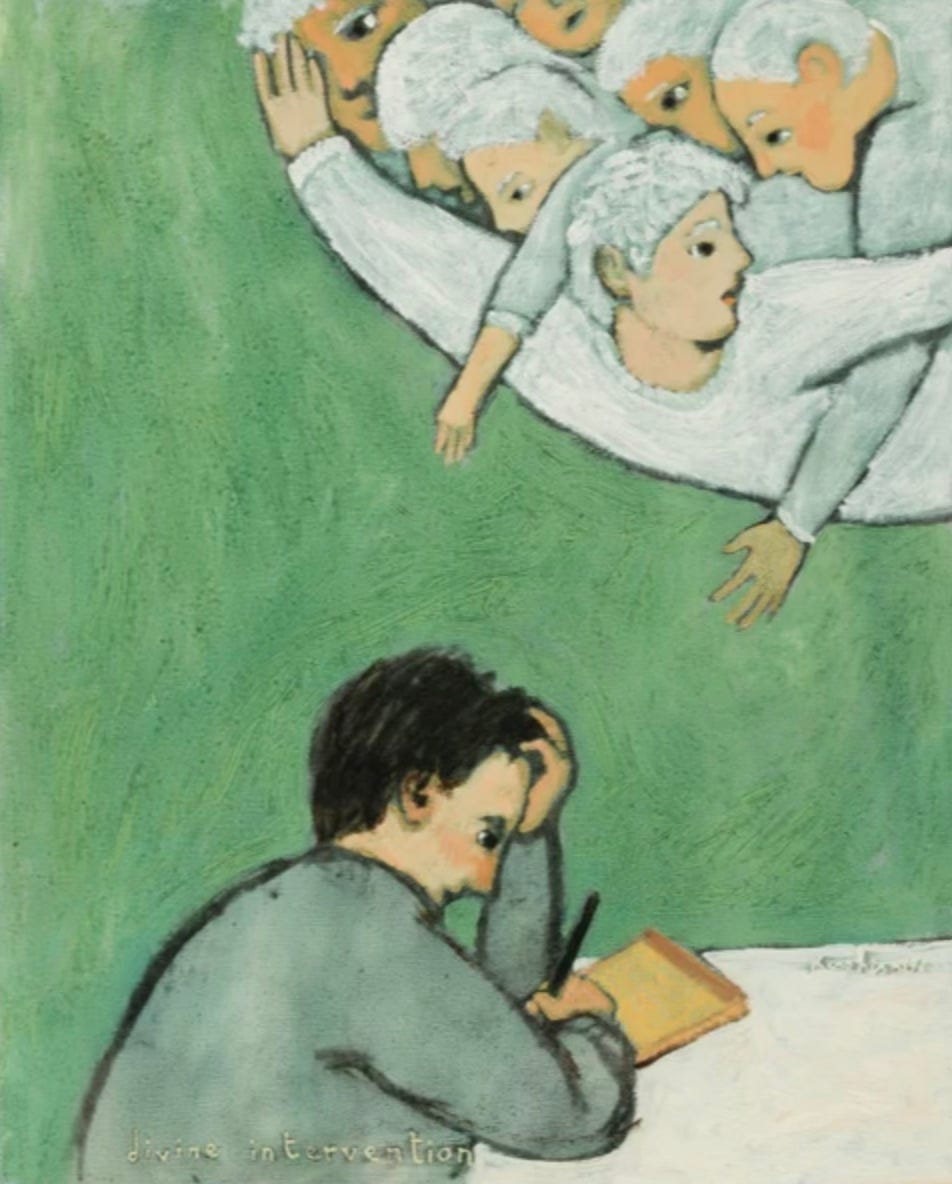
In my office, I have a print of a Brian Kershisnik painting entitled “Divine Intervention.” Pictured is a man struggling to write something on a piece of paper. What the man is writing is not depicted—it could be an essay, a letter, or perhaps even a math problem. Above him, several angels are rushing to his aid, but a single angel holds back the heavenly throng. Perhaps the man will be left to struggle on his own for a while. Perhaps an angel will break through just long enough to convey an inspired thought that will nudge the man just a bit further along.
Seeing this painting for the first time reminded me of an experience I had as an undergraduate mathematics student. My graduate student advisor in the research group I had recently joined gave me a small problem to tackle. We had been studying a certain class of symmetry groups defined algebraically over polynomials. My task was to investigate a proposed geometric description of these symmetry groups, which perhaps would help the research team better understand the more difficult mathematics that relied on them. I was to see if the geometric group description was isomorphic to our algebraic one—not equal, but essentially the same in all mathematical respects.
As I worked with my problem for several months, I came up with many ideas and a few partial results. My advisor suggested some possible approaches, and I spent time reading up on background theory that had some potential to help with my research. But time and time again, I had no luck.
Then one day, as I had my notes spread out on the table in front of me in the university library, I fixed on the mathematical definition of the polynomial symmetry group. I had spent many hours staring at this equation previously, but this time as I stared at my notebook a very distinct idea flashed through my mind: “Erase the A and write S instead!”
These letters represented two different matrices of numbers that I had defined previously. Substituting one for the other in my equation created a brand-new mathematical object, and at first I had no clue what to do with it. But as I continued to work on my problem in the subsequent weeks, I soon realized that this was the missing link to my puzzle—a mathematical object that bridged the gap between the algebraic and geometric symmetry group descriptions that I was trying to reconcile.
As soon as it happened, I knew that my mathematical inspiration did not originate with me. I attributed this idea to God, who took pity on my meager efforts and, perhaps through an angelic messenger, provided me with just enough information to push my project along.
Now imagine that instead of laboring intensely over my problem and praying for guidance, I had focused my efforts on crafting a carefully-worded prompt about my research question which I then fed into a large language model (LLM) AI system. Then imagine that, after a few minutes of “reasoning,” the AI system responded with the same mathematical object mentioned previously and offered me step-by-step instructions on how to use it to resolve my question. In this hypothetical scenario, I glance through the AI output, look up a few definitions, and do a few calculations. I have a solution to my problem, and though it was not one that I had come up with myself, I still bring it back to my advisor at our next meeting and we discuss next steps for our project. The mathematical progress is the same as what had actually transpired—with the benefit of being much more time-efficient. But what did I miss out on? The chance to struggle with a difficult math problem and the chance to experience God through the process.
Until very recently, this reimagining of my experience would have seemed absurd. Research-level mathematics has been out of reach of even the most powerful AI models for quite some time. In August 2025, for example, OpenAI released GPT-5 with the claims that it had “PhD level“ intelligence. OpenAI researcher Sébastien Bubeck quickly made several claims that GPT-5 was capable of generating new mathematics, but had to walk back the comments after being shown that the “new” AI results were actually plagiarized from previously published papers (see examples here and here).
However, researchers continued to develop more powerful AI models. In May 2026, OpenAI announced a startling improvement in mathematical ability in one of its latest models, and this time it had the receipts. In response to a single prompt about whether or not an open conjecture in discrete geometry was true, an AI system independently “reasoned” through the problem and found a counterexample to disprove the original statement (many mathematicians had thought the conjecture to be true). No additional guidance was given beyond the original prompt. No additional work needed to be done to complete the AI proof, though mathematicians later reviewed and refined the result.
Though this is only the first instance of an AI independently generating a novel proof, and one that primarily synthesizes ideas from disparate areas of mathematics rather than developing entirely new mathematical machinery, it raises many questions about what the future of research mathematics will look like and the role humans will play in it.1 Math focuses on discovering true statements that can be derived from sets of commonly accepted axioms using logically rigorous proofs. In many cases, math is useful for developing new technology and helping us better understand our world. However, unlike other creative fields such as art, music, and literature, there is not likely to be a strong demand for human-made mathematics as AI systems improve.
There are compelling arguments for keeping mathematics human-centered, with humans deciding which research questions to pursue, and humans having the final say on the validity of mathematical proofs. Especially with the potential growth in AI’s mathematical ability in the coming years to both generate and validate mathematical proofs, we must continue to champion human efforts to work through difficult problems so that we may better appreciate our accomplishments, wonder at the beauty of creation, and even encounter the divine along the way.
I am not alone in claiming spiritual aid to establish a mathematical result. Georg Cantor, a Russian and German mathematician famous for being the first to show that infinite sets could have varying sizes—that some infinities are “larger” than others—saw himself as a messenger sent from God to communicate new mathematical ideas and even claimed to receive divine assurances of the truth of his work.2
Similarly, in the early 20th century, Indian-born Srinivasa Ramanujan filled his notebooks with dense equations that were sometimes difficult even for fellow mathematicians to unravel. According to some sources, Ramanujan claimed to occasionally have dreams where he would be shown new formulas; upon waking he would write them down. “An equation for me has no meaning unless it expresses a thought of God,” he said.3 More recently even the agnostic Andrew Wiles, famous for proving Fermat’s 300-year-old “last theorem,” described the moment that he discovered the final piece that connected his proof puzzle together as a “revelation.”
But for each of these mathematicians, simply laying claim to inspiration was not sufficient to establish their results. Their work could only be accepted after being scrutinized and vetted by the broader mathematical community, which often required additional effort beyond their epiphanies.
Though Wiles might not describe his breakthrough moment as spiritual in nature, it is clear that it was only possible due to his persistence, and meaningful because of the vast amount of effort he put in to get there. Andrew Wiles spent seven years working alone on Fermat’s last theorem. After he finally presented his proof, reviewers found an irreconcilable gap in his logic. Wiles spent another year on the problem, worked with some collaborators, and finally had his moment of revelation that tied his proof back together. Initial ideas that Wiles had toyed with but set aside previously now came back to fill the gap.4
Due to his unconventional training, many of Ramanujan’s formulas were missing the accompanying proofs needed for full mathematical rigor. Proving these equations kept him and his collaborators busy during his lifetime, as well as many others long after Ramanujan had died. Some of Ramanujan’s equations, along with later work building on his results, eventually enabled Andrew Wiles to finish his own proof of Fermat’s last theorem. The divine inspiration that Ramanujan claimed only opened the door to further research, instead of settling problems once and for all.5
Cantor’s case is more complicated. For a paper early in his mathematics career, Cantor worked to determine the number of elements in two different sets: the set of algebraic numbers, and an interval on a real number line. He tried to show that the algebraic numbers were countable (able to be completely labeled by positive integers), and that the amount of numbers inside an interval on the number line was uncountable (that any labeling by positive integers would necessarily leave some numbers out). Cantor ran into some small issues though: His proof for the algebraic numbers was flawed, and his proof for the real interval was overly complicated. His collaborator, Richard Dedekind, provided a correct proof for the algebraic numbers and a simplified proof for the real interval. But instead of acknowledging Dedekind’s assistance, Cantor decided to publish these proofs under his own name and remove all traces in the proofs that would point back to Dedekind. Despite having felt called by God to champion this mathematical work, Cantor’s proofs were incomplete. Instead of continuing to work to resolve these problems, Cantor took the easy way out and claimed credit for something he did not produce.6
Interestingly, Cantor’s plagiarism did not tarnish his mathematical career. Dedekind kept silent about the slight, though he ceased corresponding with Cantor for a few years afterward. And due to pressure from Leopold Kronecker, Cantor eventually revised his uncountability proof, creating his famous diagonalization argument that is a staple in undergraduate mathematics and computer science curricula.
But for many budding scholars, taking easy-to-get answers to hard problems without putting in the effort to resolve them could stunt both academic and spiritual growth. This is especially tempting in a time of readily available AI results, which can diminish creativity and critical thinking skills.7 As Melissa Inouye puts it, “Our Heavenly Parents have given us the opportunity to struggle mightily with life’s puzzles, thereby exercising our divine capacity. We reason and rage. We stumble, and correct course. We learn to be unshaken. We learn to bend.” It is through the struggle to solve difficult problems that we learn, grow, and encounter the divine.
I firmly believe that the study of mathematics affords ample opportunity for this type of growth. I resonate with Henry Eyring, who once reminisced about his own efforts to study mathematics as an undergraduate. He candidly admitted that as a student, “I felt overwhelmed. I began to feel that I was trying to learn something that was beyond me. The more I felt overwhelmed, the less I felt the strength to keep trying.” Because of how much he struggled, he turned to God for help. He recalled that, “As I prayed, I felt the quiet assurance of the Lord. I felt Him say to my mind, ‘I am proving you, but I am also with you.’” Henry Eyring’s divine assurance came precisely because his subject was difficult to master, and because he was putting in the effort to master it.
Does working with AI necessarily mean that we are not communing with God? Must we reject technological advancement that makes research too easy, shouting with Captain Kirk, “I need my pain”? I do not think that these paths to knowledge are mutually exclusive. Latter-day Saints have had a long tradition of embracing truth from whatever source it comes.8 Mathematician Thomas Bloom also positively notes that “AI is helping us to more fully explore the cathedral of mathematics we have built over the centuries.” But as we work together with machines to develop new knowledge, we should remember to keep God in the loop not only to guide us to important insights but also to help us appreciate what it is we are accomplishing.
Ultimately, in the age of AI, the quest to develop new mathematics should be celebrated as well as the final results. In Virginia Woolf’s novel To the Lighthouse, a character named Mr. Ramsey takes a moment to reflect on his academic achievements. Laying out his accomplishments along the alphabet as a spectrum, he notes that he had “reached Q. Very few people in the whole of England ever reach Q.” But he agonizes over the fact that “he [was] stuck at Q. . . . He would never reach R.” Mr. Ramsey tries to comfort himself by saying that only one person in a generation would ever reach the letter Z. “Is he to be blamed then if he is not that one? Provided he has toiled honestly, given to the best of his power, and till he has no more left to give?”
While cold comfort for Mr. Ramsey, I believe that we must embrace our human struggle to solve problems and create new knowledge. For it is often through that very struggle that we arrive at sacred solutions and thereby encounter God.
Nathan Cordner is an assistant professor of computer science at Utah Valley University.
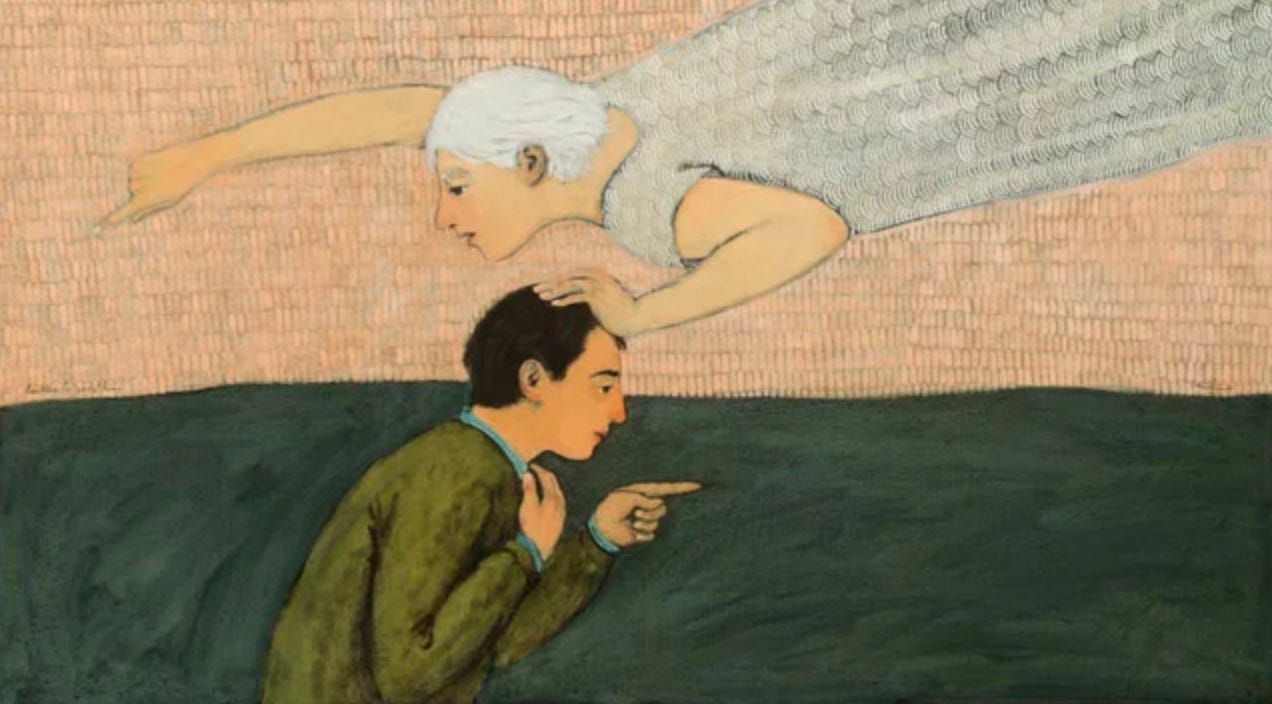
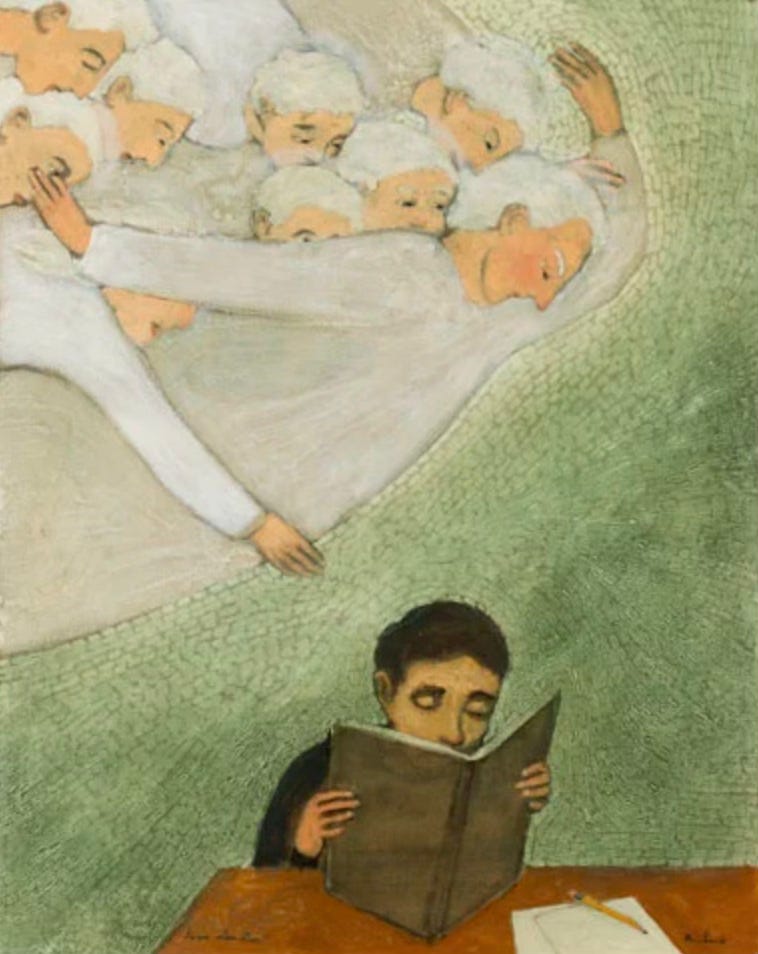
Art by Brian Kershisnik (@briankershisnik).
A previous AI-assisted proof was completed in March 2026, but the researchers continued to give feedback to the AI beyond the initial prompt and wrote their own proof based on the ideas generated by AI.
For further context for Cantor’s claims to divine communication, see Joseph Dauben, “Georg Cantor and the Battle for Transfinite Set Theory” (1993), Proceedings of the 9th ACMS Conference (Westmont College, Santa Barbara, Calif., 2004).
Ramanujan’s dream is quoted in Belal E. Baaquie and Frederick H. Willeboordse, Exploring Integrated Science (CRC Press, 2009), 38. Ramanujan’s equation quote is given in Gregory Chaitin, “Less Proof, More Truth,” New Scientist 195, no. 2614 (2007): 49, https://doi.org/10.1016/S0262-4079(07)61908-3.
Simon Singh’s Fermat’s Enigma or the BBC Horizon documentary “Fermat’s Last Theorem” both offer good overviews on Wiles’s work.
For example, in 1916 Ramanujan created his tau function, proved some properties about it, and conjectured another. Ramanujan’s conjecture was not proven until 1974 by Pierre Deligne. The Bhavana article “TIFR and a conjecture of Jean-Pierre Serre” offers a good discussion about how these results tie into Fermat’s last theorem.
An overview of Cantor’s plagiarism and some recent research into Cantor and Dedekind’s correspondence is highlighted in Quanta, “The Man Who Stole Infinity.”
For example, a preliminary study by MIT showed significant cognitive decline across several tasks like essay writing for chronic LLM users.
For example, Brigham Young once proclaimed, “I want to say to my friends that we believe in all good. If you can find a truth in heaven, earth or hell, it belongs to our doctrine. We believe it; it is ours; we claim it.”
