


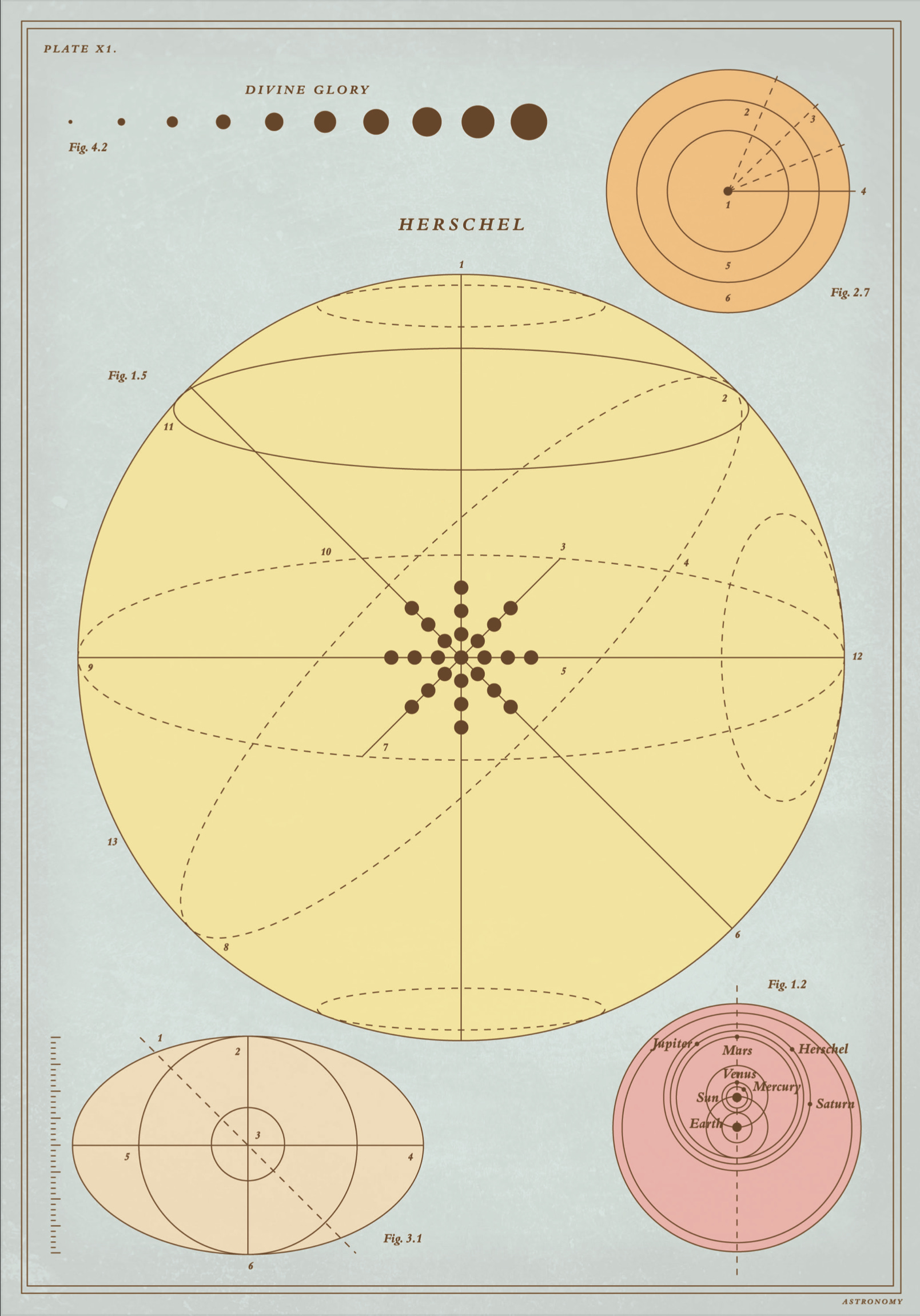
In 1823, the philosopher scientist Thomas Dick complained that he heard many preachers say from the pulpit, “There never was, nor ever will be, through all the ages of eternity so wonderful a display of the Divine glory, as in the cross of Christ.” Dick, though a fervent evangelical, dismisses the seemingly innocuous Christian verbiage as
nothing more than a presumptuous assumption, which has a tendency to limit the perfections of Deity. . . . It takes for granted, that we know all the events which have already happened, and which are now taking place throughout the whole range of God’s Universal Empire. This empire appears unbounded; and that portion of it which we can minutely explore, is but as a point in comparison of the whole. But before we can, on good grounds, hazard such an assertion as that under consideration, we must have explored all the dispensations of God, through every portion of his vast dominions; and be able to form a comparison between the different displays of Divine glory, made to all the different classes of intellectual beings, under the government of the Creator.
How can we “set limits to the operations of [the] Almighty”?
Dick’s American editor could not resist interpolating into a footnote his shock and indignation at Dick’s criticism. The guardians of orthodoxy frequently feel alarm at what they suppose are fragile veneers safeguarding divine dignity. Dick’s words, of course, were meant to untether God’s love from any conceptual limitations—religious or cosmological.
An unexpected justification for Dick’s dangerous lack of theological decorum is suggested by the book’s frontispiece, 350 pages earlier. The illustration may be a little disconcerting to modern readers. It is a partial depiction of the solar system, which compares heavenly bodies of differing sizes, specifically “the planets Herschel, Saturn, Jupiter, the Earth and Moon.” The date of the edition: 1833.
The explanation for that mysterious first planet in the list begins a few years earlier: In 1789, as revolutionaries in France were reshaping the political order, the leading astronomer of the age, William Herschel, was shifting the cosmic paradigm. In 1781, for the first time in two thousand years, he had identified a new planet in the heavens. It would not definitively receive its modern name (Uranus) for another seventy years. In the interim, it was known by the name of its discoverer—hence Dick’s identification of the planet as “Herschel.” Such, presumably, would have been the name by which Joseph Smith knew a planet discovered only a few decades before his birth.
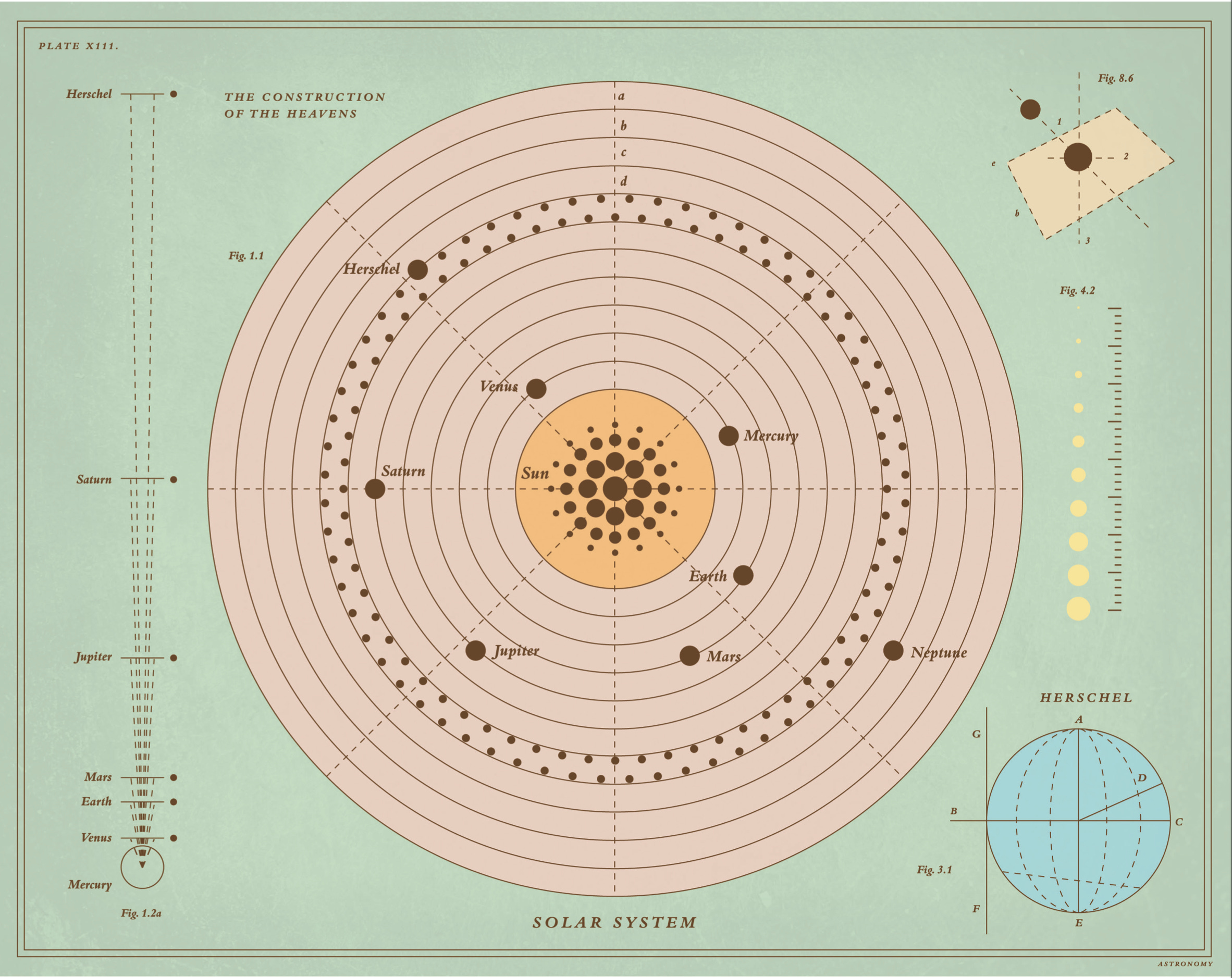
Expanding the solar system for the first time since human eyes turned heavenward would have been momentous enough. However, Herschel’s paper on “The Construction of the Heavens,” published by the Royal Society in 1785, effected a change in the Western world’s cosmological model more dramatic than simple expansion or even than Copernicus’s replacement of an earth-centered system by a heliocentric one. For generations of thinkers, God’s supreme perfections had seemed to suggest that the universe he created was flawless and complete when he laid down his celestial instruments. When God pronounced his labors good and rested from his efforts, the perfectly ordered cosmos had naught to do but hum along in sublime harmony until the end of time.

At first, Herschel’s astronomical observations through his telescopes of unprecedented power and precision only confirmed the infinitude of God’s domain, revealing star systems beyond star systems in unending procession. But Herschel quickly perceived that he was observing a universe in a process of continual disruption, upheaval, and transformation on a colossal scale. He described “extensive combinations,” stars in process of “condensation,” others in retreat or in collision. “When, at the same time that a cluster of stars is forming in one part of space, there may be another collecting in a different, but perhaps not far distant quarter, which may occasion a mutual approach towards their common center of gravity. . . . As a natural consequence of the former cases, there will be formed great cavities or vacancies by the retreat of the stars towards the various centers which attract them.” The whole was a scene of such violent contestation that he admitted surprise that the entirety did not “tend to a general destruction, by the shock of one star’s falling upon another.” Indeed, as one writer has summarized the import of Herschel’s shocking discovery, he “completely overturned any residual idea of a stable, overarching, temple-like universe, created once and for all by the great Celestial Architect” and replaced it with a dynamic cosmos of waxing and waning worlds, “fluid movements and changes.”
Becoming versus Being, Process versus Perfection, Creation, Time, and Eternity—on diverse interpretations of such principles hang theologies, cosmologies, and philosophical systems. Five years after Herschel’s essay, William Blake gave the new age its mantra when he wrote that “without contraries is no progression.” The long nineteenth century would see Herschel’s claims and Blake’s assertion elaborated across the entire span of intellectual achievement. The Great Chain of Being, an unchallenged paradigm of a static, orderly, and harmonious universe, was buried beneath the emergent model of chaos, flux, radical transformation, and conflict. Thomas Malthus wrote in 1798 that human populations and natural resources were in perpetual collision, resulting in a planetary legacy of famine, disease, and calamity. G. W. F. Hegel made the violent confrontation of a thesis with its antithesis the interpretive key to human history. Marx made matter rather than spirit the foundational principle and transformed Hegel’s dialectic into the most influential political theory of succeeding generations. Darwin rewrote the human understanding of the natural world and God’s place in it by accounting for the diversity and splendor of all creation in terms of unremitting competition within and between species.
If there was one prevailing sense in which Joseph Smith refracted the greatest intellectual revolution since the Renaissance, it was in the avidity with which he translated this Romantic paradigm of agon and contestation and celestial boundlessness into a new conception of the prophetic vocation. Iain McGilchrist—correctly, I believe—interprets Romanticism with eloquent concision as a protest against the fixity, the closure, the static dominion of left-brain thinking that culminated (temporarily) in Enlightenment thought; in sum, Romanticism defiantly asserted the human soul’s irrepressible and infinite “longing” rather than “wanting.” At our best, we feel ourselves drawn toward rather than impelled from behind—“the first has a clear view of its target.” The second, not so much. Longing entails openness to new ways of imagining and requires new ways of encoding future possibilities. Romantic poets like Goethe were continually striving to “break out of the otherwise unbreachable defenses of our conceptual systems.”
Joseph expressed this impulse, counter-culturally, as a religious hostility to creeds (“the very mainspring of all corruption” [D&C 123:7]). “It felt so good not to be trammeled,” he once remarked, and he lived and prophesied with Blakean abandon. No wonder, notes E. Brooks Holifield, that Joseph Smith’s theological innovations lead to “realms of doctrine unimagined in traditional Christian theology.”
The lava flows and cools, charisma gets routinized, correlation channels, and bureaucracy tames the roiling waters. Yet John’s words hover above all the domesticating levees: the spirit, like the wind, blows where it blows, and we can’t map or chart its course (3:8). “Mormonism,” writes Thomas Cahill, “could yield no intellectual system to nourish a great intellect.” His facile condescension aside, he may be right. We might take his words as the inadvertent compliment Joseph would have inferred. Mormonism yields no “system.” This was precisely why Mormonism could rupture the bounds of creedal orthodoxy with such invigorating possibilities. It is hostile in principle to presume to know what the universe will look like from the next horizon. That was the very spirit that animated Thomas Dick and so alarmed his American editor. Romanticism—like Mormonism—anticipated to a remarkable degree the course of modern physics and biology alike: Process has replaced “thingness,” relationship trumps essence, “all things flow,” as John Dupré and Daniel Nicholson insist. Systems and mappings fail in principle, not execution.
Saints are obsessive about our history—with good reasons. A debt to the dead and scriptural injunctions and an inspiring heritage give more than ample warrant. The indispensability to Zion-building of art, literature, music, and speculative theology is more subtle and therefore more subject to collective amnesia and suspicion in our religious culture. History chronicles the past, but imagination is revelatory of possible futures. So many of Joseph Smith’s pronouncements echoed William Blake that one cannot doubt a kindred spirit, if not influence. “I know of no other Christianity,” wrote Blake, “and of no other Gospel than the liberty both of body and mind to exercise the Divine Arts of Imagination: Imagination, the real & eternal world of which this vegetable universe is but a faint shadow.” Precisely.
Terryl Givens is Senior Research Fellow at the Maxwell Institute and author and coauthor of many books, including Wrestling the Angels and The God Who Weeps.
Art by Brent Croxton.
This essay appeared in Wayfare issue 6.
Interesante su construcción narrativa. D.C insiste en proponer a Dios(entre otras sugerencias lingüísticas gramaticales) Como un giro perpetuo…de ahí la necesidad del logos sobre la toma en un cristal de “petri”. Gracias por su reflexión.