


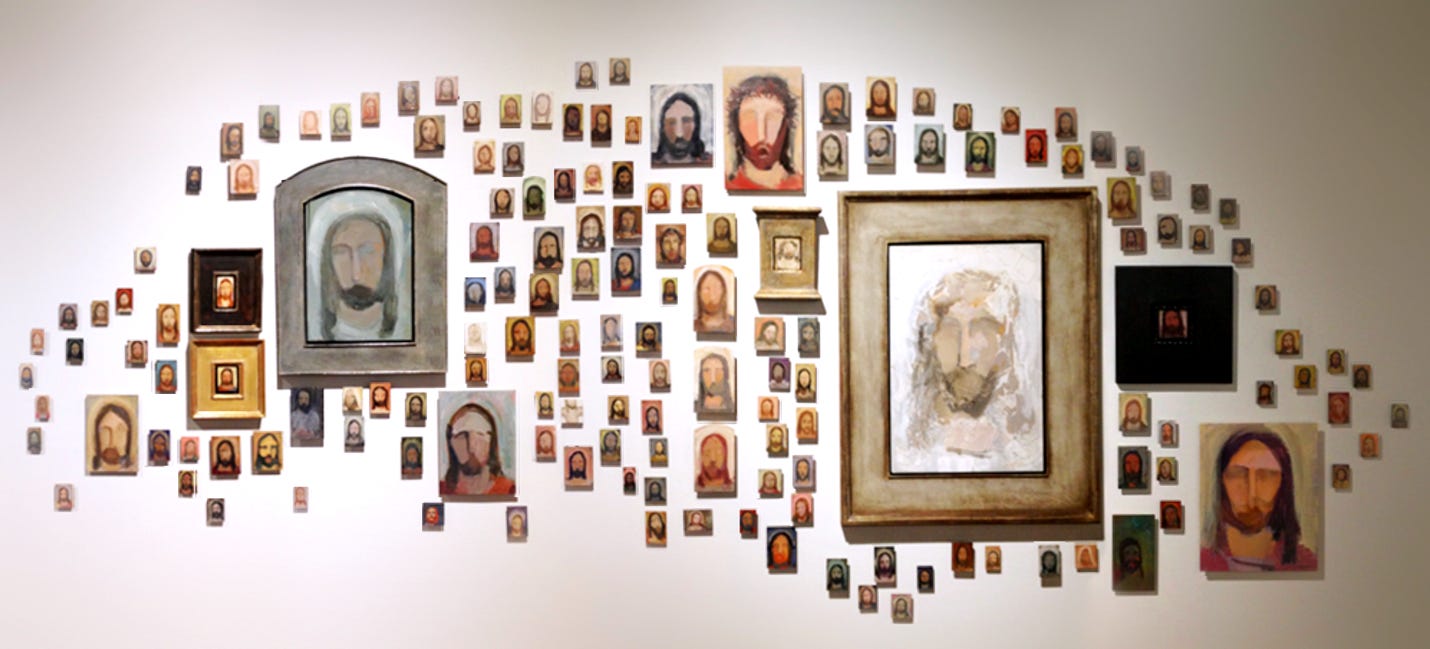
J. Kirk Richards’s Untitled (Cristo Series) asks a lot of the viewer. The title itself feels like an unfinished sentence—an ellipsis instead of a period. Precisely because of their apparent incomplete state, the dozens of paintings of Christ in varying hues and sizes compel the viewer to enter a relationship with the artwork. In this way, the series suggests a work in progress, a theology in motion—the gallery version of continuing revelation.
Taking in the multitude of blurry paintings of a vague visage of Christ becomes a two-way promise where each side offers something to fulfill the pact. Like the covenant and work-based theology of Mormonism, we are asked to use our own faith (imagination) to fill in the details, to make it come to life through participation. And all this while we are realizing (through art!) that our conceptions of the Lord are necessarily small, inadequate, and flawed, in the very best sense. The series’ images don’t just reflect Christ; they reflect us reflecting on Christ and our inability to fully frame or grasp his glory.
This is visual theology rooted in Latter-day Saint sensibilities: Christ-centered, but not in the most expected ways. Are Mormons Christians? Yes!...Yes? Well, it depends on what you mean. Richards’ Cristo Series leans into that ambiguity.
Untitled tells us, “find him here. Complete your side of this relationship.” That relationship—between viewer and image, mortal and divine—is everything in Mormonism. Grace and agency. The images are unfinished, and so are we. But relationships and care can complete us.
While Mormon to their core, the images are also outliers, because they are not the kind of realism one might expect in Mormon visual culture. There have long been a few “sanctioned” representations of Christ in Latter-day Saint culture and curriculum, even classrooms (but not chapels). And images of Christ have been integrated directly into the temple experience. But growing up in the church, the visual theology for me often meant more work in trying to find Christ in the already sparse use of art in the day-to-day experience of Latter-day Saint life.
I tried to find Christ in gold flourishes: the leafing on the Hymnal’s title, my name engraved on my scriptures, or even the Angel Moroni’s gilded skin atop the temple. I tried to find Christ in the surprisingly muscular arms of Friberg’s Book of Mormon prophets. I tried to find Christ in MormonAds and CTR rings that adorned our walls and fingers. Or even in the boxy suits, white shirts, flower dresses, carpeted walls, wooden pulpits, and plastic cups. Sometimes I found him in these. Often, I didn’t.
This is why I choose Richard’s Untitled (Cristo Series) to represent the visual theology of Mormonism. It feels profound, because it doesn’t just hand you Christ. It makes you metaphorically reach out your hand to Christ to look for him and elevates you in the process. In this way, it mirrors the Latter-day Saint path of covenant transformation. Working to see Christ through making covenants and living up to them—to become a new creature—is the faith. Art that compels us to reflect on this kind of becoming, “after all we can do” captures the heartbeat of Mormon theology and its expansive emphasis on progression. You don’t just believe in Christ. You try to become like Him, even when the image seems blurry.
Mason Kamana Allred is an associate professor of communication, media, and culture at Brigham Young University–Hawaii. He earned his MA and PhD from the University of California, Berkeley in German history and culture with an emphasis on film and media studies.
Art by J. Kirk Richards
