


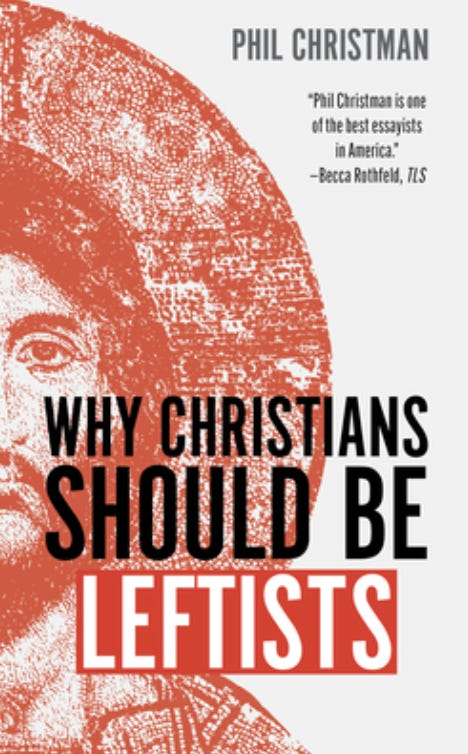
Phil Christman, a writer and lecturer at the University of Michigan, is a committed Protestant Christian. He grew up attending a fundamentalist church which embraced a strict Calvinist theology, and although he shared that perspective, he struggled with and eventually rejected it. His rejection of the Calvinist approach to Christianity didn’t lead him to renounce his faith; instead, his faith evolved, and with that spiritual evolution came a political one as well. In the excellent Why Christians Should be Leftists, he explores and affirms that evolution and calls other Christians to join him. Most probably won’t, but that takes nothing away, I think, from his powerful testimony. Here, as a literal card-carrying leftist (assuming my monthly dues to the Democratic Socialists of America are up to date), as well as a believing LDS Christian, I want to explain why.
The fact that Christman’s book is best understood as a testimony is something that Steven Smith observed in his review of the book in Wayfare last December. Smith acknowledged that he doesn’t share Christman’s political convictions (at least not all of them), and also that he isn’t a fan of testifying when it comes to complex political topics, which he characterized as providing “soft or simplistic reasons . . . in defense of a prior inspiration.” But he also admitted that “it would be a mistake just to dismiss such testimonies.” Sharing convictions that come to us through spiritual inspiration rather than argument is, Smith thought, a major part of what allows us to realize attachments across all sorts of boundaries; by respecting the idea that God’s grace may work in ways unknown or disagreeable to us, we are better able to apprehend “the imago dei that makes you and me and everyone else intrinsically worthy of love and respect.”
I’m sure that Smith must have chosen that formulation intentionally, because it parallels exactly the spiritual conviction which grounds Christman’s account of his own political evolution. In his account, Christman was a college student attending a Calvinist university, feeling lonely, confused, and frustrated—he was, in his own words, an “ungirlfriended loser” (8). One day he was reading from the Bible outdoors with a group of similar losers—at least compared, in his mind at the time, to the other groups of students playing guitar, smoking, or flirting all around him—and as they worked through Jesus’s Sermon on the Mount from the Book of Matthew, he found himself thinking about everyone around him quite differently:
I suddenly saw the glory of God shining out of their faces. . . . Each of these people was a subject that a person could love, and was capable of giving love to others, and was therefore infinitely precious and infinitely interesting. That whole economy of losers and winners, with its implied scarcity of worthiness, had disappeared. Or not disappeared but receded: it didn’t seem inevitable or fully real anymore. It seemed like a lie that needed to be undone by the constant practice of universal, constant, and unvarying love. (8–9)
From this point on, step by step, the idea that the Christian message of God’s grace, forgiveness, and love entails an absolute, universal equality of persons unfolded in Christman’s life and thought. “Part of the point of being a Christian,” he writes, “is that you’re supposed to unlearn the human instinct to circle the wagons, identify the outsiders, prioritize the in-group,” and instead develop “the deep conviction that every stranger, every enemy, is a neighbor” (30–31). And he concludes that since the structure of capitalism depends upon the private or corporate accumulation of profit and property—and thus functionally excludes others from possession of such wealth—that means that Christians must move beyond capitalism, even liberal versions of it. Similarly, Christman concludes that since the structure of national borders depends upon territorial claims to sovereignty—and thus excludes others from the systems of law and care which sovereign governments establish—that means that Christians have to move beyond borders too, even democratic versions of them. The universalizing, the absolute neighboring, of the resources of the world and the people who live within it is the socialism that Christman comes to believe the plain teachings of Jesus require.
Smith would say that, admirable as the lessons which Christman drew from his spiritual insight may be, things are not actually that simple. I disagree with Smith on this point—but not because I think it is that simple, or because I think Christman’s testimony actually amounts to a complex argument. Rather, it’s because Christman’s spiritual insight parallels socialist arguments that I find persuasive. The fact that many socialists are instinctively dubious of religious testimonies is as unfortunate as the fact that many Christians cannot see parallels to socialist insights in their own scriptures and revelations (and, insofar as the LDS Church goes, even our own history). But such facts don’t change, I think, the undisputable leftist reality of the Christian teachings in question: namely, that Jesus’s message of love, forgiveness, and redemption is antithetical to any human-built system that results in humans experiencing division, discrimination, or deprivation. Jesus’s call was one of abundance; it is “to go and be generous,” and to trust in God to enable us to transcend “the urge to fear our own capacity for generosity” (38–39). Martin Luther King, Jr., a confessed democratic socialist, called the goal of the Christian message “the beloved community”; his invocation of Christian hope was hardly the same as Karl Marx’s prediction of universal communist revolution, but the shared sympathies between these two leftist visions are strong enough that Christman—at least once his eyes had been opened on a college campus long ago—cannot avoid them, and he doesn’t want us to avoid them either.
Admittedly, the way Christman talks about “leftism”—which he refuses to capitalize, stating in an early footnote that he thinks the term describes an “overall direction” and not a destination “where a person can definitively arrive” (16)—might initially seem incompatible with leftist economic arguments. Rather than starting out by defining terms and unfolding a discourse premised on the materialist language that has defined so much of post-Marxist leftism over the past two centuries, Christman’s reflections are rooted in a grab-bag of deeply religious, even Biblical, concepts and a concern that every believing Christian, in one way or another, confronts. Nonetheless, his testimony of leftism, when seen as an argument, connects.
It might seem that the main obstacle to that connection is Marx himself, who would have had all sorts of problems with Christman’s account. Marx’s deep contempt for Christian socialism, which he called “the holy water with which the priest consecrates the heart-burnings of the aristocrat,” made his perspective fairly clear: socialism is something that must be built historically, structurally, materially—that is, scientifically—and not something that emerges from the guilty feelings or inspired insights of religious believers. His perspective is certainly at least partly responsible for the hostility to religion widely associated with the left over the centuries.
But as anyone who spends any time amongst actual leftists can tell you, this incompatibility between leftism and religion is a perspective that 1) was obviously wrong from the beginning and has remained so over the years, and 2) has been basically ignored by tens of millions of leftist religious believers over the same period of time, Christians most certainly included. In regards to point 1, the revolutionary force which Marx’s analysis of the history of capitalism provided—whatever its usefulness and insight insofar as understanding the alienation experienced under industrialization is concerned—has been questioned, denounced, and re-interpreted and re-affirmed in different ways that gave shape to every socialist argument since the mid-nineteenth century on; to stick resolutely to a plain linkage between an opposition to capitalism and therefore an opposition to religious faith is to do as much damage to the heritage of that argument as is done by non-leftists who insist that the egalitarian and communitarian demands of “socialism” can only ever mean the tyranny of Stalin or Mao. And in regards to point 2, the fact that Christian socialists—the Methodists who helped form the British Labor Party, the Catholics who organized the Catholic Worker Movement, and hundreds of other examples—have, sometimes out of necessity and sometimes out of genuine intellectual agreement, appropriated and articulated their views in manners borrowed from Marx (talking about “class struggle,” for example) hardly means that their socialism is therefore Marxist, and necessarily carries all of its materialist, historicist, anti-religious baggage.
This is especially the case for believers in the words of Jesus as presented in the New Testament, since of course those words immediately inspired believers to—as recounted in the Book of Acts, chapter 4—sell their goods, distribute them equally, and have all things in common, right from the beginning. (For members of the LDS Church there are additional examples, such as the Book of Mormon story in the book of 4 Nephi of a people who, after a visitation by the resurrected Christ, built a Zion where all things were held in common, such that divisions between rich and poor disappeared.) So when it comes to socialism, one might suggest that Marx himself was a late contributor to a long-standing Christian tradition, and as important (for both good and ill) as Marx’s contributions were, the left has no reason to feel more beholden to him than to religious socialists like Leo Tolstoy, Eugene Debs, Keir Hardie, Beatrice Webb, or Dorothy Day (and maybe even Hugh Nibley too).
Christman, for his part, suggests treating Marx’s thought “as we’d treat a buffet: you pick the stuff you think is helpful and ignore the rest, the same as you would any other economist or political theorist” (144–145). For people whose approach to these matters is grounded in historical and theoretical arguments over ideology and the intellectual trajectories of particular individuals, this is a pretty frustrating approach. Partly because it gets stuff wrong, as Christman does on occasion. (For example, at one point he goes much too far in condemning the liberalism of John Locke as incapable of responding to the threats of capitalism, forgetting that Locke himself wrote that the rights of property-owners oblige them to make sure that “enough, and as good” will always be available to everyone else (70).) But more importantly, I think, because opponents of this testimony-led approach will insist that these are, by necessity, political debates that we are having, and as such being guided by one’s revelatory experience with the Sermon on the Mount leaves much unsaid.
But that doesn’t mean, and shouldn’t mean, that defenses of socialism like Christman’s need to be considered wrong; they aren’t. They just aren’t complete—as I think Christman himself would be quick to acknowledge. Again, his book is a testimony of why the Christian message made it clear to him how he should think about inequality, about war, about borders, about wealth, and thus found himself moving leftward, hand-in-hand with his faith. As someone who wants to be faithful to the truth he came to understand, he does what every actually serious socialist has ever done: think seriously about addressing social and economic inequalities and divisions, and how to address them. In an impressively succinct series of paragraphs, Christman thoughtfully considers all sorts of leftist arrangements which the socialist tradition has inspired reformers and revolutionaries alike to consider over the centuries: worker co-ops, government ownership, wealth funds, and more. Ultimately, he acknowledges that there is plenty of thinking and working yet to be done in pursuing these Christian ends, and that no one is certain of the best means to achieve leftist ends. At one point, he ruefully comments, “I don’t think it pays to get too dug in at this point on any of those systems” (121). But that doesn’t mean that his inspiration has been judged wanting. Rather, it just means that Christman, like any other religious believer whose eyes have been opened to the socialist imperative, is in the same condition as the rest of us Christians: asking for God’s grace as we make our way—experientially, creatively—towards more justice, more fairness, more beloved communities in our world.
It is worth noting that Why Christians Should Be Leftists has been extensively reviewed in Christian publications, including some quite right-leaning ones, and without exception, all these reviews recognize that any proper understanding of Christianity imposes a universalist vision of neighborliness and love upon believers. Consequently, they acknowledge the salience of Christian condemnations of how wealthy citizens and countries police their borders and protect their wealth. Yet they demur from recognizing that such condemnations put them, however partially, on the socialist left. One reason for this—one that Smith explicitly pointed out as a hang-up for himself as well—is the left’s association with sexual freedom. What about personal sin?, they ask. What about moral purity? Of course, the records we have of Jesus’s words suggest that he didn’t talk about sexual morality nearly as much as he talked about sharing your goods with your neighbor, and didn’t condemn personal lifestyles nearly as much as he condemned exploiting the poor. But still, to insist that he never talked about the former isn’t correct either.
So those who want to find reasons to doubt the sincerity of Christman’s Christian faith—and thereby avoid facing up to the leftist insistence upon socio-economic equality and community in the Bible which Christman makes clear—solely on the basis of what he thinks about abortion or homosexuality or any other culture war issue can certainly do so. And sure, when I put on my political scientist hat, I can explain at length how predictable it was that Christman, as he moved away from the Calvinist socialization of his youth, likely came to follow well-established patterns of liberal thought that granted enough importance to individualist expressions of moral choice such that he simply couldn’t take the sexual traditionalism of much of American Christianity seriously. But frankly, as something of a left conservative myself, I am happy that Christman felt no need to warp his testimonial writings so as to defend those aspects of his current political beliefs which actually have nothing to do with the heart of his political evolution. That heart is, simply, a pious conviction that we must apply the Sermon on the Mount—apply a complete abandonment of any kind of distinction between winners and losers—to public life. Compared to that, everything else is secondary, as one of his final reflections makes clear:
The machinery of history is not ours to operate even if we could, which we can’t. But that’s OK, because there isn’t any machinery anyway. There’s the kingdom of God, which God is bringing about and will bring about. We live in a way that anticipates it. We forgive debtors, we hasten to resolve conflicts, we try to love our enemies. We try to build a society where the meek, the peacemaker, the person on the bottom of things is abundantly blessed. Leftism at its best helps us to do that. We are leftists only insofar as it is a name for our doing that. (153–154)
Christman’s last words of testimony are, appropriately, “Even so, come quickly, Lord Jesus” (174). Both the unreconstructed Marxist and the Christian conservative who struggle to accept Jesus’s call to have complete solidarity with the poor, one’s enemies, and everyone else as both a serious and a socialist statement would likely sniff at such a conclusion. But this Christian socialist loved it, and the book itself.
Dr. Russell Arben Fox is a local democracy expert who comments on Kansas politics, edits "Front Porch Republic," and has published widely in academic journals. He lives in Wichita with his wife and four daughters.
Art by Georges Rouault (1871-1958).
