


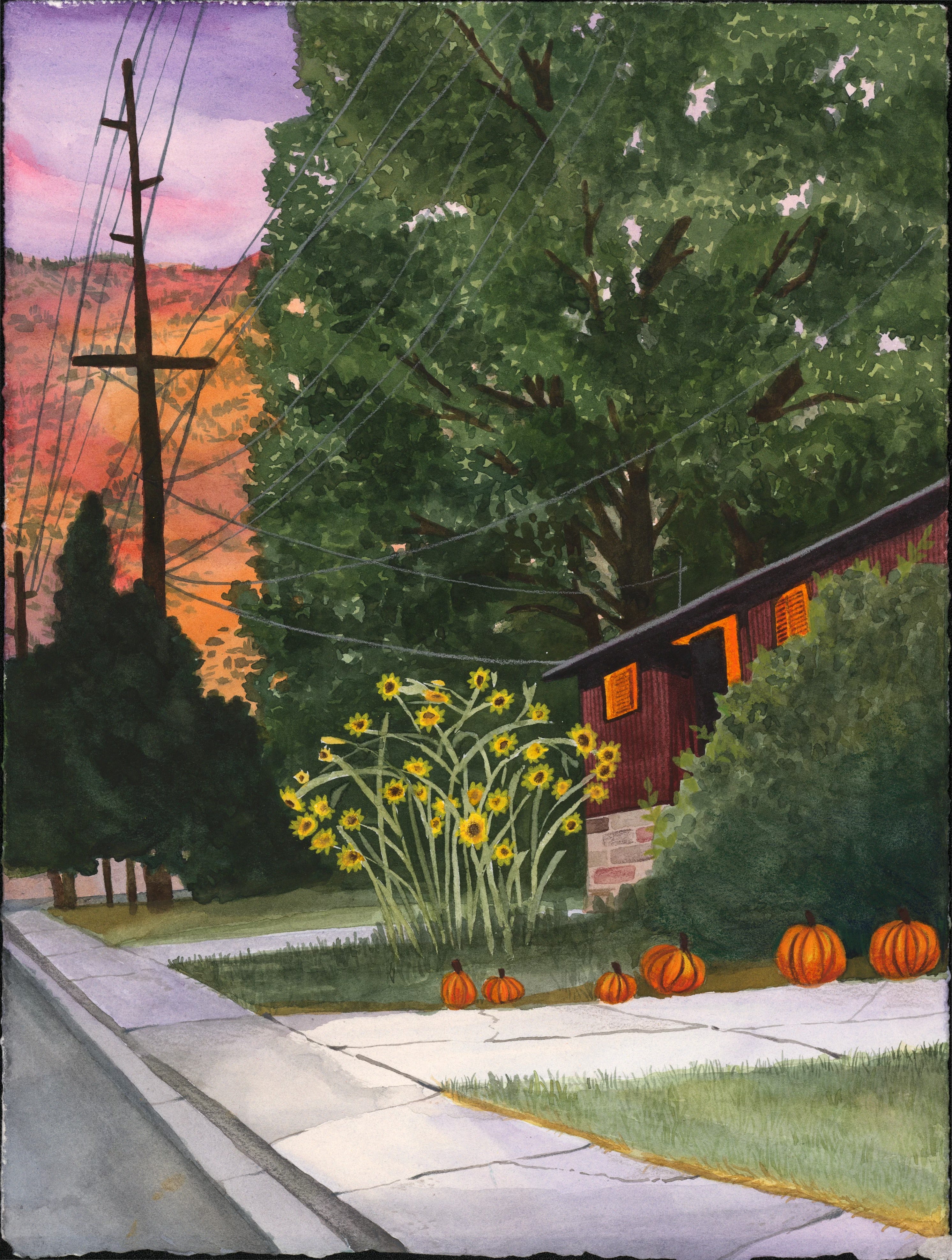
It was Halloween and, once again, I was dressed as a ghost. My costume choices—that year and all the others—were ghost, witch, or clown. Those were the choices my brother and sister had, as well, because those were the costumes my mother had made years before. There was a bin of costumes in the cubby under the stairs, each voluminous enough to accommodate a growing body, and that was that. Take your pick. Have fun. And when you’ve outgrown the costumes, you’ve outgrown Halloween.
In those years and in that place, Halloween wasn’t scary yet, or maybe I was simply too young to know the difference. Halloween was bobbing for apples, painting funny faces on pumpkins, scarecrow-themed art projects at school, and running around the neighborhood after dinner carrying an old pillowcase filled with candy. I liked peanut butter cups the best.
That afternoon, my neighbor friends and I planned our route for trick-or-treating. Krista’s family ate dinner early and mine ate dinner late (we were both having chili and cornbread), and Erin’s family, as usual, had no plan. We decided to meet at seven o’clock—so late!—and go clockwise through the ring of streets surrounding the lake.
After my friends headed home to dress, Mom poured me a glass of milk and said, “Be sure to trick-or-treat at every house. Don’t skip anybody.” I scoffed as only a nine-year-old can. “Mom. Of course we’ll go to every house.”
She looked me in the face and smiled. She’s a kind woman, with dimples like ladles of glee. “Erin or Krista might want to skip the stone house on the corner, but I want you to make sure to ring that doorbell, even if the girls won’t go with you. Alright? Ring that doorbell, and give a big smile to whoever answers the door, and say ‘Happy Halloween!’ with lots of gusto, and chat with them about your costume, okay? Will you do that?”
Mom was right. I thought it was strange that neither of my friends went to the door with me, and I noticed in a peripheral way that nobody else trick-or-treated that house, either. The two men who answered the door were delighted to see me and, while I stood in the lamplight of their porch, asked me about my favorite candy and favorite teacher and favorite book. They introduced me to their dog. They gave me all the candy they had—so much candy!—and thanked me for trick-or-treating at their house, as if doing so had been a much-appreciated favor.
With the grace and good breeding of a nine-year-old lady-in-training, I said, “You’re welcome,” and ran off to the next house, immediately forgetting all about them.
Days later, as I told Mom about the neighbor kids taking their candy to the hospital to be X-rayed, she asked if I’d visited the stone house on the corner. She was glad to hear I’d done as she asked, glad to hear it was a friendly interlude, glad to hear I had set an example to those watching from the sidewalk.
It was the South in the early 1980s. The AIDS crisis was on the news every night, and the community around us made its fearful standards clear. I didn’t understand that, of course; I wouldn’t understand for years to come. All I knew then was that on Halloween, as the moon came out and the air turned crisp—as I wore a silly bedsheet and obeyed my mother—I practiced what Jesus preached.
Hadley Duncan Howard is a writer, editor, and creative. Her work often focuses on themes of identity, family, and faith, with essays published or forthcoming in Under the Gumtree, Dialogue, Exponent II, and elsewhere. Find her online: @notingthebeauty.
Art by Lauren Wood.
Get some more shivers by reading Irreantum’s collection of Halloween fiction, including a short story by Wayfare’s Fiction Editor, Jeanine Bee.
