


When I approached forty, I felt a quiet restlessness.
Not a crisis. Not dissatisfaction, exactly. The life I had crafted fit well enough. I had built something sturdy and meaningful. But something inside had been pressing outward, a low hum asking for more space, more breath. I did not yet know what spaciousness might feel like—or whether I could afford it. I only know that something in me kept tapping from the inside, and I kept finding ways to ignore it.
I see this same stirring in the women around me. My friends, my neighbors, the women I meet in therapy. Their children are older, their marriages shifting, their bodies no longer bending to old demands. Beneath the distress of depression or anxiety whisper questions they have carried silently for years: What is left for me? Who am I now?
Richard Rohr writes that the second half of life is a descent, not a climb. A letting go. No longer proving, no longer performing. A turning inwards towards the self that has been there all along, waiting patiently beneath the scaffolding of roles and expectations.
For me, that call was subtle at first, easy to overlook, like a thread showing through the weave of a larger, familiar pattern. For years I stitched together the scraps of traditional fabrics I had picked up along the way—people pleaser, overachiever, the one who made it look easy—checking the pattern the whole time. Is this how it’s done? Somewhere in all that piecing, my own voice got quiet.
Quilting brought it back.
I learned to quilt as a young mother, in the thin margins of a full life. My first quilts were tidy, traditional, cautious. But over time my hands grew bolder. I began cutting fabric in unexpected shapes, pairing colors that shouldn’t go together, leaving space for improvisation. The quilts began to look like me: less perfect, more alive. The process of quilting became a form of listening, a way to inhabit my own choices, a quiet practice of self-authorship. Life, I realized, is not simply following the patterns we inherit. It is also daring to alter them—to make something messier, something that bears your own fingerprints.
Quilting did not give me a voice so much as return me to one I had once misplaced. There was a year, before all of this, when I nearly lost it entirely.
I was living in Southern California then, newly transplanted, lonely in a landscape of curated Pinterest perfection. Chevron patterns were everywhere—walls, pillows, maxi skirts—and I absorbed the message that beauty meant sameness, that fitting in required smoothing edges. I grew quieter than I’d ever been. I remember standing in a Target aisle getting things for my new home. I stared at rows of identical throw pillows, unable to remember what I liked. I would text my best friend and then erase the message, unsure how to explain that nothing was wrong, exactly—and that made it harder to say anything at all. I complied. I performed. I tried to disappear into prettiness. I had the sense that I was living slightly beside my own life, without the language to understand it. It didn’t last long, but that season sometimes bleeds outwards in my memory, flattening everything that came before it, as though I were always that muted version of myself.
That story is too simple, though. And it is unkind.
The truth is, even then, I was not absent from my own life. I was bending where I could—changing course here, reconsidering there. What looks like silence from a distance is sometimes gestation. What looks like conformity is sometimes survival. We are never just one thing.
This realization has softened me toward my past. Just as every quilt is stitched from what came before—new prints, old shirts, inherited scraps—so too do our lives carry both the constraint and the courage of earlier choices. Nothing is wasted. Everything belongs.
This is what I carry into my work: the conviction that every life is a patchwork of becoming—torn, trimmed, re-hemmed. Not neat lines. Not single stories. But contradictions, surprises, shadow and light, angles and curves.
After years of quilting, I went back to school, drawn toward a profession that honored complexity. I became a therapist, sitting daily with stories that resist tidy conclusions. People do not arrive in straight lines and clean narratives. They come layered, contradictory, unfinished—shadow and light held together in the same body.
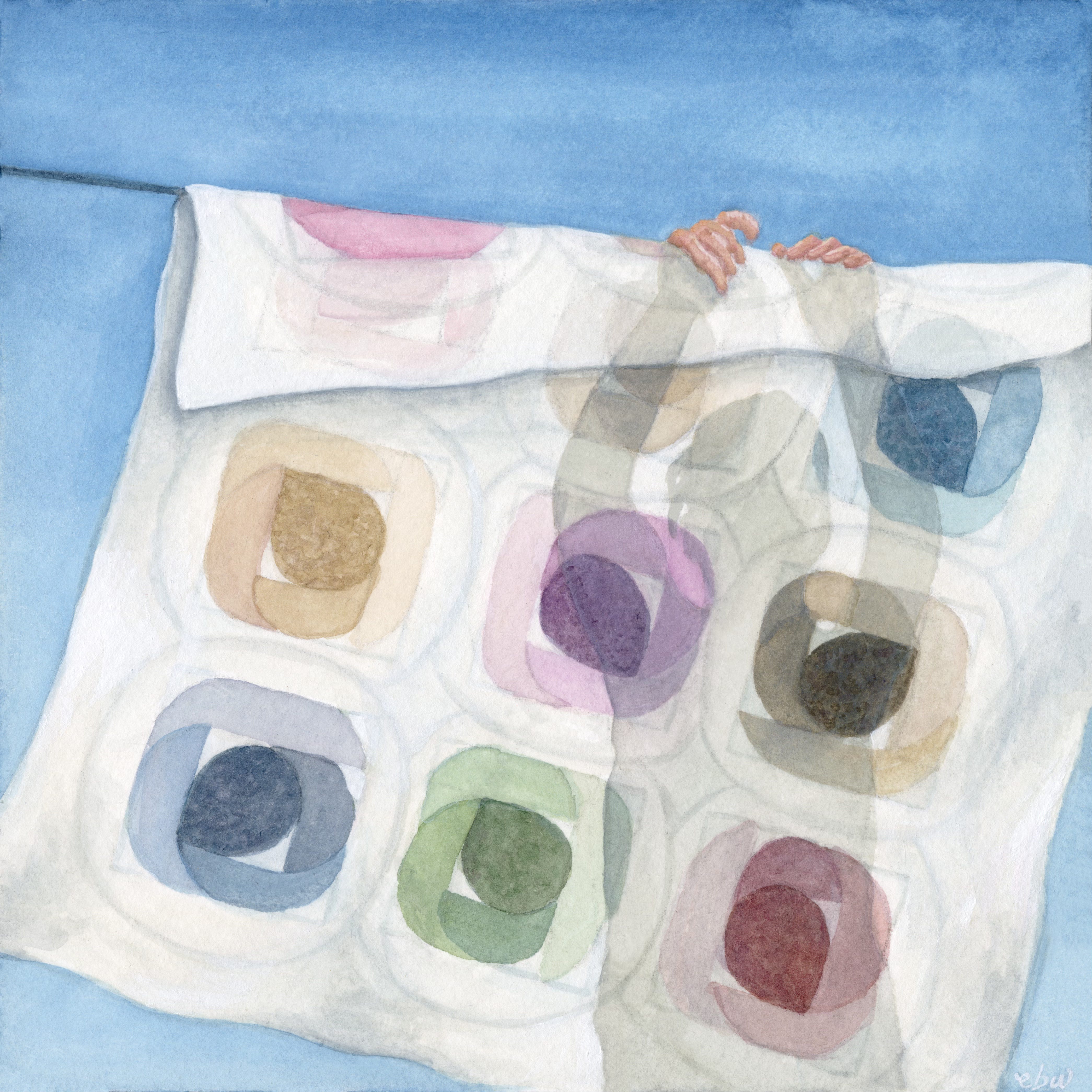
In my office, a quilt hangs on the wall behind the armchair I sit in. I took the traditional log cabin block, perhaps the most common quilt block, and altered it—softening its hard geometry. The pieces curve instead of meeting at right angles. The result looks like bowed figures. The quilting lines originate from their centers and expand outward, creating overlapping ripples, like drops in a pond. Often, when clients share the deepest pieces of themselves, their eyes drift from mine to the quilt. They trace the lines with their gaze, following the movement, finding their way through.
Our lives are rarely linear. They are storied in relationships, in choices, and in the retelling of our own choices. Midlife, then, is less about erasing what came before than about repurposing it with new eyes.
I couldn’t pinpoint the moment I realized that my life was not only something I had inherited but something I was still making. For so long, the fabric seemed already chosen, and the question was: How do I piece these together well enough? But at some point, the question instead becomes: What do I want stitched into the rest of my life?
It is a steady whisper more than a dramatic turning point. It shows up in the spaces between carpool and parent-teacher conferences, in the long exhale after a day that has asked too much and given back little. Sometimes it feels like grief for the pieces of myself I had set aside. Other times it feels like desire, like hunger for air, for beauty, for something more alive.
The body has been one of my teachers here. In my twenties and thirties I could push past its limits—sleep less, carry more, spread thinner. But midlife came with messages I could no longer ignore: fatigue that lingered, a back that ached. At first, I resisted. I wanted a body that obeyed me, and I felt angry when it didn’t. Slowly, reluctantly, I began to listen. To rest without apology. To move in ways that felt nourishing rather than punishing. To understand that my body was not betraying me but inviting me into another way of being alive.
Spirit, too, has asked for re-visioning. I once thought faith meant certainty, answers, proof. But there have been long stretches where prayer has felt like speaking in an empty room. I kept showing up anyway, wondering what I might find in the emptiness. The God I encounter now comes more often in questions, in silence, in mystery. In daily bread rather than grand revelation. In exhaustion as much as inspiration. I don’t feel the need to hold faith as tightly as I once did; it has settled deeper into my bones. Less a shield, more a grounding.
And then there is story—the way I tell my life to myself has been changing. I used to see only the sharp edges: the times I conformed too much, the times I stayed quiet. Now I notice the courage threaded through those years—the small yeses that bent the story in new directions, the hidden ways I kept hold of myself.
Around this time last year, I found myself pausing at one of the largest quilt shows in the country. A specially curated exhibit showcased ten of my quilts, each made at a different point over the last ten years. Hanging together, they told a story in color and movement. I leaned against the wall and watched quietly, holding back tears, as the first of thousands of people walked by, reading the artist’s statements, discussing my work. It was a moment of recognition, both of the life I had stitched together and of the life I was still piecing into being.
Standing there, I understood something that words had not yet given me. I am not interested in perfection. I am interested in wholeness. In making peace with the complexity: strong and uncertain, devoted and restless, quiet and bold. My story, like my quilts, is not seamless. But each fragment belongs. Each choice, even the half-conscious ones, has its place in the pattern.
This is the work I give myself now: to gather, to listen, to re-author. To claim my life not as something finished, but as something still being made—designed with that quiet restlessness and stitched with my own fingers, uneven and alive.
This essay appeared in Wayfare issue 7.
Melissa de Leon Mason is a therapist, writer, and quilter who enjoys playing in the intersections of faith, creativity, and embodied wholeness. She lives in Logan, UT with her husband and four kids.
Art by Elizabeth Bishop Wheatley.

Your description of the self that has been there all along, waiting patiently between the scaffolding of roles and expectations, spoke directly to my heart. Thank you for writing so beautifully about the possibilities our life holds as we become older- wholeness, not perfection, a life we are still crafting. Your essay was deeply moving.
I like the quilt theory of identity.