


“All things which have been given of God from the beginning of the world . . . are the typifying of him” (2 Nephi 11:4).
Typology can be a tricky mode of biblical interpretation, since inspired Old Testament prophecies and creative modern readings are not always aligned. The author of the epistle to the Hebrews was confident of one typological reading that should have particularly powerful resonance with Latter-day Saints. In that discourse, Jewish temple practices are clearly linked to a specific fulfillment in Christ. The Holy of Holies represented the dwelling place of God, a presence imbued with such holiness that only the high priest of the Jewish people could enter the precinct, which was protected by a veil, only once a year on Yom Kippur, the Day of Atonement.
When Christ effected his incarnation and work of reconciliation, he opened participation in the everlasting covenant to everyone by the adoptive covenant of baptism. The author (Paul by tradition) invited his audience to have the “boldness to enter into the holiest [holy of holies] by the blood of Jesus” (Hebrews 10:19, KJV). He drew the typology more concretely when he added, “by a new and living way, which he has consecrated for us, through the veil, that is to say, his flesh” (Hebrews 10:20). Joseph Smith, in his inspired development of Restoration temple theology, formally ritualized the equivalence of Christ’s flesh and the temple veil.
One might venture to suggest this is prefigured in the fifteenth chapter of Genesis. A few chapters earlier (Genesis 12), we find the first record of a covenant between Abraham and the Lord with the promises familiarly associated with that covenant: inheritance of the land, a great name and posterity, and the promise of ensuing blessedness to “all families of the earth” (Genesis 12:3). It is in chapter 15, however, that the promises are confirmed by an unusual sacrificial rite, found nowhere else in scripture. God commands Abraham to offer a heifer, a goat, and a ram (along with two birds). He then divides each large carcass into two halves, laying them one against the other, apparently in mirror image, leaving a space between the halves. Subsequently, after many hours, as Moses experienced before his theophany and Joseph Smith before his, Abraham suffers “an horror of great darkness” (Genesis 15:12). Only then is the covenant sealed by a divine manifestation: “a smoking furnace, and a burning lamp . . . passed between those pieces” (Genesis 15:17), following which the Lord personally affirms his covenant with Abraham.
Christians generally see blood sacrifice as typifying the death of Christ, a key moment in his “ministry of reconciliation.” In light of Paul’s reading of sacrificial precedent especially, it is hard not to see the parallel between the flesh of this offering in particular and the future body of Christ, both of which—in broken and bleeding form—provide a passage of sorts. A lamp of the Lord passes through the fleshly veil, and Christians in a dispensation to follow pass through its counterpart in a temple veil. This startling image captures the quintessence of the everlasting covenant, enacted in LDS temple theology. It signifies the passage in Christ by means of which men and women progressively move through covenantal life. The temple saga tracks human pilgrimage from incarnate spirits, through adoption into Christ’s family, to assuming greater levels of commitment and higher standards of holiness, to entering into binding covenants that reify and extend human and divine connectedness. Eventually, cleansed and sanctified by the offering of Christ’s own incarnation and Resurrection, they enter into the divine presence, part of an eternal sociality with those they love.
Terryl Givens is Senior Research Fellow at the Maxwell Institute and author and coauthor of many books, including Wrestling the Angels and The God Who Weeps.
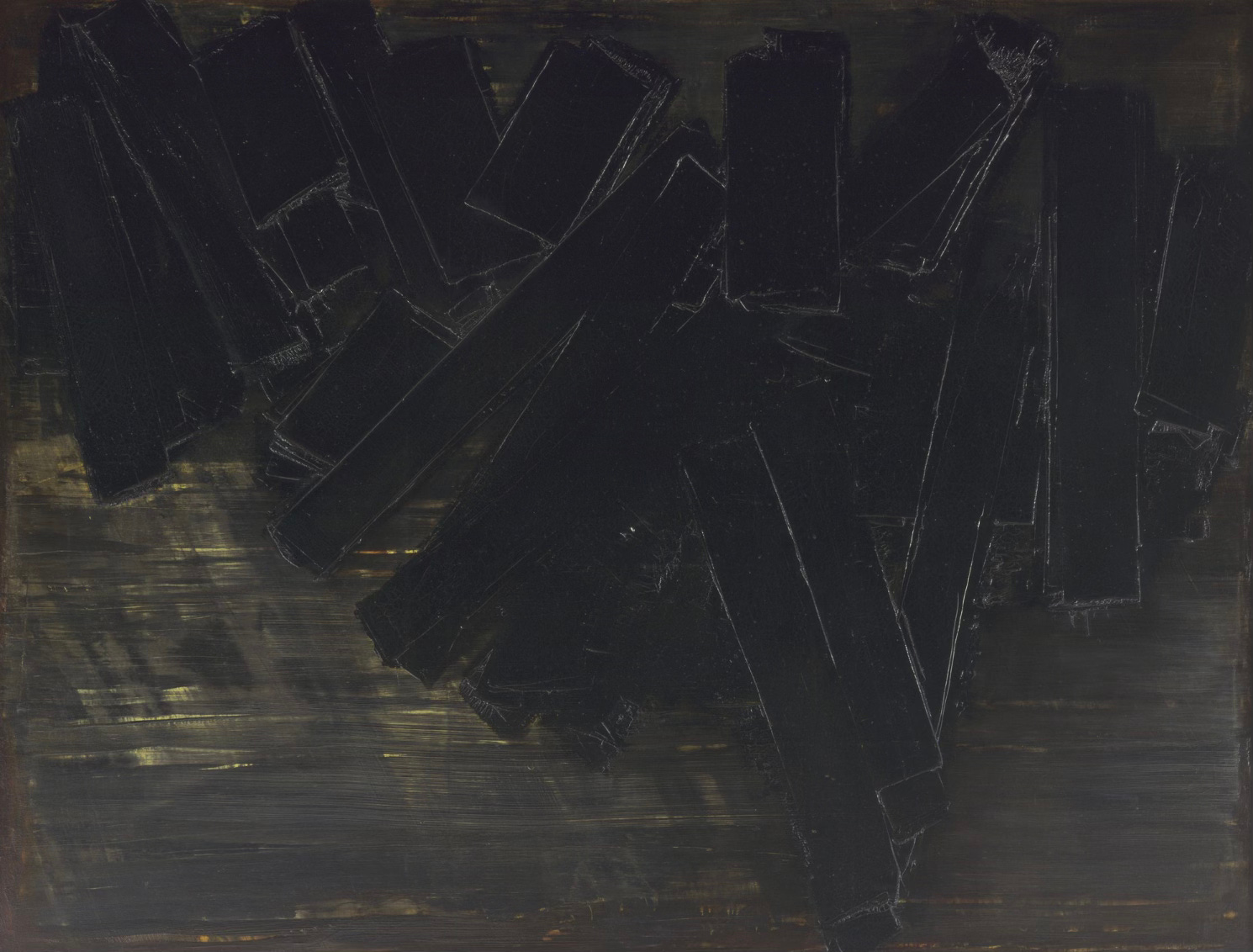
Art by Pierre Soulages (1919–2022).
The Old Testament Reflections series is published in collaboration with the Maxwell Institute: https://mi.byu.edu/old-testament-reflections.

