



We can’t recall many occasions when we have heard a general authority recommend a work of biblical scholarship not written by a Latter-day Saint. But at the recent groundbreaking ceremony for the Winchester, Virginia Temple, Elder Robert M. Daines of the Seventy did exactly that, commending to the audience Leon Kass’s Founding God’s Nation: Reading Exodus. Kass is a distinguished emeritus professor at the University of Chicago, and his book is a sustained, close reading of Exodus as literature, asking not only what the text says, but what—taken as a whole—it is trying to communicate.
This distinction is important. Kass’s central argument is that the book of Exodus is more than the remarkable story of how God delivered Israel from bondage. It is the origin story of how the Israelites became a people.
As Daines put it, the high point of the book of Exodus is not the parting of the Red Sea but the establishment of the Tabernacle so that God could “dwell among [the Israelites]” as they wandered. “The point of the Exodus,” according to Daines, “was to form them into a people prepared to dwell with God.” By this account, the exodus from Egypt was not an end but a beginning. Israel’s deliverance made possible something even more important than freedom: the creation of a community capable of receiving God’s presence. People who, as Daines put it, must learn to “act more like Him.”
Kass organizes the formation of Israel as a people around three pillars: 1) the exodus narrative itself, which gives Israel its identity and sense of purpose in the world; 2) the law at Sinai, which establishes the moral code binding the community together; and 3) the Tabernacle, which places God at the center of collective life. Taken together, these three pillars show us how God goes about building a community.
Restoration scripture offers us a glimpse of what may come when a people succeed in building a godly community. The Book of Moses tells us that the people of Enoch “were of one heart and one mind, and dwelt in righteousness; and there was no poor among them,” but it gives us little sense of how they got there—no account of the community’s formation or its missteps along the way to these monumental feats. Exodus, on the other hand, shows us how halting and imperfect such an effort can be.
So how we do try to build a community in which God can dwell?
It is worth remembering that for the earliest Latter-day Saints, that question was the question. Before the Word of Wisdom, green Jello, or church basketball—before we had all the cultural forms that now define us to the world—there was the aspiration to recreate Enoch’s city here and now. Joseph Smith’s revelations returned time and time again to the City of Enoch as a model. The same aspiration, as New Testament scholars remind us, drove the earliest Christians. It is embedded, after all, in the Lord’s Prayer: “Thy kingdom come. Thy will be done on earth, as it is in heaven.”
But what is the story that defines us? The story that, like Israel’s memory of the exodus, shapes our understanding of who we are in the world? And what does that story tell us about our role in helping bring about God’s kingdom on earth here and now?
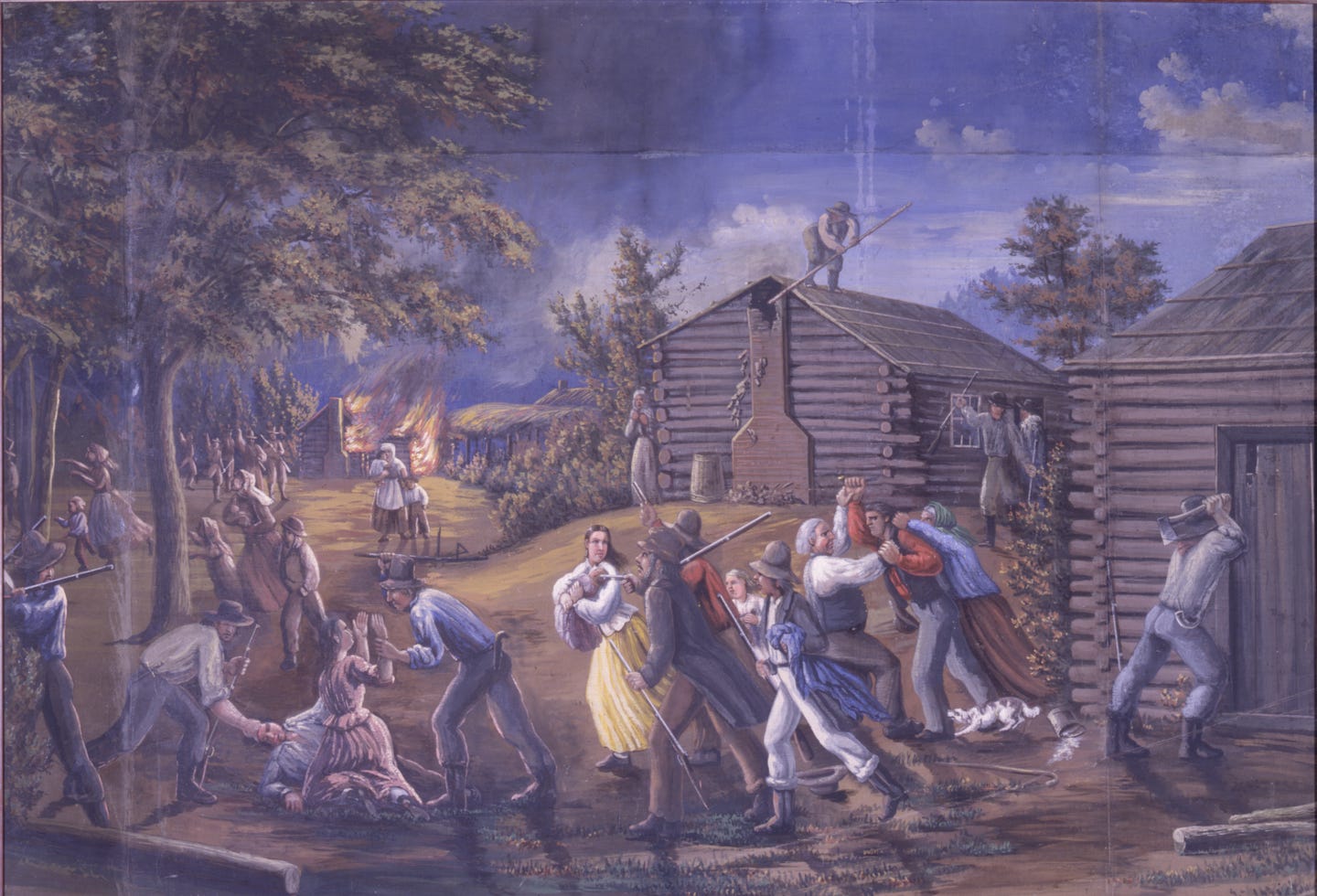
We are a people who know something about forced departure. In 1838, the governor of Missouri signed an order directing that members of the church “be exterminated or driven from the state.” We were driven from Missouri to Illinois, and then (after the murder of our leader) from Illinois to the frozen banks of the Mississippi in the dead of winter. Tens of thousands of men, women, and children made their way across a thousand miles of open prairie and mountain pass to a valley no one else wanted. We journeyed not as conquerors or crusaders but as refugees, expelled from the territorial United States by bigotry and persecution.
And how did we respond when we settled the Great Basin? We built. Houses and farms and cities, sure, but also institutions for mutual care. We built a system for gathering and distributing resources across a scattered people. We invented practices—the ward, the cooperative, the labor mission—designed to knit strangers into neighbors and neighbors into something resembling the community of one heart and one mind. We chose as our emblem the beehive, representing communal interdependence, rather than a lion or an eagle.
We were expelled from American society, so we built our own. But rather than remaining closed off from the world, we have been instructed to engage, to build bridges, to make peace.
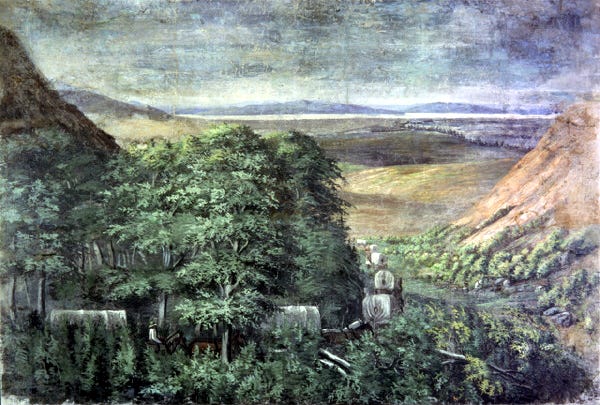
This is our origin story. We are a people who have been persecuted and mocked. But our response is not—cannot be—contempt. We were expelled from American society, and we wandered, and we built. Now, we have been called back to the society that cast us out—not to exact vengeance but to make peace, to share what our long exodus has taught us about community building, forgiveness, and reconciliation.
We live in a moment when much of our public life runs on contempt. The measure of a political leader, these days, is often the fury he or she can generate against those who think differently. The Book of Mormon, read carefully, is in part a long warning about exactly this dynamic. It is the story of a people who let contempt harden into faction, faction into conflict, and conflict into collapse. And it holds out, as its most radiant counter-image, a society in which there were no “manner of -ites,” no contentions, and where “every man did deal justly one with another.”
Our apostolic leadership has named what is being asked of us. President Dallin H. Oaks, has called on us to “use the language and methods of peacemakers.” He has urged us to “moderate and unify” on contested issues, to “seek fairness for all,” and to resist the temptation to pursue total victory in our civic disputes. The historian Patrick Mason has observed that among all the Beatitudes, “Blessed are the peacemakers” is unique. The others describe conditions of the soul, but this one commands an action. President Russell M. Nelson taught us that “the Savior’s . . . true disciples build, lift, encourage, persuade and inspire. True disciples of Jesus Christ are peacemakers.”
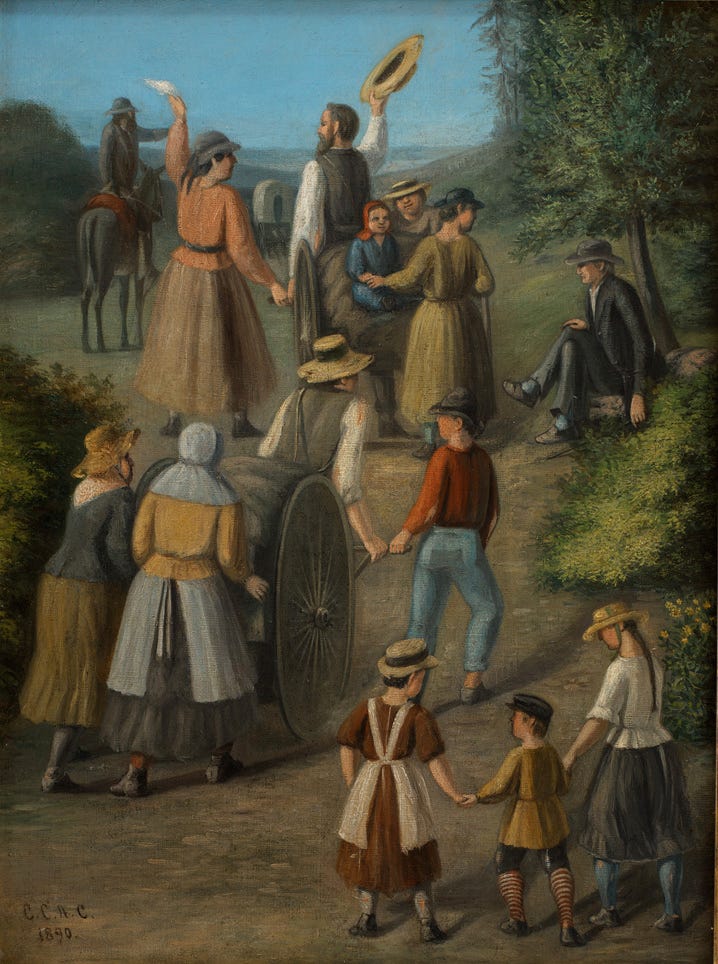
How might we change if we took our origin story seriously? What would our lessons and sermons look like? What would our ward and stake activities look like? Our worship might focus less on drawing lines and more on bearing one another’s burdens. Our sense of spirituality might have less to do with what we should avoid and more to do with who we can serve. Our politics might involve less contempt and more bridge building. To borrow a phrase from President Spencer W. Kimball, we would have “a style of our own,” characterized not by unique dress and grooming standards but by how we build communities and heal divides.
Like the Israelites of old, we have been shaped by an exodus, and we have been called to build a community in which God can dwell. The question now is whether we are up for the task.
Thomas B. Griffith was a judge on the US Court of Appeals for the DC Circuit from 2004 to 2020. Currently he is a lecturer on law at Harvard Law School, a fellow at the Wheatley Institute at Brigham Young University, special counsel to the international law firm of Hunton Andrews Kurth, and senior policy advisor to the National Institute for Civil Discourse. His most recent writings have appeared in the Harvard Law Review, the Yale Law Journal, and BYU Studies.
Joshua Topham is a BYU graduate and Barry Scholar at the University of Oxford.
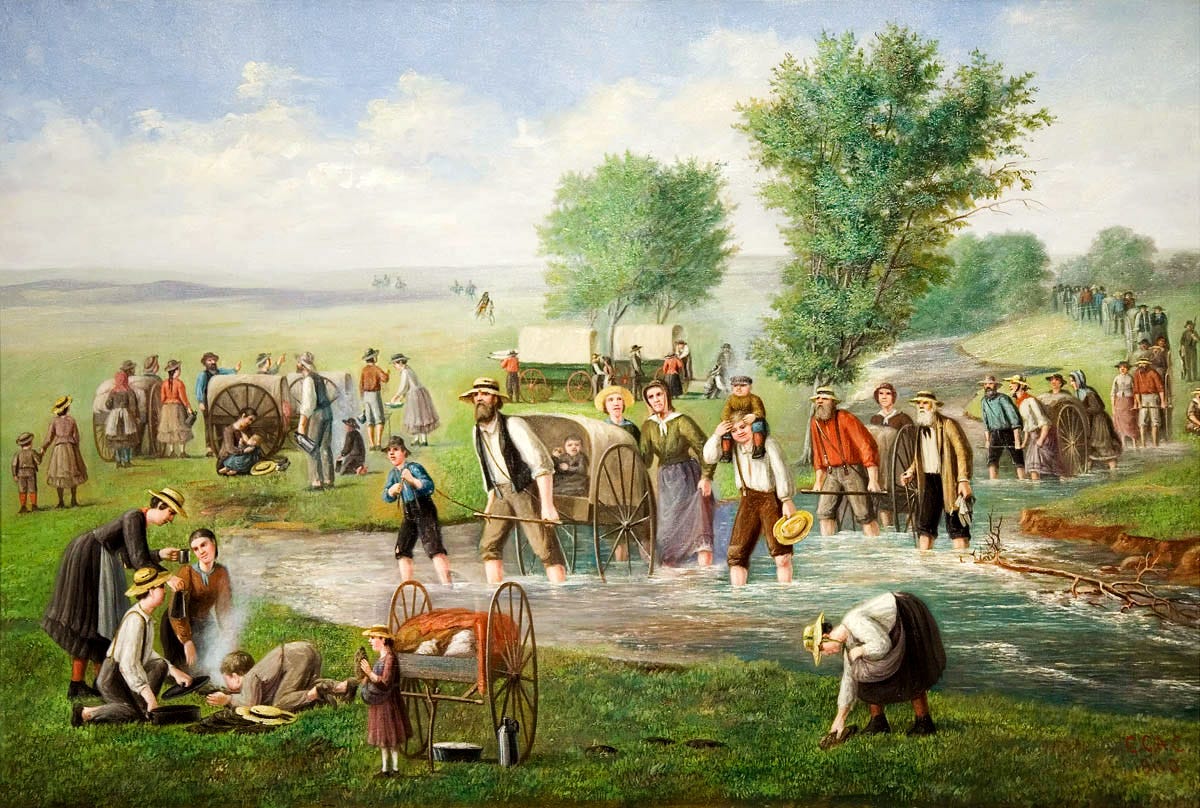
Art by C.C.A. Christensen


The opening paragraphs about the Exodus is especially prescient knowing that Franklin and others at the Constitutional Convention used that story, and Israel in the OT, as a template for nation building. Check Ben Franklin’s idea for an early Great Seal.
This is a beautiful reminder of our divine commission to “build a community in which God can dwell.” To accomplish this, I think we must not only remember the vital contributions of those who preceded us but also learn from their mistakes. Sadly, as a Church, we do not have a strong legacy of peacebuilding when confronted with high conflict. Instead, our historical responses included forming militias and a paramilitary organization (Danites), engaging in repeated wars with Native Americans, and resorting to violent, bellicose rhetoric against our adversaries. Yet collectively, we give ourselves high marks as peacemakers.
I am not saying we should condemn those who were caught in unbelievably difficult and dangerous situations. However, we should take Moroni's invitation seriously and learn from them so we can do better. As President Kimball noted, the Saints are a “war-like people,” and he didn’t mean it as a compliment. Until we honestly confront our past and the ways we have worshiped, and continue to worship the false god of this world that rules by the aggressive use of force, I do not see how we can ever build the kind of community where God will dwell.