


A good friend and his family accompanied us through the Oquirrh Mountain Temple open house in the summer of 2009. My one-year-old daughter sat in a hiking backpack on my shoulders.
I loved the open house, and not only because it’s a touch exhilarating to enter somewhere that is normally off-limits. The baptistry’s oxen. The mirrors in the sealing room. And the snacks the church provided to visitors afterwards. We felt welcome.
I’ve now been to three temple open houses. I admired the way that the creation room in the Brigham City Temple resembled the nearby Bear River Refuge and its abundance of avian life. The cherry blossoms in the Washington, D.C. carpets were another standout.
Learning a little bit does make one want to learn more, or to understand things more fully. Why ordinances rather than rituals or sacraments? Why the special white clothing? And while it was fairly easy to grasp the purpose of baptism for the dead or sealing in marriage, what was the point of the endowment? Or the overall meaning of the temple for Latter-day Saints?
I also contemplated the distance between my own Protestant tradition and what one might call “temple Christianity.” My Presbyterian congregation meets in a building whose architecture is charitably described as “brutalist.” We’ve got cinderblocks all around us, a plain table for the Lord’s Supper, and a shallow, simple font for baptisms. Latter-day Saint meetinghouses are also fairly plain, but at least they’ve got the temples as a counterpoint. My theological ancestors stripped and whitewashed cathedrals in northern Europe. Are we Protestants missing out?
Jonathan Stapley’s The House of the Lord is a helpful guide for anyone curious about the history and meaning of Latter-day Saint “temple liturgy,” the work of the people in these sacred spaces. He introduces topics ranging from recommends to burial practices. He also walks readers through the rooms of the temple and describes its ordinances insofar as church standards of temple confidentiality permit. The House of the Lord is thus ideal for outsiders such as myself, though I surmise that many Church members would also benefit from Stapley’s crisp but sensitive analysis.
Stapley quickly answered some of my simpler questions. It turns out that some of my other theologically “fastidious” ancestors had discarded the Catholic term sacrament for the rituals of baptism and the Lord’s Supper. They preferred the civic term ordinance, which eliminated any sense that the rituals conveyed God’s grace or contributed to human salvation. “Even as early Latter-day Saints referred to the rituals of the church as ordinances,” Stapley explains, “they swiftly took a sacramental approach to them.” (73–74) The Saints simply stuck with the not-very-exciting and not-very-inviting term.
What about the purpose of temples? Before reading Stapley’s latest, I had several answers in mind. Latter-day Saints go to the temple to make covenants with God that, if kept, will bring about their exaltation. They also experience a foretaste of heaven on earth, particularly in the celestial room. And Church members go to the temple to perform rituals on behalf of ancestors.
I also had some sense of how the temple’s rituals and meaning had evolved over time, from a promised endowment of power realized in the Kirtland Temple, to the Nauvoo endowment’s dramatic reenactment of Adam and Eve’s progression from creation to celestial glory.
Stapley carefully documents these changes and others, including the inclusion and exclusion of certain peoples from temples. The exclusion of Black Latter-day Saints from the Church’s most sacred spaces and ordinances will be familiar to most readers. Stapley, though, includes a number of less well-known stories. Sarah Ann Mode Hofheintz was the daughter of a white woman and Black father in Philadelphia. She and her German immigrant husband were baptized and moved to Nauvoo. In the Nauvoo Temple, other women “washed her to become a priesthood, and placed upon her the first layer of priesthood vestments.” Hofheintz is the earliest known Black individual to have received the endowment.
Even after Brigham Young excluded persons of known African ancestry from the Church’s most sacred ordinances, Rebecca Henrietta Foscue, a mixed-race woman who had been born into slavery, was endowed and sealed in the Salt Lake City Endowment House. The elimination of the ban in 1978, coupled with the halting rejection of its theological underpinnings, moved the church closer to John of Patmos’s apocalyptic vision of “a great multitude . . . of all nations, and kindreds, and people, and tongues” standing before the heavenly throne.
That vision is at the heart of The House of the Lord. As Stapley notes, “Joseph Smith repeatedly identified biblical archetypes which he ritualized.” One was of this multitude “clothed with white robes,” having been washed in the blood of the Lamb, standing before God’s throne. “This was temple imagery from the Hebrew bible,” Stapley explained, “appropriated and recast to describe the Christian heaven.” Simply put, the Latter-day Saint temple creates a “kingdom of priests and priestesses in heaven and on earth,” and when they come to the temple, men and women “perform” this biblical vision “on a cosmic scale.” (7)
Other biblical archetypes informed the development of Latter-day Saint temples and their ordinances. In the first several years after the 1830 organization of the Church of Christ, Smith “revealed that the Saints were to be endowed with power from on high, that they could be sealed up to eternal life, and that faithful evangelists should be washed and declared clean from the blood and sins of their generation.” Smith shifted his focus to the ancient Israelite temple when he prepared male church members for their endowment in Kirtland. The elders were washed and anointed, consecrated like the priests of ancient Israel.
Smith then expanded this liturgy in Nauvoo, both in terms of its content and in terms of who participated in it. Men and women became kings and queens, priests and priestesses. Both men and women “were washed, anointed, and dressed in priestly clothing.” And they integrated the dead into what Stapley here and in his prior work calls “the cosmological priesthood.”
Another strength of The House of the Lord is Stapley’s willingness to introduce personal meaning and memories alongside his scholarly analysis. He writes about his own endowment in the Manti Temple, the first time he had seen anything other than the baptistry. The Manti Temple then had “live sessions” rather than films, and Stapley’s uncle played one of the roles, which offered Stapley assurance in an otherwise unfamiliar space. Then, when he stood in the celestial room, another relative hugged him and wept. “This man,” Stapley narrates, “had spent decades away from both the temple and the church.” Some individuals, like this man, find healing and reconciliation in the temple. Stapley also includes other stories that highlight alienation or rejection, such as a no-longer-active Latter-day Saint who took her wife to a temple open house to “show her . . . a part of her life that was no longer accessible,” (35) and those of members for whom the endowment’s intimacy and unfamiliarity generated anxiety and discomfort.
Stapley has a penchant for the concise summary of complex theology. In a chapter on the Church’s doctrine of exaltation, he distinguishes between Joseph Smith’s “vision of the royal priesthood of heaven” and Brigham Young’s “deeply material cosmos governed through . . . lived experience of procreative biology.” Even Stapley, however, cannot resolve every sticky theological wicket. For example, he notes intra-church debates in the second half of the nineteenth century about whether monogamous men could achieve exaltation. Brigham Young asserted that “a man can obtain as full a salvation with one wife as with more” but cautioned that the monogamist’s eternal progression would be “slow.” More broadly, Stapley explains that Church leaders by the late 1900s “ceased talking about the work of the temple in terms of making kings and queens, priests and priestesses.” They focused instead on “eternal marriage” and “exaltation” but “simultaneously avoid[ed], with prominent exceptions, any detailed descriptions of what exaltation meant.” (110) Some theological questions remain unanswered or ambiguous.
So am I and my fellow Protestants missing out? I relish the rituals I know, the Lord’s Supper above all, but also liturgical prayers, or just a closing song after a weekly activity. But while unfamiliar rituals might be intriguing, especially if I can just watch, being asked to do something new or strange is off-putting.
Among Protestants of a certain age, certain rituals smack of Catholic superstition. Please no fancy garments, candles, or genuflection, at least not in my worship space. Thus ritual is one of the things that Protestant Christians have found objectionable about the Latter-day Saint tradition. Not the Sunday morning sacrament meeting, which seems rather Protestant minus the grape juice. But the temple, with its clothing and pageantry, with its keywords and tokens.
And yet ritual seems irresistible. The congregation I grew up in now invites worshipers to come forward and light candles during prayers. People seem to like the innovation. And my own congregation now imposes ashes at the start of Lent. I meet this partway. No ashes on my forehead, but I let the pastor smear a black cross on the back of my hand.
So I don’t have holy envy when it comes to Latter-day Saint temple work, but I am both sympathetic and intrigued. I will find a reason to come to Utah for the Salt Lake Temple open house prior to its rededication.
John G. Turner teaches Religious Studies and History at George Mason University and is the author of Joseph Smith: The Rise and Fall of an American Prophet (Yale University Press, 2025).
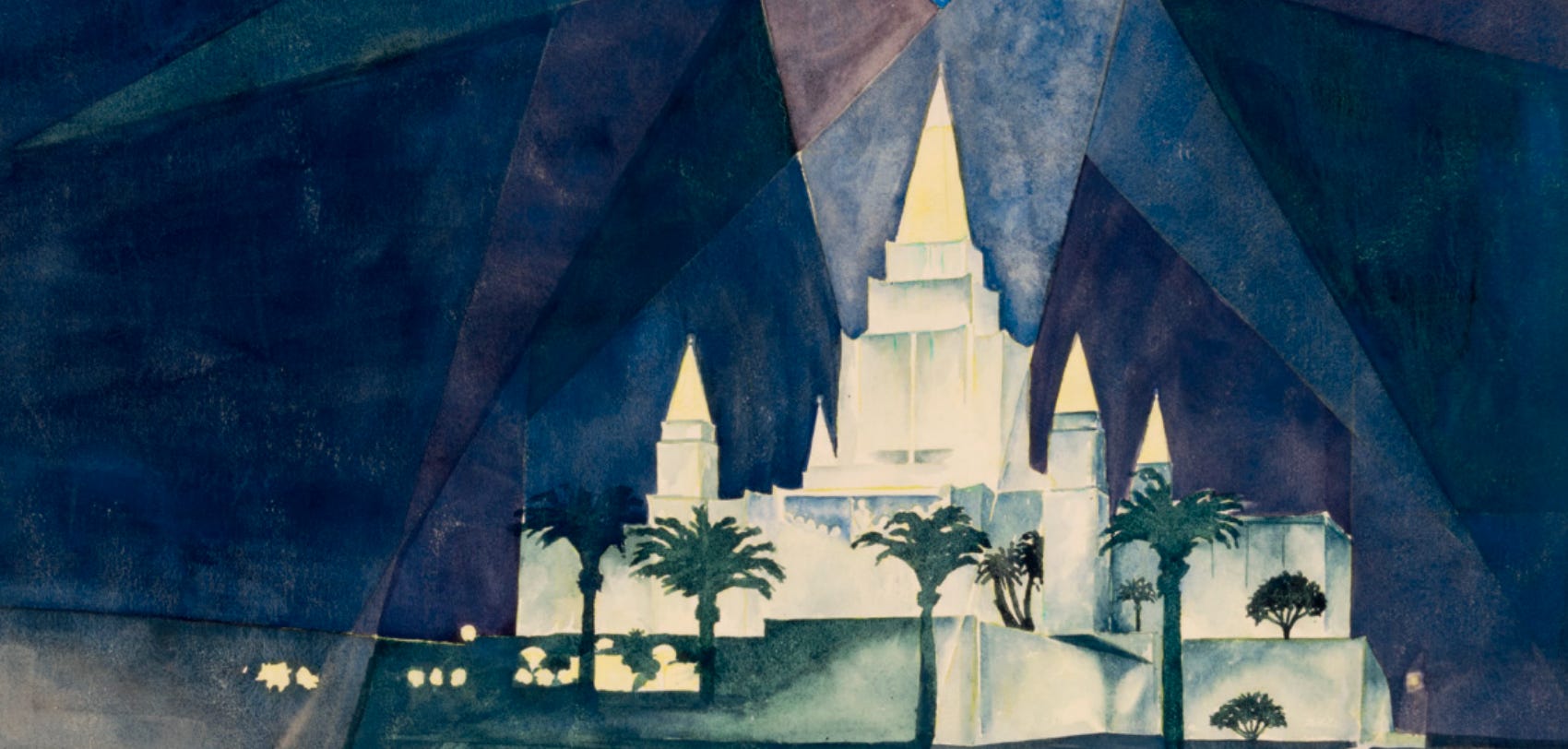
Art from Holiness to the Lord: Latter-day Saint Temple Worship, Jonathan A. Stapley (Oxford University Press, 2025).
