


In “The Four Horsemen of New Theism” Wayfare Editor Zachary Davis makes the case that the cultural vibe in the West has shifted away from the stridently anti-religious sentiments of New Atheism toward a re-enchanted and spiritually curious “New Theism.”
Specifically, Davis looks at four books: All Things Are Full of Gods by David Bentley Hart, Believe by Ross Douthat, Living in Wonder by Rod Dreher, and Against the Machine by Paul Kingsnorth. He writes, “Although these books vary widely in tone and emphasis, they share a core belief: our crisis is spiritual, rooted in an aggressive, reductive materialism that looks upon the wonder of creation and sees only lifeless matter to analyze, control and exploit. They also converge on a shared hope that amid the ruins of Christendom, genuine religious life can be reborn in the West.”
This shift toward New Theism is welcome, Davis asserts, because it’s an answer to the widespread loneliness, sorrow, and loss of meaning we’re collectively facing. The more we embrace this shift, the argument goes, the more we’ll discover “a deeper, richer form of freedom found in dedication to community, contemplation, and faith.”
For my part, I strongly agree that our crisis is spiritual and that both reductive materialism and the Machine (replete with its enticements toward mindless scrolling) are a poison to the soul. And yet there’s a thread running through these books that troubles me—a thread that, to me, is a sign these New Theists don’t embrace enough mystery.
Before I unpack this, I’ll say that I view David Bentley Hart as an exception. Indeed, he wrote as much in a comment to Davis’s piece, declaring, “For the record, I don’t have much in common with the other three figures mentioned here,” and his book All Things Are Full of Gods tends toward the fuller embrace of mystery I’m advocating for—a mystery that transcends the traditional categories we human beings have invented to make sense of our world.
With that in mind, let’s turn to the stories of the other three New Theists.
The Many Conversions of the New Theists
Ross Douthat, Rod Dreher, and Paul Kingsnorth each write of their conversions to particular strains of Christianity. Douthat was baptized Episcopalian, later converted to “charismatic Christianity,” and then settled into Catholicism. Dreher was raised Methodist, later converted to Catholicism, and then settled into Eastern Orthodoxy. Kingsnorth grew up a cultural Christian, later practiced Zen Buddhism, joined his “local Wiccan coven,” and then settled into the Romanian Orthodox Church.
In each case, these writers assert that they settled into their current faith because they came to believe certain truth claims.
Douthat suggests that Catholicism is the truest religion—not just “true enough”—because, among many reasons, it has had such staying power and is “the part of Christianity known for systematizing everything.” He writes, “When I say the Nicene Creed, I mean it.”
Dreher, on the other hand, says that after researching the Catholic sex-abuse scandal for years, he “just couldn’t believe in the truth claims of the Catholic Church anymore” so he converted to Eastern Orthodoxy, believing that it “had valid sacraments and a valid hierarchy” without the scandal. He also recounts that he has since had the truth of his choice confirmed when he visited the Church of the Holy Sepulchre during Orthodox Holy Week and put his hand in the Holy Fire for several minutes without getting burned.
Kingsnorth writes that after joining his local Wiccan coven, he had an unexpected and vivid dream where Jesus visited him. Months later, he had an experience at a concert where he “could see how everyone in the room was connected to everyone else.” He recounts, “I was overcome with a huge and inexplicable love, a great wave of empathy.” In that moment, he writes, “I became a Christian because I knew, suddenly, that it was true.”
In short, all three of these writers have gone through a series of conversions and now assert that their current faith is true because of a combination of intellectual reasoning and personal spiritual experiences.
While I don’t dismiss their stories outright (more on that in a moment), I personally long for even more mystery than they’re allowing for here.
For instance, we might ask: What if God’s ways truly are beyond our comprehension? What if God calls people—ourselves and others—toward surprising paths even when those paths differ from our own and even after we feel settled?
What if the goal of religious life is less about pinning which of 10,000 possible views is the truest and more about developing the courage to take a step into the dark together?
Mystery Is Bigger Than Our Perception of Truth
Which view is the truest?
In most cases, we’d all agree that answering such a question requires thoroughly understanding each current possible view. Any good scientist, for example, would start an inquiry by gathering all available data, understanding the theories behind that data, and analyzing that data as impartially as possible.
I have yet to see anyone do this with religion—likely because it would be an impossible task in a single lifetime. Not only would one have to fully contrast Christianity with Islam and Islam with Hinduism and Hinduism with Judaism, etc., but one would also have to contrast each strain of each religion, because the differences between, say, Pure Land Buddhism and Zen Buddhism matter to practitioners of those strains. (In other words, there are many “Buddhisms,” just as there are many “Christianities.”)
On top of this, one would also have to thoroughly practice each religion, for knowing the truth of a religion often lies in the practice of it. (For instance, one who has read about Zen but has never meditated does not understand Zen!)
We simply don’t have time in a single life to complete this inquiry, at least not well.
And yet this doesn’t stop some people in each tradition from declaring that their position is the truest position. It doesn’t matter, they seem to say, that they haven’t read the Upanishads or the Dhammapada or the Zhuangzi—it doesn’t matter that they haven’t practiced the Noble Eightfold Path or experienced the aural magic of the Qur’an or delved into the self-inquiry practices of Advaita Vedanta. They already know all of those things pale in comparison with their own views. They already have a Bible, and there cannot be any more Bible.
Admittedly, the New Theists aren’t ignorant of my critique here. As I mentioned, Kingsnorth has some years of experience with Zen and Wicca. And Douthat’s thesis in Believe is that people should choose the religious path that most calls to them, even while he declares that Roman Catholicism is objectively the truest path. This ecumenism signals a greater generosity of spirit than religious fundamentalists tend to exhibit. (Though I will say that Douthat does tremendous handwaving when it comes to addressing what biblical scholars have discovered about the thorniest issues in the Gospels, seriously downplaying the strongest arguments against his views.)
And anyway, the argument goes, the point of faith isn’t entirely rational. People don’t know their religion is true because of reason alone. They know their religion is true because of their personal spiritual experiences.
Mystery Is Bigger Than Our Interpretations of Spiritual Experience
Spiritual experiences are among life’s greatest gifts. They bring us a sense of love and unity. They break us open to new possibilities. They give us a reason to live. They are real.
They’re also frequently leveraged as proof that a particular strain of faith is true. As I mentioned, Kingsnorth experienced love and empathy at a concert and then declared that Christianity is the true religion. One could find hundreds of thousands, if not millions, of similar interpretations of spiritual experiences from believers around the world.
And yet it’s worth noting that believers do not have a monopoly on such experiences. In The Little Book of Atheist Spirituality, for instance, the French philosopher Andre Comte-Sponville tells of a moment in a forest when he felt “a seemingly eternal sense of peace” so strongly that he felt he “contained only the dazzling presence of the All.” The self-proclaimed atheist Marius Favre writes about a similar experience, saying, “The border between my body and the world had vanished.” And the journalist Barbara Ehrenreich writes that when she was a young woman, she was on “a pre-dawn walk” when “the world flamed into life” and “nothing could contain it.” Many other nonbelievers, including Buddhist practitioners, have reported similar transcendent experiences.
Even the New Atheists have expressed openness to this territory. Richard Dawkins writes of being “moved to tears by a beautiful piece of music,” loving “hymns and Christmas carols,” and feeling “breathless with joy” while gazing “at the stars on a dark night with no moon and no city lights.” Christopher Hitchens wrote about being drawn to “the lure of wonder and mystery and awe.” And Sam Harris frequently promotes the work of mystics from a variety of traditions as well as the work of his wife, Annaka, whose writings on wonder and consciousness are a hair’s breadth from David Bentley Hart’s views in All Things Are Full of Gods, as Annaka likewise posits that consciousness—not materialism—is the fundamental foundation of reality.
Now, one might respond by saying that true spiritual experiences are about more than personal feelings of awe, mystery, and wonder—that true spiritual experiences require a belief in the supernatural as well.
But even supernatural experiences do not uniformly converge toward a single religious tradition. Yes, people like Paul Kingsnorth have had profound dreams of Jesus leading them toward Christianity. But many Muslims have likewise reported having dreams of Muhammad so profound they changed their life, to name just one counter example.
Similarly, near-death experiences—as profound as they are—tend to be all over the religious map. As one researcher of these experiences writes,
Typically, near-death experiencers experience symbols drawn from the religions closest to home. A Jew may find himself being judged by rabbinic authorities, a Hindu might be saved by Krishna, a Catholic might find herself in the presence of the Virgin Mary or Christ, and a person of indigenous origin may receive knowledge at the hands of his own ancestors.
In mentioning this, I don’t intend at all to invalidate any of these experiences. To the contrary, the sheer number of people from different cultures who have spiritual experience strongly suggests that something real is happening here.
I only mean to say that mystery itself is bigger than our interpretation of these experiences—that it’s misguided to leap from having a spiritual experience to declaring that our experience means our tradition is the true strain of faith for all people everywhere.
Again, I’m opening the possibility that God is bigger—more mysterious—than we can comprehend.
Mystery Demands More of Us
So, where does all of this leave us?
Near the end of Believe Ross Douthat draws a binary between his view (wherein he asserts that Roman Catholicism is the truest religion) and perennialism (which says that all religions point to the same basic truth and that our task is to piece together a worldview that works for us). Douthat opposes perennialism because he sees it as easy and undemanding, a tepid form of anything-goes relativism that results in isolation rather than community and commitment.
For my part, I believe that Douthat’s binary is false.
I believe there is another option—one that demands more of us. It’s the option to fully commit to mystery, to be willing to be called into the dark by a God we cannot completely comprehend.
In this view, God is bigger than any single tradition even while God sometimes calls us into a tradition. This doesn’t mean that we know with certainty that the particular tradition we’re called into is the truest tradition for all people everywhere. It just means that, barring a fresh calling elsewhere, we commit anyway, in faith.
As we commit, we will see other people declare that they feel called in other directions, including toward disbelief in traditional views of God. When this happens, we might be tempted to think of their views as morally inferior. But what if we were to instead remain curious? What if we were to instead hold the possibility that God is calling them in one direction and calling us in another? And what if we were to hold the possibility that the friction inherent between these different journeys yields the fruit that’s actually best for us all?
In response to such questions, a religious fundamentalist might express skepticism. “That’s impossible,” they might say. “My God points everyone toward the same path!”
But that assertion boxes God in. It confidently declares—without evidence—that God’s thoughts are their thoughts, that God’s ways are their ways. As it does this, it is ultimately faithless. It doesn’t trust that God is quietly and almost imperceptibly orchestrating life better than we could possibly realize.
What if faith, by contrast, is about believing that God is bigger than our perceptions and bigger than our interpretations? What if faith is about actually believing that God “will yet reveal many great and important things pertaining to the kingdom”?
Jon Ogden is the cofounder of Uplift Kids, which helps families explore wisdom and timeless values together. To subscribe to his column, first subscribe to Wayfare, then click here to manage your subscription and turn on notifications for “One Step Enough.”
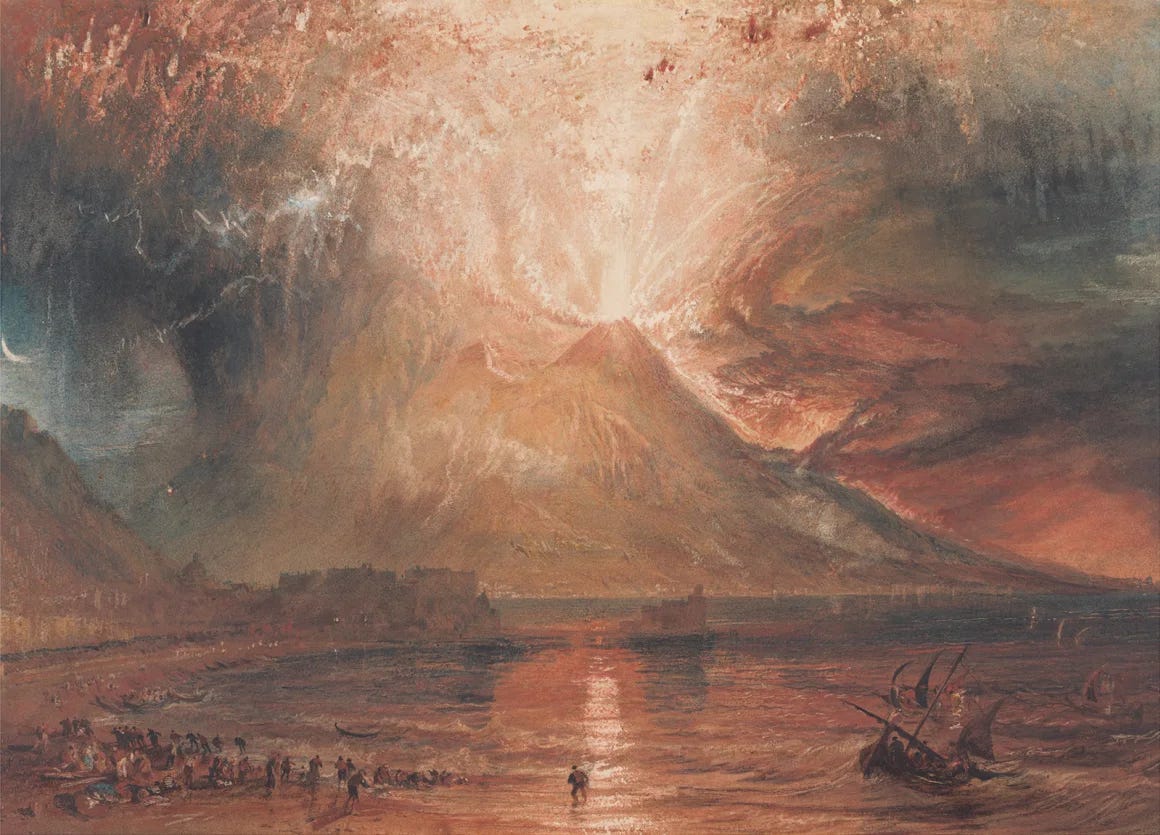
Art by J.M.W. Turner.


Thank you, Jon. Such a beautiful opening. Your piece has me feeling peace and trust beyond concept or experience.
Ultimately, as you summarized, Jon, God’s ways are not our ways. Limiting God to what we think he/they should be is negating any belief that God is more than we can comprehend. It is the knowledge that my comprehension is limited that keeps me seeking for more understanding. Thank you!