


This essay is part of Wayfare’s Emerging Voices program, where previously unpublished writers work in small groups with Wayfare editors to develop a piece of writing. Please enjoy!
I wanted to steer clear of problematic pioneer stories on Trek. But the path and the past are muddy.
June 2024
I thought the uphills would be the hardest part. But it turns out that a handcart slips easily from sweaty hands on a downhill slope of Carolina clay, accelerating out of control. It took all twelve of us to hold the handcart back: the couple serving as the Ma and Pa leaders, the trio of young women sporting French braids, and the baby-cheeked middle schooler who struggled to tie his hiking boots. All of us, our hands on the cart or the rope we’d attached to it, digging in our heels with each step.

January 2024
I shifted on the primary chair as the high councilor extended the assignment to serve on the Trek planning committee. “Trek?” I thought. “In North Carolina?” Having grown up in Wisconsin, I had assumed Trek was either a Church practice that had long since been abandoned—like Wednesday night Sunday School—or it was just one of those Utah things that didn’t have much traction outside of the Intermountain West. If Trek was ever out of style though, it was now back in. At least in the lump of North Carolina boundaried by my stake. The high councilor assured me this Trek would be “modern dress,” i.e., I wouldn’t need to rummage around the internet for a historically accurate bonnet.
Early on in the planning process, the Trek co-leaders introduced the committee members to the Ma & Pa Handbook, which they had borrowed from another stake. I clicked open the Google Doc and started skimming over the sections: Registration & Packing List, Itinerary, Roles of Mas and Pas. My pace slowed as I arrived at the section titled Pioneer Stories. The Mas and Pas were encouraged to familiarize themselves with the stories and find opportunities to share them with the youth during Trek.
Many of the stories had plotlines reminiscent of a Marvel movie, only set in the nineteenth century and with suffering starring as a superpower: Ellenor Roberts exchanged her wedding ring for flour and walked from Missouri to Salt Lake with no shoes! Susannah Stone got frostbitten feet, buried her fiancé, and never murmured! One story was titled simply “The Miracle.” It described parents, Oli and Marn, who follow the direction of their company leader to abandon their baby “stricken” with dysentery under a bush. It was unclear to me if the baby had actually died or was just near death at the point of abandonment. During the night, Marn walks back to the spot, brings back the girl alive, and the company leader proclaims it to be a miracle.
On their surface, these stories championed attributes of faith, perseverance, and sacrifice, and sent the message that God works miracles—grand ones!—in the lives of the faithful. But lurking just below all this was a murkier layer. The more I reread the stories, the more uncomfortable I felt. A company leader directing a mother to leave behind her baby? And the pioneers in the other stories felt one-dimensional. Like caricatures instead of real people who walked dirt trails and built up callouses.
Additionally, none of the stories in the Ma & Pa Handbook referenced any type of source. Some had quotations around the text, but no indication of where the quote had been lifted from. This, combined with their feel-good, ready-for-the-big-screen nature, meant the stories felt untethered and free-floating, neither grounded in history nor connected to a reality I could relate to.
One of the Church’s stated purposes for Trek is that the youth “learn and appreciate Church history.” By their nature, reenactments like Trek signal that a historical event is so important to remember it is worth embodying. Not only passing down history by telling it, but attempting to live it. At least for a few days.
But how would we be able to connect to Church history on Trek, to ground ourselves in the stories of the handcart pioneers, if these were the stories we were carrying?
June 2024
As we stepped into the creek, I felt the water surge over and into my waterproof hiking shoes. After clambering out onto the bank I dumped the water out and squeezed as many drops as I could from my socks. Even so, as we walked I could feel the squelching of each footstep. The mud on the path ahead of us was ankle-deep. One of the young men in the group behind us lost his shoe, sucked right off his foot into the muck. The handcart wheels became projectile machines, spewing mud everywhere: gobs of it landing on my hands, my hair, my lips.
February 2024
My unease with the stories on Trek had begun to make me question my role in planning Trek itself. Opportunities for the youth to learn Church history, and to strengthen their testimonies, seemed to me worthy goals for Trek, ones I was happy to have a hand in. But I didn’t want to be part of perpetuating pioneer myths and stereotypes. If our historical references had become so airbrushed that the people in them only served as moral symbols, then sharing the stories might provoke an emotional response, but they wouldn’t help the youth to learn and grapple with Church history or create connections with each other or with God.
I grabbed my phone to see if I could Google-search my way out of my mounting discomfort. I was hoping for a blog post from someone who had been in a situation similar to mine, or even a comments section thread. What I wanted were instructions on how to create a Trek that was free from problematic narratives, or at least find a way to keep myself free from them. Google found me sewing patterns for petticoats.
Since it was the pioneer stories section of the Ma & Pa Handbook that had started me on this path, leading to my confusion and doubt around planning Trek, I wondered if perhaps pioneer stories closer to the source could provide a way forward.
Following the routes of digital citation trails led me to Lynn Slater Turner’s Emigrating Journals of the Willie and Martin Handcart Companies and the Hunt and Hodgett Wagon Trains. Turner had compiled entries written by members of the handcart companies, which included the writings of Jessie Haven and John Jaques. Haven was a cousin of Brigham Young, who, on the way back from his mission to South Africa, led a handcart company that eventually merged with the Martin Handcart Company. Jaques was convert from England who traveled with the Martin Handcart Company. A poem he wrote earlier in his life became the hymn “Oh Say, What Is Truth?”
27 July 1856
Jessie Haven: “Sunday. The Saints in a rather bad predicament, being without tents, all their things got wet. Started and came on nearly 3 miles. The Saints last night and this morning, found much fault, and grumbled much about me. They blamed me because the tents were left behind.”
6 August 1856
Jessie Haven: “Came about 10 miles then camped for the night. Dealt out provisions, gave 12 ounces of flour to each person daily. Before, we had given only 10 ounces. So many leaving. I came to the conclusion that the provisions would hold out.”
18–20 November 1856
John Jaques: “As the company was crossing the South Pass, there was a sufficiency of wagons, for the first time, to carry all the people . . . . But it was much colder to ride in a wagon than to follow afoot, and a few of the sturdier of the emigrants preferred to hold on to the wagons and walk behind them . . . It seemed impossible to get warm, sleeping in a wagon. It was warmer sleeping with beds on the ground, where if the biting, frosty air got the upper hand of you, it could not get the underside of you as well, but it could do both in a wagon.”
March 2024
All this time—from Primary activities to seminary lessons—I’d been carrying an image in my mind of handcart pioneers who rarely complained, who all banded together in their companies to support one another during the journey and were rescued from their hardships in a grand flourish on the plains of Wyoming and promptly carried to Salt Lake where they celebrated with their relatives. But the more I read from Haven and Jaques, the more I realized that my own knowledge of the handcart companies’ journeys was shot through with as much myth as the pioneer stories in the Ma & Pa Handbook. According to the accounts by Haven and Jaques, in the Martin Handcart Company there was plenty of complaining; enough pioneers abandoned the company within the first few weeks to increase food rations for everyone who was left; and the grand arrival of wagons to Martin’s Cove was not the end of the suffering on the plains for the pioneers, many of whom still had a month of walking ahead of them in bitterly cold temperatures.
How was I going to help plan a Trek grounded in historical narratives if I didn’t even know the history?
As a step, I wanted to invite Haven and Jaques along for the journey. Not because they were exemplary travel companions (Haven might have made me leave my tent behind!) nor because they were untouched by the moral quandaries of their era (for starters, Haven was a polygamist and Jaques later became one) but because their journal entries grasped at everyday truths, human hardships. Their words were wet with rain, hollowed by hunger, blown by a frosty wind. Far from being tidy or one-dimensional, it was the complex nature of these stories that drew me in. The more I read, the smaller the distance felt between 1856 and 2024.
June 2024
At designated points along the route, youth in each handcart group took turns reading from Haven and Jaques’s journal entries. I had tucked the Haven and Jaques quotes into Ziplock bags so they would be readable regardless of mud splatter. The stories starring Oli and Marn, Ellenor Roberts, and Susannah Stone had been left behind, relegated to the edit history of the Ma & Pa Handbook.
As we approached the biggest downhill, we set up a pulley system using a tree. Of the handcart groups, ours was one of the last to descend. As we approached the tree I could see the indentations on the bark made by the pulley ropes of earlier groups. Carved into it by the weight of each handcart. Looping our own rope around the trunk, we eased our handcart down the hill bit by bit. The weight we couldn’t hold, the tree held for us.
Some of our Church history can be too heavy for us to carry on our own. It’s easier to gloss over the details, even make some of them up, and accelerate to a picture-perfect ending that only shows part of the picture. We skip over uncomfortable bits, such as leaders misusing their authority, but in the process we leave out the extent of the pioneers’ suffering and we miss the opportunity for real connection to our past and to each other. In shaping the narrative to fit an ideal arc, we tuck away the icky parts and end up with stories that may feel good but aren’t grounded.
Perhaps one reason we end up with myth-fueled pioneer narratives is out of an impulse to protect ourselves. Presenting a squeaky-clean version of our past so we can keep ourselves unmarked. That was my own inclination as a Trek planner, to keep myself unsullied from any muddy narratives I found. But both our history and the way we recount it is already messy. To navigate its landscape in any meaningful way requires us to walk together through the mud, even at the risk of losing a shoe in it. In doing so, we gain a better appreciation for what the pioneers experienced and sacrificed, and a greater understanding that they were just as human and fallible as we are.
I was wrong about the uphills being the hardest part of Trek. But on a downhill slope of Carolina clay, when the handcart is too heavy to hold, we might experience the grace of eleven other pairs of hands pulling in the same direction. Mud in our hair, heels firmly rooted in the dirt, distributing the weight among us and a tree bearing the rest. Stories that ground us, linking our history to our humanity as we trek forward.
Cara Evanson lives in North Carolina and works as a research librarian.
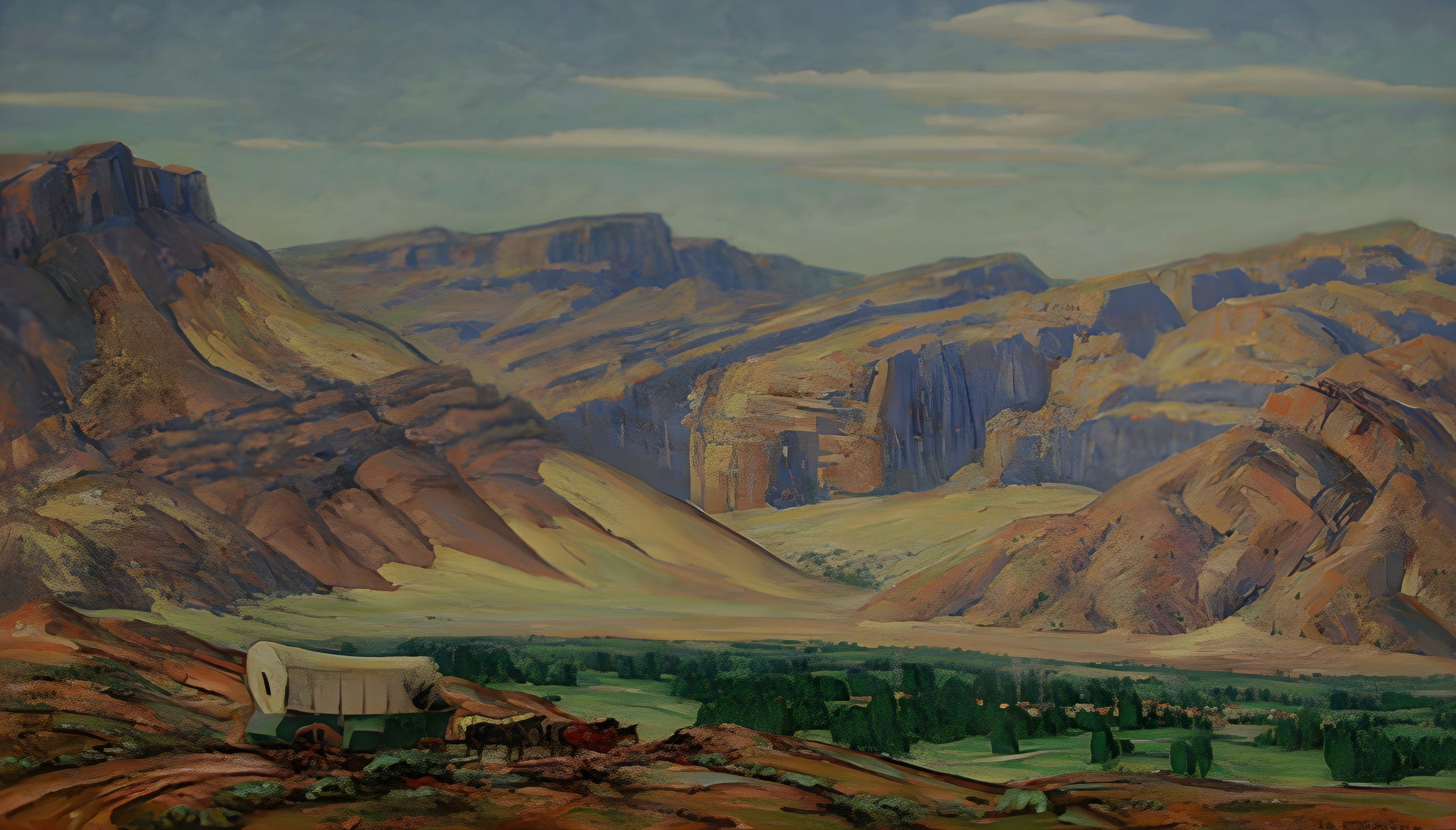
Approach to Moab (The Pioneers) by Ila McAfee (1897–1995).
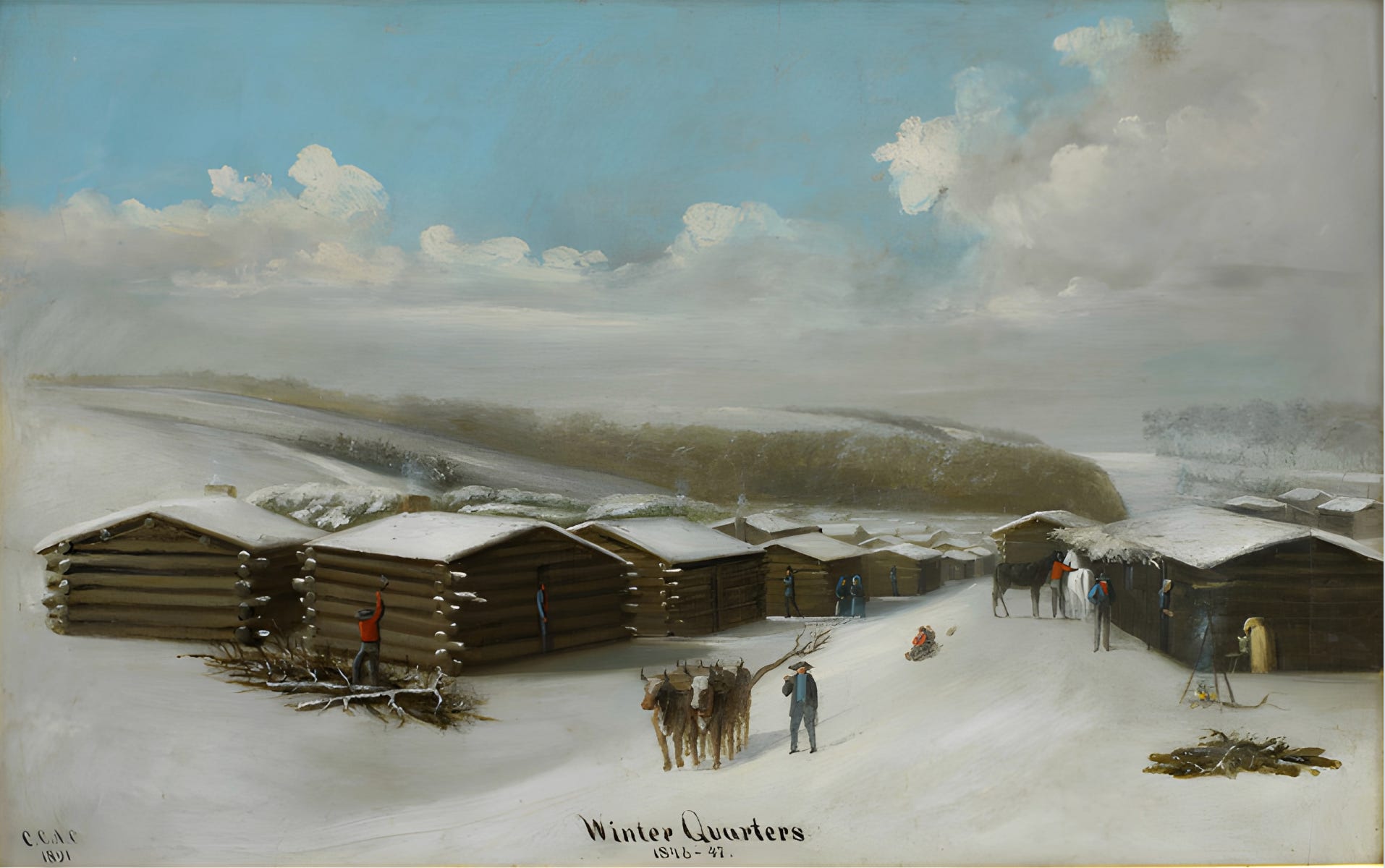
Winter Quarters by Carl Christian Anton Christensen (1831–1912).
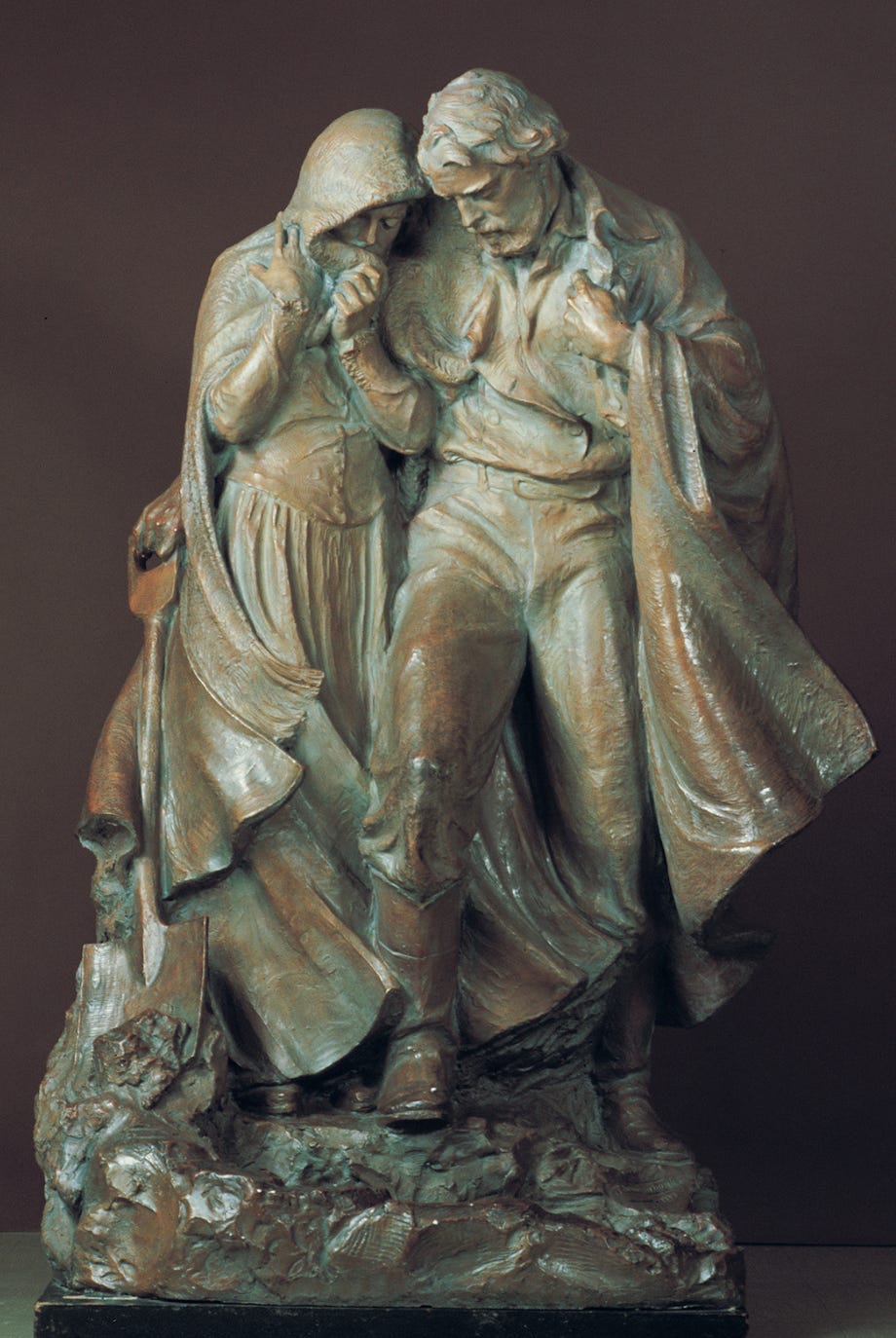
Tragedy at Winter Quarters by Avard Tennyson Fairbanks (1897–1987).

thank you for illustrating how honest narratives help young people to feel more comfortable with their own narratives, no matter how rough they may be.